
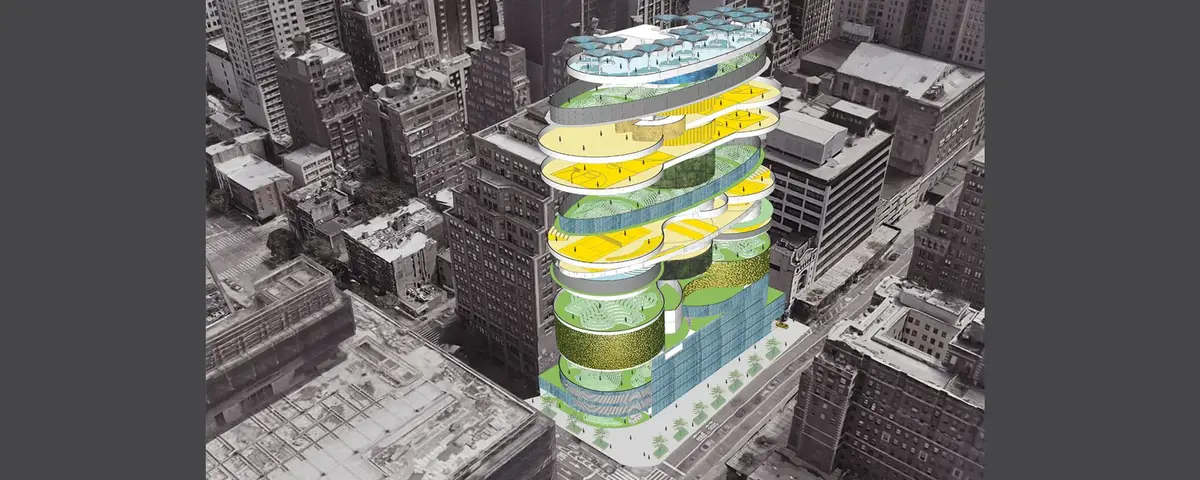
VERTI-PARK: Stacking Parking, Sports, and Green Space into One Manhattan Tower
Two blocks from Madison Square Garden, a vertical ecosystem layers smart parking beneath jogging tracks, swimming pools, and moisture-harvesting canopies.


What if a parking garage could also be a park, a gym, and a neighborhood amphitheater? VERTI-PARK takes that question seriously, proposing a high-rise tower in Midtown Manhattan that stacks smart parking, public sports courts, layered gardens, and civic gathering spaces into a single curvilinear envelope. Rather than treating car storage as a monofunction problem, the project reimagines the parking structure as a vertical community hub, one where you might jog a loop on a green terrace three stories above the level where your car charges.
Designed by Shreejit and awarded a Jury Commendation in the Yo Parking 2019 competition, VERTI-PARK is sited just two blocks from Madison Square Garden. The location is strategic: it plugs into one of New York's densest corridors of pedestrian traffic and sports culture while addressing a genuine scarcity of open green space and affordable parking in the area. In a borough where Central Park remains the only major outdoor respite, the project asks whether architecture can vertically multiply the utility of pocket parks rather than waiting for new ground-level land to appear.
A Section That Reads Like a Vertical Neighborhood
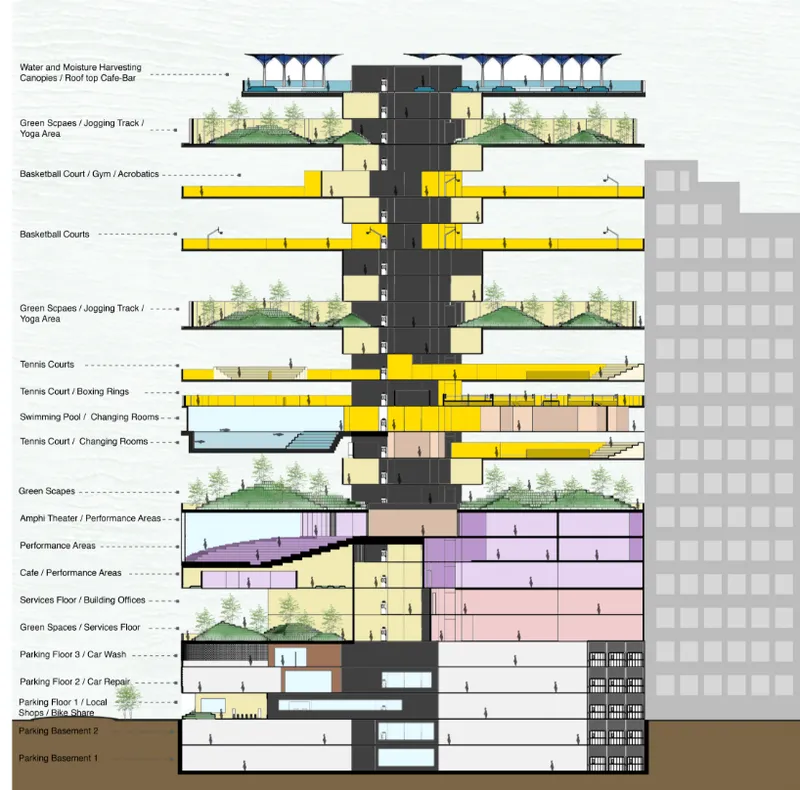
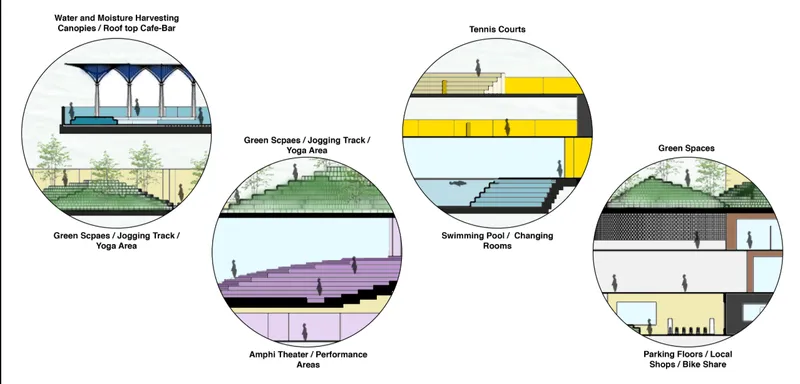
The full building section reveals how deliberately the programmatic layers are sequenced. Parking basements and stack systems occupy the lower floors, where structural loads are heaviest and direct street access simplifies vehicular circulation. As the section climbs, floors transition into recreational programs: basketball courts, tennis courts, swimming pools, boxing rings, and gyms. Higher still, green terraces with jogging tracks and yoga zones give way to rooftop canopies designed for moisture harvesting. The circular vignette diagrams break this vertical gradient into legible episodes, showing how each floor module operates as a distinct spatial experience while contributing to the tower's collective identity.
Each floor plate is shaped with curvilinear geometry, a decision that does more than aesthetic work. The organic forms maximize views outward toward the Manhattan skyline, promote passive ventilation through open terrace edges, and break the visual monotony of the standard rectangular tower. It is a conscious departure from the slab parking typology, signaling from the outside that something other than cars lives inside.
Oval Floor Plates and the Logic of Stacking Programs
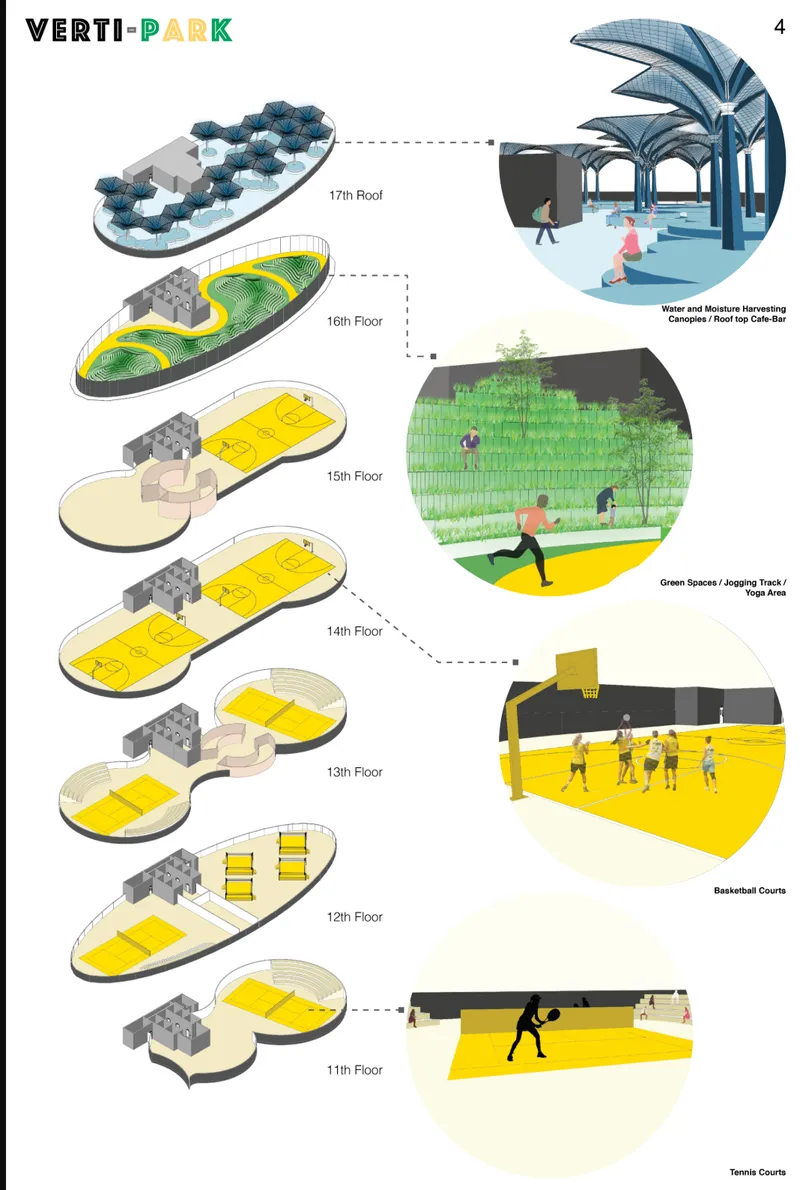
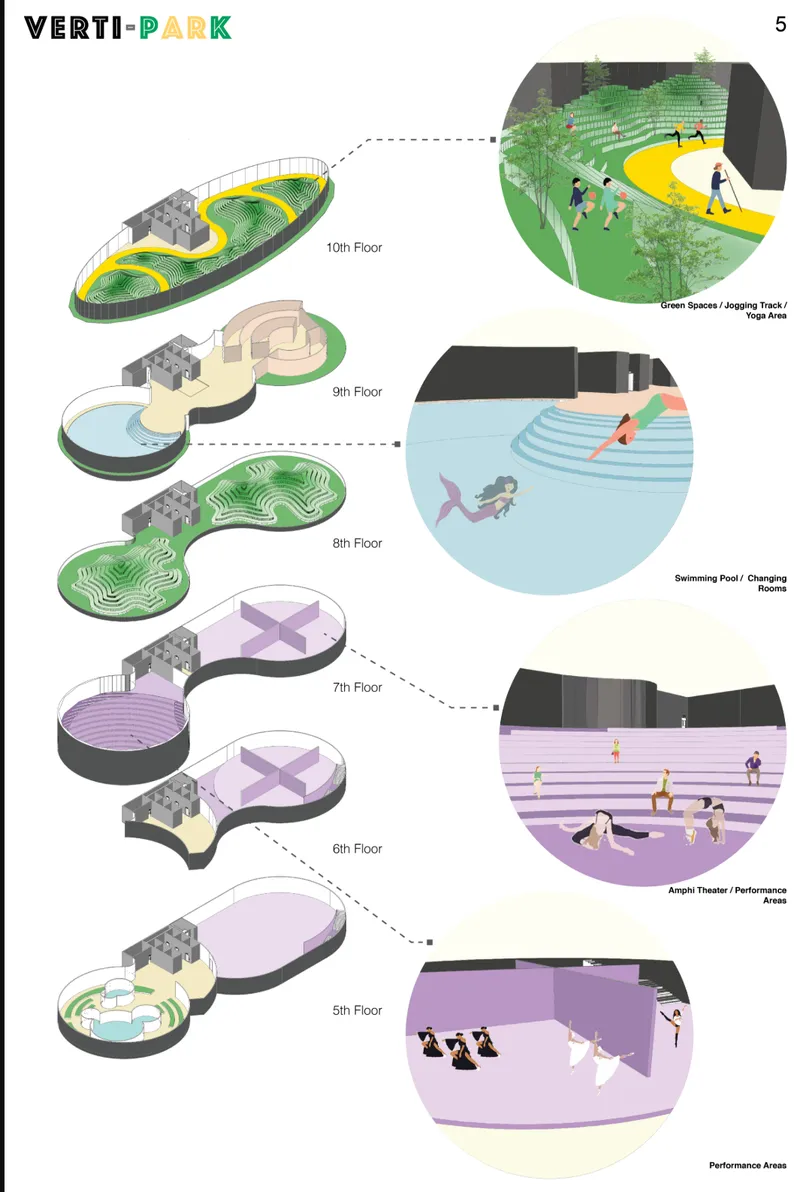
The axonometric drawings offer the clearest reading of how VERTI-PARK's stacked oval plates generate distinct microclimates and activity zones on every level. Callout views isolate rooftop canopies, green terraces, a basketball court, a swimming pool, and a performance amphitheater, each nested within the tower's overall massing. The floor plates are not identical extrusions; they shift and rotate subtly, creating overhangs that shade lower terraces and gaps that allow daylight and air to penetrate deep into the building.
What makes the stacking strategy compelling is its argument about density. Manhattan already builds tall, but most of its towers serve a single function: office, residential, or storage. VERTI-PARK proposes that a single vertical envelope can absorb the programmatic diversity of an entire block, layering civic, recreational, ecological, and transportation uses without requiring additional land. The green jogging track wrapping an upper floor, for instance, occupies space that in a conventional garage would simply be another parking deck.
Ground-Level Activation: Cafes, Bike Share, and Retail as Urban Connectors
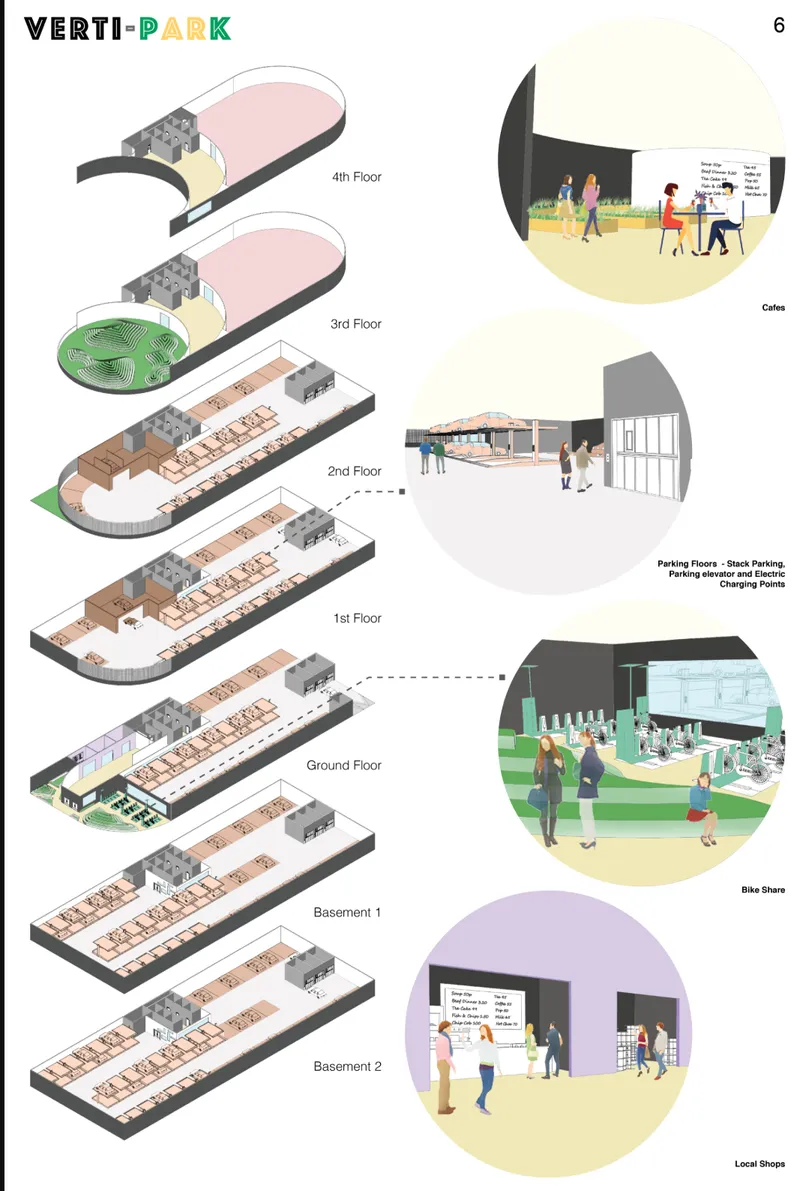
The lowest floors are not afterthoughts. The axonometric detail of the parking and retail levels shows cafes, service areas, local shops, and bike share stations lining the building's street edge. These ground-floor activators ensure that VERTI-PARK meets the sidewalk as a public destination rather than a blank garage facade. Electric vehicle charging points are integrated into the parking floors above, acknowledging the shift in mobility patterns that makes a forward-looking parking structure viable in the first place.
The inclusion of bike share alongside car parking is a quiet but important gesture. It positions VERTI-PARK not as a monument to the automobile but as a multimodal transit node, one that accommodates personal vehicles, bicycles, and pedestrian activity within the same structure. Combined with the rooftop rainwater harvesting systems and vegetative insulation provided by layered plantings throughout the tower, the ground plane strategy reinforces the building's ambition to operate as sustainable urban infrastructure rather than a conventional garage.
Why This Project Matters
VERTI-PARK's core provocation is simple and worth taking seriously: in a city where land is measured in millions per square foot, why should any building serve only one purpose? The project does not merely add a green roof to a parking structure and call it sustainable. It rethinks the entire vertical section as a gradient of public life, from vehicular storage at the base to ecological canopies at the crown, with sports, performance, and community gathering woven in between.
As a competition entry, VERTI-PARK is necessarily speculative, and some of its programmatic ambitions would face serious structural, regulatory, and economic scrutiny in practice. But the underlying proposition holds weight. Cities are already building mixed-use towers; they are just rarely mixing uses this aggressively or this publicly. Shreejit's project suggests that the next generation of urban towers should be measured not by their height or their efficiency ratios but by how many kinds of city life they can host within a single footprint.
View the Full Project
About the Designers
Designer: Shreejit
Enter a Design Competition on uni.xyz
uni.xyz runs architecture and design competitions year-round that reward proposals with spatial conviction and real site intelligence.
Project credits: VERTI-PARK by Shreejit Yo Parking 2019 (uni.xyz).


Popular Articles
Popular articles from the community


U.GA Architects Wraps an Oval Rooftop Pool in Curved Board-Formed Concrete on Busan's Jeollidan-gil
In Busan's Jeonpo-dong, a 454 m² mixed-use block stacks a neighborhood facility, guest rooms and an oval rooftop pool inside spiraling concrete walls.

Cube Design Draws an Ecological Corridor Between Two Shenzhen Hills with the Nankai Building
Beside Shenzhen's container docks, the Nankai Building pairs stacked balconies with a climbing green screen to connect two hillsides across its height.

Architekt Andreas Gruber Scatters 23 Dark Timber Chalets Across a South Tyrolean Forest Edge
In Molini di Tures, Amonti Chalets breaks a resort into a hamlet of gabled timber houses, with parking, storage and services pushed into the slope.

Jaramillo Van Sluys Arquitectura and Urbanismo Turn a Demolished Registry Lot in Quito into an Orchard Plaza
In Quito's Centro Histórico, a 2,800 m² plaza exposes the San Agustín convent wall and redraws its lost Augustinian orchard in volcanic stone.

Similar Reads
You might also enjoy these articles


Vereda Arquitetos Renovates a 40-Square-Meter Apartment Inside Niemeyer's Copan Building
A compact unit in São Paulo's most iconic residential tower gets a material overhaul that pairs exposed concrete with bold blue Formica.

Shakur's House: Exposed Brick as an Interior Organiser in a 168 m² Mashhad Residence
Brick moves indoors in this Mashhad residence, where masonry walls, glass partitions and teal planes sequence a compact home without closing it off.

Day and Night Park: A Time-Based Urban Newsstand in Beijing
A temporary urban newsstand in Beijing blending travel, light, and reading through poetic colors, compact form, and community-focused design.

Modernist Patio Renovation in El Masnou, Barcelona by Oliver Segura Arquitectura + Cebrià Arquitectura
Modernist patio renovation blending tradition and innovation with a movable pool, leveled floors, and Catalan materials in El Masnou.


Comments (0)
Please login or sign up to add comments
No comments yet. Be the first to comment!