

Air TO Z: A Megastructure That Turns the Sky into Infrastructure
Stacked spherical modules, lattice skins, and aerial transit hubs form a self-sustaining vertical city designed for 2050.


What if a skyscraper didn't just reach the sky but actually used it? Air TO Z takes the familiar ambition of the supertall tower and rewires it around a premise most high-rise design ignores: the sky is not a ceiling, it is a transit network. By treating aerial space as active infrastructure, the project proposes a megastructure where flying vehicles dock at mid-level hubs, sky gardens replace sterile atriums, and modular spherical volumes stack vertically to house an entire city's worth of program within a single spine.
Designed by Júlio Ferreira, Carolina Matos, and Tiago Santos, Air TO Z was shortlisted in the Hybrid Futures '19 - Work x Fly competition. The brief asked entrants to imagine how work and flight might converge by 2050. Rather than bolting a landing pad onto a conventional tower, the trio reimagined the entire vertical typology, producing a structure where aerial commuting, ecology, housing, and commerce are fused into one continuous organism.
A Spine of Spheres: Modular Program Stacked Vertically
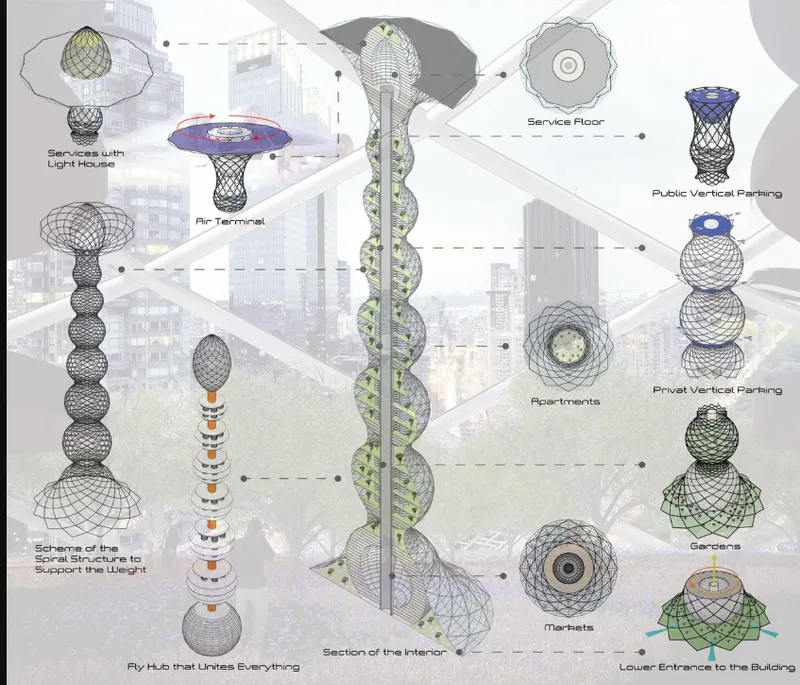
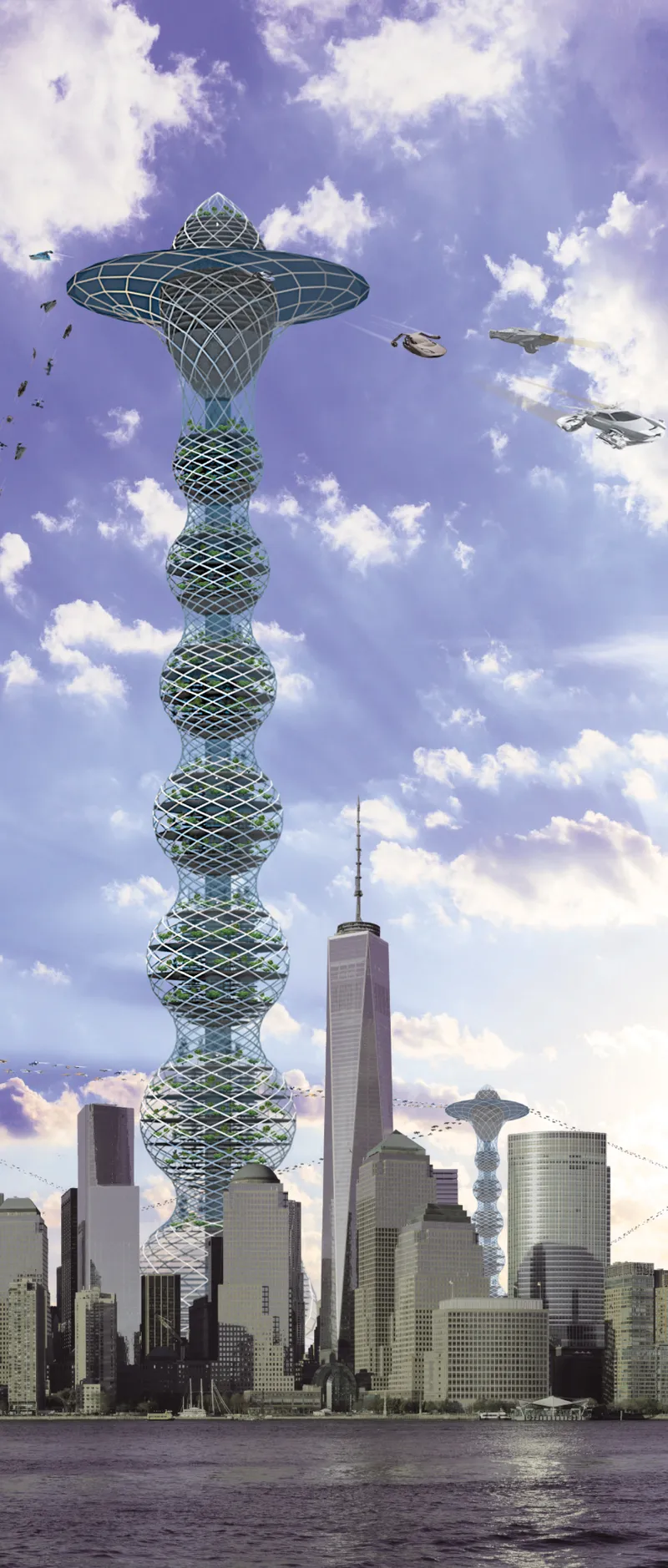
The annotated section drawing reveals the project's organizing logic: a central spine composed of bulbous, spherical segments, each calibrated for a distinct urban function. Residential volumes, commercial floors, transit nodes, and ecological zones alternate as they climb, creating a self-sustaining vertical city rather than a single-use tower. The spheres are not arbitrary formal gestures; they allow each programmatic zone to operate with a degree of autonomy while remaining physically and circulatorily connected to the whole.
The rendering of the spiraling mesh tower brings this sectional logic to life against an urban skyline populated with flying vehicles. The stacked modules swell and taper along the height of the structure, and the lattice skin wraps the entire assembly like connective tissue. It is an image that makes the case for vertical density as something other than repetitive floor plates: each sphere reads as a distinct neighborhood, scaled to encourage community within a single vertical plane.
A Lattice Skin That Works: Passive Performance Through Structure
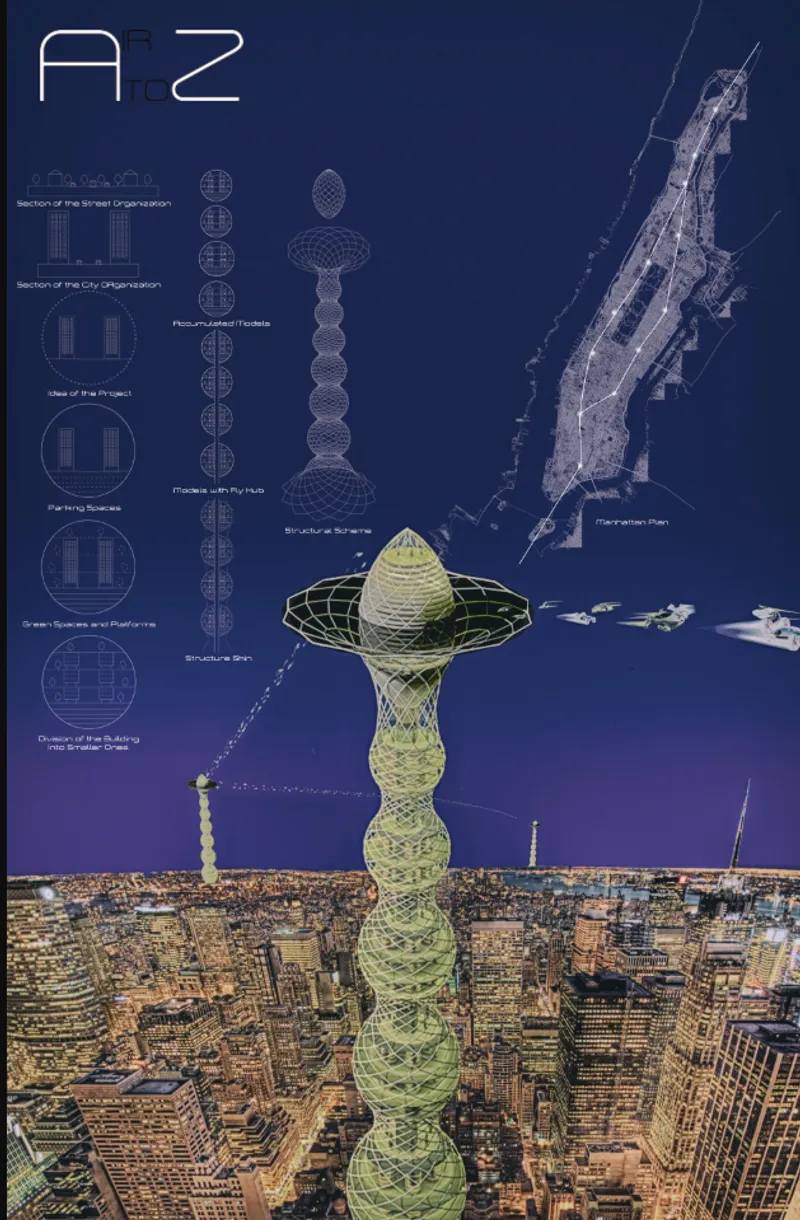
The composite drawing at dusk reveals the full vertical profile of the tower against an aerial city view, with diagrammatic overlays hinting at the environmental systems at play. The entire structure is encased in a responsive, lattice-like skin that does triple duty: it filters sunlight, enhances air circulation, and supports plant life across its surface. This is not decorative parametricism. The skin functions as a passive climate-control system, reducing the megastructure's dependence on artificial heating and cooling. In a project of this scale, that distinction matters enormously. The tower becomes, in the designers' framing, an ecological ally rather than an energy drain.
Ground to Sky: How Program Distributes Across the Height
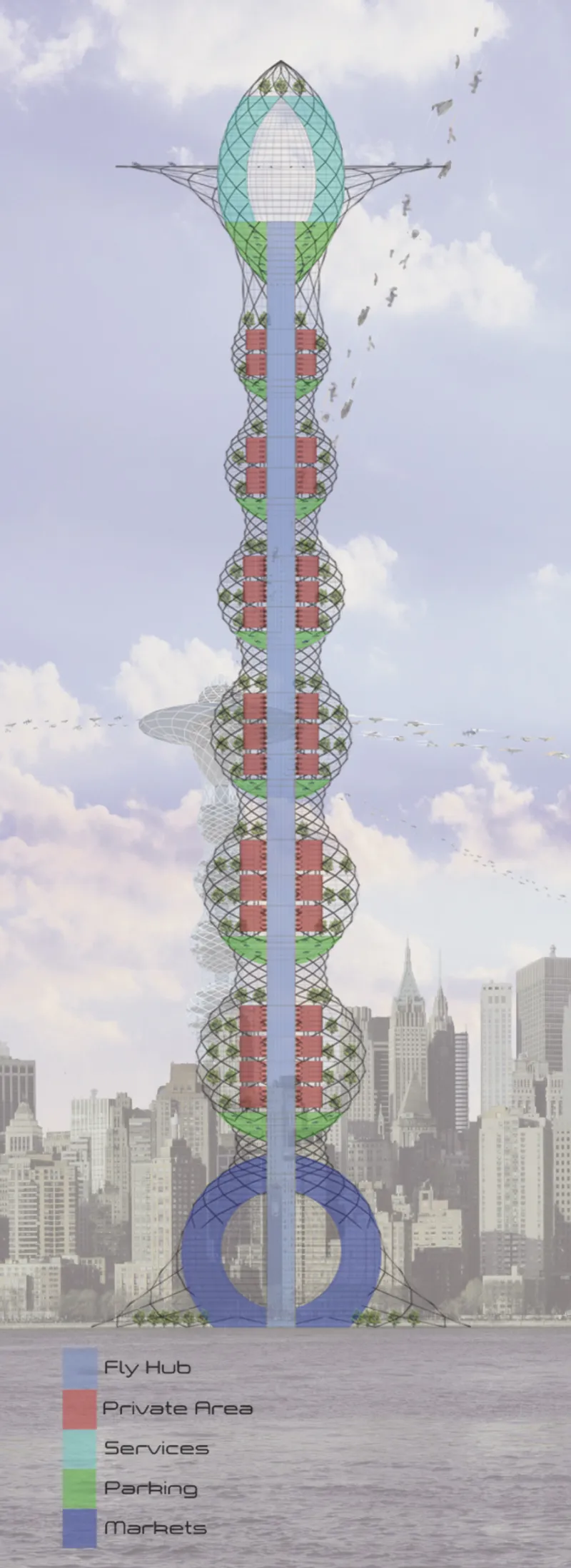
The elevation rendering with color-coded program zones lays bare the vertical hierarchy. At the base, a circular platform sits by the water, housing commercial areas and public infrastructure that bridge the megastructure to the existing city fabric. Mid-levels are given over to private residential units and social zones designed to encourage interaction. The upper reaches contain air terminals, drone ports, and observation decks, the structure's most forward-looking interventions. Each section is equipped with specific environmental and logistical solutions, and the color-coding makes it possible to read the entire system at a glance: this is not a tower with a program chart bolted on, but a program chart that generated the tower.
The waterfront siting is worth noting. Placing a megastructure of this density at the edge of the city, rather than its center, suggests a deliberate strategy of decentralized infrastructure. Fly hubs serving as transport nexuses, vertical parking zones for aerial vehicles, and sky-level marketplaces all reduce the need for ground-level congestion, proposing a model where the city grows upward and outward simultaneously.
Why This Project Matters
The speculative high-rise has a long history in architecture, and most entries in that tradition fail in the same way: they look dramatic but tell you nothing about how people would actually live inside them. Air TO Z succeeds because its spectacle is structural, not cosmetic. The modular spheres create real programmatic variety along a vertical axis. The lattice skin delivers measurable environmental performance. The zoning strategy, commercial at the base, residential in the middle, transit at the top, responds to how aerial commuting would reorganize daily life rather than decorating a conventional tower with drone pads.
Ferreira, Matos, and Santos have produced something genuinely useful for the discourse around future cities: a project that treats vertical mobility not as an add-on but as the fundamental driver of architectural form. In doing so, they raise a question that will only become more urgent as urban populations grow and aerial transit technologies mature. If the sky is going to become a transit network, why are we still designing towers that pretend it is empty?
View the Full Project
About the Designers
Designers: Júlio Ferreira, Carolina Matos, Tiago Santos
Enter a Design Competition on uni.xyz
uni.xyz runs architecture and design competitions year-round that reward proposals with spatial conviction and real site intelligence.
Project credits: Air TO Z by Júlio Ferreira, Carolina Matos, Tiago Santos Hybrid Futures '19 - Work x Fly (uni.xyz).


Popular Articles
Popular articles from the community


Singing Woman: An Opera House That Performs Before the Curtain Rises
Ovidiu Cristian Pavel's conceptual opera house translates Estonia's choral identity into a sculpted waterfront landmark facing the Baltic Sea.
Temporary Home for Dogs: A Reversed Zoo Rethinks Animal Shelter Architecture
In Bucharest, a sinuous corridor and freed landscape flip the logic of containment, designing a shelter that works to make itself unnecessary.

Tsunami Convergenics: Turning Catastrophic Ocean Forces into Underwater Housing Infrastructure
A speculative underwater settlement off the coast of Onagawa, Japan, treats tsunamis and typhoons as energy sources rather than threats.

The Amber Palace Opera: A Geological Fiction Surfaces on Tallinn's Baltic Waterfront
Pierre Brillard reimagines a Baltic legend as a public landscape, opera house, and waterfront promenade rooted in Tallinn's coastal identity.

Similar Reads
You might also enjoy these articles

Pixel Gardens: One Repeated Module Stacked Into a Terraced Social Housing Tower for Famagusta
Salem Bader's shortlisted housing tower builds a vertical neighbourhood from one repeated module, offsetting units to carve terraces, light and air.

Bao Huynh Watercolor Atelier: A Serene Art Retreat in Hội An
Bao Huynh Watercolor Atelier in Hội An blends multifunctional art spaces, sustainable design, local materials, and family-friendly living in a serene environment.

Atelier Macri Concept Store Interior Design by CASE-REAL
Atelier Macri store features a "ko" counter, walnut wood details, cork displays, blending retail, gallery, and seamless customer experiences.

Manuel Vargas Izquierdo Stadium and High-Performance Sports Center: Architectural Excellence in Jalpa de Méndez
The Manuel Vargas Izquierdo Stadium blends sustainable design, inclusive sports facilities, and cultural-inspired architecture, revitalizing Jalpa de Méndez’s public spaces.

Comments (0)
Please login or sign up to add comments
No comments yet. Be the first to comment!