

VIASCAPE Threads a Mirrored Canopy Through One of Shanghai's Densest Neighborhoods
Leshan Pocket Park carves 5,600 square meters of shared public life into the heart of Xuhui District's residential grid.


In Xuhui District, where more than a million people share fewer than 55 square kilometers, open space is not a luxury but a survival mechanism. Leshan Pocket Park, designed by VIASCAPE design and led by architect Yijia Sun, reclaims a deteriorating 5,600 square meter triangular lot roughly 800 meters from the historic Zikawei neighborhood and converts it into the only integrated open space serving the Leshan community center. The park sits within walking distance of office towers, schools, kindergartens, and a university, which means its user base is broad, intergenerational, and relentless.
What makes Leshan worth studying is not that it packs program into a tight urban parcel. Plenty of pocket parks do that. What sets it apart is the disciplined way VIASCAPE orchestrates a single formal gesture, a curving white canopy with a mirrored underside, to unify disparate activities beneath a coherent spatial identity. The canopy does not merely shelter; it reflects the ground plane, doubles the visual depth of the park, and creates an optical generosity that the actual footprint could never achieve on its own.
A Canopy That Multiplies Space
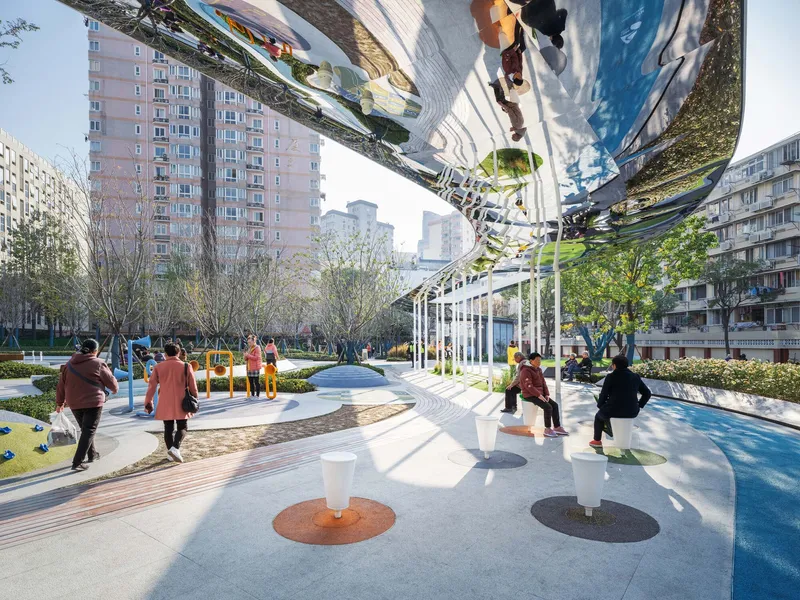
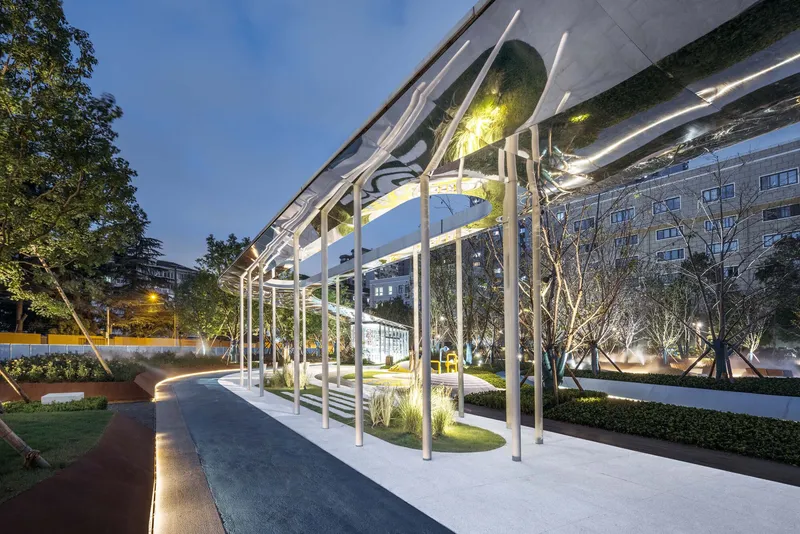
The mirrored underside of the canopy is the park's most consequential design decision. Supported on a grid of slender white steel columns, it hovers over the plaza and pulls the patterns of pavement, planting, and pedestrian movement into a doubled image above. At twilight, when the lighting embedded in the ground and the columns activates, the reflected plane turns the canopy into a lantern visible from the surrounding residential towers. It is a smart trick: the park gains vertical presence without adding mass.
The circular insets in the ground plane beneath the canopy provide informal gathering spots. Residents cluster around them in the afternoon, and the reflective surface overhead lends the scene a slightly theatrical quality. The design avoids the trap of precious materiality; the concrete, steel, and mirror finishes are durable enough to withstand the heavy daily use this neighborhood demands.
Curving Through the Canopy

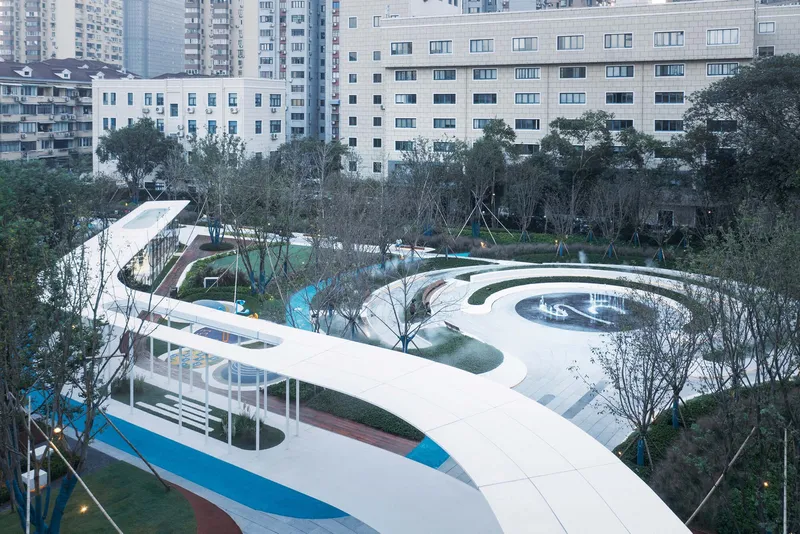
From above, the canopy reads as a white ribbon threading through the treetops, its curves softening the rigid geometry of the surrounding residential slabs. The aerial views at dusk reveal how precisely VIASCAPE calibrated the canopy's footprint: it covers enough ground to create meaningful shelter while leaving substantial open sky for the planted zones and play areas to breathe. The newly planted trees will, in a few years, begin to canopy the spaces the roof does not, creating a layered overhead plane of architecture and foliage.
The wedge-shaped site forced the design into an inherently directional layout. Rather than fighting that constraint, the curving form of the canopy works with it, guiding movement from the wider end of the triangle toward the narrower tip. The result is a park that feels longer and more spatially varied than its actual dimensions suggest.
Ground Plane as Program

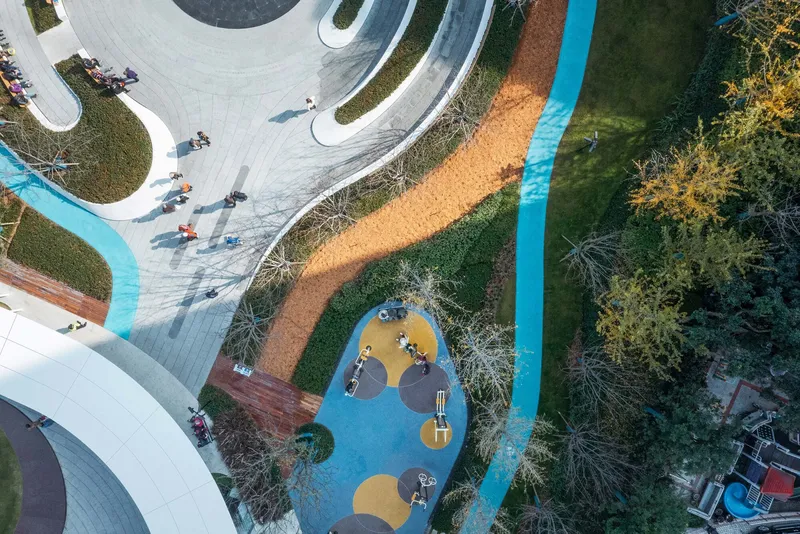

VIASCAPE treats the ground surface itself as the primary organizational tool. A blue rubberized running track weaves around planted zones and play areas, defining circulation without the need for walls or barriers. The circular playground, visible in the aerial views, uses the same blue surfacing to signal child-friendly territory within the larger landscape. Concentric white paving rings in another zone create a target-like gathering space where people naturally converge at the center.
The approach is economical and legible. Color and geometry do the wayfinding that signage typically handles, and the result is a park that reads clearly from both eye level and from the apartment windows above. For a community where seniors, children, joggers, and office workers share the same compact ground, that legibility is essential.
Edges and Intimacy
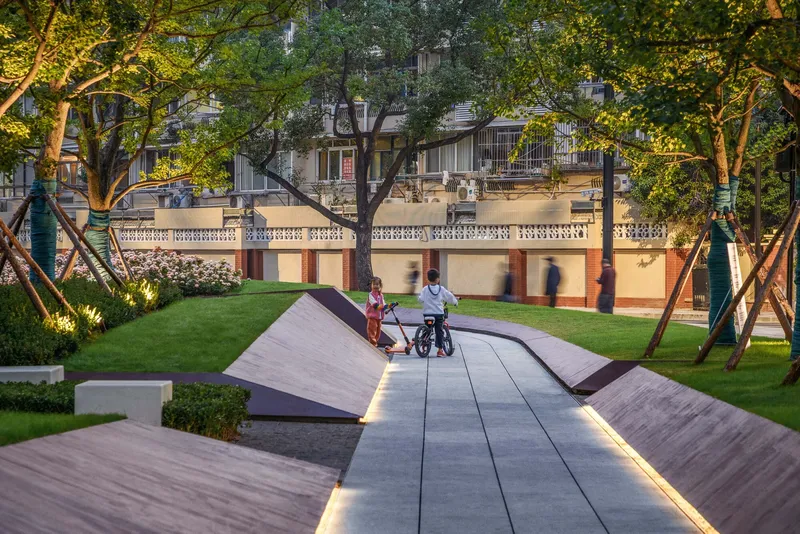

Away from the canopy, the park's edges shift to a warmer register. A folded timber deck pathway winds beneath overhanging trees, its integrated lighting creating a lantern-lined promenade after dark. Curved white concrete benches with built-in illumination nestle among planted beds and bare winter branches. These quieter zones accommodate the activities that VIASCAPE describes as viewing, wandering, resting, and reading. The contrast with the more active central zones is deliberate: the park offers genuine solitude within a few steps of a playground.
The "Shared Happiness Corridor," a sheltered rest area equipped with hot-water facilities and air conditioning, targets the neighborhood's elderly population specifically. It is a pragmatic acknowledgment that not every user of a public park wants or can tolerate exposure to Shanghai's humid summers and cold winters. Providing climate-controlled comfort within a landscape project is unusual, and it signals that VIASCAPE understood their user demographics with uncommon precision.
Sponge City in Miniature
Leshan embeds rain gardens, water collection devices, and permeable paving throughout the site, aligning with Shanghai's broader "sponge city" ambitions. These are not decorative gestures. In a district this dense, every impervious surface contributes to stormwater runoff that overwhelms aging infrastructure. VIASCAPE's decision to treat the park as a piece of green infrastructure, absorbing and filtering rainfall before it enters the municipal system, gives the project a civic utility that outlasts its aesthetic appeal.
Plans and Drawings

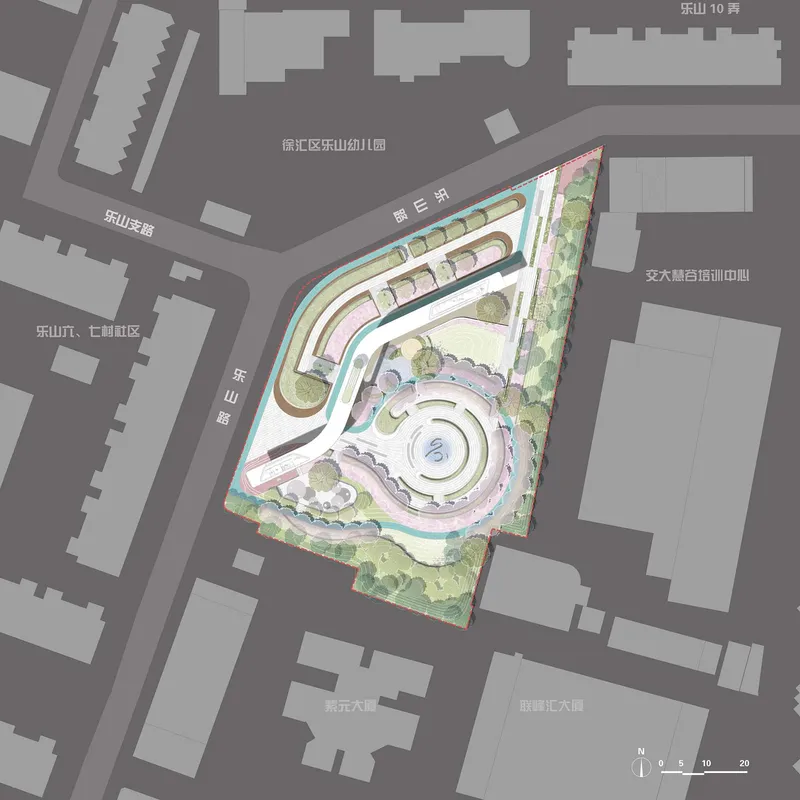
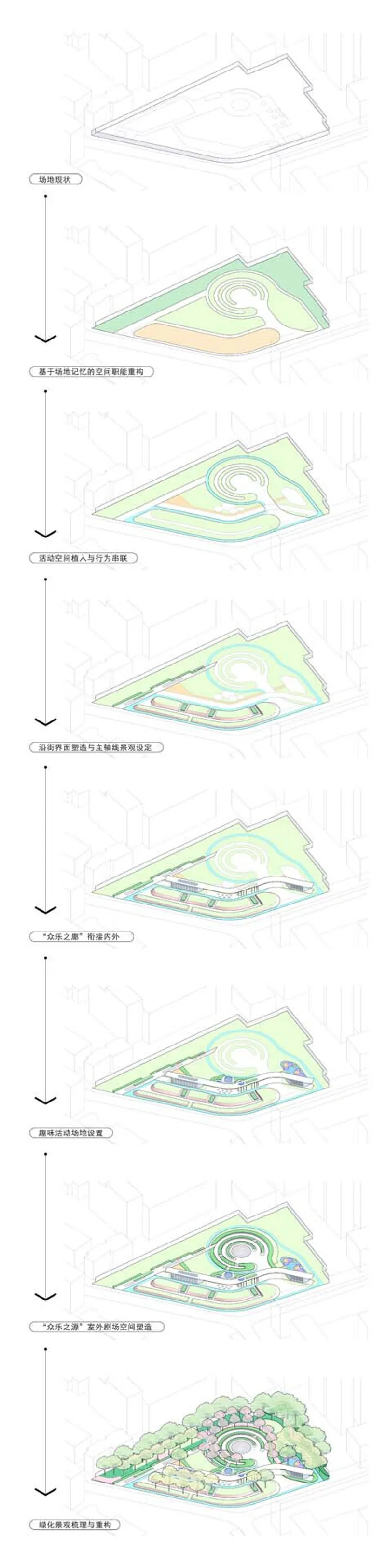

The site plan and master plan make the triangular constraint unmistakable. Bounded by streets on all three sides and hemmed in by residential blocks, the parcel offers no graceful geometry to work with. The design process diagrams show how VIASCAPE evolved the layout from orthogonal grids toward the curvilinear organization that ultimately won out. The elevation drawings of the canopy structure reveal a gradient color-coded analysis of the curving frame, suggesting careful structural optimization to minimize column counts while maintaining the sweeping profile.
Why This Project Matters
Pocket parks are often described as urban acupuncture, small interventions that relieve pressure in congested neighborhoods. Leshan does that, but it also demonstrates something less commonly achieved: it creates a genuine sense of spatial abundance within a footprint that would normally feel cramped. The mirrored canopy, the layered ground surfaces, and the carefully calibrated sequence of active and contemplative zones produce a park that serves a massive and diverse population without feeling oversubscribed.
More importantly, VIASCAPE treats infrastructure and atmosphere as the same problem. The rain gardens are not segregated from the play areas; the climate-controlled corridor is not a separate building appended to the park. Everything is woven into a single continuous landscape. In a city adding density at the pace Shanghai does, that integration is not optional. It is the only way a 5,600 square meter patch of ground can carry the full weight of public life.
Leshan Pocket Park, designed by VIASCAPE design, lead architect Yijia Sun. Located in Xuhui District, Shanghai, China. 5,600 m². Completed in 2021. Photography by CreatAR Images and Yijia Sun.
Share Your Own Work on uni.xyz
If projects like this are the kind of work you want to make, uni.xyz is a place to publish your own, find collaborators, and enter design competitions.


Popular Articles
Popular articles from the community


Cube Design Draws an Ecological Corridor Between Two Shenzhen Hills with the Nankai Building
Beside Shenzhen's container docks, the Nankai Building pairs stacked balconies with a climbing green screen to connect two hillsides across its height.

U.GA Architects Wraps an Oval Rooftop Pool in Curved Board-Formed Concrete on Busan's Jeollidan-gil
In Busan's Jeonpo-dong, a 454 m² mixed-use block stacks a neighborhood facility, guest rooms and an oval rooftop pool inside spiraling concrete walls.

David Macias Steps a Doorless Stone and Plaster House Down a Tropical Colombian Hillside
In the humid hills of Colombia, Threshold House replaces the front door with an open void and terraces its 850 m² down the slope instead of fighting it.

longwave studio Reorganizes a 112 m² Tainan Apartment Around the Daily Routines of a Family and Two Cats
In Tainan, Taiwan, birch plywood, rust-red furniture and a freestanding plaster wall link arrival, storage, work and family life in one apartment.

Similar Reads
You might also enjoy these articles


LAVA Architecten Gives Vocational Education a Sawtooth-Roofed Face on a Mechelen School Campus
In Mechelen, Belgium, a 2,053 m² STEM school on a 6×6 m grid turns workshops and classrooms into rooms that can be rearranged as teaching changes.

KEMA Studio Turns a Derelict Marvila Attic into a 60 m² Lighthouse Apartment Above Lisbon
In Lisbon's Marvila district, a rebuilt roof, four skylights and two plywood volumes turn an unlivable attic into a bright home facing the Tagus.

Pixel Gardens: One Repeated Module Stacked Into a Terraced Social Housing Tower for Famagusta
Salem Bader's shortlisted housing tower builds a vertical neighbourhood from one repeated module, offsetting units to carve terraces, light and air.

Bao Huynh Watercolor Atelier: A Serene Art Retreat in Hội An
Bao Huynh Watercolor Atelier in Hội An blends multifunctional art spaces, sustainable design, local materials, and family-friendly living in a serene environment.

Explore Public Park Competitions
Discover active competitions in this discipline

Challenge to reimagine the Iron Throne

Photograph architecture without architects

Illustrate the lost glory of Angkor Wat - Render Challenge

Design challenge to reuse E-waste
Comments (0)
Please login or sign up to add comments
No comments yet. Be the first to comment!