
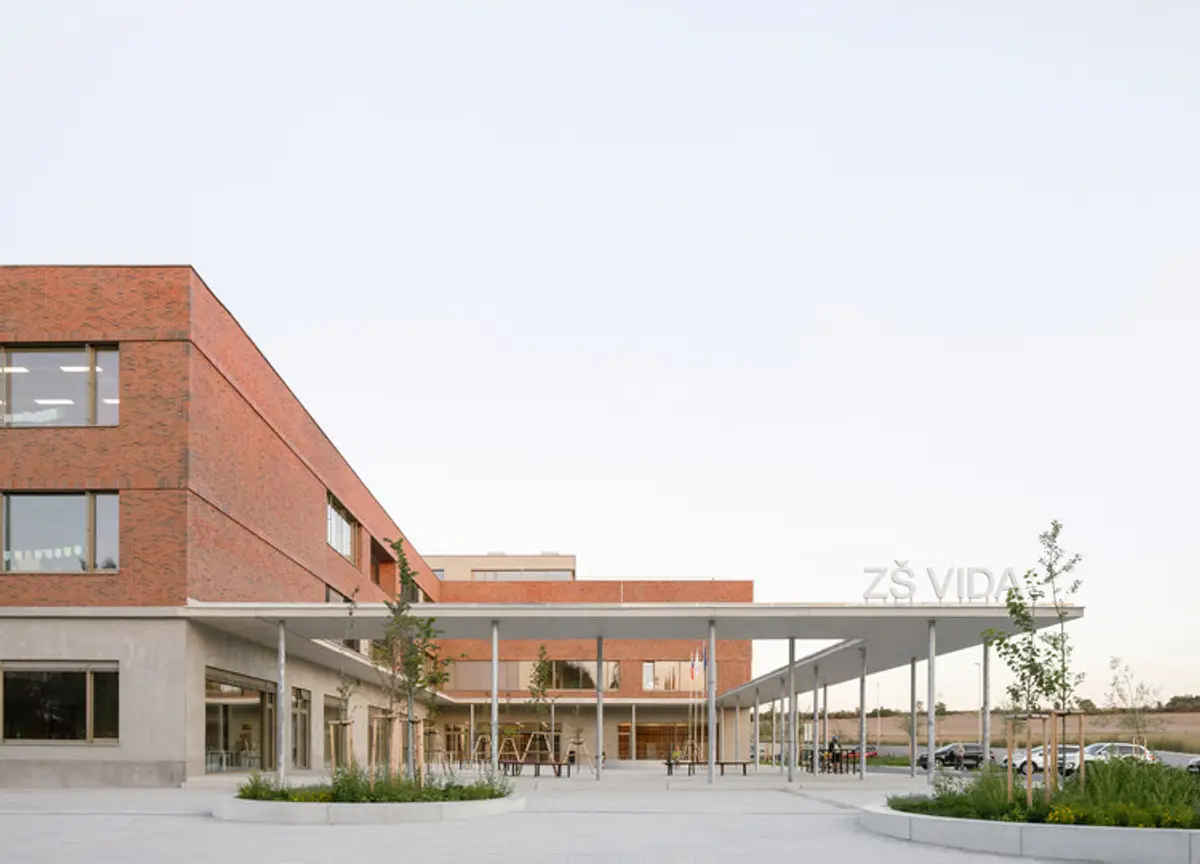
VIDA Elementary School By OVA | Chýně, Czechia
VIDA Elementary School redefines learning through flexible shared spaces, community integration, and sustainable design, supporting education, play, and lifelong engagement.


VIDA Elementary School, designed by OVA, is a forward-thinking example of contemporary educational architecture that reimagines how learning environments support academic, social, and community life. Completed in 2025 in Chýně, Czechia, the 5,175 m² school responds to a rapidly growing municipality near Prague, offering a flexible, sustainable campus designed for both present needs and future urban integration.
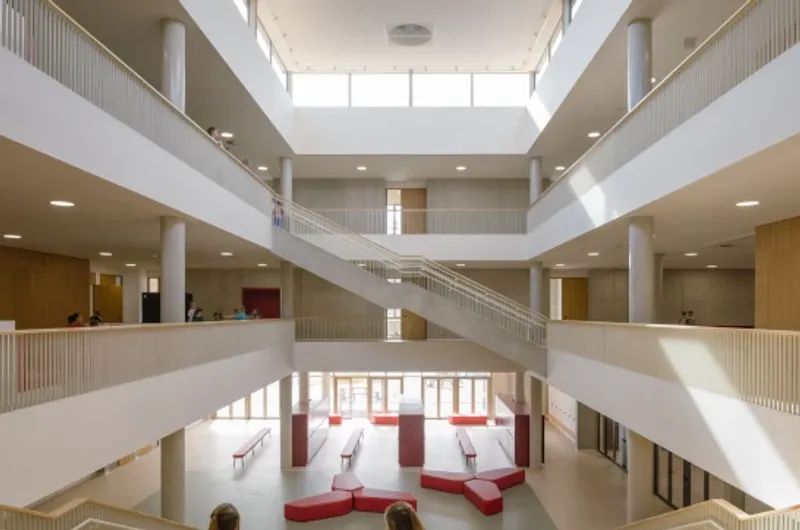
Rooted in modern educational principles, the school treats shared spaces, indoors and outdoors, as equal partners to traditional classrooms. Learning extends beyond formal lessons, unfolding in corridors, alcoves, courtyards, rooftops, and informal meeting areas. The result is a rich, layered environment where younger pupils and teenagers can explore, concentrate, collaborate, and relax in spaces suited to different learning styles and rhythms.

Urban Context and Site Strategy
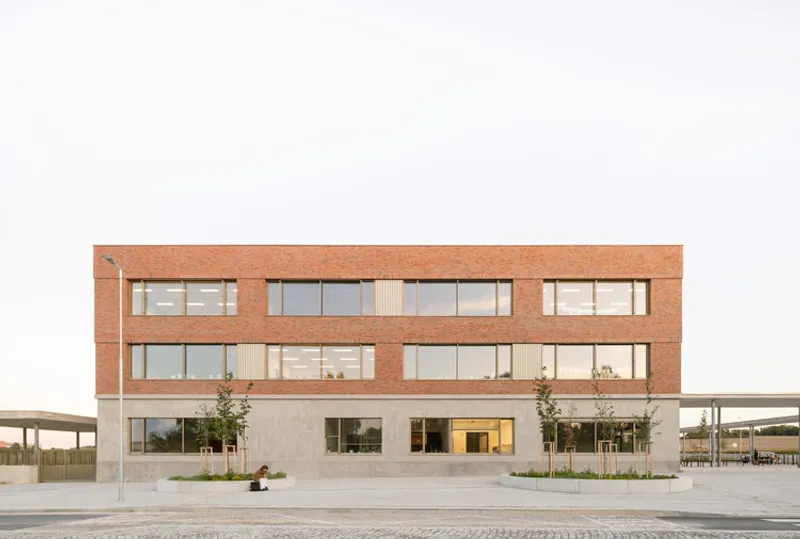
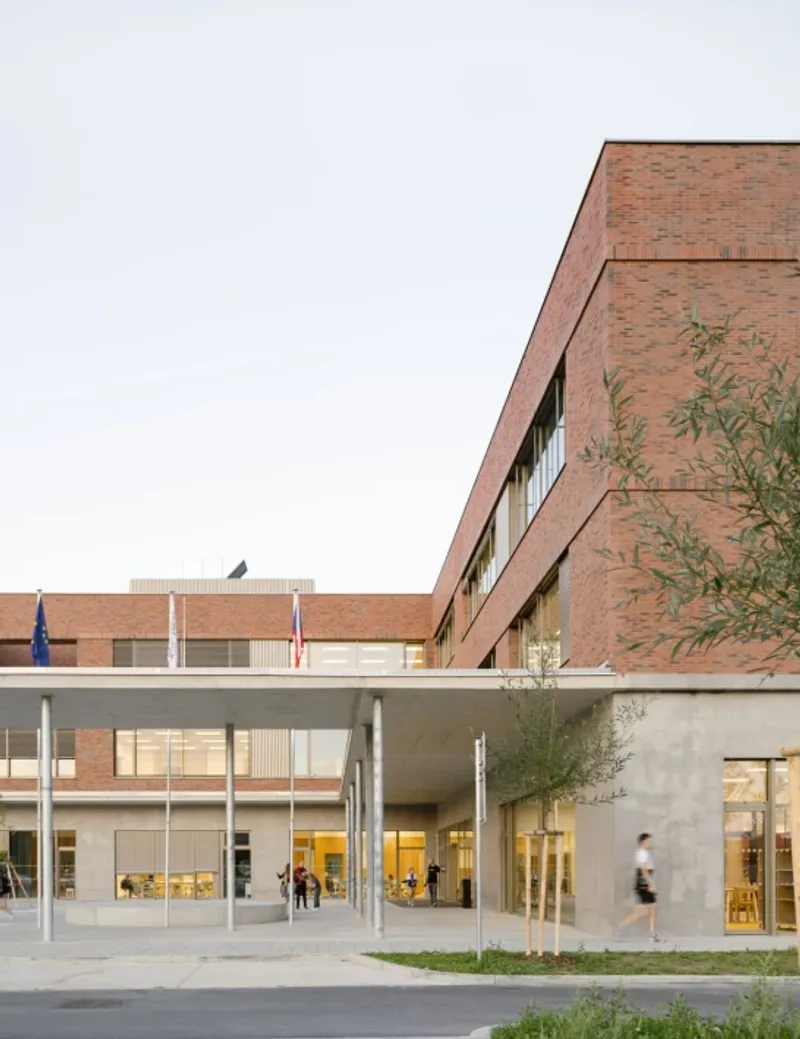
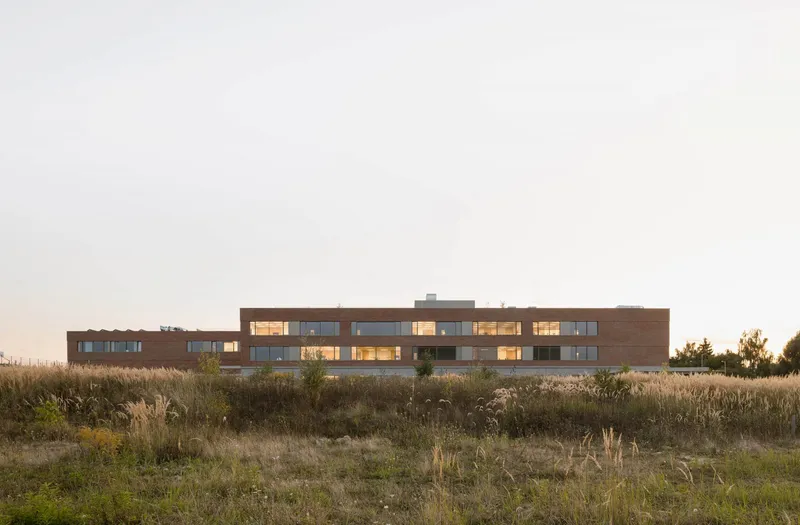
Located on an elongated, sloping site near the town center, VIDA Elementary School currently stands at the edge of Chýně, surrounded by open fields. As residential development expands, the school is expected to become an integral part of the town’s urban fabric. One of the project’s core objectives was to address both conditions, temporary isolation and long-term urban integration, by establishing a clearly defined public presence and a legible spatial structure.
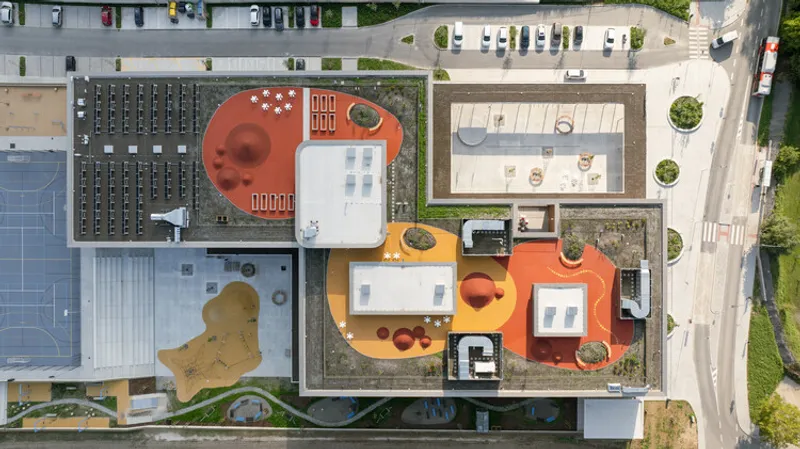
The design organizes the campus around two courtyards: one public and one more private. This duality creates a welcoming civic face while ensuring secure, protected spaces for students. The northern wing houses classrooms and the main communal learning areas, while the southern wing contains sports facilities, an auditorium, and supporting functions.

Learning Beyond the Classroom
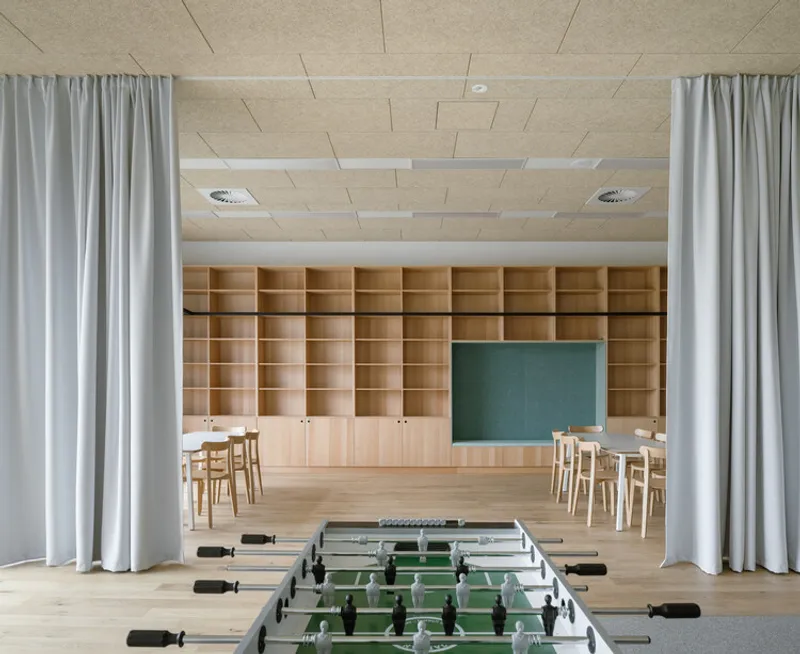
The interior layout encourages informal and self-directed learning. Along corridors, alcoves and small nooks support quiet conversations, individual study, or group discussions. Dedicated study rooms offer varied seating arrangements to accommodate different levels of concentration and interaction.
The building rises over three storeys, with its height responding sensitively to the sloping terrain. Multiple access points allow entry from different levels: the ground floor connects to the town, while the first floor links directly to the sports complex. On the upper levels, outdoor classrooms and terraces ensure that each floor maintains a direct relationship with the exterior.
The roofscape plays a vital educational role, functioning as both a recreational and learning environment. Rooftop terraces, outdoor classrooms, and planting beds support gardening activities, environmental education, and experiential learning.
A School for the Whole Community
VIDA Elementary School is designed as a shared civic resource. In addition to daytime primary education, the building supports afternoon and evening programs, including extracurricular activities for pupils and educational or sports activities for adults.
The school operates in two distinct modes. During school hours, the entire building is accessible to students and staff. In the afternoon, a reduced operational mode allows public access to selected areas, such as the gymnasium, library, multipurpose hall, and club rooms. These spaces can also host cultural events, strengthening the school’s role as a community hub.
Outdoor Spaces and Sports Facilities
The campus landscape is organized across two main height levels that follow the natural slope. The lower level corresponds to the school’s main floor and courtyards, while the upper level accommodates the sports complex.
The sports facilities include an athletic track with an integrated football field, support buildings, an athletic tunnel, and refreshment areas. Spectator seating is provided both at ground level and on the roof of the facilities building, which doubles as a grandstand. A secondary training field located between the school and the track remains accessible during school breaks.
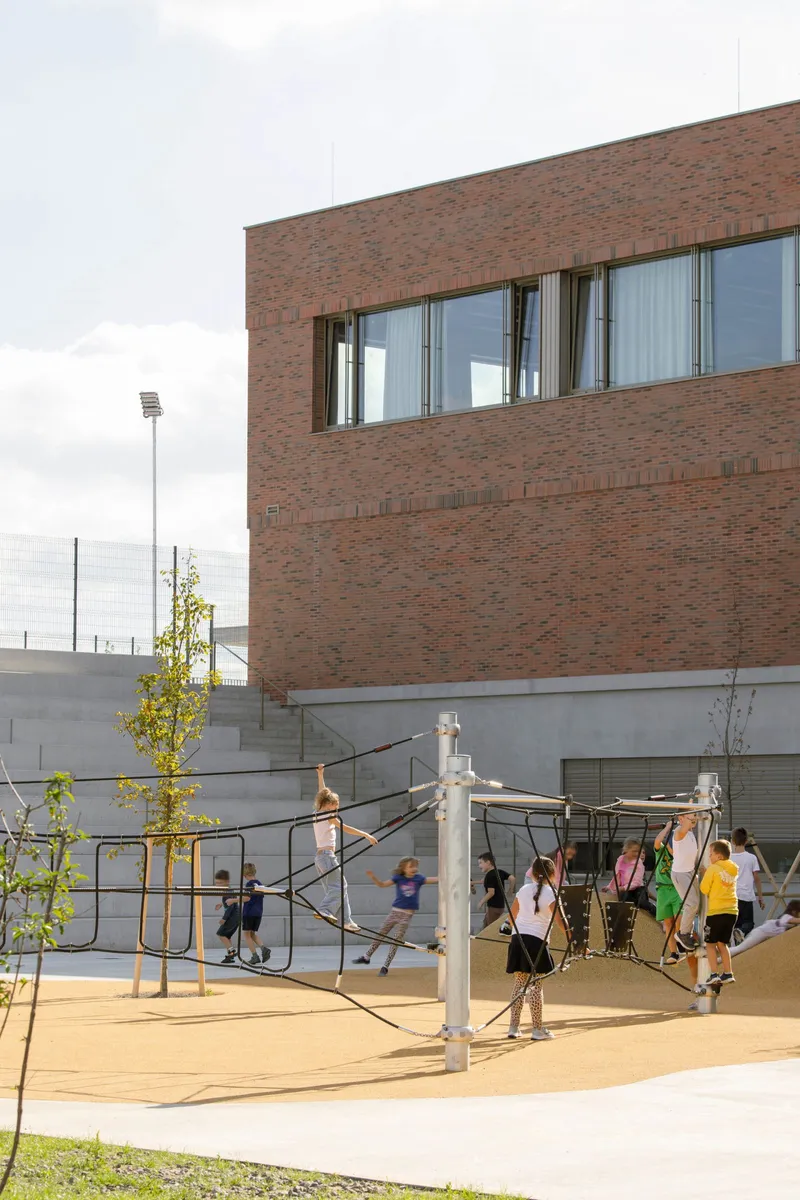
The entrance courtyard functions as a shared public space, offering lounging platforms for teenagers and play surfaces for younger children. The inner courtyard extends the canteen outdoors with dining tables and supports play, relaxation, and social interaction. Play structures, soft surfaces, rope pyramids, and open areas encourage movement and creativity throughout the day.

Sustainable and Energy-Efficient Design
Sustainability is a key pillar of the project. VIDA Elementary School meets Energy Performance Class A, supported by a comprehensive environmental strategy. Heating is provided by heat pumps, while controlled mechanical ventilation ensures high indoor air quality. Operable windows allow for natural ventilation in all occupied spaces.
Photovoltaic panels installed on the roofs of both the school and sports buildings improve the overall energy balance. External shading devices, high-performance thermal insulation, and the thermal mass of reinforced concrete and masonry construction contribute to energy efficiency and indoor comfort.
The façade is clad in ceramic elements, offering durability and a refined architectural expression. Roof canopies and planted “tree nests” mitigate heat gain and help prevent the formation of urban heat islands, reinforcing the project’s environmentally responsible approach.

A Holistic Model for Future Schools
VIDA Elementary School demonstrates how architecture, pedagogy, sustainability, and community life can be woven into a cohesive whole. By creating diverse learning landscapes, flexible operational modes, and energy-efficient systems, the project sets a strong precedent for next-generation elementary and middle school design in Europe.
All the photographs are works of Alex Shoots Buildings


Popular Articles
Popular articles from the community


Manzana Morphosis: Stretching Barcelona's Grid into a Living Landscape for 2050
A radical reworking of the Eixample manzana turns density into a tool for generous public space, vertical ecology, and environmental performance.


David Ortega Stacks a Two-Story Mexico City Penthouse Around a Steel Stair and a Pergola-Shaded Roof Terrace
In Colonia Roma, a 300 m² penthouse uses oak joinery, a planted steel stair and a slatted roof pergola to make a new-build apartment feel like a house.

The Amber Palace Opera: A Geological Fiction Surfaces on Tallinn's Baltic Waterfront
Pierre Brillard reimagines a Baltic legend as a public landscape, opera house, and waterfront promenade rooted in Tallinn's coastal identity.

Opera on the Sea: Driftwood Logic Shapes a Timber Opera House on Estonia's Coast
Trevor Orgill's opera house translates the entangled drift of floating timber into a civic building where wood, water, and music converge.

Similar Reads
You might also enjoy these articles


Hodi-Mandai Geram
Project Function: Preservation and revitalization of the Intangible heritage and socio-spatial identity of the Hodi by Housing, Cultural Memory Center, Sacred Grove, landscape, local tourism economy


Olio Towers: A Mid-Rise for Performers That Fuses Housing, Rehearsal, and Stage
Located blocks from Houston's Theater District, this modular tower stacks living units around a central performance atrium.

Oasis: Modular Green Housing Carved into Dhaka's Urban Fabric
A shortlisted Plugin Housing entry reclaims unauthorized settlements in Dhaka with stepped concrete volumes, green roofs, and ventilation-driven design.

Black Hole: A Floating Megastructure for the Post-Physical Era
Emiliano Mazzarotto envisions a spherical, self-scaling arena where e-sports, digital hotels, and holographic stadiums replace traditional public space.

Explore Educational Building Competitions
Discover active competitions in this discipline

Challenge to design public laboratory

Challenge to reimagine the Iron Throne

Photograph architecture without architects

Illustrate the lost glory of Angkor Wat - Render Challenge
Comments (0)
Please login or sign up to add comments
No comments yet. Be the first to comment!