

Viki Link: A Copenhagen Bridge Built as a Chain of Turf-Roofed Hills
Majid Aghazadeh turns a pedestrian and cycling crossing into a sequence of planted hills, with cafes and workshops sheltered beneath the turf.


Most bridges exist to be crossed as quickly as possible. Viki Link asks the opposite question: what if a crossing were slow enough, green enough and inhabited enough to become a destination in its own right? The answer is a bridge shaped like a row of grass hills rising out of the water. It reads less as a deck and more as a piece of landscape that happens to span a river, and it borrows its silhouette from the earth-covered dwellings of Denmark's Viking past.
Designed by Majid Aghazadeh, the project is set in Copenhagen, a city whose identity has been shaped for decades by cycling, human-centred streets and inventive public space. Aghazadeh treats that culture as the brief. The cycle route becomes the primary spine of the bridge, pedestrian paths run alongside it, and the spaces beneath the planted roofs hold cafes, retail, workshops, information centres and gathering areas. The proposal also includes a movable section that opens to let boats pass, so the bridge has to answer to river traffic as well as to people on foot and on bikes.
Rooms Tucked Beneath the Hills
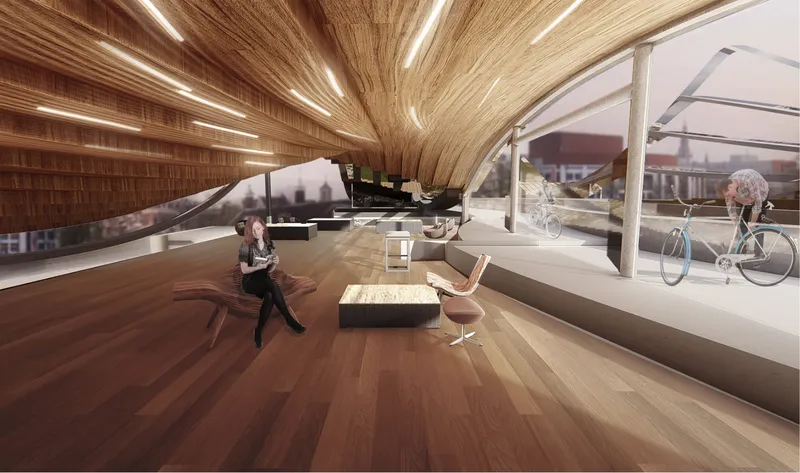
The interior rendering shows what the hills are really for. Beneath the turf sits a timber-lined room with a curving wooden ceiling and lounge seating, while a cyclist rolls past just outside the glazed wall. That thin layer of glass is the project's key relationship: the people sitting still and the people moving through stay in view of each other, and the bridge's social life depends on it. Aghazadeh notes that the planted mass above also works as natural insulation, which gives these sheltered rooms a practical reason to be buried rather than simply a romantic one.
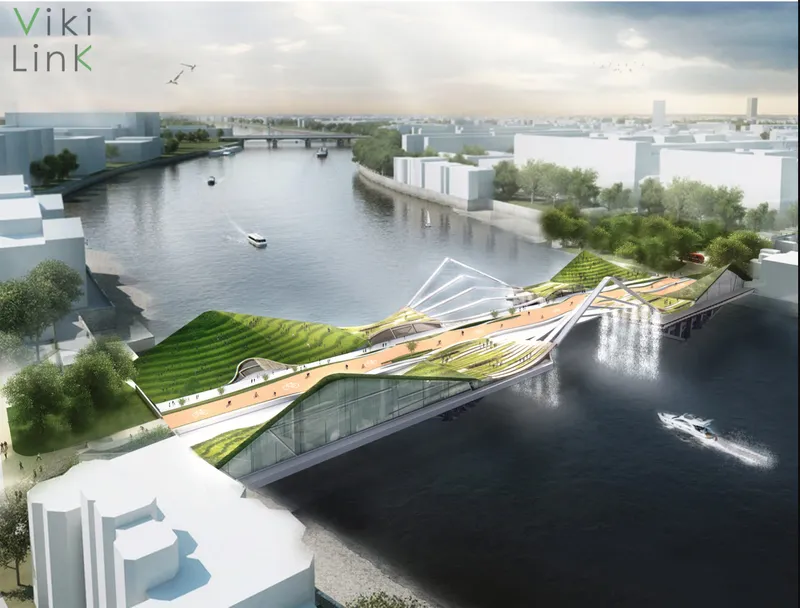
The aerial view pulls back to show the whole idea at once. A sequence of grass-terraced mounds stretches across a wide river while a motorboat slides underneath. From this height the bridge looks like a coastline that has wandered into the water. The overcast sky is a fitting choice, since it presents the scheme in typical Danish weather rather than in a flattering sunset, and the hills still read clearly as both landform and shelter.
A Red Cycle Line Through the Lawns
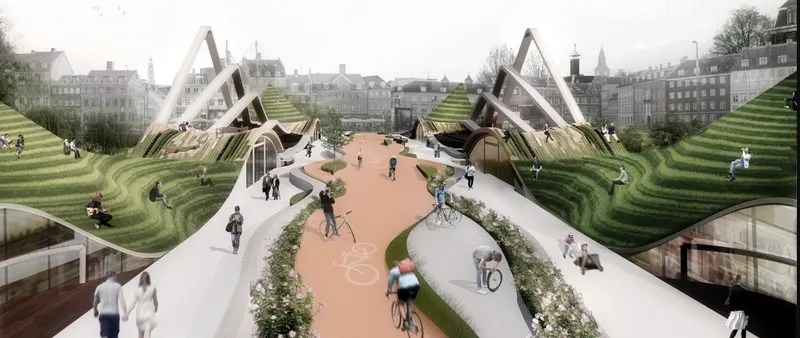
Here the circulation strategy becomes concrete. A red cycle path runs between sloped grass banks, framed overhead by timber A-frames, while people sit on the lawns watching riders pass. The A-frames recall the pitched roofs of Viking longhouses without turning them into literal pastiche, and they give the route a rhythm, as if cyclists were moving through a sequence of gateways. The design text describes the experience as moving through a landscape rather than crossing a bridge, and this image makes the case well.
The parallel pedestrian paths matter just as much. By keeping walkers and cyclists side by side but on separate routes, the scheme protects the speed of commuters while still letting the slopes work as informal seating. The open question, and one worth developing further, is how the rise and fall of the hills translates into gradients that remain comfortable for everyday cycling and fully accessible for people on foot.
Programme Distributed Across the Span
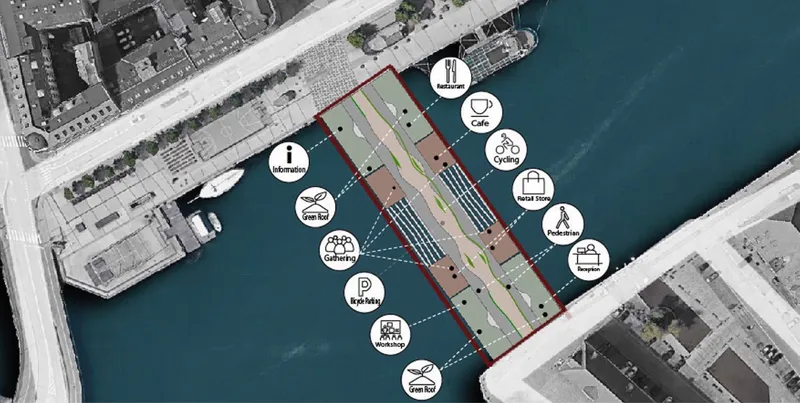
The site plan clarifies how the bridge is organised. Labelled zones for cafe, cycling, retail, gathering and green roof show a deliberate scattering of uses along the length of the crossing rather than a single cluster at one end. Aghazadeh describes these as moments of activity and pause: a place to stop for coffee, a space for small events, a sheltered room to wait out the rain. Spreading programme this way gives people a reason to linger at several points, which is what separates a public space from a corridor.
Two further layers add to the scheme. Waterfalls along the edges of the bridge bring sound and movement, tying the structure back to the river it spans. The opening mechanism, which allows a movable section to partly open for passing boats, means the bridge itself changes shape over the day. Together they keep the design from feeling static and remind visitors that this is working waterfront infrastructure, not a park floating in isolation.
From Turf Huts to Harbour Colour
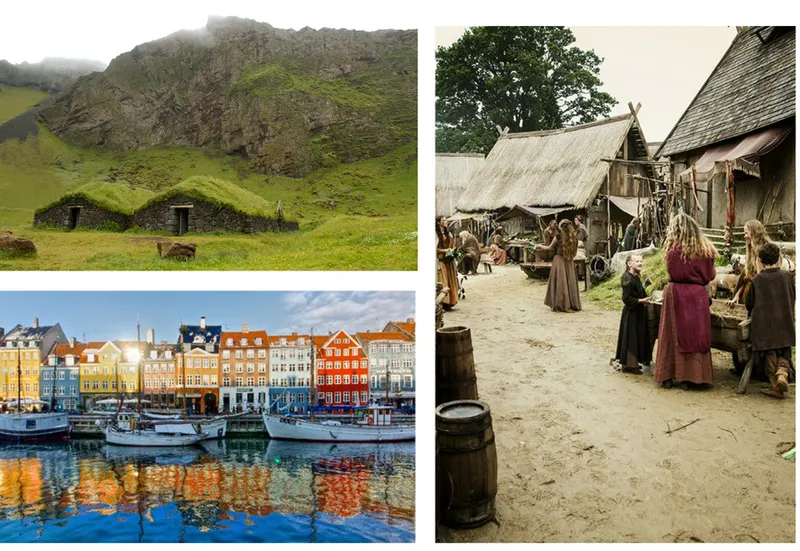
The reference collage sets out the cultural sources: turf-roofed huts below a misty cliff, colourful harbour houses reflected in still water, and a thatched market village scene. These are the threads Aghazadeh weaves into the bridge. The turf huts give it its section, the harbour houses its waterfront setting, and the market village its idea of a crossing full of trade and gathering.
What makes the reference work is restraint. Rather than reproducing Viking ornament, the project takes the deeper lesson of earth-sheltered building, where roof and ground merge and architecture sits low against the weather. Translated into contemporary structure, that lesson produces a landmark that feels rooted in place instead of imported.
Why This Project Matters
Viki Link joins a growing argument that infrastructure should carry more than traffic. By folding green roofs, sheltered interiors, retail and gathering space into a single crossing, Aghazadeh treats the bridge as civic ground, a place to sit, meet and look at the river, not just a way to reach the other bank. In a city where cycling is already part of everyday life, that ambition feels less utopian than overdue.
The project's strongest move is how it ties heritage to ecology. The earth-covered Viking dwelling becomes a model for a planted structure that supports biodiversity and shelters public life below. Questions of gradient, structure and the mechanics of the opening section still invite development, but the core idea is clear and persuasive: the most memorable bridges may be the ones that ask us to slow down.
View the Full Project
About the Designers
Designer: Majid Aghazadeh
Enter a Design Competition on uni.xyz
uni.xyz runs architecture and design competitions year-round that reward proposals with spatial conviction and real site intelligence.
Project credits: Viki Link by Majid Aghazadeh.


Popular Articles
Popular articles from the community


David Ortega Stacks a Two-Story Mexico City Penthouse Around a Steel Stair and a Pergola-Shaded Roof Terrace
In Colonia Roma, a 300 m² penthouse uses oak joinery, a planted steel stair and a slatted roof pergola to make a new-build apartment feel like a house.

U.GA Architects Wraps an Oval Rooftop Pool in Curved Board-Formed Concrete on Busan's Jeollidan-gil
In Busan's Jeonpo-dong, a 454 m² mixed-use block stacks a neighborhood facility, guest rooms and an oval rooftop pool inside spiraling concrete walls.

Jaramillo Van Sluys Arquitectura and Urbanismo Turn a Demolished Registry Lot in Quito into an Orchard Plaza
In Quito's Centro Histórico, a 2,800 m² plaza exposes the San Agustín convent wall and redraws its lost Augustinian orchard in volcanic stone.

David Macias Steps a Doorless Stone and Plaster House Down a Tropical Colombian Hillside
In the humid hills of Colombia, Threshold House replaces the front door with an open void and terraces its 850 m² down the slope instead of fighting it.

Similar Reads
You might also enjoy these articles
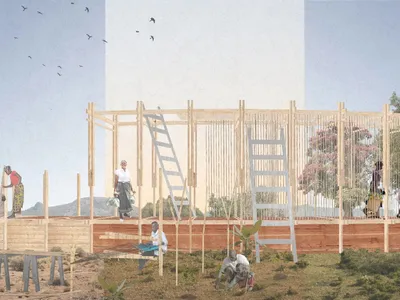
Healing Façade: A Modular Chapel System That Restores Ethiopia's Sacred Forests
Winner of the Eco-Chapel competition, this circular timber façade collects water from air to rebuild soil and reforest degraded Ethiopian landscapes.
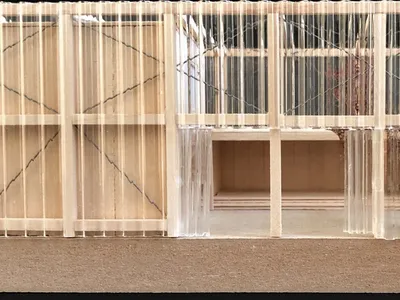
Kaffeebühnen: Where Coffee Shop Architecture Becomes a Civic Stage in Vienna
A linear sequence of timber boxes, transparent shells, and open yards turns the Viennese café tradition into a public performance space.
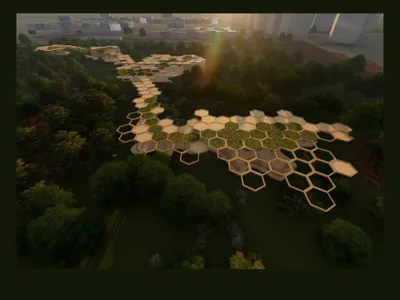
Eco Chapel: A Modular Forest Pavilion That Grows Like the Landscape It Protects
Hexagonal timber modules weave through existing trees, turning a chapel into a living system for prayer, education, and reforestation.


Urban Forest: A Vertical Ecosystem for 5,000 Workers in Singapore's Changi Business Park
Radially stacked pods and layered green decks turn a 7-acre plot into 47 acres of ecological workspace projected for 2040.


Comments (0)
Please login or sign up to add comments
No comments yet. Be the first to comment!