
Shape Architecture Turns a Sharjah Villa into a Living Canvas for Arabic Calligraphy
Villa Diwani in the United Arab Emirates fuses Kufic script, stone mosaics, and courtyard planning into an 850 m² residence that doubles as an art gallery.


A house that claims to be the first building in the world conceived as "architecture of letters" had better deliver on that promise with more than a decorative panel or two. Villa Diwani, completed in 2023 by Shape Architecture Practice + Research in Sharjah, mostly does. Designed under the direction of Emirati consultant and engineer Abdullah Al-Shamsi, with calligraphy by artist Khaled Al-Saei, the 850 m² residence treats Arabic script not as applied ornament but as a generative logic: Kufic letterforms are carved directly into white stone facades, recreated in stone, metal, and glass mosaics across interior surfaces, and used to organize the perforated screens that regulate light and privacy.
What makes the project genuinely interesting is the tension between its ambition and its restraint. The villa could easily have become a calligraphy theme park. Instead, it operates through a fairly disciplined courtyard plan organized along a central axis, with spaces arrayed on either side and multiple courtyards tuned to specific functions. The calligraphy intensifies or recedes depending on where you stand, turning the walk through the house into a curated sequence rather than a single overwhelming gesture.
A Facade That Reads
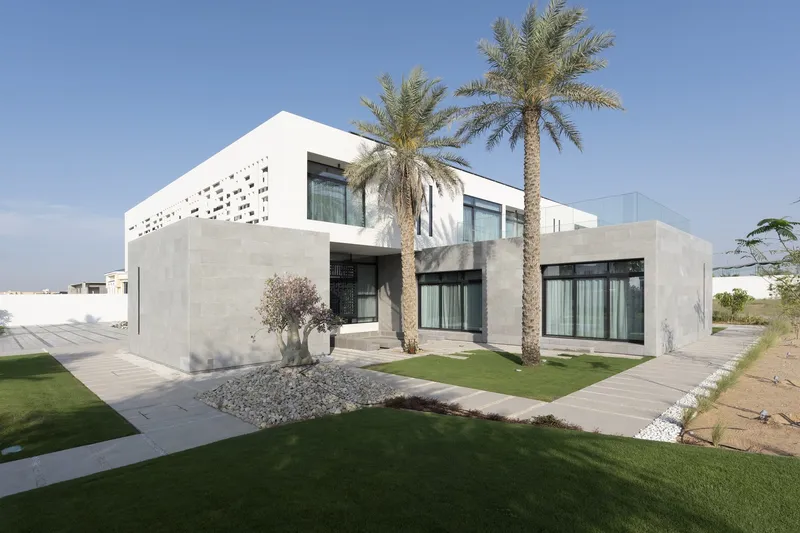
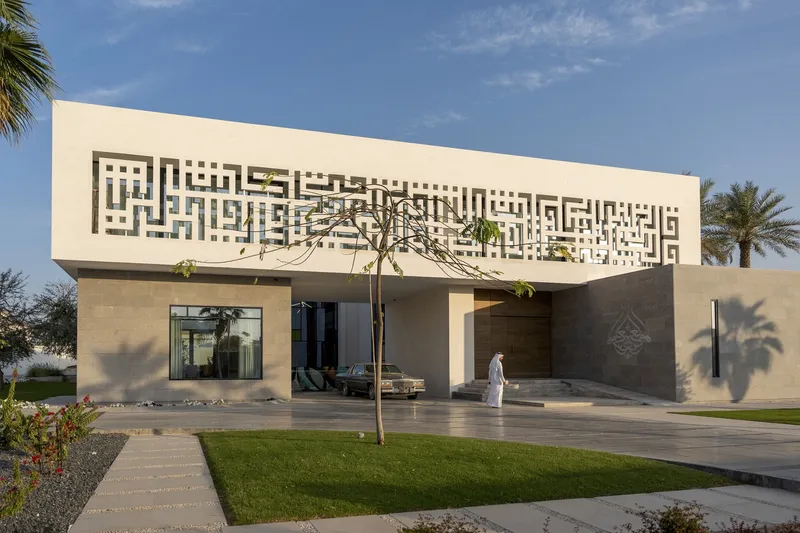
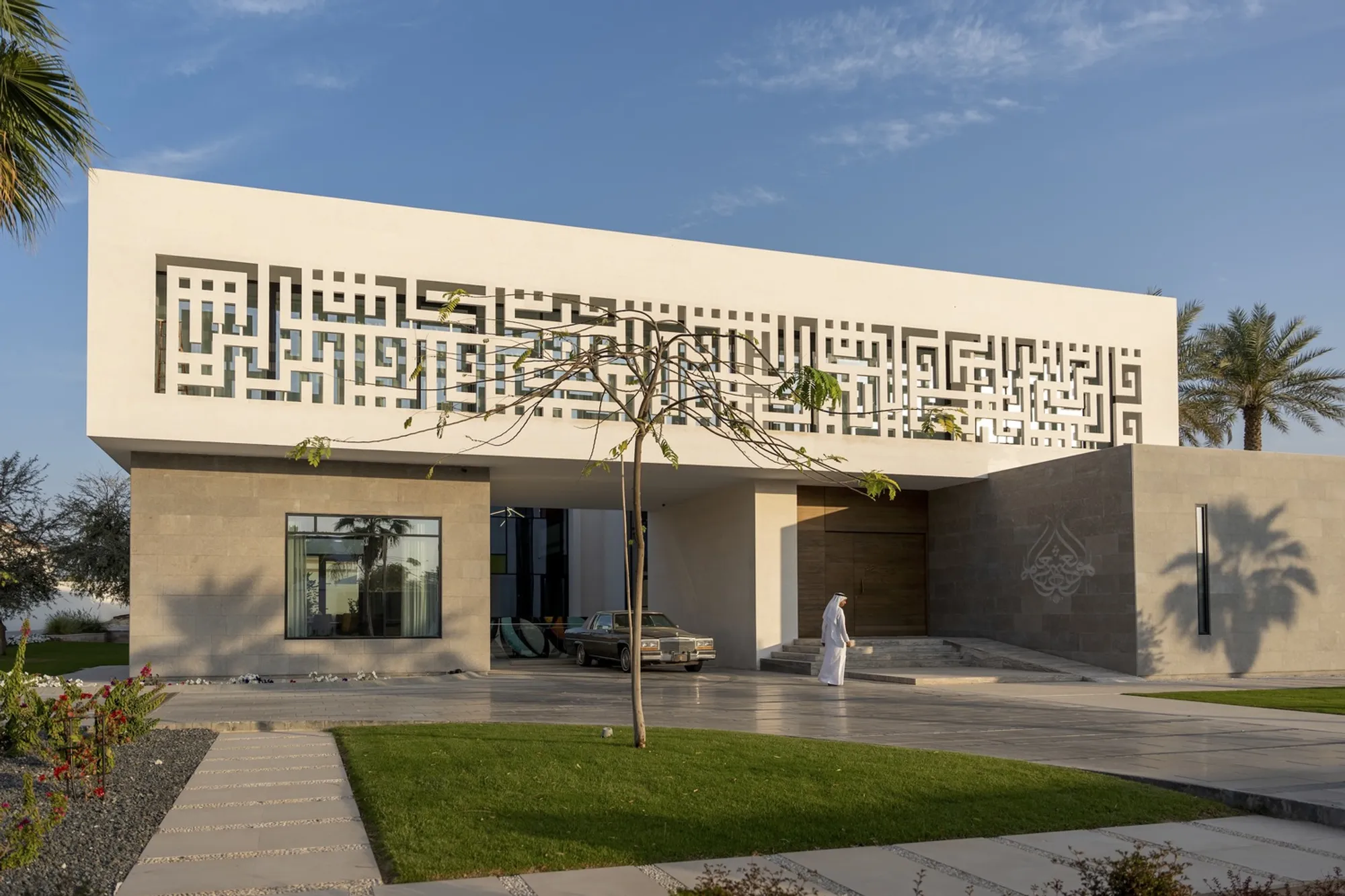
The street elevation sets up a clear compositional hierarchy: a white stone-clad upper volume hovers above a darker concrete and grey stone plinth. The perforated screen that wraps the upper storey is the building's most legible calligraphic element, its geometric openings derived from Kufic script patterns. Against the Sharjah sun, this screen does real environmental work, filtering harsh light while projecting shifting letter-shaped shadows into the rooms behind it. The palm trees and low lawn keep the foreground deliberately simple, letting the facade hold attention on its own terms.
The proportional game here is worth noting. The heavy plinth grounds the composition, while the lighter perforated volume appears to float. A figure in white in one view gives immediate human scale and reinforces how the building mediates between the domestic and the monumental. It reads like a residence from the garden and like a small cultural institution from the street.
Thresholds of Light and Script
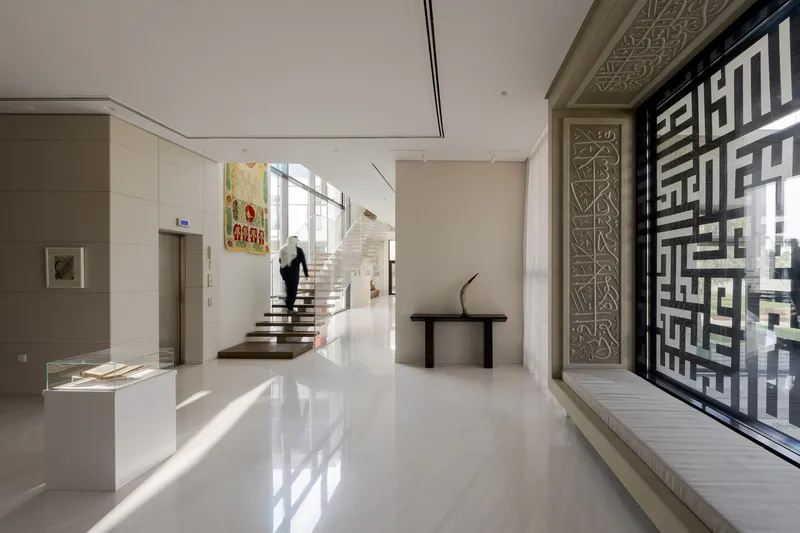
The entrance hall is where the building's real argument begins. A floating timber staircase anchors the space while a geometric perforated screen catches afternoon light and casts it across the interior in sharp, shifting patterns. The calligraphy here is experienced kinetically: as you move through the hall, the shadows on walls and floors recompose, so the script is never static. It is read by the body in motion as much as by the eye.
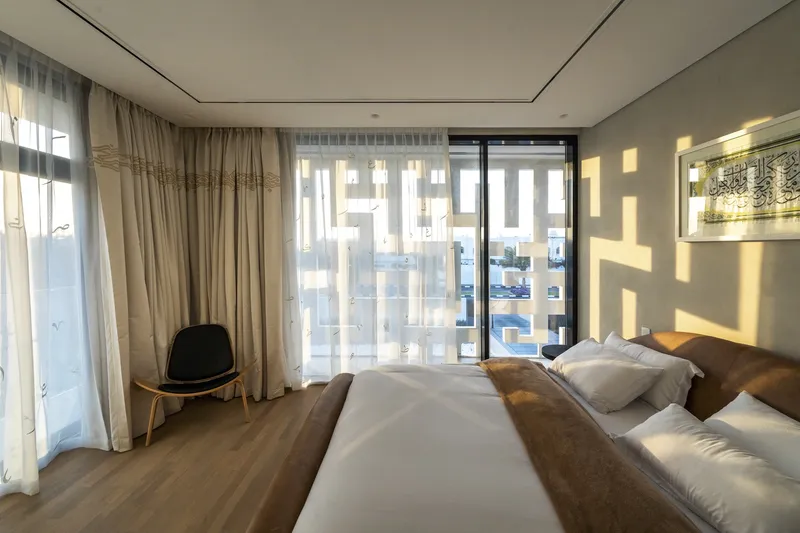
The same principle plays out in the bedrooms, where sheer curtains intercept the screen's shadow geometry and soften the letter-forms into something almost atmospheric. By midday the wall behind the bed becomes a slow projection of the facade's pattern, a quiet insistence that the calligraphy is always present even in the most private rooms. It is a compelling detail: ornamentation dissolved into light rather than fixed in material.
The Interior as Gallery
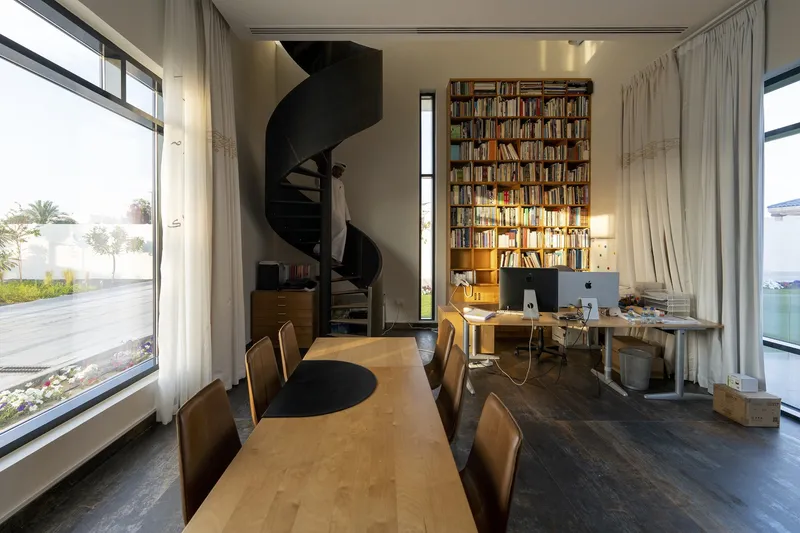
The double-height library, with its floor-to-ceiling bookshelves and black spiral stair, is the room that most explicitly declares the villa's dual identity as residence and art gallery. The long dining table below suggests communal use, a salon atmosphere where books and conversation share equal billing. The proportions are generous without being cavernous, and the spiral stair introduces a sculptural counterpoint to the predominantly rectilinear plan.
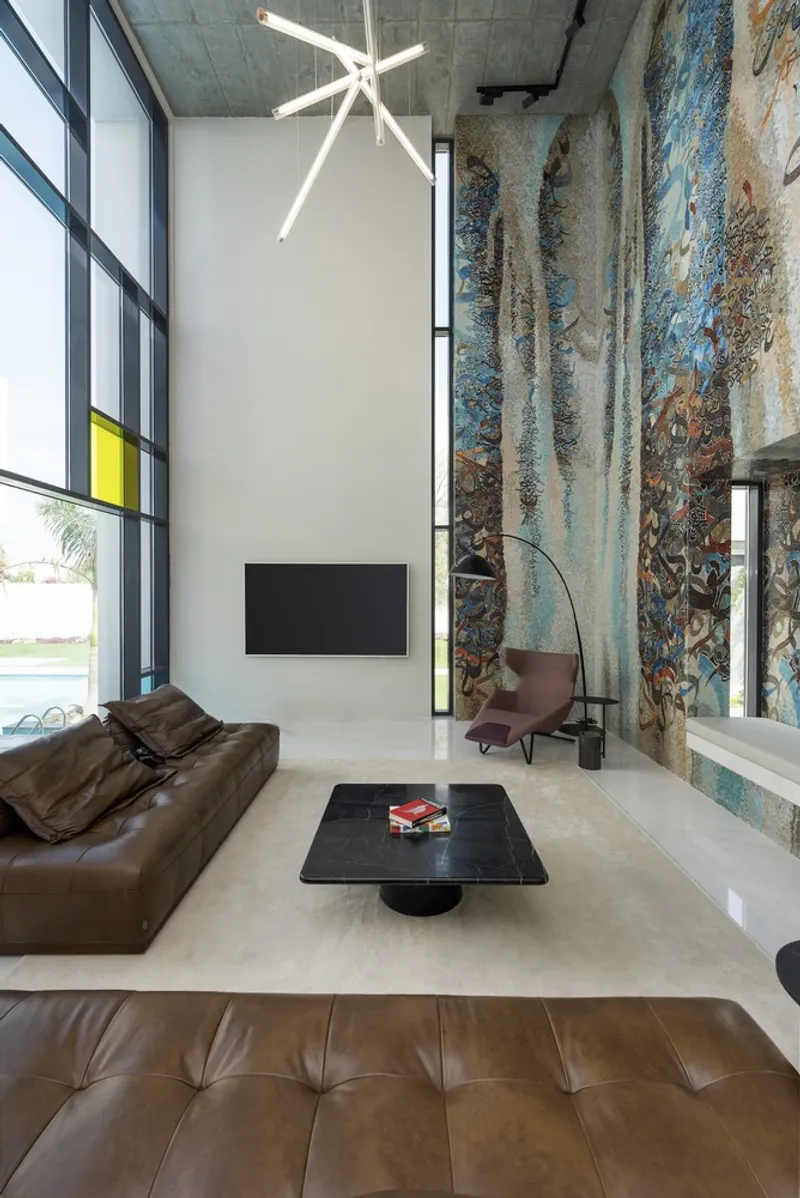
Elsewhere, the living room pairs an exposed concrete ceiling with a textured tile wall that carries calligraphic patterning into a more tactile register. A ribbon window opens directly to the lawn, collapsing the boundary between inside and outside. The material palette here is deliberately muted: concrete, stone, tile, all in earth tones, so the calligraphic surfaces read as texture rather than color. This is where the collaboration with Khaled Al-Saei and other regional artists is most legible. Original works were recreated in mosaic by skilled artisans, preserving the gesture of each piece while translating it into architectural permanence.
Courtyards and the Outdoor Axis
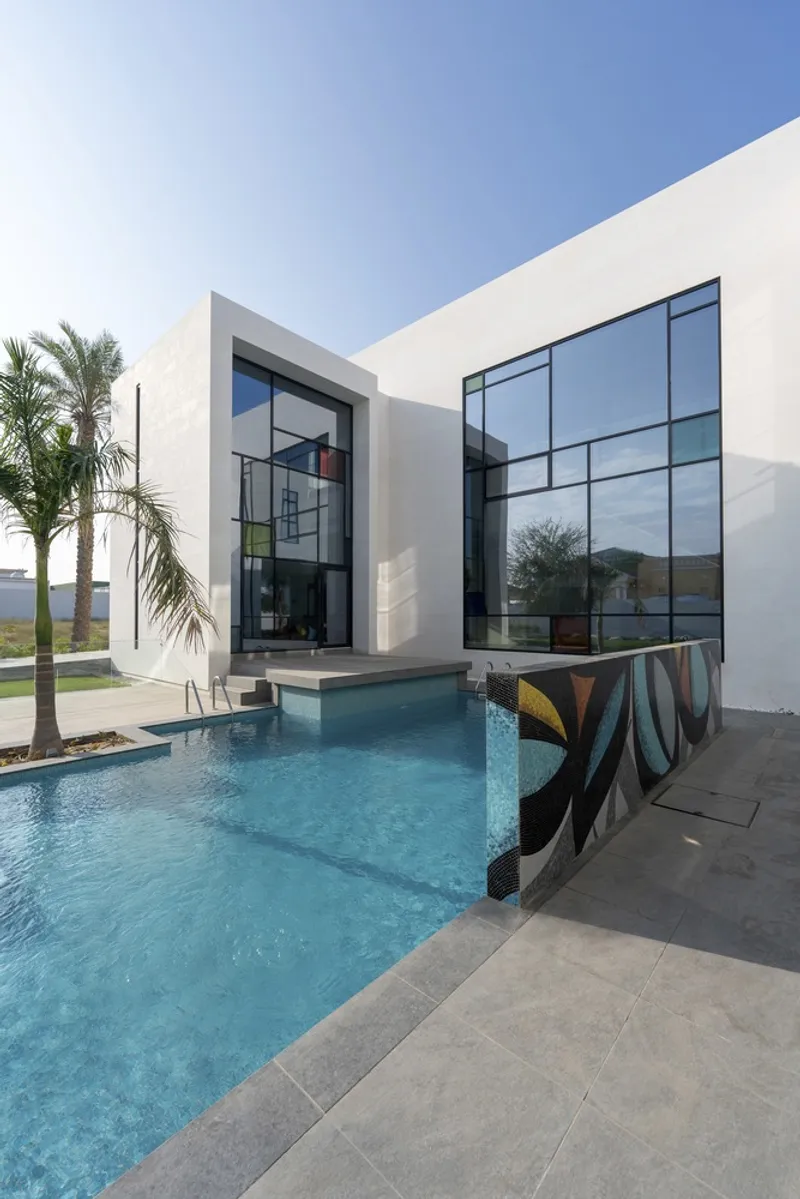
The poolside elevation reveals the villa's more relaxed register. White stucco walls meet floor-to-ceiling glass, and the blue pool extends the central axis outward into the landscape. Grey paving and palm trees maintain the restrained material vocabulary established at the entrance, while the glass walls dissolve the boundary between the interior living spaces and the courtyard. The design includes a sunken majlis courtyard with a dedicated sitting area for gatherings, a typological nod to traditional Gulf hospitality that the plan integrates without sentimentalizing.
After the villa's completion, artists were invited to curate surfaces across the surrounding landscape, extending the calligraphic program beyond the building envelope. This post-occupancy curation is an unusual move. It implies the villa is unfinished by design, an evolving canvas that accumulates meaning over time rather than delivering a fixed statement at handover.
Why This Project Matters
Villa Diwani matters because it proposes a specific, testable idea: that Arabic calligraphy can operate as architectural structure rather than surface decoration. The perforated screens, the mosaic programs, and the light-shadow choreography all work toward that thesis with varying degrees of success. Where the project is strongest is in its treatment of light as a medium for script, turning static letter-forms into temporal experiences that shift with the sun. Where it is more conventional, notably in the courtyard plan and material palette, it borrows from well-established Gulf residential typologies. That combination of radical ambition and typological grounding is what makes the house credible rather than gimmicky.
For a region where calligraphy is too often reduced to decorative wallpaper or a branding device, Villa Diwani insists on a deeper integration. The collaboration between Shape Architecture, Abdullah Al-Shamsi, and Khaled Al-Saei produced a building where script is carved, cast, projected, and woven into every scale of the design. Whether it truly constitutes "architecture of letters" is a question the building poses more convincingly than it answers, but the posing itself is worth the visit.
Villa Diwani by Shape Architecture Practice + Research, with architectural design by Abdullah Al-Shamsi and calligraphy by Khaled Al-Saei. Sharjah, United Arab Emirates. 850 m². Completed 2023. Photography by Shoayb Khattab.
About the Studio
Share Your Own Work on uni.xyz
If projects like this are the kind of work you want to make, uni.xyz is a place to publish your own, find collaborators, and enter design competitions.




Popular Articles
Popular articles from the community


Riyadh For All: Intergenerational Urban Design for Active Aging in Rabat
Riyadh For All reimagines urban design in Rabat with intergenerational co-living, adaptive courtyards, and Moroccan cultural exchange today.

Co-Life: Senior Housing Design That Reconnects Older Adults With the City
Co-Life reimagines senior housing design through healing gardens, shared streets, workshops, and a sustainable community across generations.

The Musturak Paradise: Senior Living Architecture for a Connected Future in Temara, Morocco
The Musturak Paradise reimagines senior living architecture in Temara via private homes, social spaces, culture, community, and shared care.

Co-life: Sustainable Architecture for Age-Friendly Community Living
Co-life reimagines sustainable architecture for seniors through courtyards, rammed earth, shared gardens, and spaces designed for belonging.

Similar Reads
You might also enjoy these articles


Hodi-Mandai Geram
Project Function: Preservation and revitalization of the Intangible heritage and socio-spatial identity of the Hodi by Housing, Cultural Memory Center, Sacred Grove, landscape, local tourism economy


Olio Towers: A Mid-Rise for Performers That Fuses Housing, Rehearsal, and Stage
Located blocks from Houston's Theater District, this modular tower stacks living units around a central performance atrium.

Oasis: Modular Green Housing Carved into Dhaka's Urban Fabric
A shortlisted Plugin Housing entry reclaims unauthorized settlements in Dhaka with stepped concrete volumes, green roofs, and ventilation-driven design.

Black Hole: A Floating Megastructure for the Post-Physical Era
Emiliano Mazzarotto envisions a spherical, self-scaling arena where e-sports, digital hotels, and holographic stadiums replace traditional public space.


Explore Arabic Architecture Competitions
Discover active competitions in this discipline



Challenge to reimagine the Iron Throne


Photograph architecture without architects


Illustrate the lost glory of Angkor Wat - Render Challenge


Design challenge to reuse E-waste
Comments (0)
Please login or sign up to add comments
No comments yet. Be the first to comment!