
Villa MR: An Alpine Renovation by Atelier Archiplein
Atelier Archiplein renovated a mid-century villa near Annecy, exposing its concrete frame and extending it toward the mountains in sage green and oak.


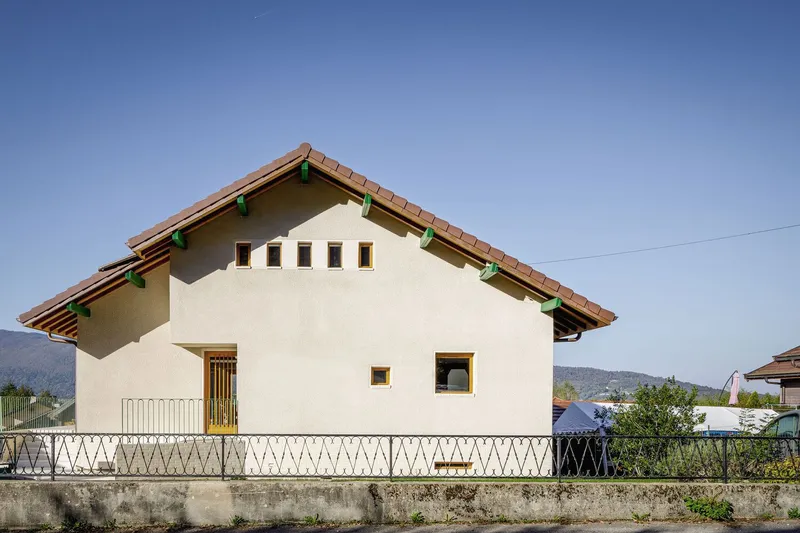
Annecy sits at the northern tip of its lake, in the French Alps. The hillside villages around it are full of mid-century villas that were built quickly, lived in for decades, and now need renovation. Most of them get gutted and refinished. Villa MR, renovated by Atelier Archiplein, takes a different approach. The architects exposed the structure that the original builders hid, and built a new ground-floor extension that reframes the entire house toward the mountains and the lake.
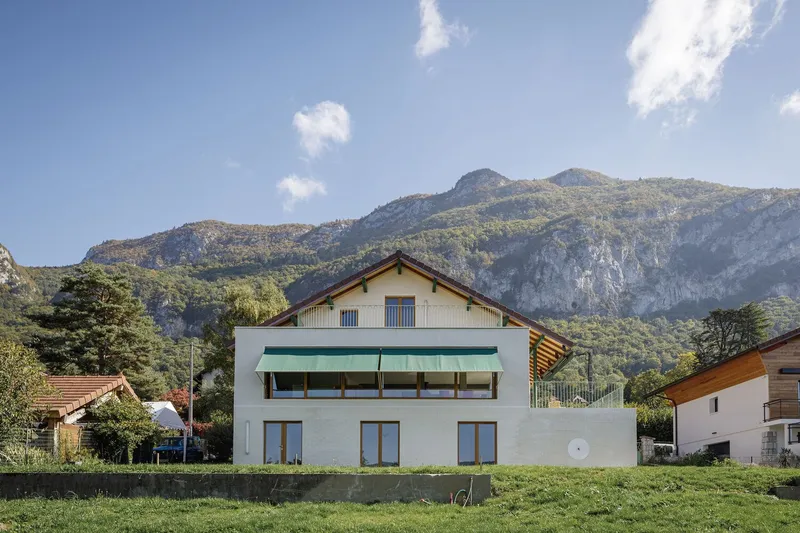
The result is a villa that looks modest from the street and dramatic from the garden. The pitched roof and rendered walls remain. But inside, exposed concrete columns, terrazzo floors, sage green joinery, and a house-shaped fireplace volume turn a conventional Alpine house into something specific and precise.
The Garden Facade and the Extension
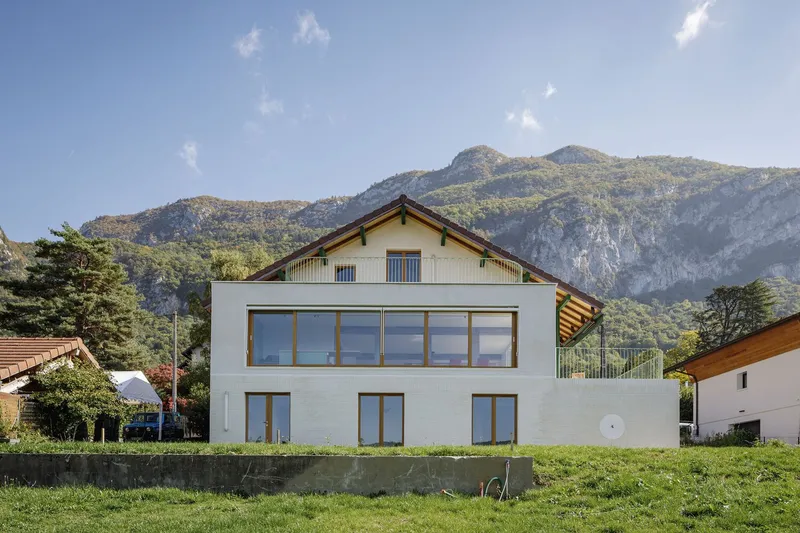
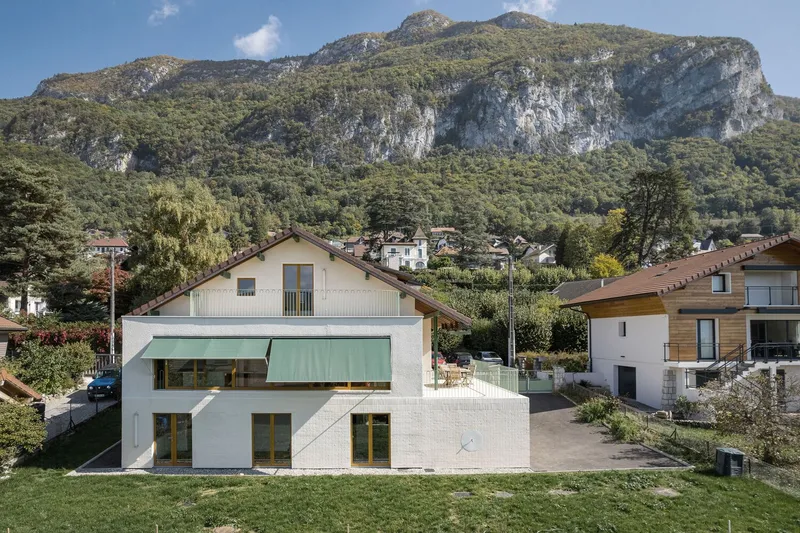
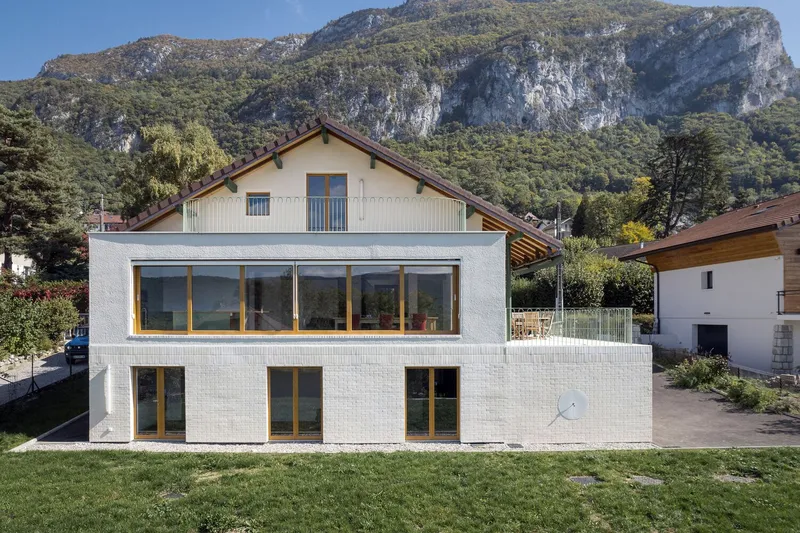
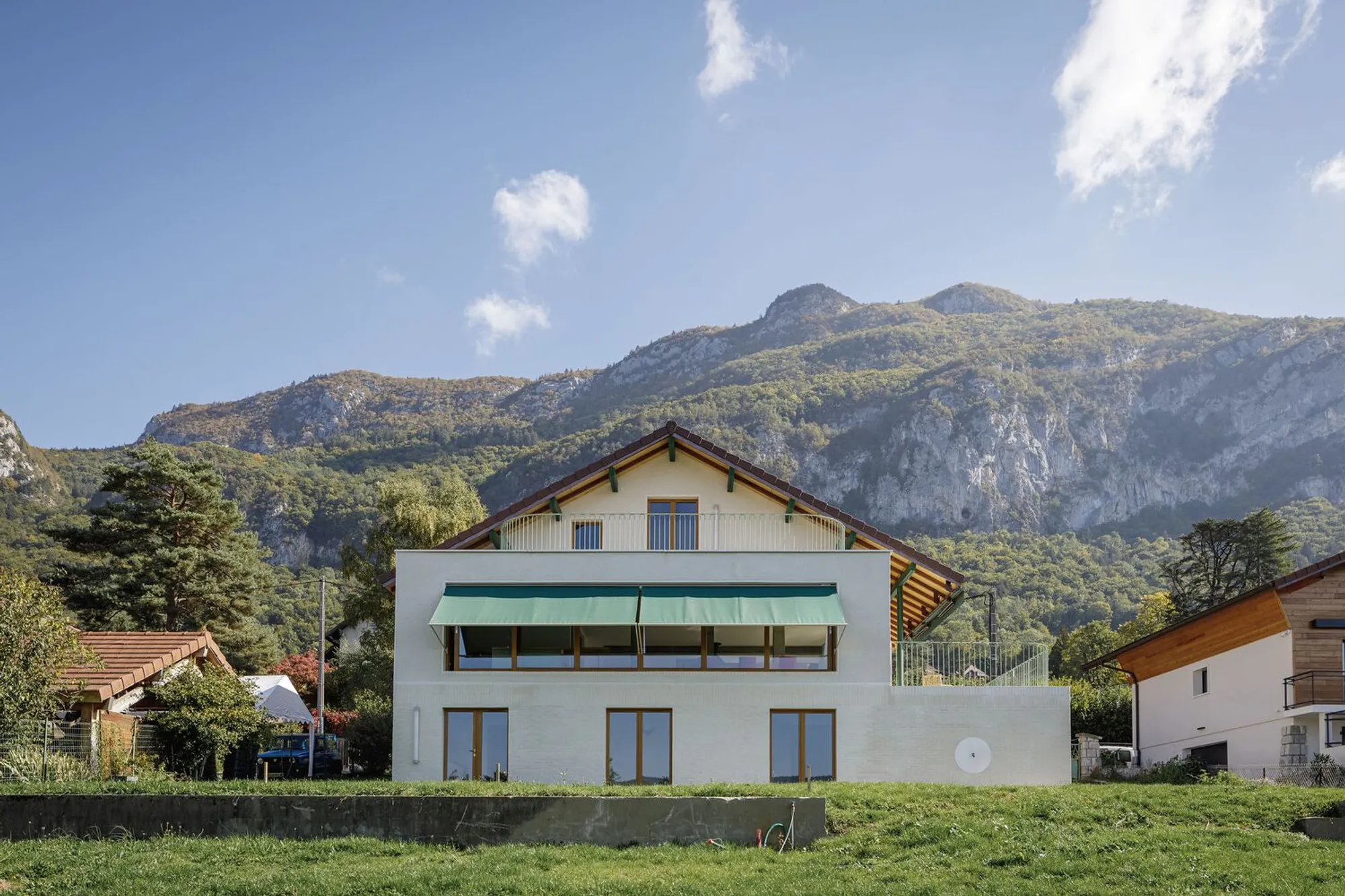
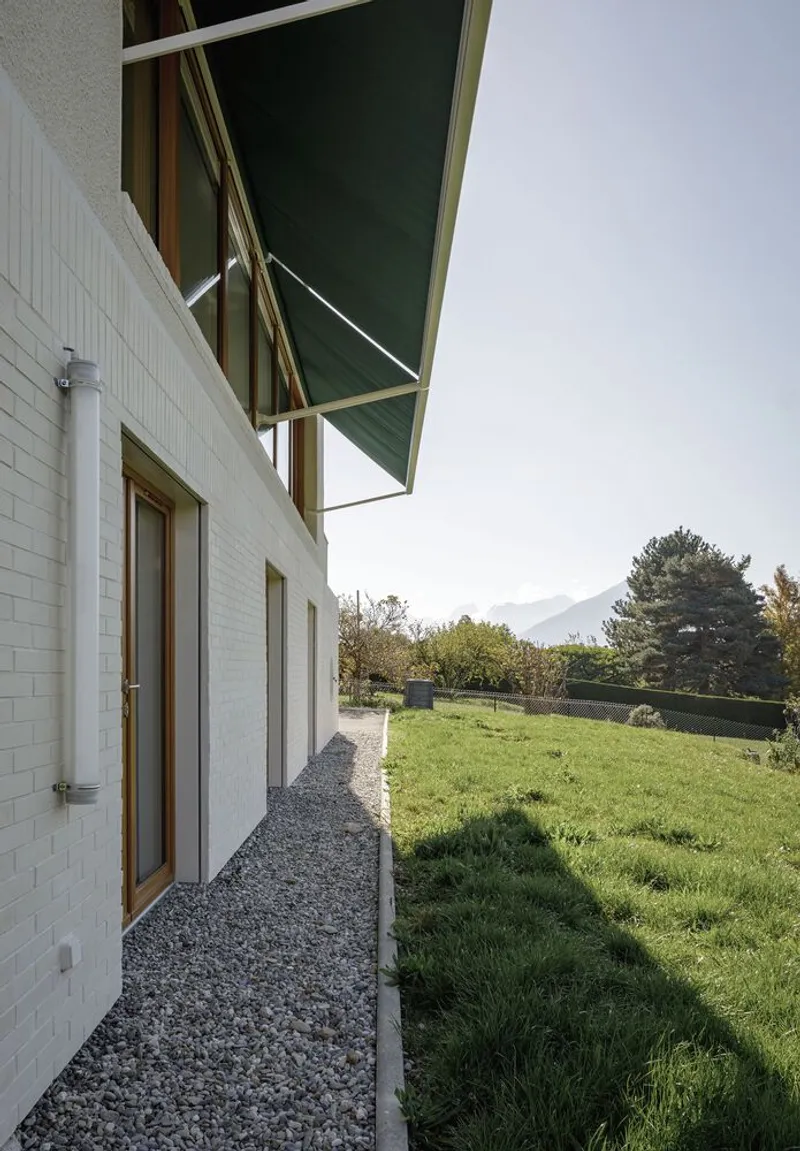
The most visible change is the ground-floor extension on the garden side. A new volume in white brick with large timber-framed windows pushes the living space toward the view. Above it, a green retractable awning and a curved metal balcony mark the upper floor. The original pitched roof and rendered gable sit unchanged above the new work.
This layering is deliberate. The extension does not pretend to be original. The white brick is different from the render. The timber frames are larger than the old windows. The new and old read as distinct layers, which is what makes the composition work. Imitation would look wrong. Contrast looks honest.

Exposed Concrete: The Hidden Structure Revealed
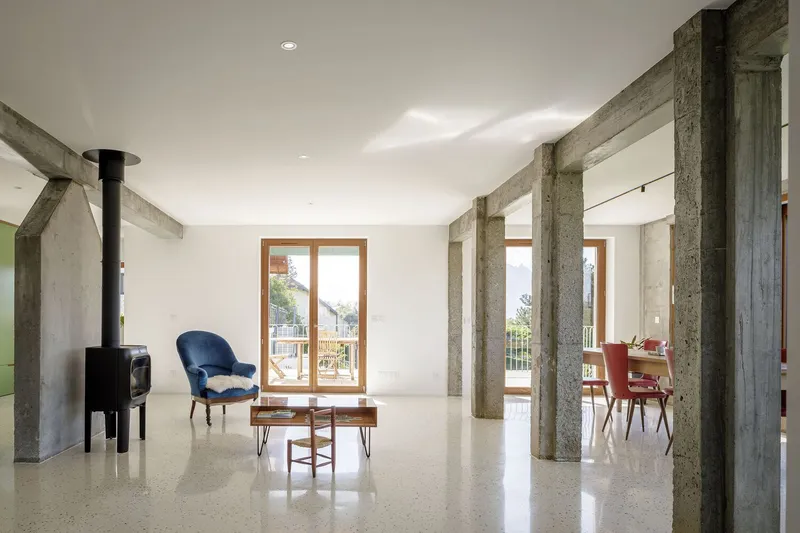
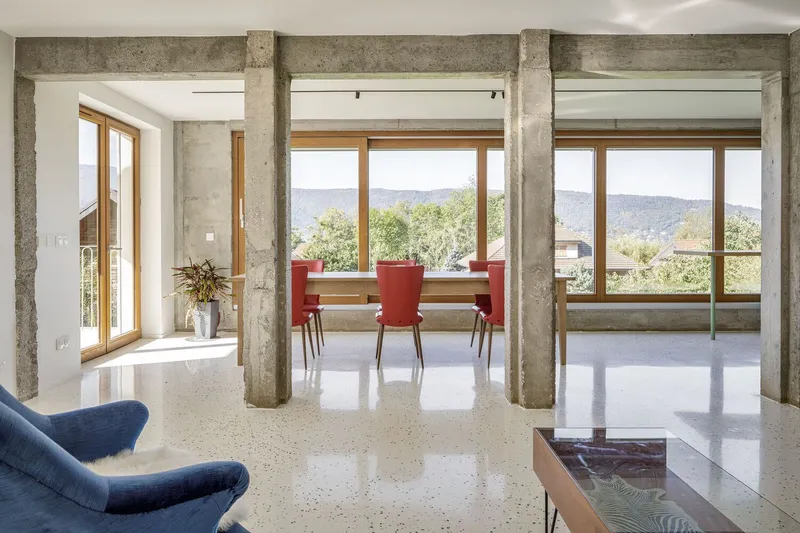
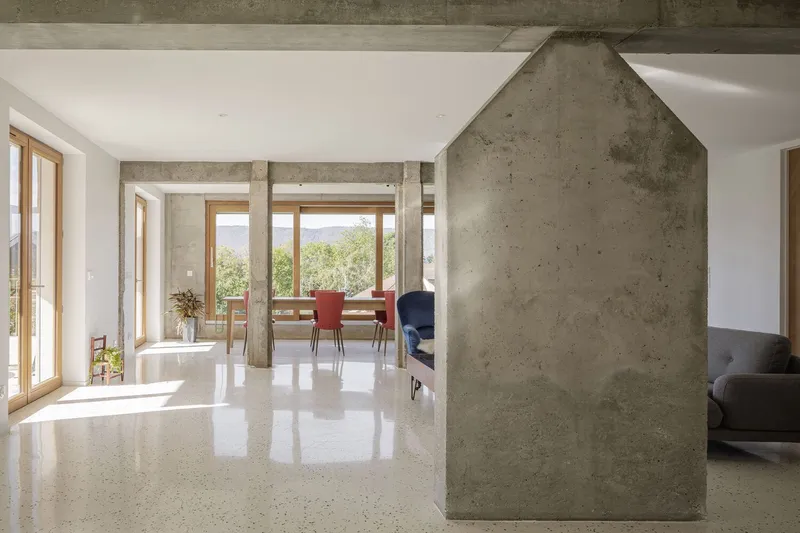
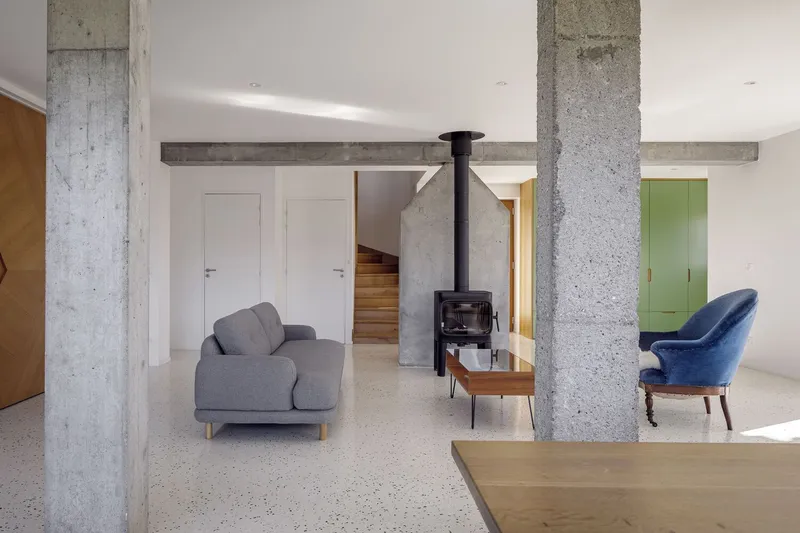
Inside, the renovation strips back the finishes to reveal the villa's concrete frame. Columns and beams that were plastered over for decades now stand raw: grey, textured, and structural. The living room is organised around these columns. They frame views, divide zones, and give the open plan a rhythm that furniture alone cannot provide.
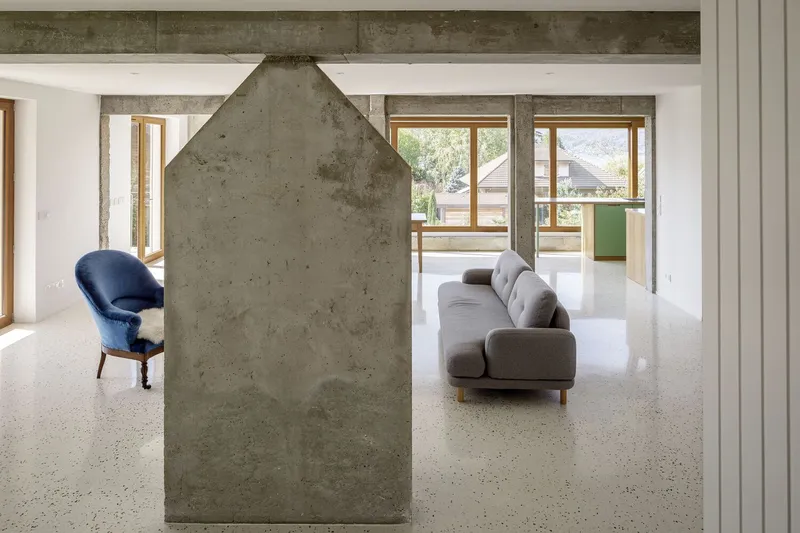
The centrepiece is a house-shaped concrete volume that contains the wood stove. It reads as a building within a building: a miniature gable form, raw concrete, standing in the middle of the terrazzo floor. It is the kind of gesture that could feel gimmicky but works here because the material is honest. It is not a decorative shape. It is a chimney that happens to look like a house.
The Kitchen: Sage Green and Mountain Light
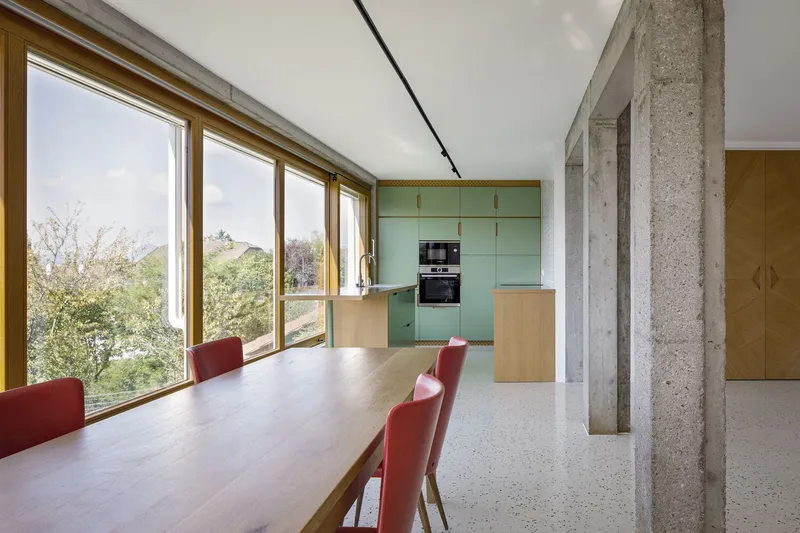
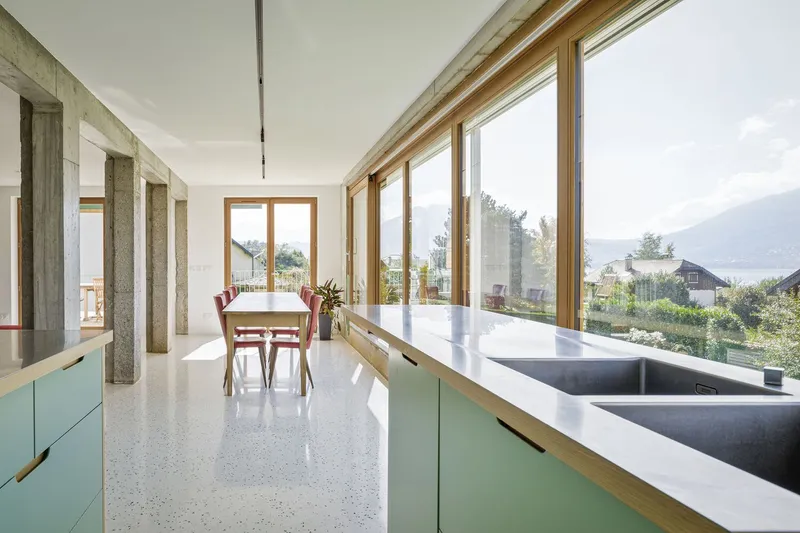
The kitchen runs along the garden side in sage green cabinetry with a terrazzo countertop. A full-width window above the counter frames the garden, the neighbouring roofs, and the mountains beyond. The colour is carefully chosen: green enough to register as a decision, muted enough to recede against the concrete columns and the view.
The long timber dining table with red chairs sits between the kitchen and the living room, framed by the concrete columns. The red is the only warm accent in a palette of grey, white, green, and oak. It pulls the room together without dominating it.
Joinery and Detail
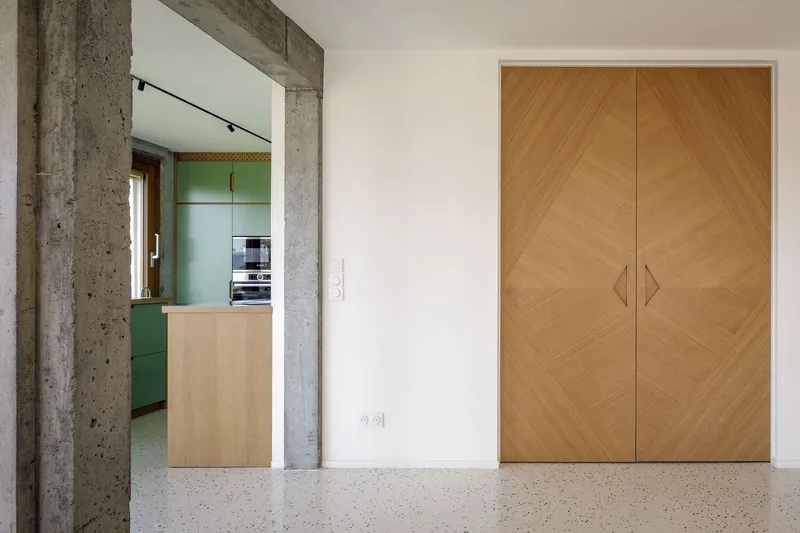
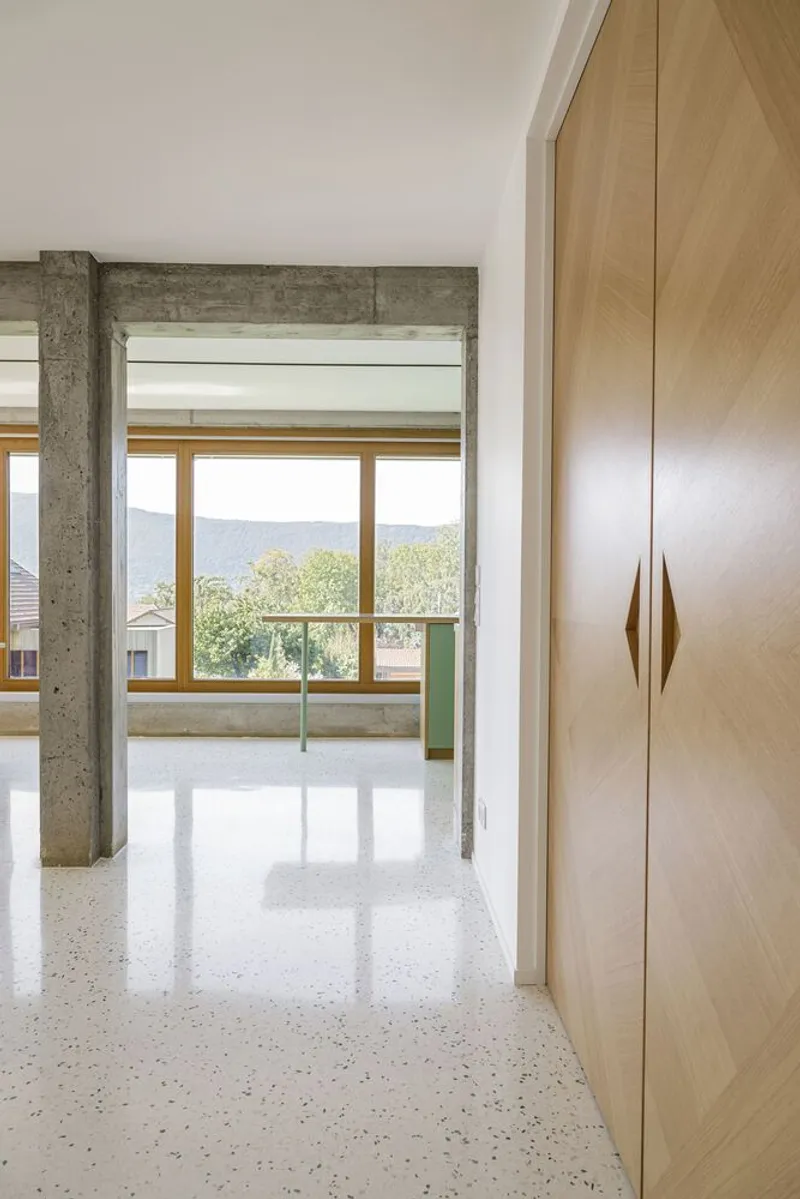
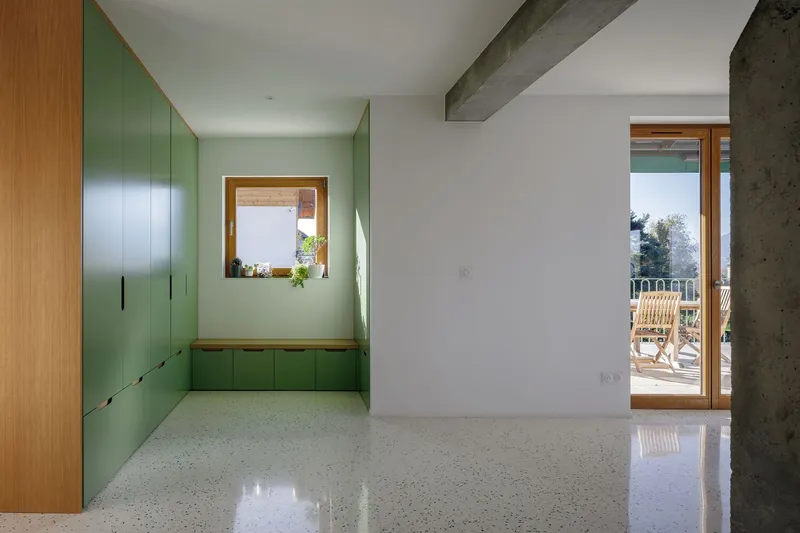
The joinery throughout is oak with chevron veneer patterns and diamond-shaped timber handles. These are custom pieces, clearly designed for this house. The children's room has sage green built-in cabinetry with a timber bench and a square interior window that borrows light from the corridor.
These details matter because they signal the difference between a renovation and a refurbishment. A refurbishment updates finishes. A renovation redesigns how the house works. The joinery here is not applied. It is integrated into the spatial logic of each room.
Chromatic Strategy: Green, Yellow, Oak

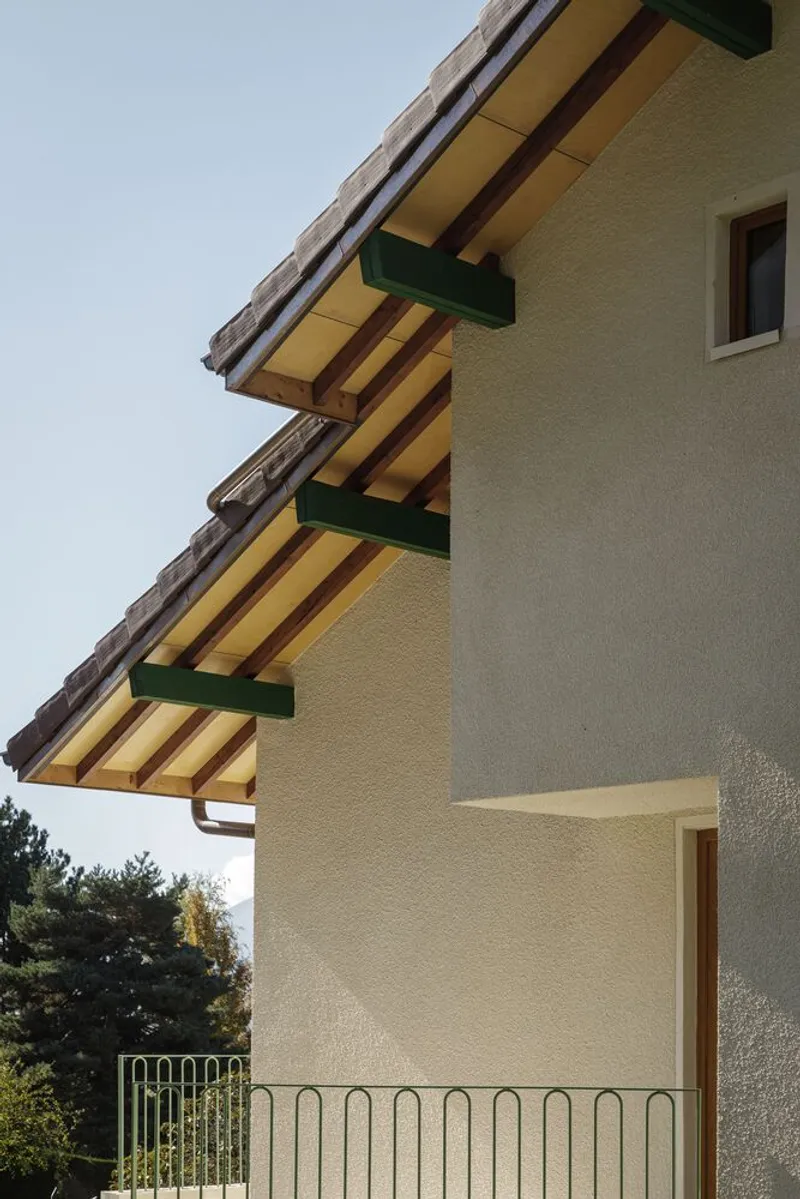
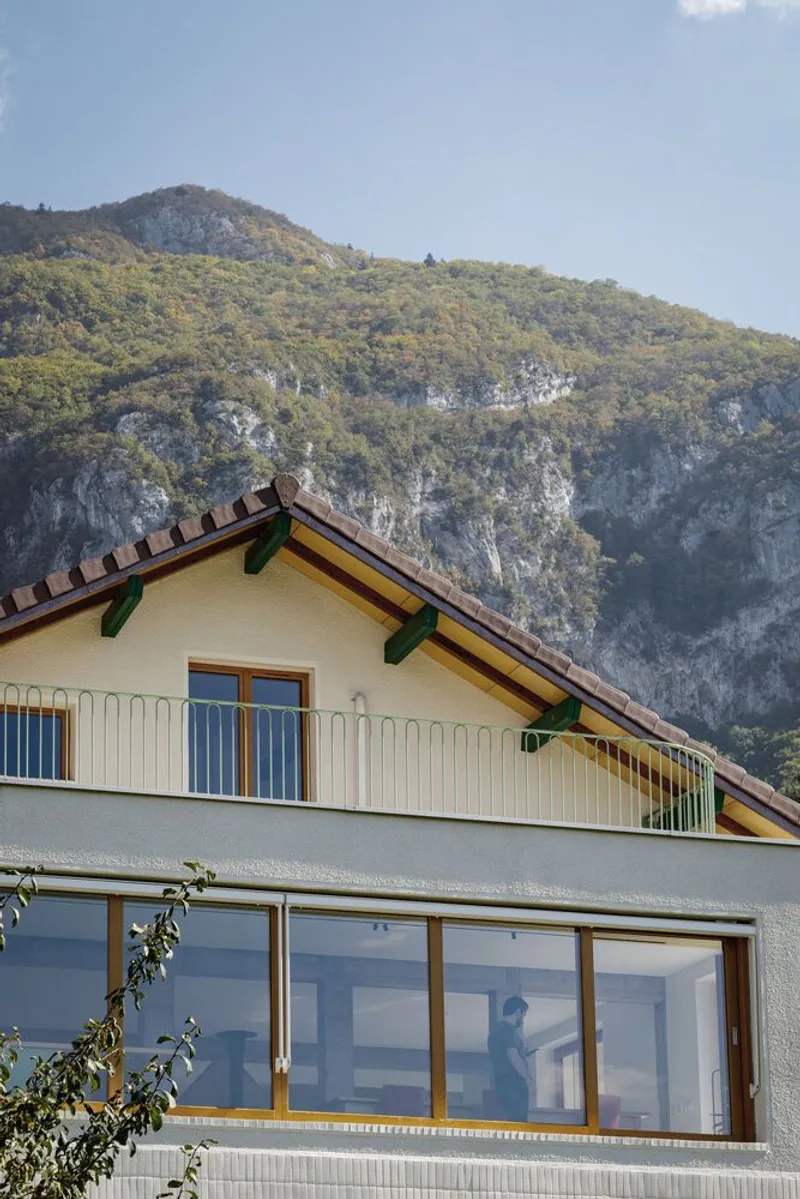
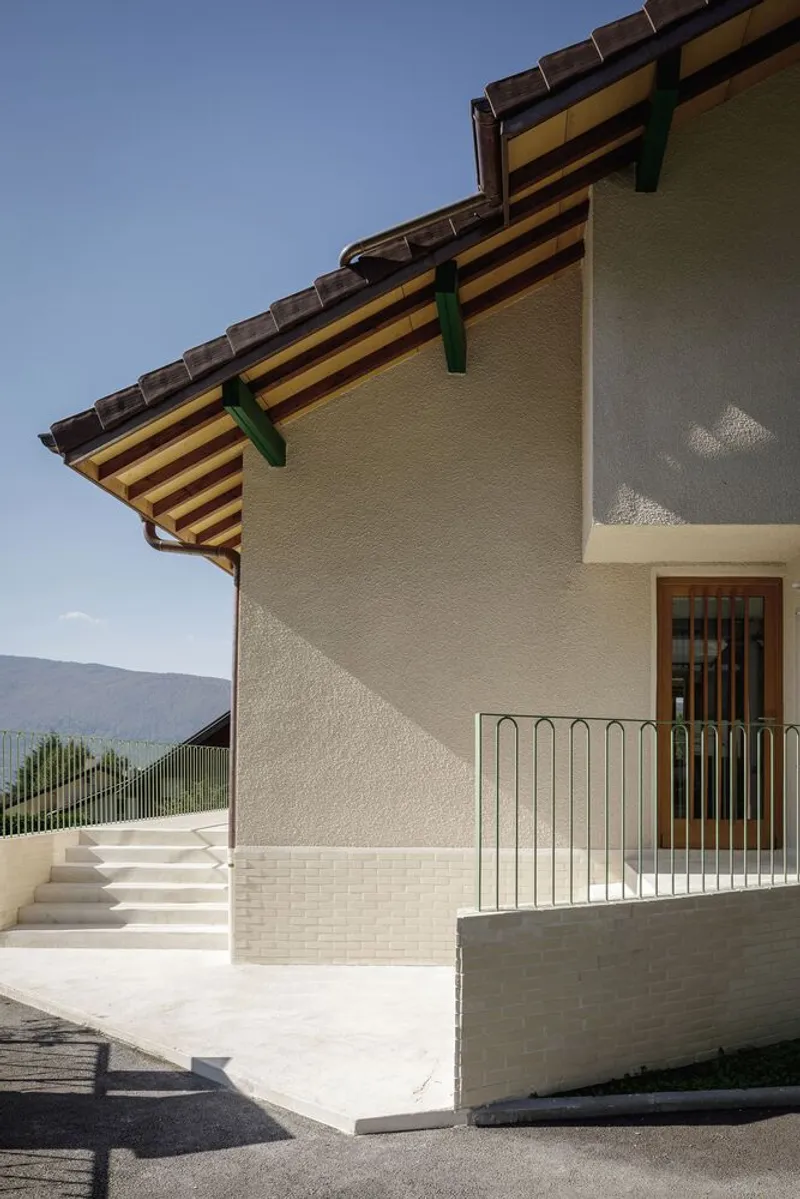
The colour palette references the villa's mid-century origins. Green appears in the kitchen, the children's room, the awning, and the gutter brackets. Yellow appears on the exposed rafter ends and inside the eaves. Oak runs through the window frames, doors, and furniture. These are not nostalgic choices. They are chromatic codes reintroduced in a contemporary register.
The exterior details reward close looking. The white brick base uses a sawtooth course at the window sills. The rafter ends are painted yellow. The gutter brackets are green. Each detail is small, but together they give the house a personality that most renovations strip away.

Drawings

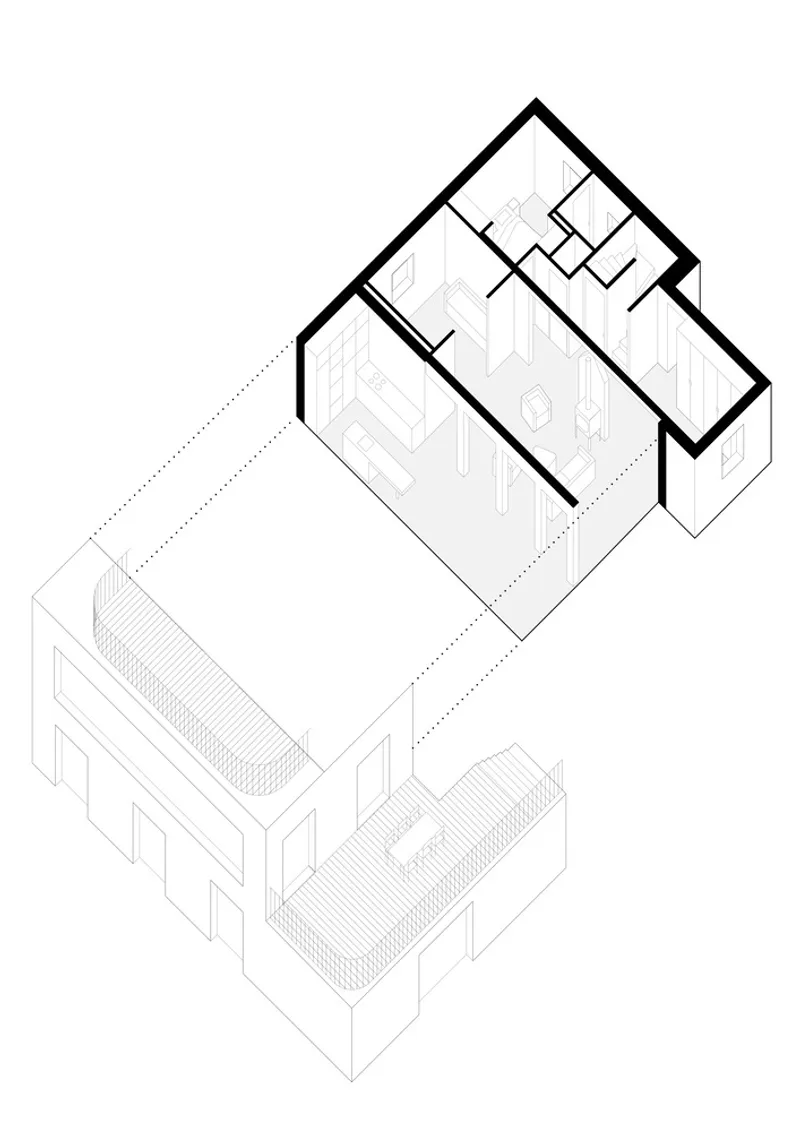
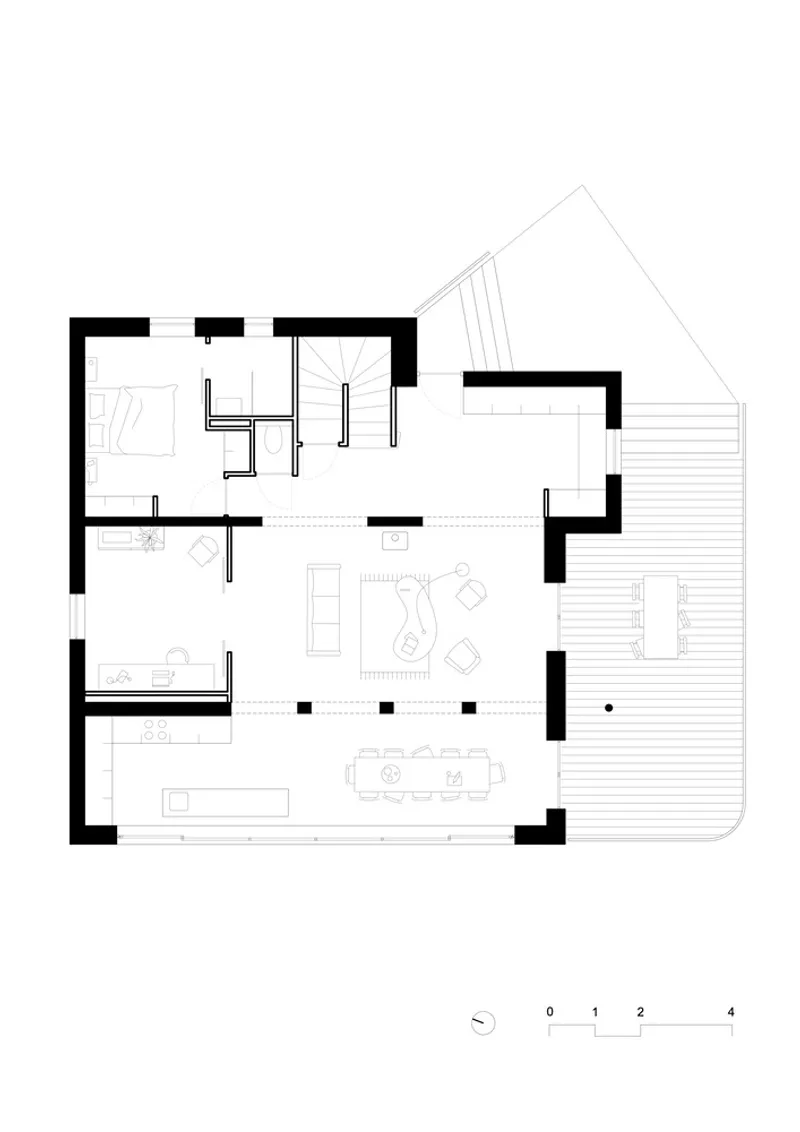
The exploded axonometric shows the new walls inserted within the existing villa envelope. The extension reads as a distinct layer added to the garden side. The floor plan shows how the open-plan ground floor organises kitchen, living, dining, bedroom, and stair around the exposed concrete columns.
Why This Project Matters
Alpine villa renovation is a growing field as mid-century housing stock ages across France, Switzerland, and Austria. Most renovations default to either full preservation or full gutting. Villa MR demonstrates a third option: expose what is structurally interesting, extend where the view demands it, and use colour and material to bridge old and new.
If you are renovating a mid-century house in a mountain setting, this project is worth studying for how it handles the dialogue between structure and finish, how it uses colour as a design tool rather than a decorative afterthought, and how a modest extension can completely reframe a house toward its landscape.
About the Studio
Share Your Own Work on uni.xyz
If you are working on villa renovation, adaptive reuse, or residential architecture in mountain settings, uni.xyz is a place to publish your work and connect with a global design community.
Project credits: Villa MR by Atelier Archiplein. Annecy, France. Photographs: Aurelien Poulat.




Popular Articles
Popular articles from the community


The Ocean Hive: Sustainable Architecture for a Self-Sufficient Civilization at Sea
The Ocean Hive imagines sustainable architecture at sea, where modular habitats, algae, wave power and ocean waste sustain a growing colony.

Hill & Cross Opera: Sculptural Opera House Architecture Shaped by Tallinn’s Landscape and Identity
Hill & Cross Opera reimagines opera house architecture in Tallinn through its sculptural hill, civic plaza, glass wave and a luminous cross.

Co-Life: Senior Housing Design That Reconnects Older Adults With the City
Co-Life reimagines senior housing design through healing gardens, shared streets, workshops, and a sustainable community across generations.

The Musturak Paradise: Senior Living Architecture for a Connected Future in Temara, Morocco
The Musturak Paradise reimagines senior living architecture in Temara via private homes, social spaces, culture, community, and shared care.


Similar Reads
You might also enjoy these articles


Hodi-Mandai Geram
Project Function: Preservation and revitalization of the Intangible heritage and socio-spatial identity of the Hodi by Housing, Cultural Memory Center, Sacred Grove, landscape, local tourism economy


Olio Towers: A Mid-Rise for Performers That Fuses Housing, Rehearsal, and Stage
Located blocks from Houston's Theater District, this modular tower stacks living units around a central performance atrium.

Oasis: Modular Green Housing Carved into Dhaka's Urban Fabric
A shortlisted Plugin Housing entry reclaims unauthorized settlements in Dhaka with stepped concrete volumes, green roofs, and ventilation-driven design.

Black Hole: A Floating Megastructure for the Post-Physical Era
Emiliano Mazzarotto envisions a spherical, self-scaling arena where e-sports, digital hotels, and holographic stadiums replace traditional public space.


Explore Architecture Competitions
Discover active competitions in this discipline



Challenge to reimagine the Iron Throne


Photograph architecture without architects


Illustrate the lost glory of Angkor Wat - Render Challenge


Design challenge to reuse E-waste
Comments (0)
Please login or sign up to add comments
No comments yet. Be the first to comment!