
Vision Consulting Resurrects a Communist-Era Canteen as a Village Art Centre in Rural Bulgaria
In Dolno Kamartsi, a 1980s school canteen abandoned for years becomes a 700-square-metre gallery, atelier, and art depot built with reclaimed timber.


The early 1980s left Bulgaria with thousands of utilitarian buildings thrown up by unskilled hands under Communist-era construction norms. Most of them are crumbling. The old school canteen in Dolno Kamartsi, a tiny village with no obvious claim to the contemporary art circuit, was one such ruin: at least 30 percent of its load-bearing structure was missing, its walls were failing, and its purpose had long evaporated. Vision Consulting, led by architect Eva Popnedeleva, saw a skeleton worth keeping and turned it into Art Centre Vihrony, a 700-square-metre cultural facility housing art-class ateliers, a double-height gallery, a multimedia room, and a top-floor Art Depot for the client's lifetime collection.
What makes the project worth studying is not its before-and-after transformation shots, satisfying as those are, but the hierarchy of decisions behind them. Popnedeleva's team stripped every partition wall from the ground floor canteen to create a single open gallery. They partially demolished the slab between ground and first floor to carve out double-height volume where art could be hung at scale. Then they added an entirely new gabled top floor using single-span glulam frames and epoxy timber connections, giving the Art Depot a column-free plan. At least 70 percent of the materials were reused, many in the form of public art. The entrance facade is clad in reclaimed timber, hand-etched by a local artist. Craftsmanship here is not an accent; it is the strategy.
A Facade of Two Temperaments

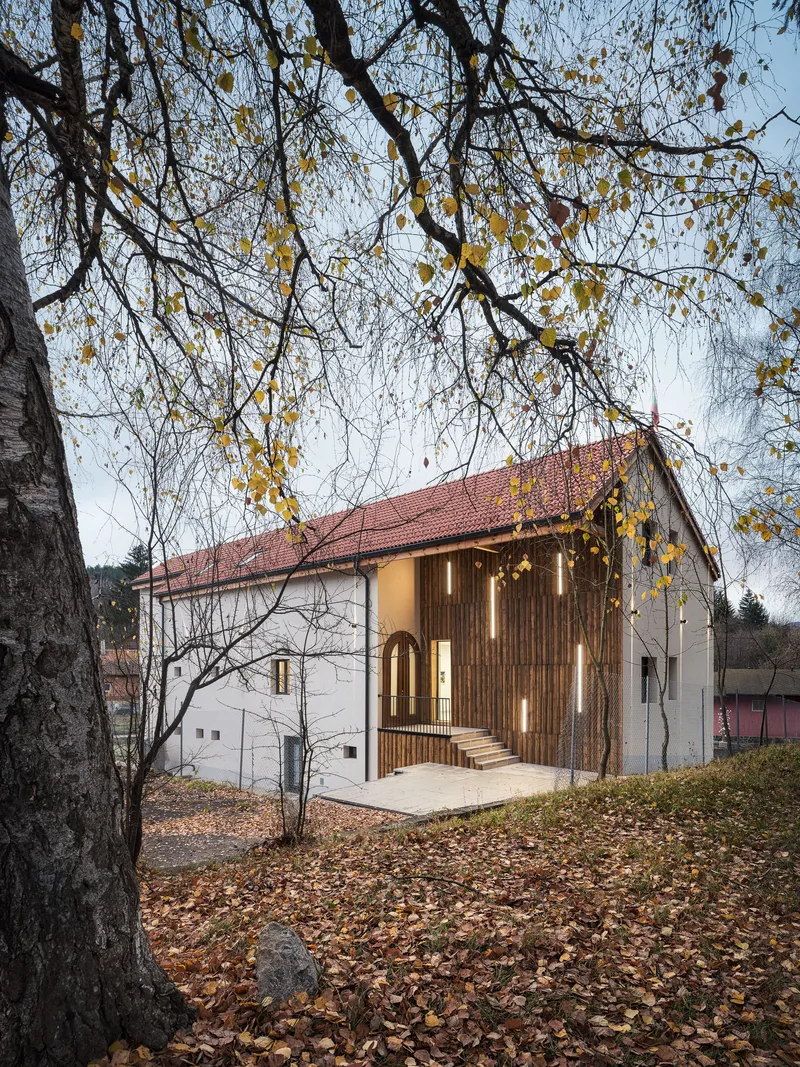

The building reads as two distinct faces. On one side, the original white stucco walls survive with their punched windows, now framing artworks visible from outside. On the other, the new timber-clad entrance volume pushes forward beneath the terracotta roof, its vertical slats backlit at night to signal arrival. The contrast is deliberate: the existing rendered mass carries the history, while the timber extension announces the new program without trying to erase the old one.
The reclaimed timber cladding deserves a closer look. Each plank was manually formed and etched by a local artist working alongside the architects, a collaboration that embedded the art program into the construction process itself. Illuminated strip lighting between the slats turns the facade into a lantern at dusk, giving the village a signal that something has changed.
The Double-Height Gallery Cut


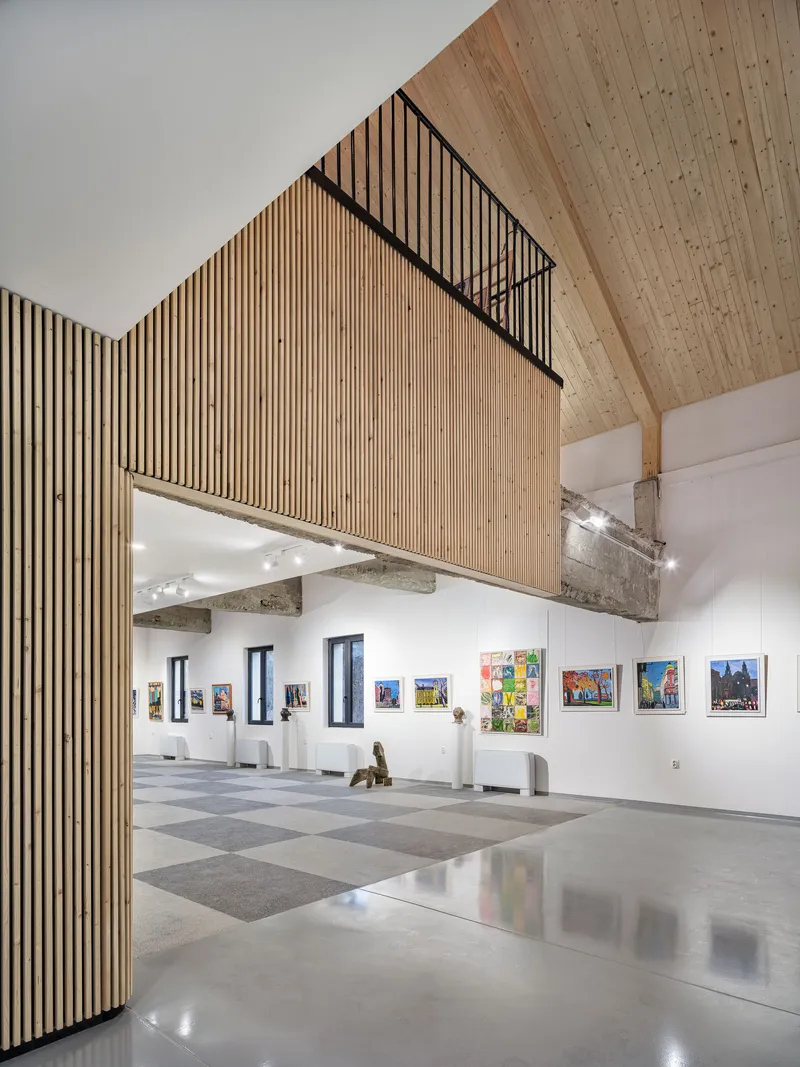
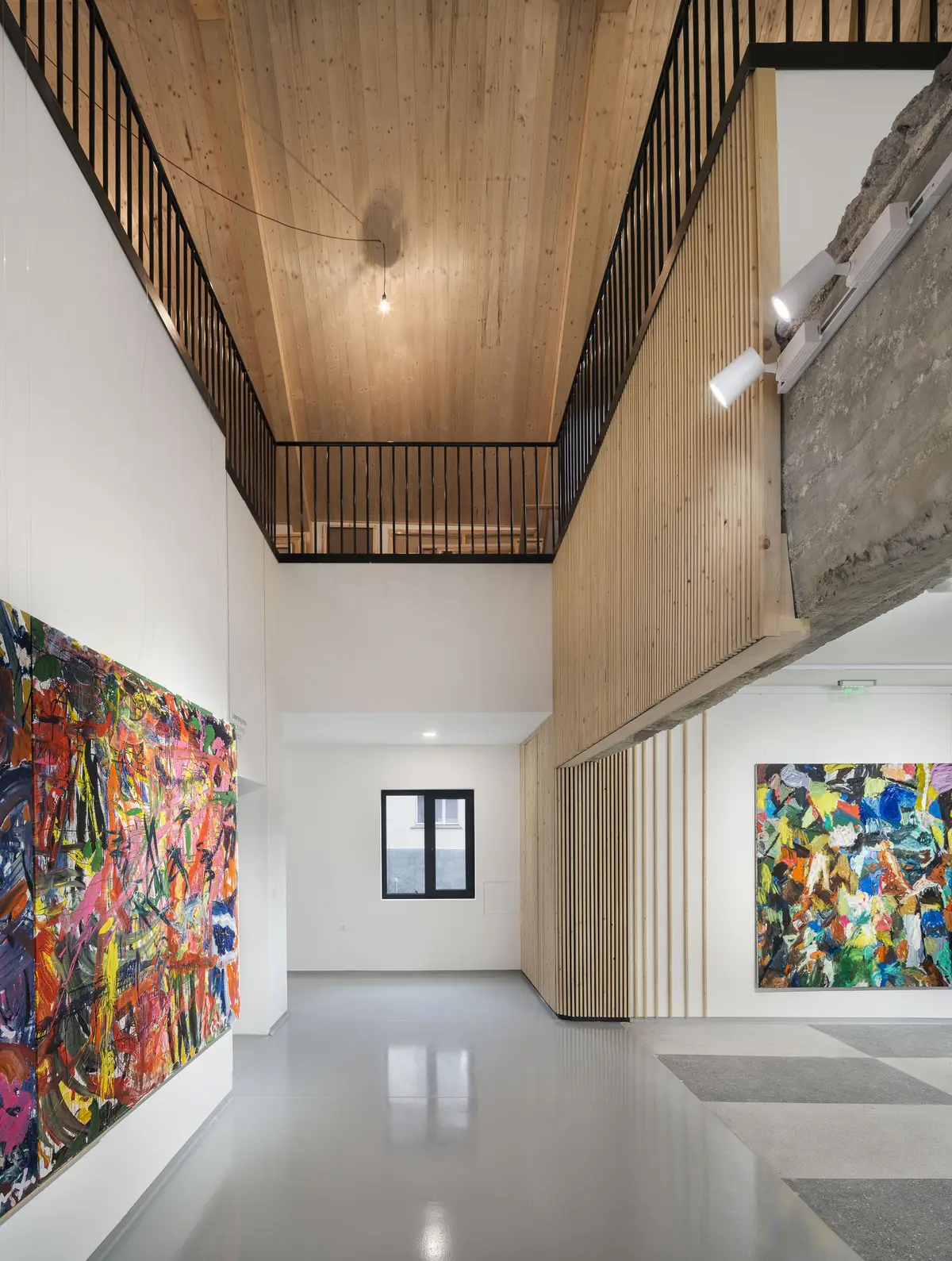
The most aggressive structural move in the project is the partial demolition of the first-floor slab. By removing a section of floor, the architects opened a double-height volume that connects the ground-floor gallery to the mezzanine above. Exposed concrete beams, remnants of the original frame, are left visible as an honest record of what was there. The timber-slatted mezzanine projects into this void, acting simultaneously as a viewing balcony and a spatial divider that separates the public gallery from the more intimate art depot above.
The decision to keep the concrete beams exposed rather than wrapping them in plasterboard is telling. Popnedeleva's approach treats the Communist-era bones not as something to be concealed but as raw material with its own character. Against white walls and polished tile floors, these beams register as tectonic artifacts, lending a roughness that prevents the gallery from feeling clinical.
Ground Floor: Ateliers and Gallery

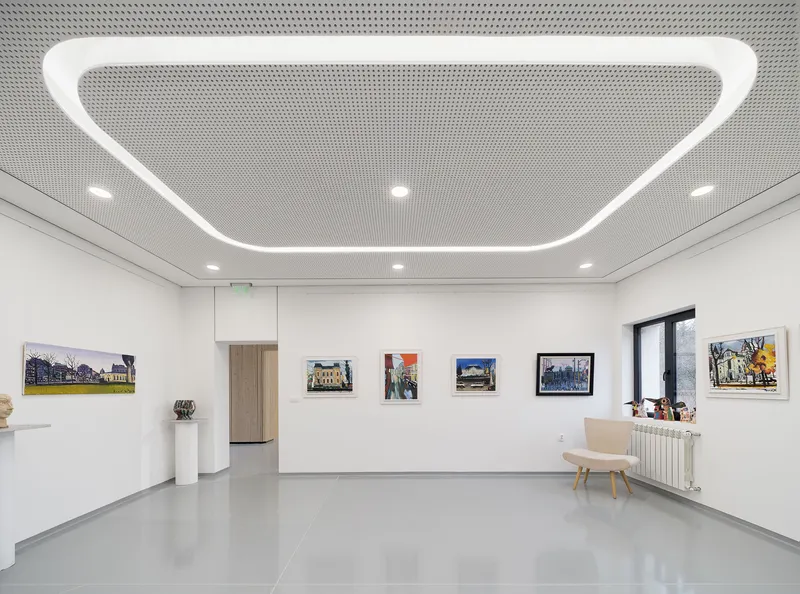

Once every partition wall of the old canteen was demolished, the ground floor opened into a generous gallery hall with checkerboard flooring and a perforated metal ceiling that conceals services while maintaining visual lightness. Six art-class ateliers line a central corridor, giving the building an educational backbone that keeps it active beyond exhibition cycles. The plan is rational, almost monastic: white walls, tall windows framing bare trees, and curved linear ceiling lights that wash surfaces evenly for art display.
The stripped-back material palette, white plaster, polished tile, timber accents, reflects the team's stated philosophy of three-dimensional thinking over expensive finishes. Nothing here relies on imported luxury. The quality comes from proportion, light, and the discipline to leave surfaces alone.
The Timber Gable: Art Depot Above
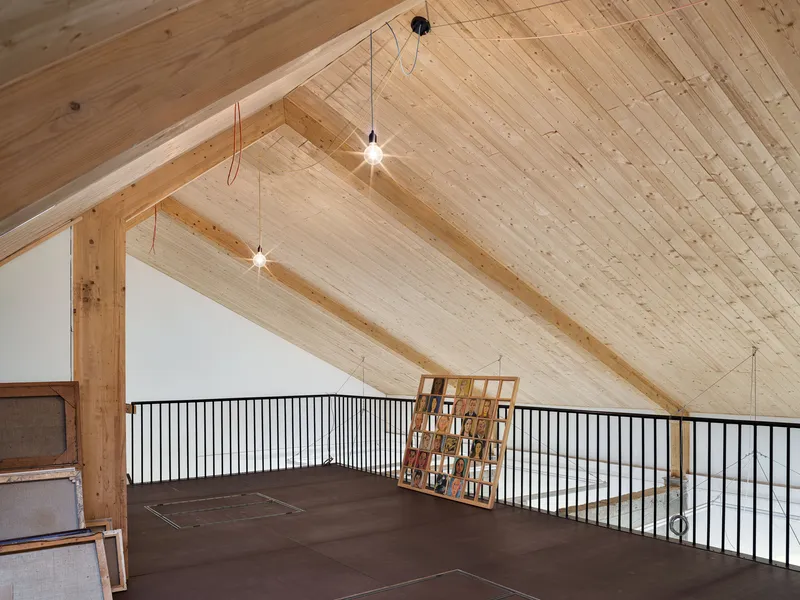
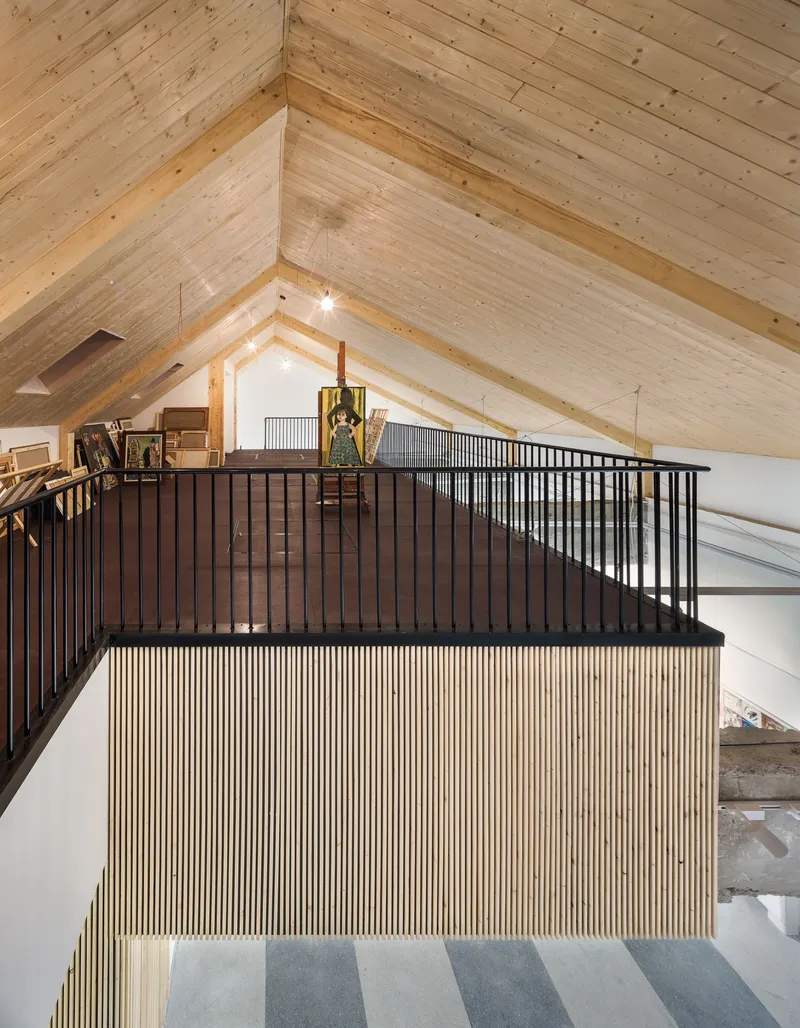

The new top floor is the project's structural showpiece. Single-span glulam frames with epoxy column-rafter connections create a column-free gabled space for the Art Depot, where the client's lifetime art collection is stored and curated. Pendant lights hang from exposed rafters, and a metal railing traces the edge of the void below, connecting the depot visually to the gallery. The timber ceiling reads as both contemporary and vernacular, a pitched form that recalls the village's domestic architecture while performing at a completely different structural scale.
Timber-slat balustrades filter light between levels and maintain visual continuity from ground to roof. The attic workspace feels warm and protected, a retreat from the more public gallery zones below. It is a considered gradient: civic on the ground, curatorial in the middle, archival at the top.
Thresholds and Corridors


Transitional spaces receive just as much attention as the primary rooms. A timber-lined arched doorway frames views to the exterior courtyard, turning a simple opening into a deliberate moment. A corridor with vertical timber slats compresses before releasing into the gallery, a classic sequence of compression and expansion that heightens the experience of arrival. Even the entrance volume, with its recessed strip lighting glowing against the dark timber, acts as a threshold between village and art world.
These details signal that the design team was thinking about how people move, not just where they stand. In a project of this scale, where budget constraints are real and the temptation is to focus resources on the main rooms, investing in transition spaces speaks to a mature understanding of spatial sequence.
After Dark

At dusk, the building takes on a second life. The white stucco facade glows faintly under vertical strip lights, while the timber entrance volume radiates through its slatted openings. For a village that likely has very little public lighting, the art centre becomes a beacon. It is a small but meaningful gesture: the building communicates its presence to the community not through signage or spectacle, but simply by being lit and open.
Plans and Drawings


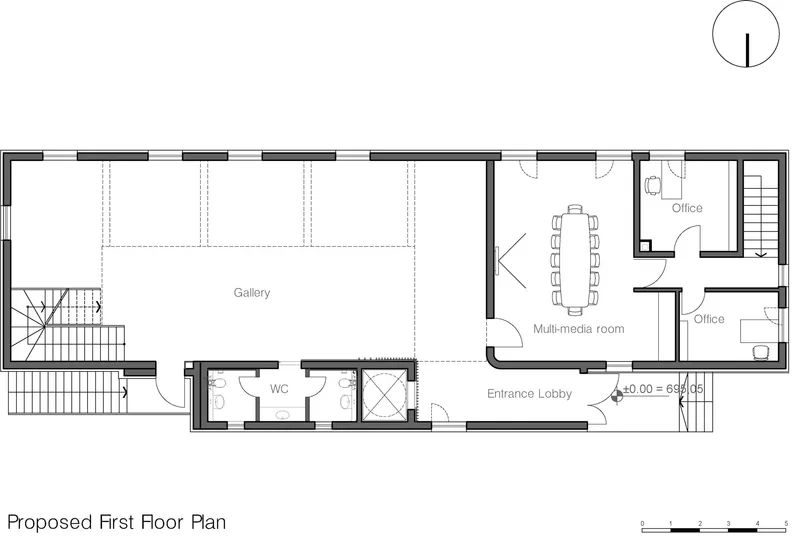

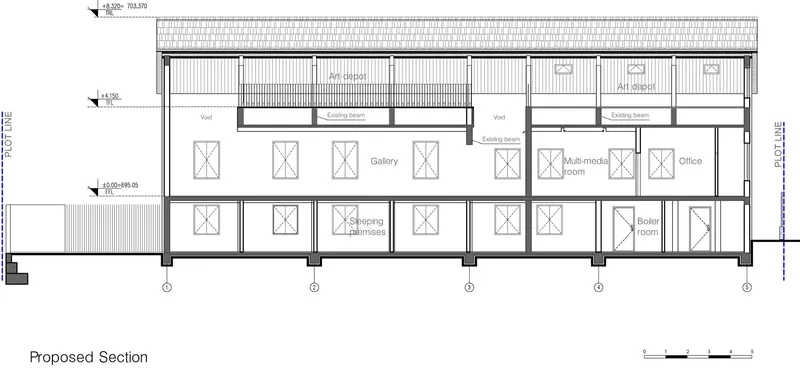
The before-and-after plan comparison tells the full story. The existing drawings show a conventional two-storey canteen chopped into storage rooms, a kitchen, offices, and a boiler room, the typical cellular plan of a state-owned facility. The proposed plans explode that logic: the ground floor becomes a linear sequence of six ateliers, the first floor opens into a single gallery volume with a multimedia room and entrance lobby, and an entirely new top floor hosts the Art Depot with void openings punched through to the gallery below. The section drawing makes the ambition of the partial slab demolition especially clear, revealing the double-height space as the hinge that holds old and new together.
Why This Project Matters
Art Centre Vihrony is a case study in what happens when an architect takes a Communist-era building seriously as raw material rather than treating it as a site to be cleared. Eva Popnedeleva and Vision Consulting did not impose a fashionable shell over a ruin. They read the existing structure, identified what could stay and what had to go, and then made a series of precise subtractions and additions: walls removed, slabs cut, a new timber volume planted on top. The result is a building that carries its history visibly while performing as a fully contemporary cultural institution.
The broader lesson is about resource intelligence. With 70 percent of materials reused, reclaimed timber shaped by a local artist, and a design philosophy that prizes spatial thinking over expensive finishes, the project demonstrates that meaningful adaptive reuse does not require a metropolitan budget or a fashionable site. It requires clarity of intent and a willingness to collaborate, with artists, with local craft, and with the stubborn reality of what is already there. For a 700-square-metre building in a small Bulgarian village, that is a significant contribution to the discipline.
Art Centre Vihrony, designed by Vision Consulting (lead architect Eva Popnedeleva), Dolno Kamartsi, Bulgaria. 700 m², completed 2022. Photography by Assen Emilov.
About the Studio
Share Your Own Work on uni.xyz
If projects like this are the kind of work you want to make, uni.xyz is a place to publish your own, find collaborators, and enter design competitions.


Popular Articles
Popular articles from the community


Manzana Morphosis: Stretching Barcelona's Grid into a Living Landscape for 2050
A radical reworking of the Eixample manzana turns density into a tool for generous public space, vertical ecology, and environmental performance.
Tsunami Convergenics: Turning Catastrophic Ocean Forces into Underwater Housing Infrastructure
A speculative underwater settlement off the coast of Onagawa, Japan, treats tsunamis and typhoons as energy sources rather than threats.
Cloaked Colonization: A Mobile Underwater Habitat That Moves Like a Fish
Micah Abaya's shortlisted EHC Pacific entry reimagines ocean settlement as a dispersed network of self-sustaining architectural organisms.

Opera on the Sea: Driftwood Logic Shapes a Timber Opera House on Estonia's Coast
Trevor Orgill's opera house translates the entangled drift of floating timber into a civic building where wood, water, and music converge.

Similar Reads
You might also enjoy these articles

Bao Huynh Watercolor Atelier: A Serene Art Retreat in Hội An
Bao Huynh Watercolor Atelier in Hội An blends multifunctional art spaces, sustainable design, local materials, and family-friendly living in a serene environment.

Atelier Macri Concept Store Interior Design by CASE-REAL
Atelier Macri store features a "ko" counter, walnut wood details, cork displays, blending retail, gallery, and seamless customer experiences.

Manuel Vargas Izquierdo Stadium and High-Performance Sports Center: Architectural Excellence in Jalpa de Méndez
The Manuel Vargas Izquierdo Stadium blends sustainable design, inclusive sports facilities, and cultural-inspired architecture, revitalizing Jalpa de Méndez’s public spaces.

KAKR Buluh Awar Hall: Revitalizing Community and Ecology Through Bamboo Architecture
Community built bamboo hall revitalizes Buluh Awar village, empowering youth, restoring ecology, celebrating vernacular craftsmanship through sustainable architecture and culture.

Explore Art Installation Competitions
Discover active competitions in this discipline

Challenge to reimagine the Iron Throne

Photograph architecture without architects

Illustrate the lost glory of Angkor Wat - Render Challenge

Bring back Drive In's
Comments (0)
Please login or sign up to add comments
No comments yet. Be the first to comment!