
J. Mayer H. Stacks Giant Glass Cubes into a Sculptural Office Block at Berlin's Alexanderplatz
VoltAir occupies an entire block behind one of Berlin's busiest squares, wrapping 29,500 square meters of flexible workspace in Germany's largest bonded gl


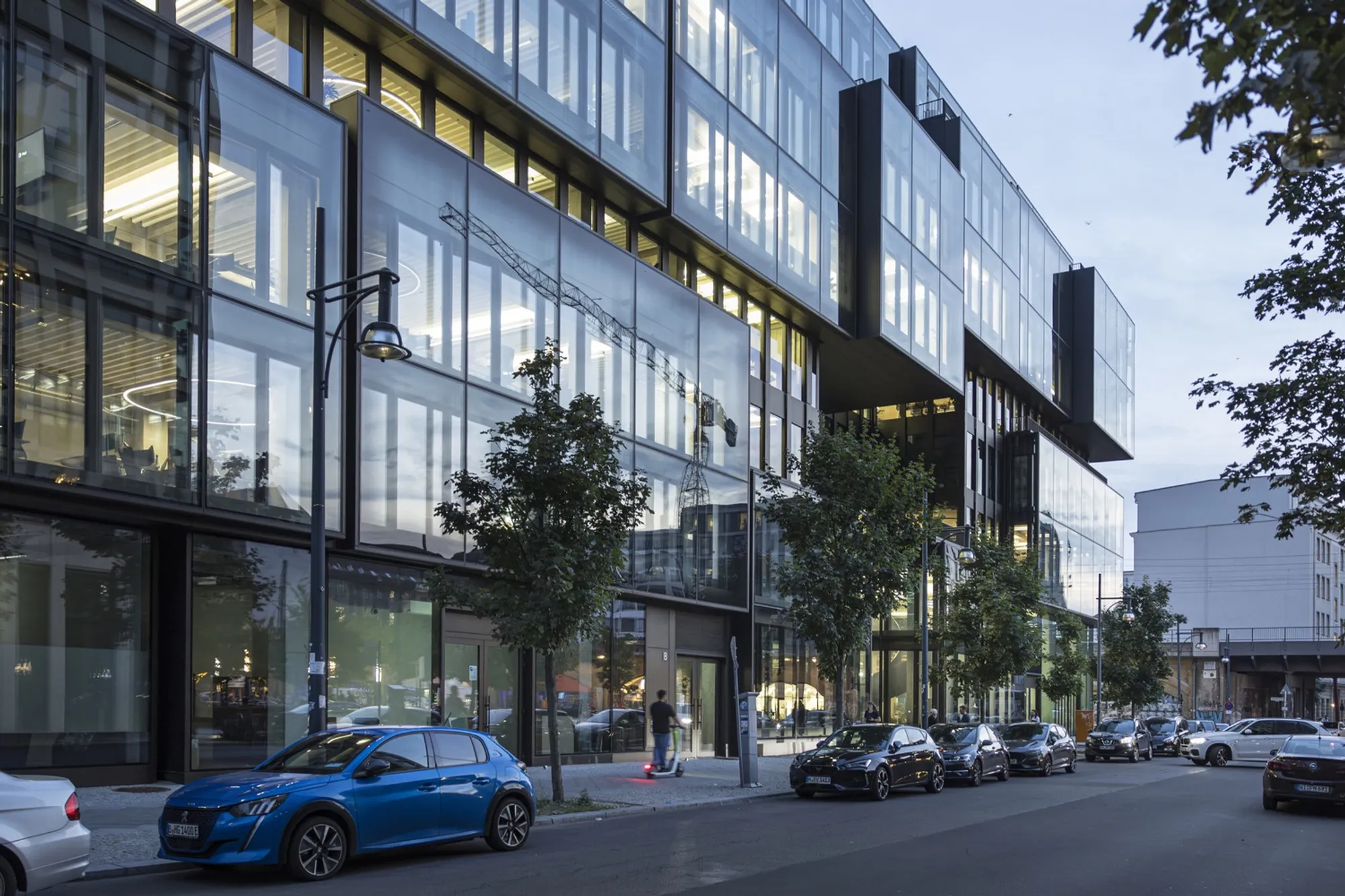
Office buildings in Berlin tend to fall into two camps: the hyper-rational slab and the gestural statement piece that prioritizes sculpture over program. VoltAir, the 29,500 square meter workplace complex by J. Mayer H. Architects, tries to be both at once, and mostly succeeds. Occupying a full block adjacent to the elevated S-Bahn viaduct near Alexanderplatz, it reads from the street as a stack of oversized glass cubes, each two stories tall, shifted and rotated just enough to create terraces, loggias, and a kinetic silhouette against the Berlin skyline.
What makes VoltAir genuinely interesting is not the sculptural move itself but the engineering required to pull it off. The double facade relies on structurally bonded, impact-resistant glass panes, the largest ever produced in Germany, each approved on a case-by-case basis after pendulum swing testing. That level of technical ambition in service of a commercial office project is rare. The building took nearly a decade from competition win in 2014 to completion in May 2023, surviving a change of ownership and a complete program shift from mixed-use hospitality to pure office. The architecture absorbed the shock and emerged with its formal logic intact.
Glass Cubes and the City
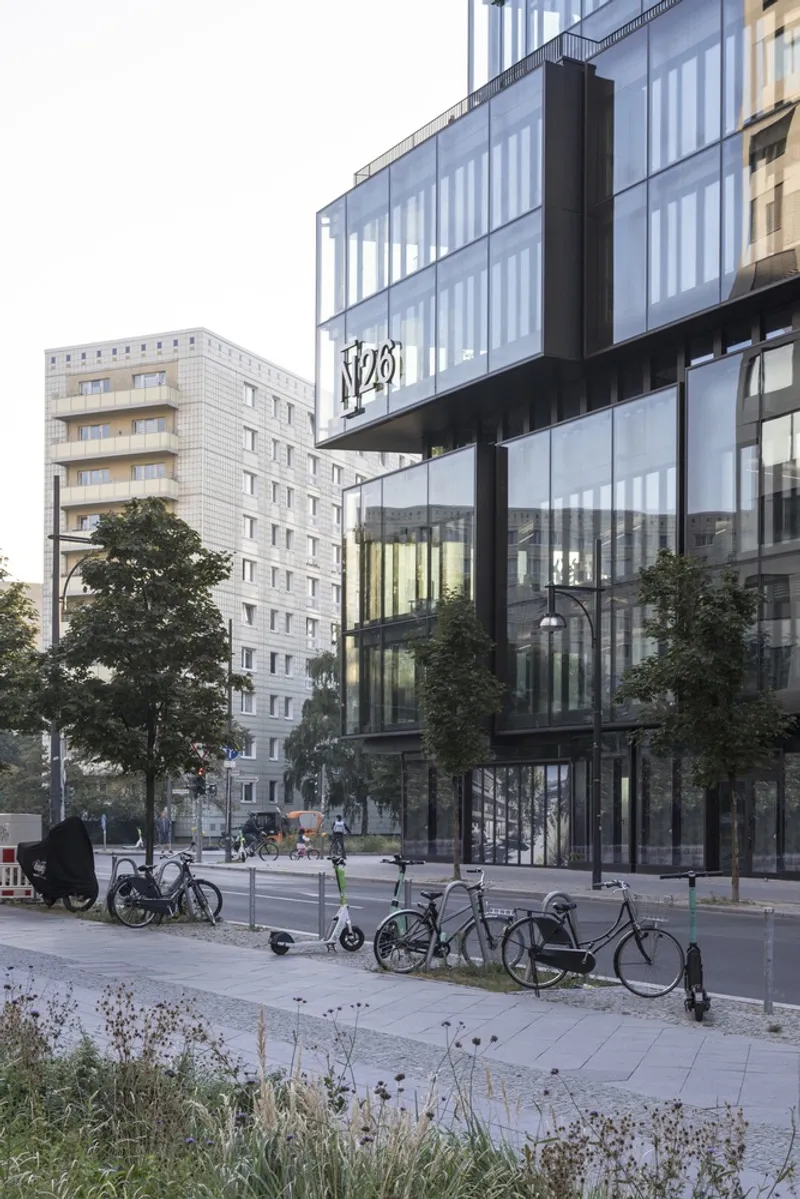
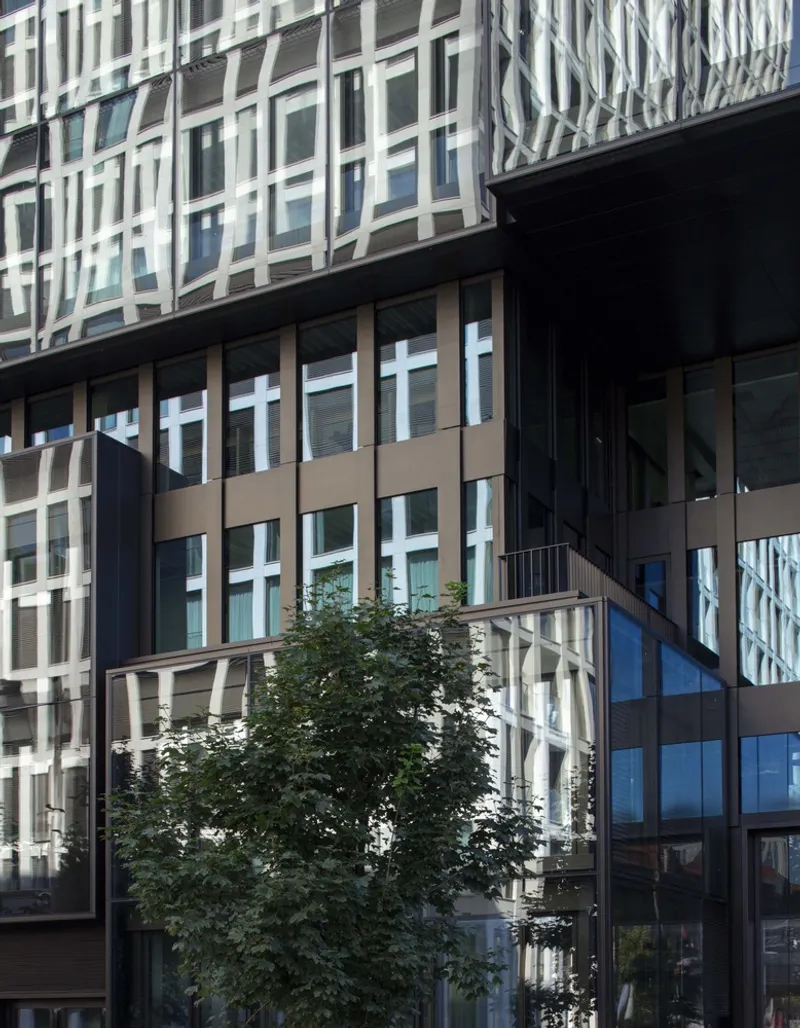
From street level, the stacked cube logic is immediately legible. Cantilevered upper volumes push outward over the sidewalk, their glass skins catching daylight at different angles depending on the viewer's position. The building does not sit flat against the block edge; it steps back at the height of the adjacent S-Bahn viaduct, creating a horizontal datum that ties the new volume to the existing rail infrastructure. That setback is more than a contextual gesture. It opens up roof terraces totaling roughly 300 square meters and introduces green planting into the facade section.
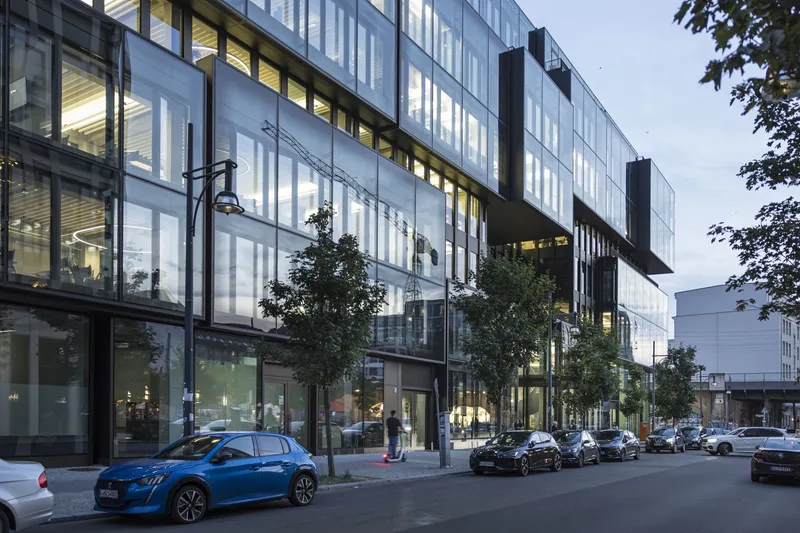
At dusk, the ventilated double facade transforms. Interior lighting renders the glass volumes translucent, and the building shifts from opaque mass to luminous lantern. The interstitial space between facade layers houses wind-protected sunshades, keeping the outer skin clean and uncluttered while giving occupants precise control over solar gain. Street trees along the sidewalk soften the base, and an inner courtyard of about 500 square meters anchored by mature planting provides a second ground-level landscape.
Loft Character, Industrial Bones
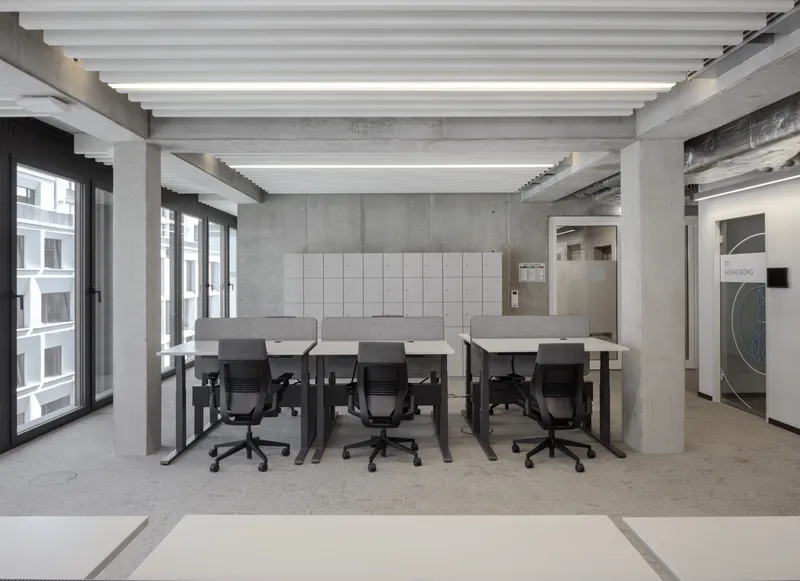
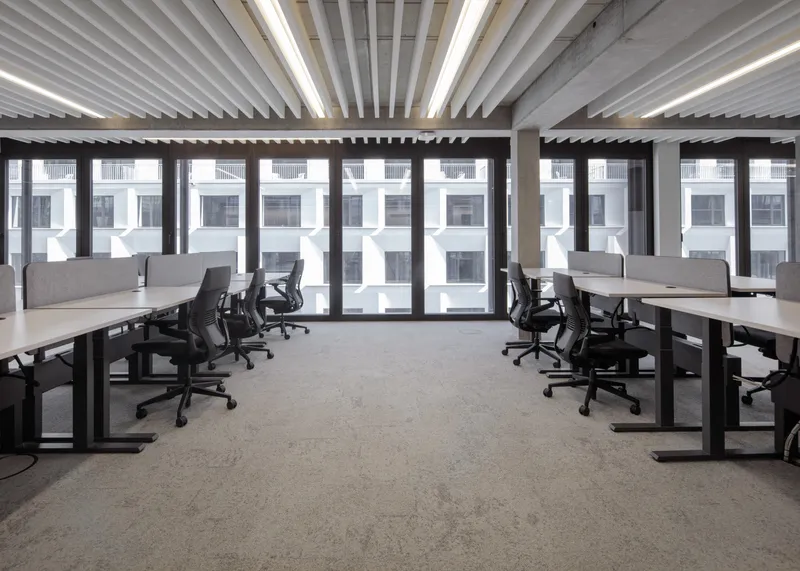
Inside, VoltAir leans into an aesthetic of deliberate rawness. Exposed concrete ceiling beams, visible technical runs, and three-meter room heights give the workspace a loft-like quality that feels genuinely earned rather than cosmetically applied. Building depths reach up to 24 meters, which is generous enough to allow deep open-plan layouts without relegating anyone to a windowless core. Linear ceiling baffles and integrated LED strips manage acoustics and lighting without dropping a conventional suspended ceiling, preserving the volume.
The floor plans are designed for maximum reconfigurability. Horizontal divisions let a single floor serve multiple tenants, while vertical connections allow a single company to link floors into a campus-like cluster. It is a simple organizational idea, but it matters when the tenant roster includes technology firms and biotech companies with fundamentally different spatial needs.
Social Spaces and the Roof
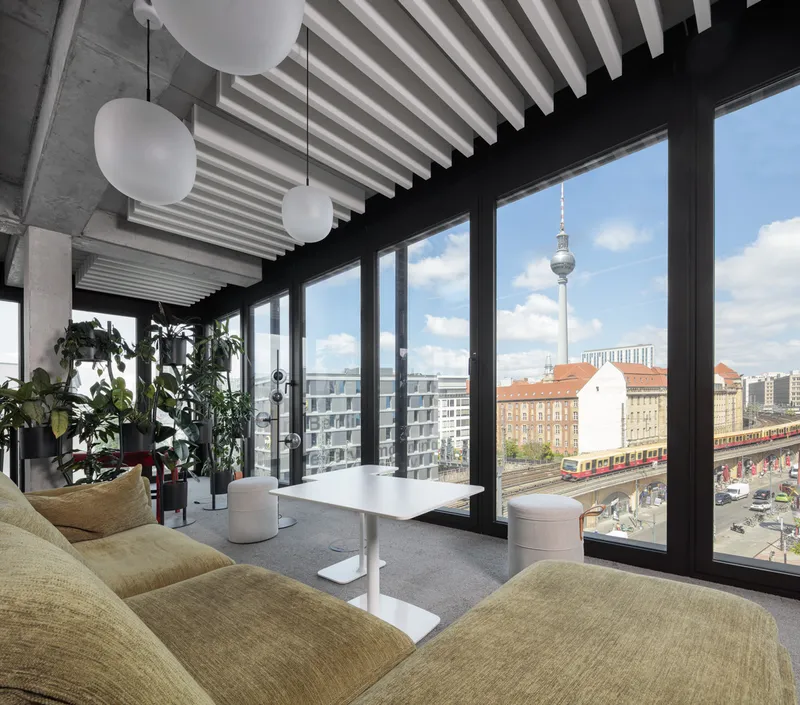
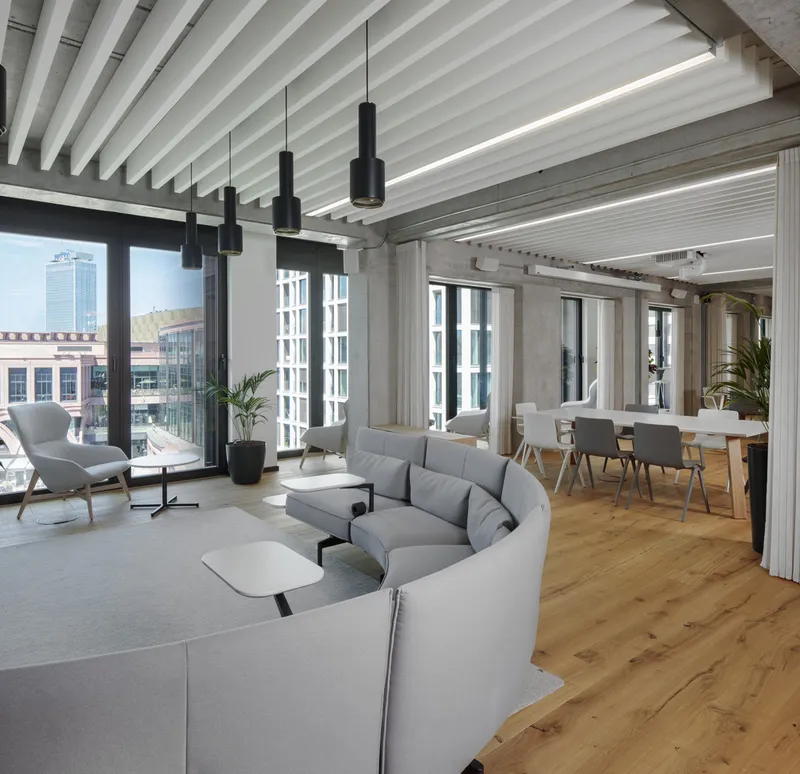
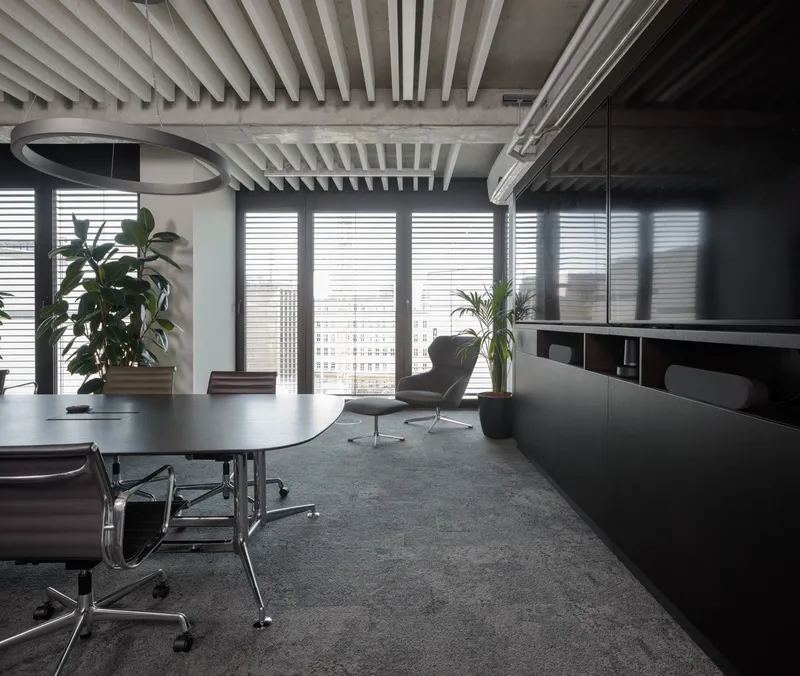
The communal interiors reveal a more curated side of the building. A lounge with floor-to-ceiling glazing frames views of the Berlin skyline, while a separate gathering space deploys curved seating beneath a white slatted ceiling and oversized pendant lights. These are not afterthought amenity zones; they occupy prime positions within the plan, signaling that collaborative and informal work is given the same spatial priority as focused desk work.
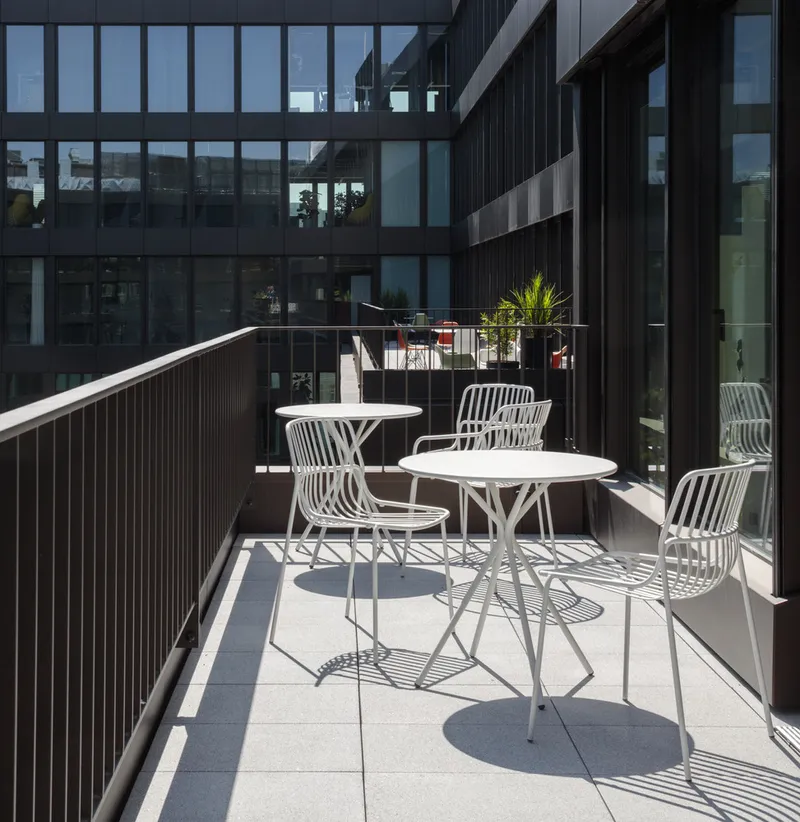
On the roof terraces, white metal furniture sits in direct sunlight, overlooking the dark-clad courtyard facades below. These outdoor rooms, three of them at roughly 100 square meters each, are elevated enough above the noise of Alexanderplatz to feel genuinely usable. The green roof surfaces beneath them are part of a broader rainwater management strategy aligned with Berlin's evolving sponge-city ambitions: capturing, filtering, and evaporating precipitation on site rather than dumping it into the municipal system.
Material Detail and Circulation
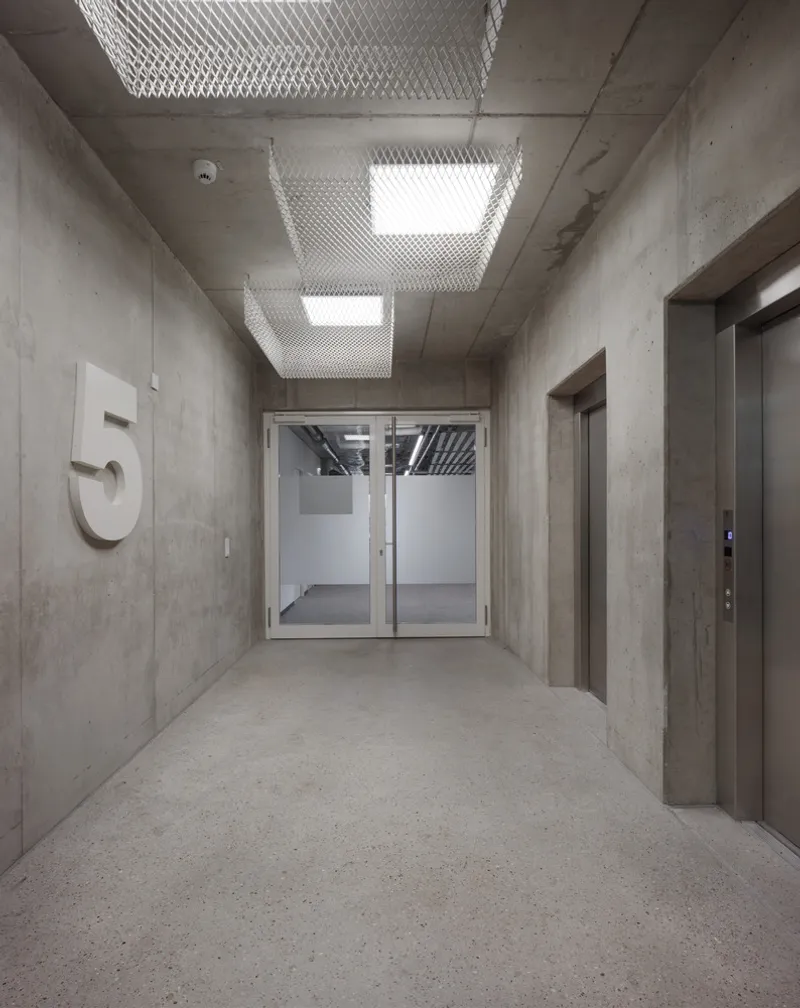
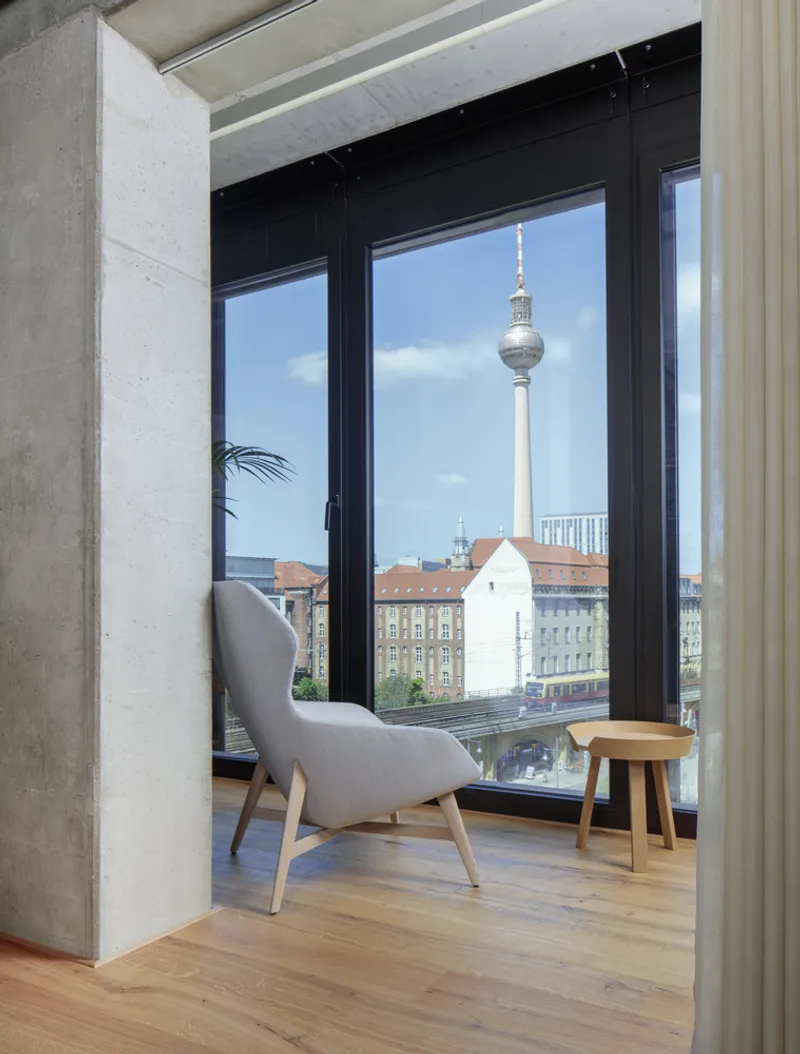
The elevator lobby distills the building's material palette to its essentials: board-formed concrete walls, glass corridor doors, and mesh-wrapped ceiling light fixtures that look like industrial artifacts. It is restrained to the point of severity, and that restraint pays off by making the moments of openness, a framed view of the Fernsehturm through a black-framed window, a row of potted plants catching low light, feel all the more generous.
Seating alcoves carved into the concrete structure offer quiet breakout spots with views across Berlin's rooftops. The framing is precise: thick concrete reveals channel the eye toward specific landmarks, turning a simple window seat into a deliberate compositional moment. It is the kind of small architectural move that distinguishes a thoughtful building from a merely competent one.
Climate Systems Behind the Glass
The sustainability credentials are substantial and go well beyond the LEED Gold pre-certification that headlines the marketing. Thermally activated ceilings handle both heating and cooling, connected to Berlin's district heating network. Heat-recovery ventilation reclaims energy from exhaust air. LED lighting throughout the office floors minimizes internal heat loads, which in a deep-plan building with extensive glazing is critical to avoiding summertime overheating. The double facade itself acts as a thermal buffer zone, moderating temperature swings and reducing peak cooling demand.
None of these strategies is individually novel. What sets VoltAir apart is their integration into a building that does not look or feel like a sustainability demonstration project. The green roofs, the ventilated facade, the thermally activated structure: they all operate in the background, supporting a workspace that prioritizes daylight, air quality, and spatial flexibility without plastering eco-branding across every surface.
Why This Project Matters
VoltAir matters because it demonstrates that sculptural ambition and environmental performance are not competing agendas. The stacked cube form is not arbitrary geometry; it generates terraces, modulates the streetwall, and creates facade depth for the passive climate systems embedded within it. J. Mayer H. took a competition concept through nearly a decade of turbulence, including a wholesale program change, and delivered a building whose formal logic still holds together. That durability suggests the design was rooted in something deeper than style.
For Berlin, the project raises the bar for what commercial office architecture at a prominent urban site should deliver. Alexanderplatz has long been a testing ground for the city's relationship with scale, density, and spectacle. VoltAir contributes a building that is large without being overbearing, technically innovative without being precious, and visually distinctive without sacrificing the flexibility that its tenants require. It is a mature piece of work from a studio often associated with more exuberant formal experiments, and it suggests an interesting evolution in their practice.
VoltAir by J. Mayer H. Architects, Berlin, Germany. Approximately 29,500 square meters. Completed 2023. Photography by Laurian Ghinițoiu, Sterling Elmendorf, and Ludger Paffrath.
About the Studio
Share Your Own Work on uni.xyz
If projects like this are the kind of work you want to make, uni.xyz is a place to publish your own, find collaborators, and enter design competitions.



Popular Articles
Popular articles from the community


AL-JANNAH: Sustainable Architecture and Permaculture for Afghan Widows
AL-JANNAH uses sustainable architecture and permaculture to create resilient oasis of housing, learning, work and renewal for Afghan widows.
EW PARK: Sustainable Architecture Reimagines the Future of Urban Parking
EW PARK reimagines city parking as a modular wooden tower combining automation, solar energy, electric mobility, and adaptable urban design.

The Ocean Hive: Sustainable Architecture for a Self-Sufficient Civilization at Sea
The Ocean Hive imagines sustainable architecture at sea, where modular habitats, algae, wave power and ocean waste sustain a growing colony.

Co-life: Sustainable Architecture for Age-Friendly Community Living
Co-life reimagines sustainable architecture for seniors through courtyards, rammed earth, shared gardens, and spaces designed for belonging.


Similar Reads
You might also enjoy these articles


Hodi-Mandai Geram
Project Function: Preservation and revitalization of the Intangible heritage and socio-spatial identity of the Hodi by Housing, Cultural Memory Center, Sacred Grove, landscape, local tourism economy


Olio Towers: A Mid-Rise for Performers That Fuses Housing, Rehearsal, and Stage
Located blocks from Houston's Theater District, this modular tower stacks living units around a central performance atrium.

Oasis: Modular Green Housing Carved into Dhaka's Urban Fabric
A shortlisted Plugin Housing entry reclaims unauthorized settlements in Dhaka with stepped concrete volumes, green roofs, and ventilation-driven design.

Black Hole: A Floating Megastructure for the Post-Physical Era
Emiliano Mazzarotto envisions a spherical, self-scaling arena where e-sports, digital hotels, and holographic stadiums replace traditional public space.


Explore Office Building Competitions
Discover active competitions in this discipline



Challenge to reimagine the Iron Throne


Photograph architecture without architects


Illustrate the lost glory of Angkor Wat - Render Challenge


Design challenge to reuse E-waste
Comments (0)
Please login or sign up to add comments
No comments yet. Be the first to comment!