
Wallmakers Coils a House from Recycled Bottles and Debris Earth into a Rocky Hillside in Tamil Nadu
CHUZHI, meaning whirlpool in Malayalam, spirals around tamarind trees on a site once dismissed as unbuildable in Shoolagiri, India.


Most architects avoid sites that engineers flag as unsuitable. Wallmakers, the Kerala-based practice led by Vinu Daniel, treats those sites as invitations. CHUZHI House sits on a steep, rocky outcrop thick with mature tamarind trees in Shoolagiri, Tamil Nadu, a plot inside an organic farming community called Sanctity Ferme on the fringes of Bangalore. The land had been written off as waste space. Wallmakers read the boulders and the trees not as constraints but as the primary generators of form, dimension, and structure.
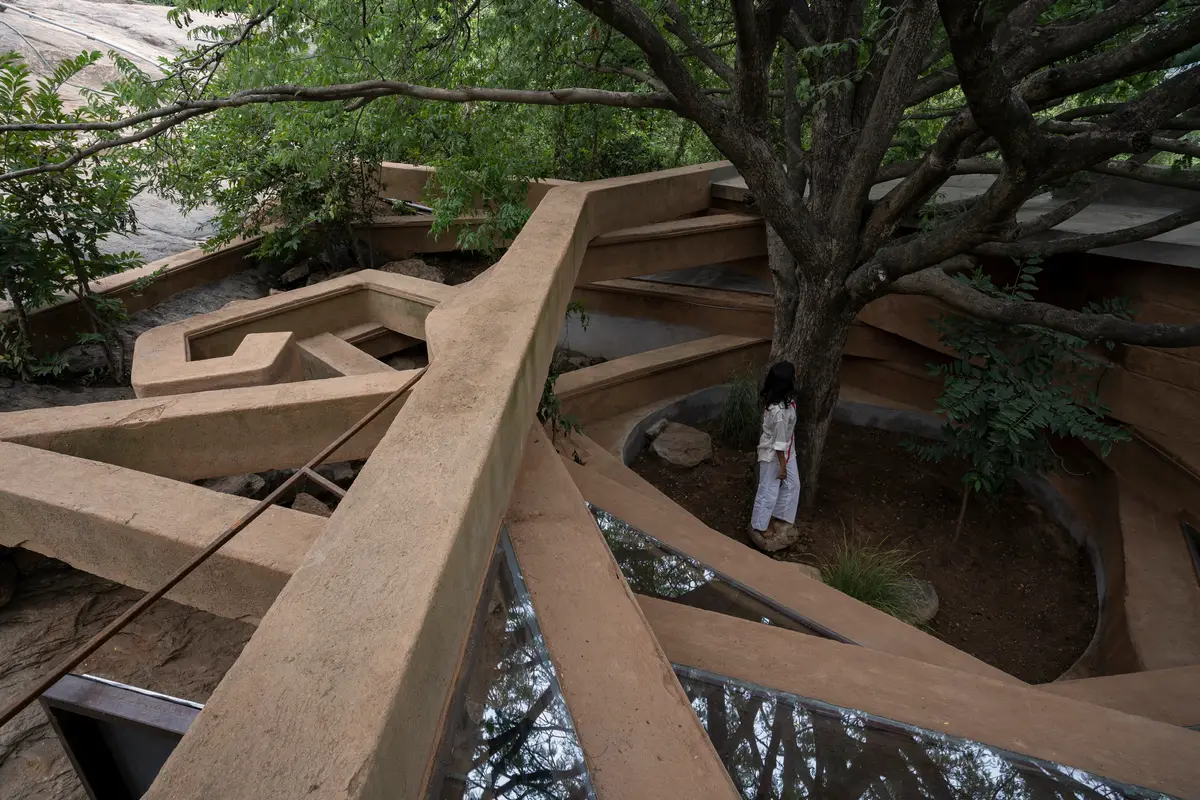
The name tells you the concept outright: chuzhi means whirlpool in Malayalam. Walls begin at grade, coil upward, and become the roof, their spiraling forms snaking around three large trees that remain untouched. The house is bermed into the landscape, partially subterranean, built directly onto exposed rock face. Its structural material is a hybrid of 4,000 discarded plastic bottles filled with concrete, poured debris earth composed of soil, waste, debris, and a small percentage of cement, and cob construction for the straighter walls. It is a two-bedroom home of 2,122 square feet that behaves more like geology than architecture.
Camouflage, Not Statement
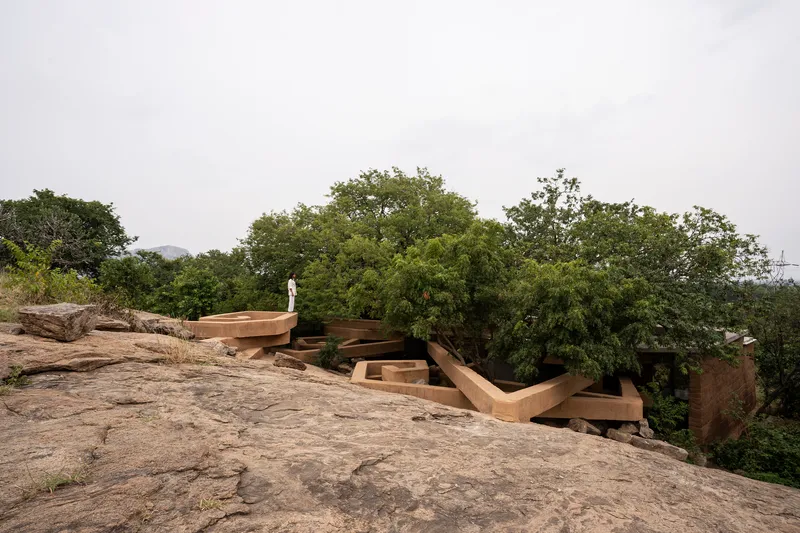
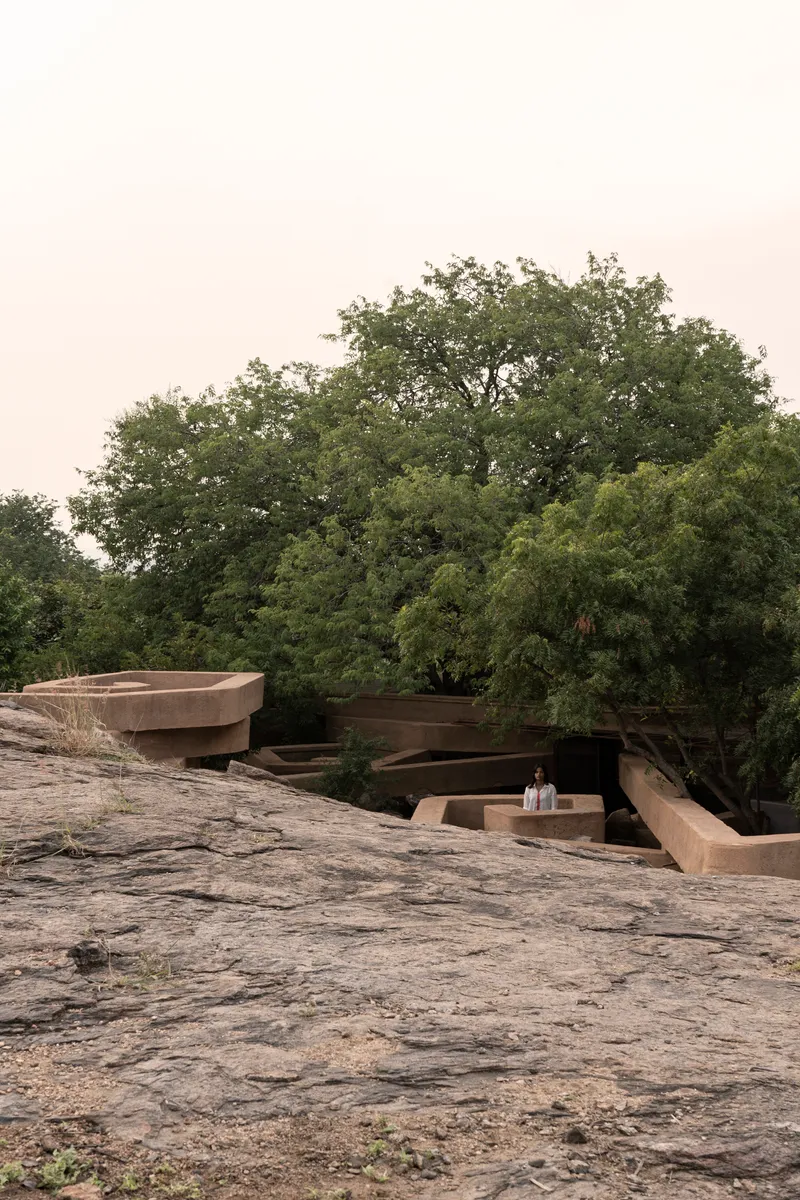
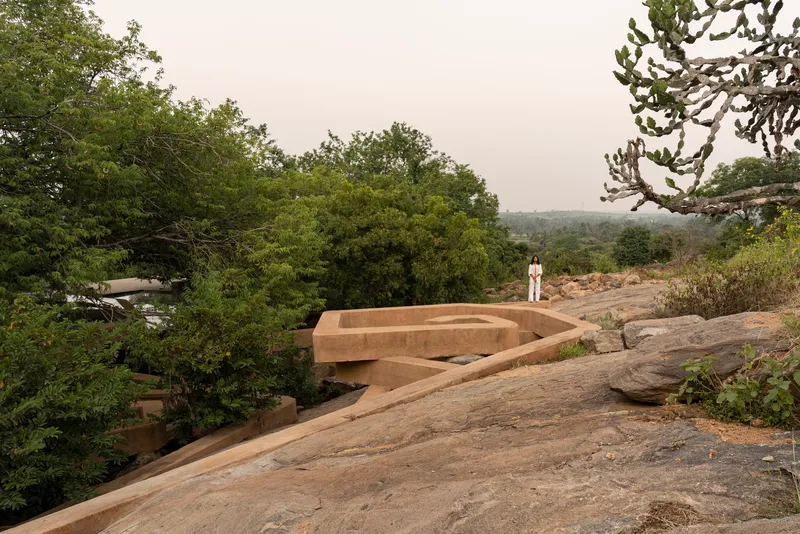
From the exterior, CHUZHI barely registers as a building. Layered bands of debris earth emerge from the rocky terrain with the same tonal warmth as the granite beneath them. The weathered surfaces, visible in distant shots, read as sedimentary strata rather than constructed walls. Wallmakers describes this as camouflage architecture, and the label is accurate: the house does not dominate its site. It burrows into it.
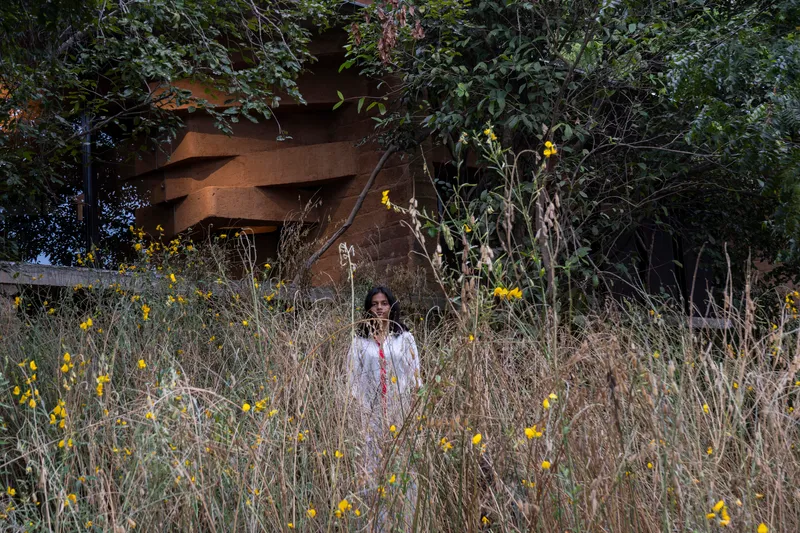
Dense vegetation and tall grasses further obscure the roofline. A figure standing among the landscape helps calibrate scale; without one, you might mistake the structure for an outcrop. The roof itself doubles as a seating terrace around the preserved trees, collapsing the distinction between building and ground plane entirely.
Spiraling Structure
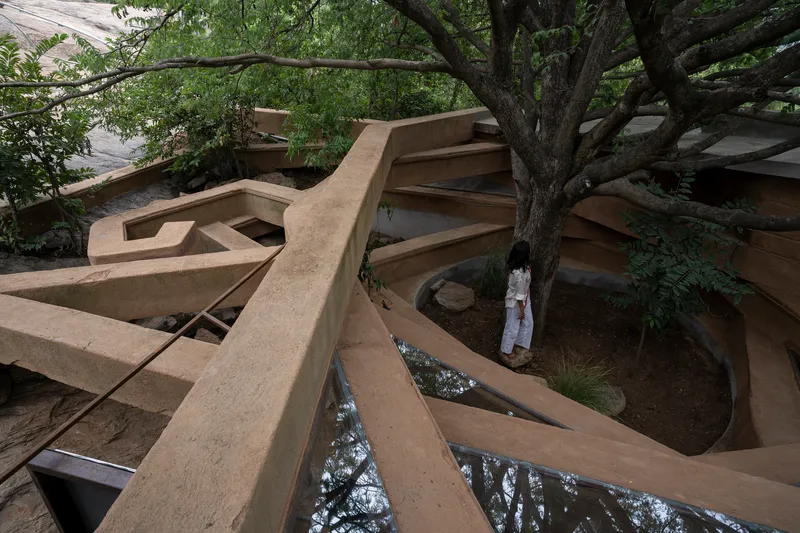
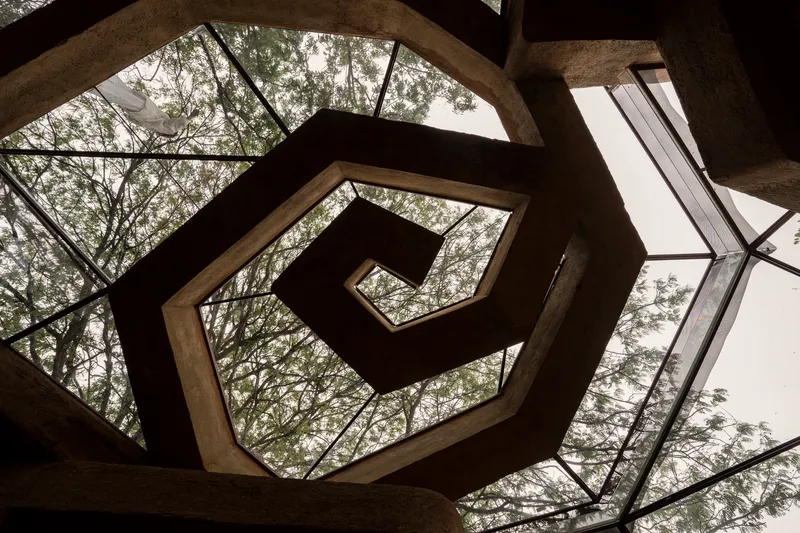
The structural logic is inseparable from the formal one. Precast poured debris earth beams, composite with the concrete-filled bottles, begin as walls and spiral continuously upward to form the roof. There is no conventional frame hiding behind a cladding system. Wall and roof are the same element at different points in a curve. The aerial view reveals how these cantilevered layers wrap around an existing tree, creating a hollow beneath for occupation and a planted terrace above for the ecosystem.
Look upward through the hexagonal skylight and you see the concept distilled: spiraling concrete ribs frame the tree canopy above through glass. The whirlpool metaphor is not applied decoratively. It governs the structural sequence from foundation to apex.
Living Under the Canopy
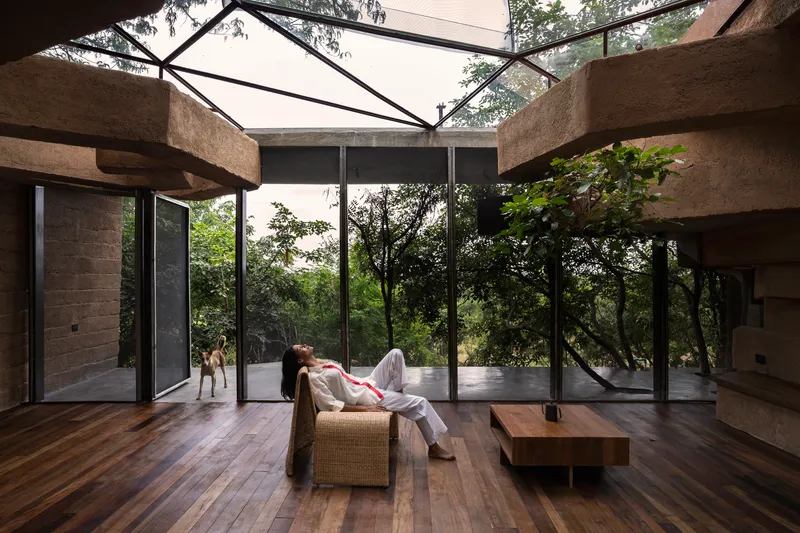
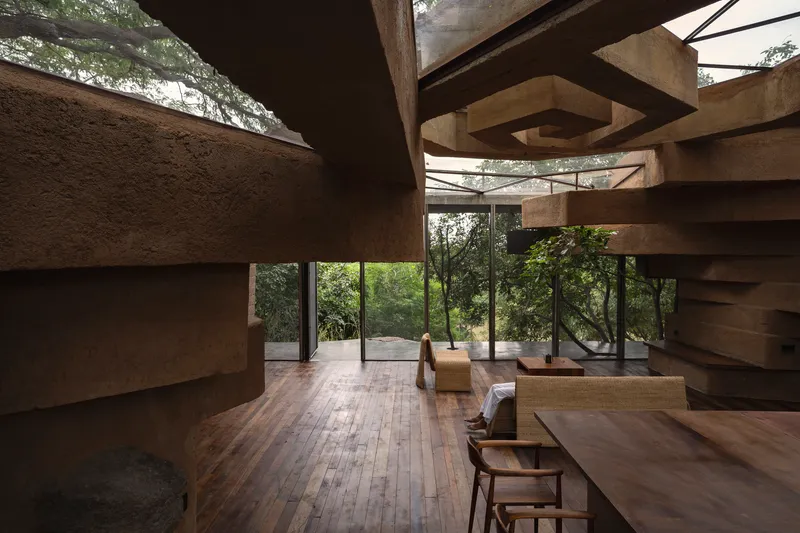
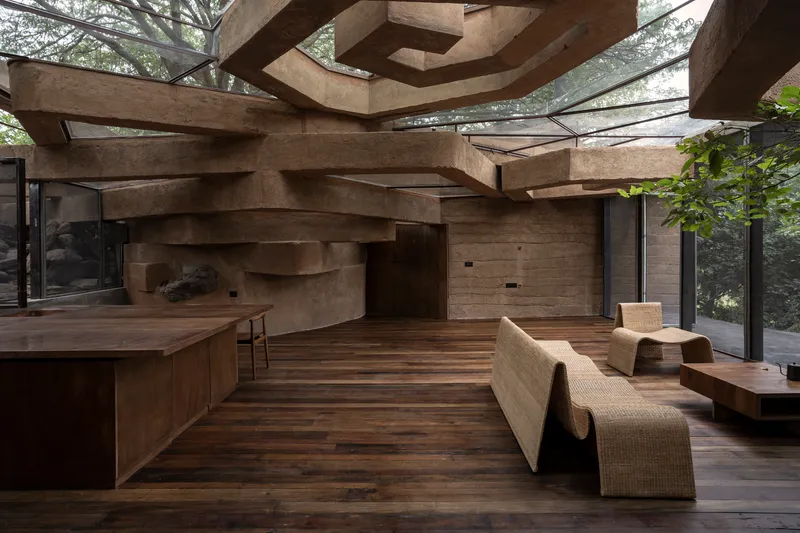
The interior is organized as a large open-plan living space flanked by two bedrooms. Floor-to-ceiling glazing on multiple sides dissolves the boundary between inside and forest. Timber flooring, reclaimed wood, runs warm against the raw earth overhead. The glass roof in the main living volume creates the sensation of sitting directly beneath the tree canopy, an effect that is less about luxury and more about the literal continuity between interior climate and exterior landscape.
Horizontal concrete beams overhead give the double-height living area a striated, geological character. Woven furniture and minimal millwork keep the palette restrained. The architecture is doing enough; the furnishings wisely stay out of its way.
Rooms That Negotiate with Rock and Root
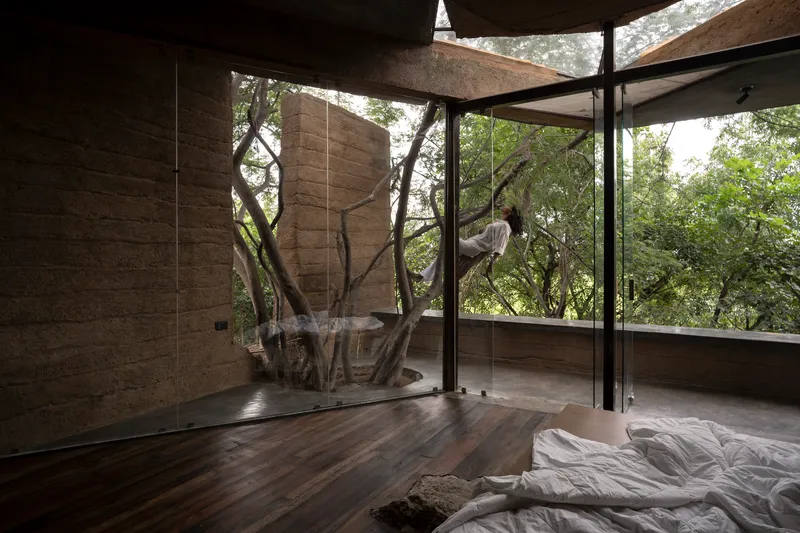
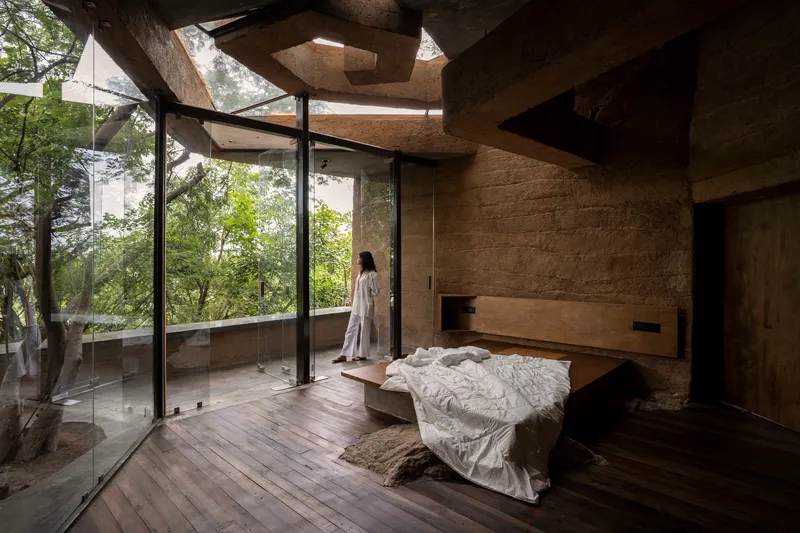
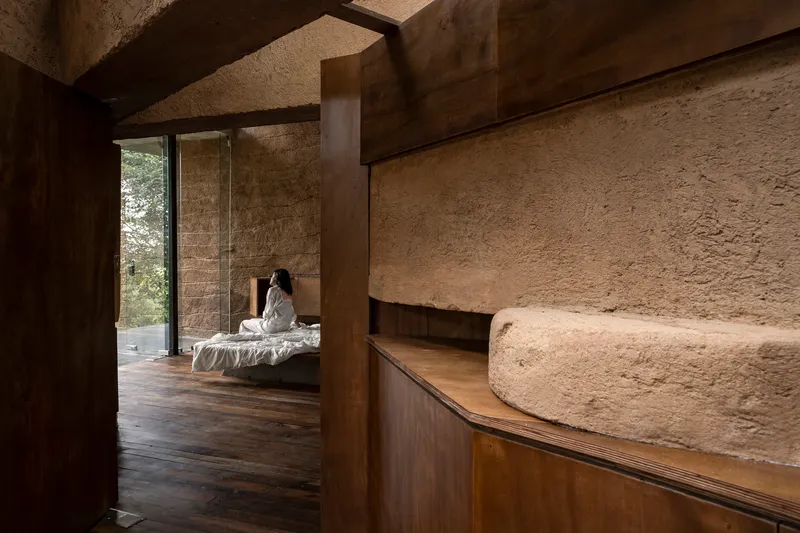
The bedrooms illustrate how closely the plan follows the site's existing features. In one room, a tree trunk penetrates directly through the timber floor and a glass enclosure, treated not as an obstacle but as the room's defining element. In another, floor-to-ceiling glass walls open onto the adjacent rammed earth wall and the trees beyond, framing them as if they were part of the furniture.
Curved wooden millwork meets textured earthen walls with a tightness that suggests each piece was shaped to fit a specific geological and botanical condition. Nothing here is generic or repeatable. The dimensions of every room derive from the position of trees and rock formations on the site, which means the plan could not have been drawn before the land was surveyed in detail.
Water and Stone
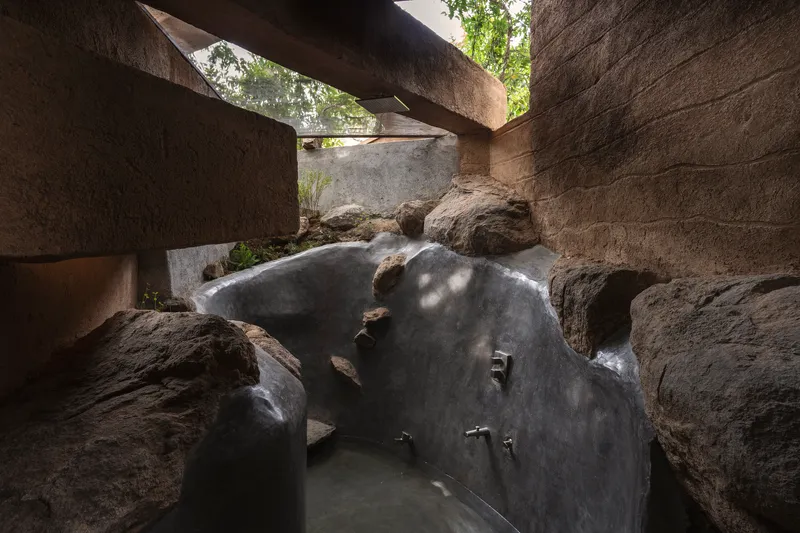
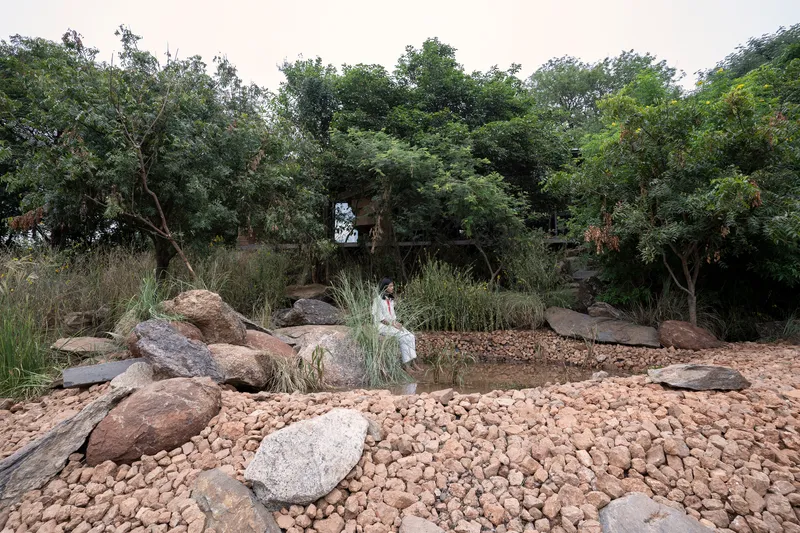
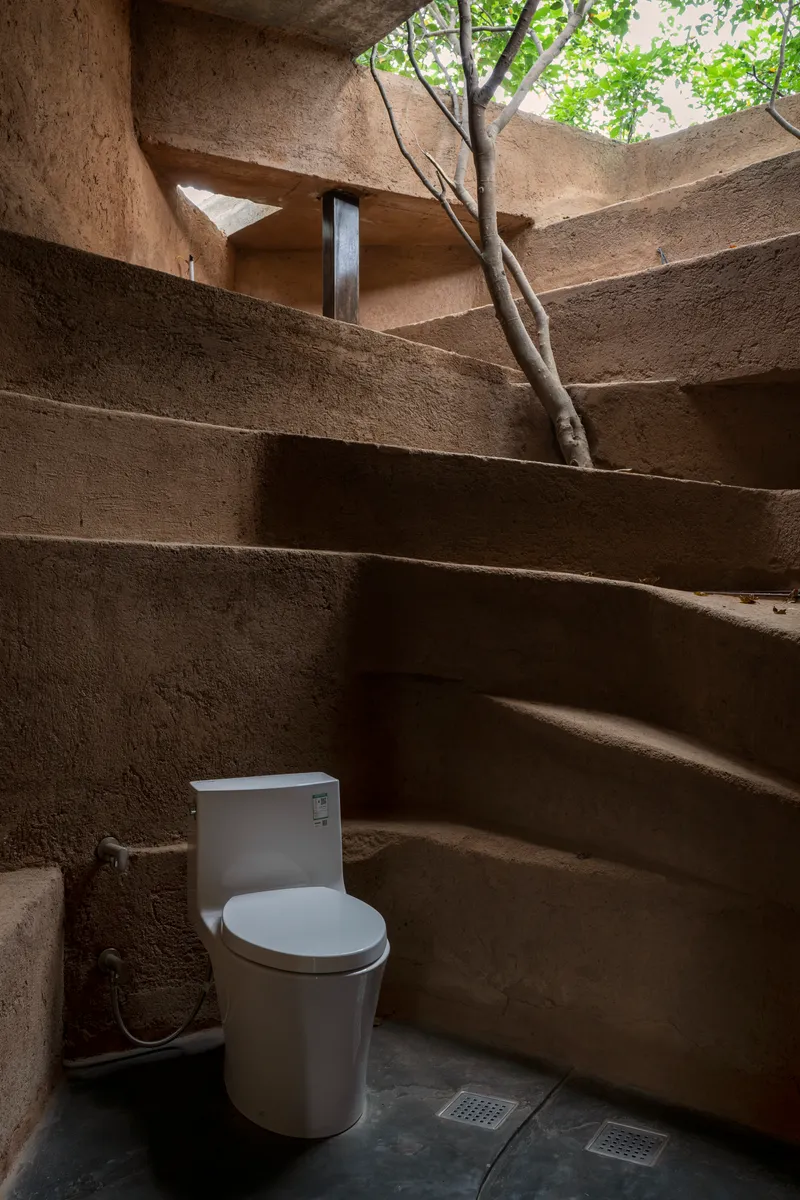
CHUZHI's relationship with water is as considered as its relationship with trees. A sunken bathing pool is carved into the natural rock beneath concrete cantilevers, dappled light filtering through the canopy above. Portions of the rock face are left deliberately exposed in the bathroom, where terraced earthen walls step upward toward a skylight that reveals tree branches overhead. The shower room is partially open to the elements, a decision that only works because the house is already so deeply embedded in its landscape that privacy comes from topography, not enclosure.
A natural pond surrounded by boulders and a pebble beach sits adjacent to the house, reinforcing the sense that this is not a cleared-and-built site but a landscape lightly intervened upon.
Material Intelligence
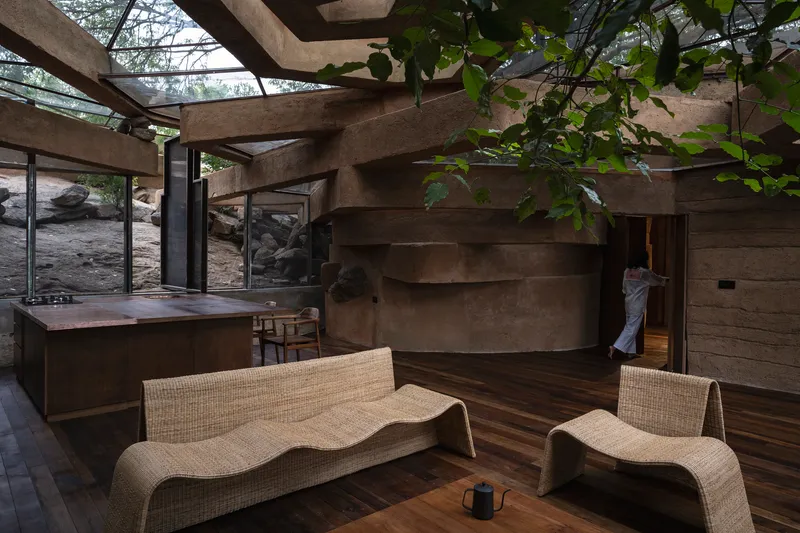
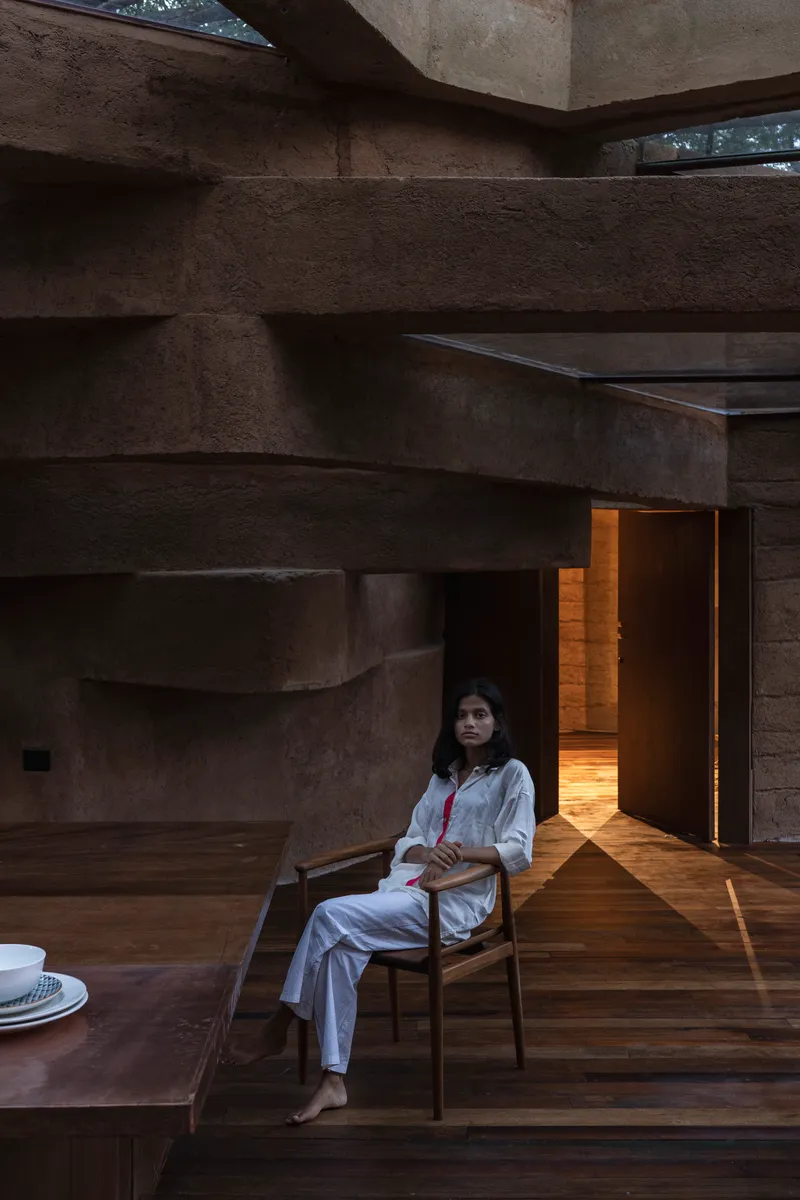
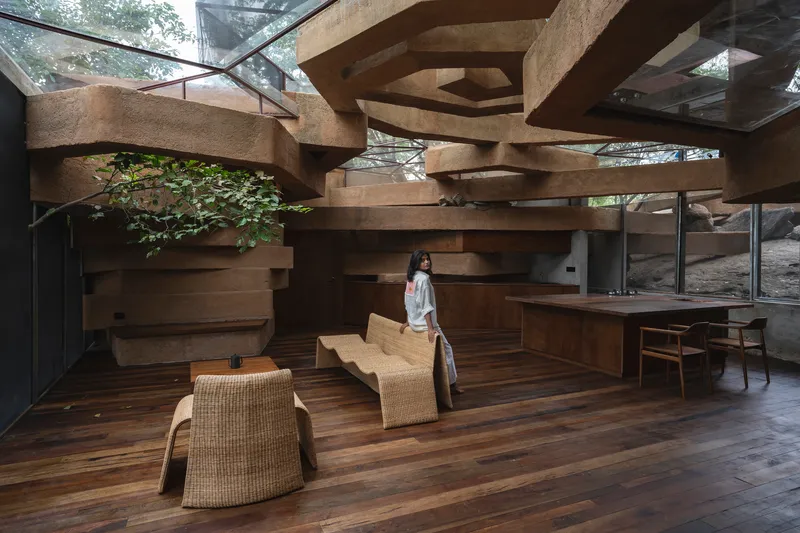
The poured debris earth technique is a wet construction method that achieves a look similar to rammed earth but uses a different process: soil, waste material, debris, and around 6 to 7 percent cement are poured into formwork. Cob, a mixture of clay, sand, straw, and water, handles the straighter walls. The 4,000 plastic bottles, all collected from within a two-kilometer radius of the site, are filled with concrete, placed around the trees, and then covered with earth. None of these materials are exotic. All of them are local, most of them are waste.
Warm afternoon light hitting the layered earthen walls reveals the textural richness of these materials. The stacked beams overhead in the living area read as geological strata, each layer slightly different in color and density. Glass and mesh openings allow constant cross ventilation, which, combined with the bermed design, keeps the house cool without mechanical intervention. The architecture performs thermally because of what it is made of and how it sits in the ground, not because of anything applied after the fact.
Plans and Drawings
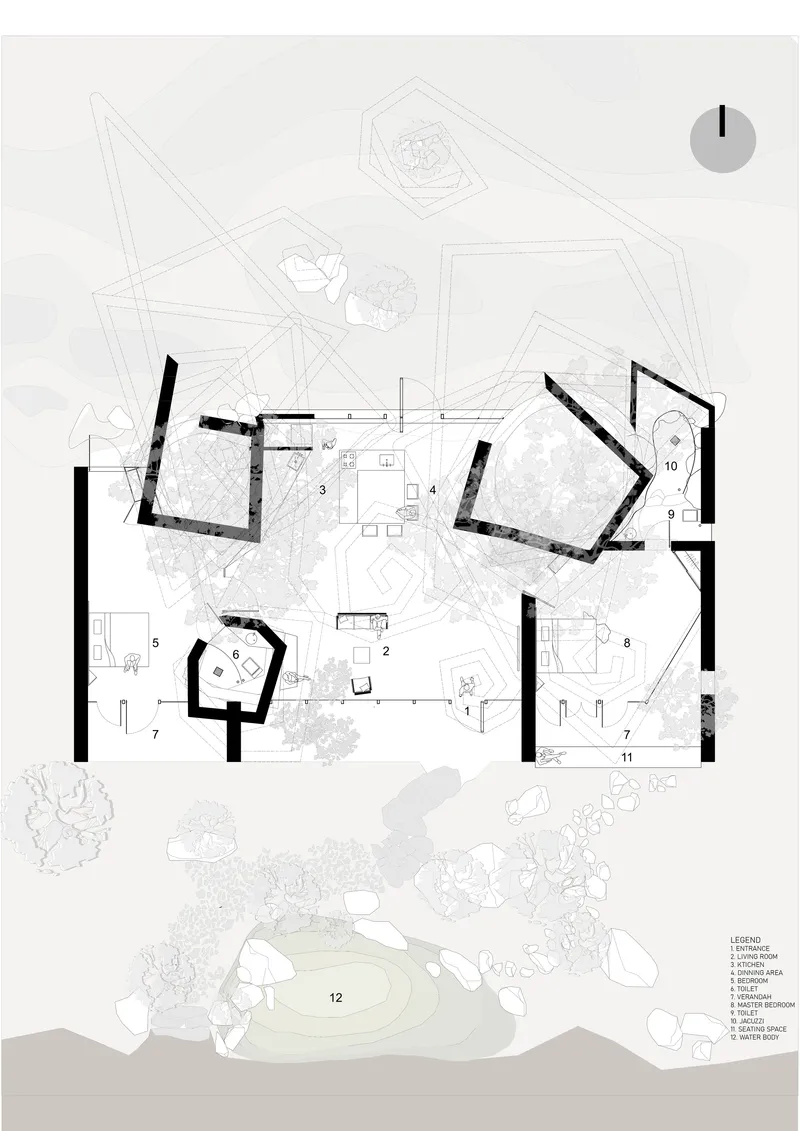
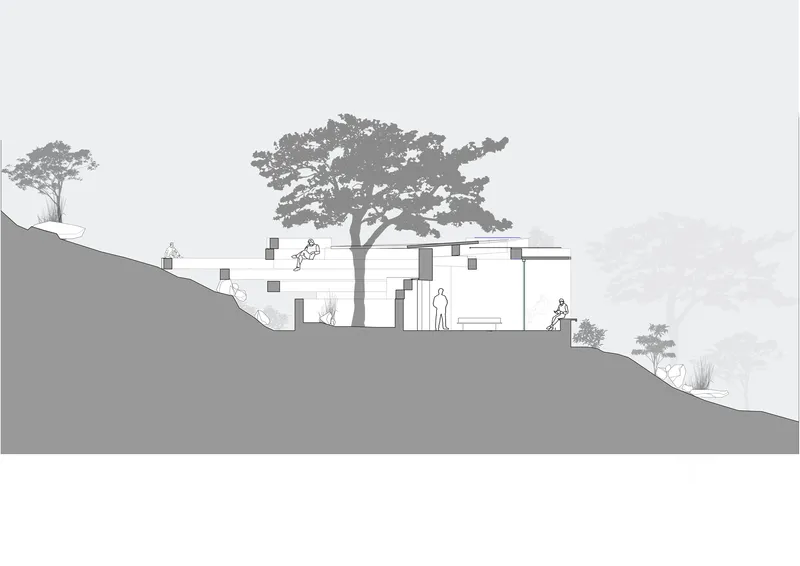
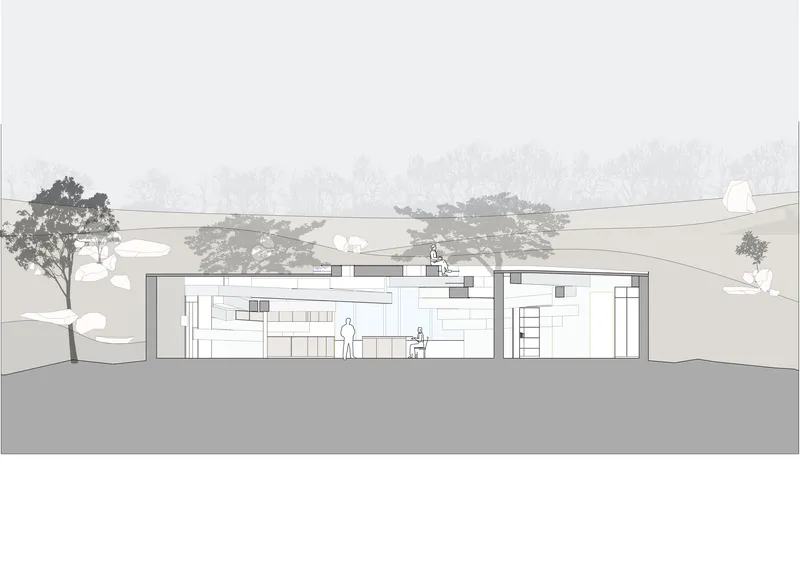
The floor plan makes the organizational logic legible: four angled volumes radiate from a central living space, each arm responding to a different tree or rock formation in the surrounding landscape. The sections are even more revealing. They show how deeply the house is embedded in the sloping terrain, with interior spaces set into the hillside beneath mature trees. The roofline barely exceeds the natural grade at several points. Bookshelves, beds, and living areas are nestled into carved-out volumes that feel more excavated than constructed.
Why This Project Matters
CHUZHI House is a provocation aimed at every developer, engineer, and architect who has ever dismissed a site as unbuildable. Wallmakers did not flatten the terrain, remove the trees, or import a structural system from somewhere else. They derived the architecture from the site's own conditions, using waste materials collected within walking distance. The result is a house that could only exist in this specific place, on this specific rock, around these specific trees. That degree of site specificity is rare in any typology; in a private residence, it is almost unheard of.
The broader lesson is about value. The land was considered waste. The bottles were waste. The debris was waste. Wallmakers turned all of it into structure, enclosure, and atmosphere. In a discipline still wrestling with how to reconcile ecological ambition with buildable reality, CHUZHI offers a concrete answer: stop looking for ideal sites and ideal materials. Work with what is already there, even when, especially when, nobody else would.
CHUZHI House by Wallmakers, Shoolagiri, Tamil Nadu, India. 2,122 sq ft. Completed 2022. Photography by Syam Sreesylam.
About the Studio
Share Your Own Work on uni.xyz
If projects like this are the kind of work you want to make, uni.xyz is a place to publish your own, find collaborators, and enter design competitions.


Popular Articles
Popular articles from the community


Co-Life: Senior Housing Design That Reconnects Older Adults With the City
Co-Life reimagines senior housing design through healing gardens, shared streets, workshops, and a sustainable community across generations.

The Ocean Hive: Sustainable Architecture for a Self-Sufficient Civilization at Sea
The Ocean Hive imagines sustainable architecture at sea, where modular habitats, algae, wave power and ocean waste sustain a growing colony.

Little Red Riding Hood: Architectural Design as a Journey Through Fear, Light, and Storytelling
Little Red Riding Hood reimagines the fairy tale through architectural design shaped by fear, light, scale, memory, uncertainty, and choice.

ALGAL REALM: A Bio-Integrated Lunar Habitat Design for Life Beyond Earth
ALGAL REALM reimagines lunar habitat design with algae-powered life support, 3D-printed regolith, and vertical living for a lunar future.

Similar Reads
You might also enjoy these articles

Bao Huynh Watercolor Atelier: A Serene Art Retreat in Hội An
Bao Huynh Watercolor Atelier in Hội An blends multifunctional art spaces, sustainable design, local materials, and family-friendly living in a serene environment.

Atelier Macri Concept Store Interior Design by CASE-REAL
Atelier Macri store features a "ko" counter, walnut wood details, cork displays, blending retail, gallery, and seamless customer experiences.

Manuel Vargas Izquierdo Stadium and High-Performance Sports Center: Architectural Excellence in Jalpa de Méndez
The Manuel Vargas Izquierdo Stadium blends sustainable design, inclusive sports facilities, and cultural-inspired architecture, revitalizing Jalpa de Méndez’s public spaces.

KAKR Buluh Awar Hall: Revitalizing Community and Ecology Through Bamboo Architecture
Community built bamboo hall revitalizes Buluh Awar village, empowering youth, restoring ecology, celebrating vernacular craftsmanship through sustainable architecture and culture.

Explore Residential Building Competitions
Discover active competitions in this discipline

Challenge to design mud housing for contemporary communities

Design challenge to reuse E-waste
Comments (0)
Please login or sign up to add comments
No comments yet. Be the first to comment!