

Waste Management Architecture: Reimagining Karachi’s Waste-to-Energy Future
Transforming Karachi’s waste crisis into sustainable architecture, where landfill becomes landscape, energy, and public life for the city.


Urban waste is one of the most urgent environmental and infrastructural challenges facing contemporary cities. In rapidly expanding metropolitan regions such as Karachi, municipal solid waste accumulates in massive landfills that intensify air pollution, groundwater contamination, and ecological degradation. The traditional model of waste management treats infrastructure as invisible and isolated hidden from the public realm and detached from architectural innovation.
The thesis project "Architecture as a catalyst for urban waste reduction" by Murtuza Mehdi challenges this paradigm through an integrated model of Sustainable Waste Management Architecture. By merging a Waste-to-Energy (WTE) power plant with landscape regeneration and public programming, the project proposes architecture as a catalyst for urban waste reduction, environmental restoration, and civic engagement.
The Politics of Waste in Karachi
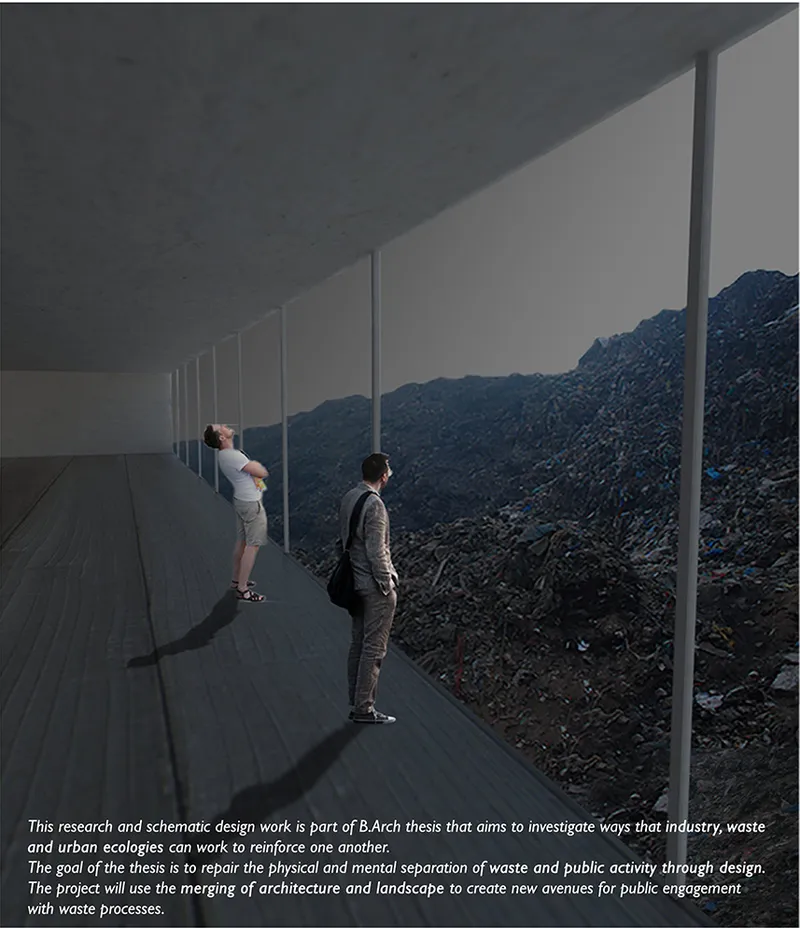
Karachi generates approximately 12,000 tons of waste daily. A small percentage is segregated at source, while informal waste pickers recover recyclable materials from collection points and landfill sites. Much of the remaining waste ends up at major dumping grounds such as Jam Chakro, where uncontrolled expansion has reshaped entire landscapes.
This fragmented system reveals a deeper socio-environmental issue: waste is not merely a technical problem but a political and spatial one. It exposes inequalities, invisibilities, and inefficiencies embedded within urban systems. The project reframes waste as both a resource and an opportunity: one that can generate energy, reclaim land, and reconnect communities with ecological processes.
Waste-to-Energy Plant as Sustainable Architecture
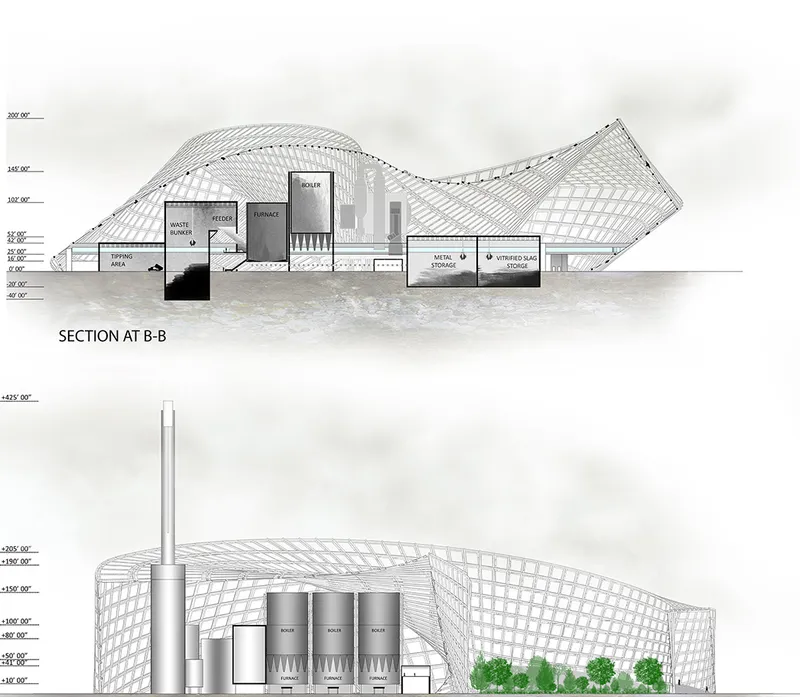
At the heart of the proposal is a Municipal Solid Waste-to-Energy Power Plant, designed not as an industrial bunker but as an architectural landmark. Using advanced thermal technologies such as plasma arc gasification, the facility converts municipal solid waste into syngas and electricity while producing vitrified slag and recoverable metals as by-products.
Key Outputs:
- 2600 tons/day municipal solid waste processed
- 1600 MWh/day electricity supplied to the city grid
- 275 tons/day vitrified slag for construction use
- 88+ tons/day metal recovery
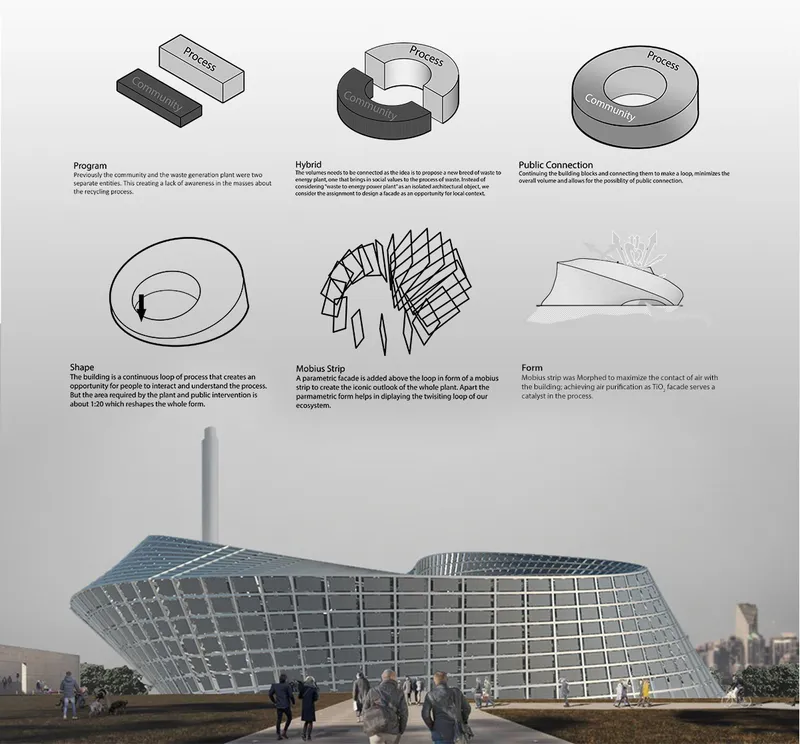
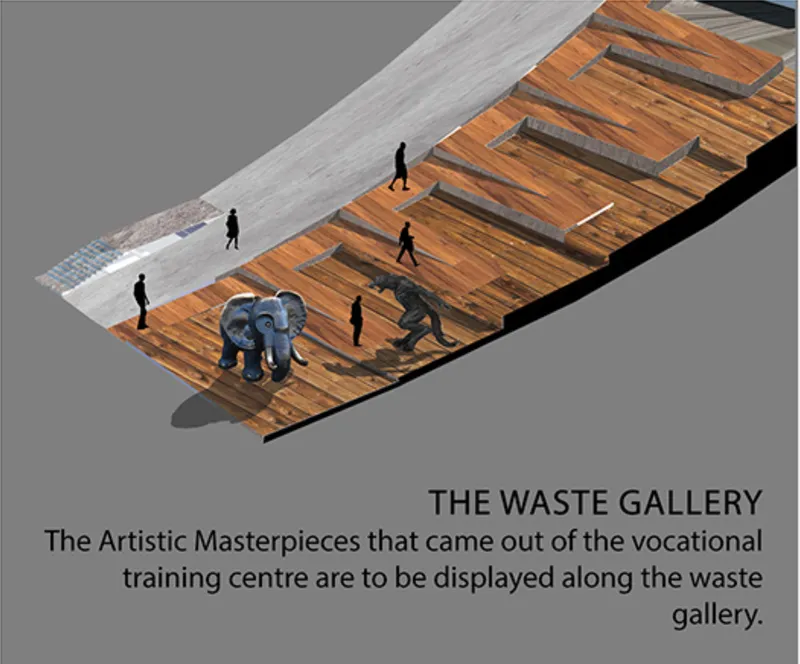
Rather than isolating the plant from public life, the design integrates viewing decks, educational galleries, exhibition spaces, and community programs. This approach transforms an “off-limits” industrial typology into a transparent civic institution.
The Möbius Strip Concept: Form as Process
The architectural form draws inspiration from a Möbius strip: a continuous loop symbolizing the cyclical nature of waste, energy, and reuse. The geometry merges process and public program into a singular spatial gesture.
The looping structure creates:
- A continuous circulation path for visitors
- Integrated observation platforms overlooking processing areas
- A hybrid zone between industrial function and public landscape
The façade incorporates Titanium Dioxide (TiO₂) panels, enabling passive air purification through photocatalytic reactions. By maximizing wind contact across its surface, the building itself becomes an environmental device, absorbing pollutants and contributing to improved urban air quality.
From Landfill to Landscape: Urban Ecological Regeneration
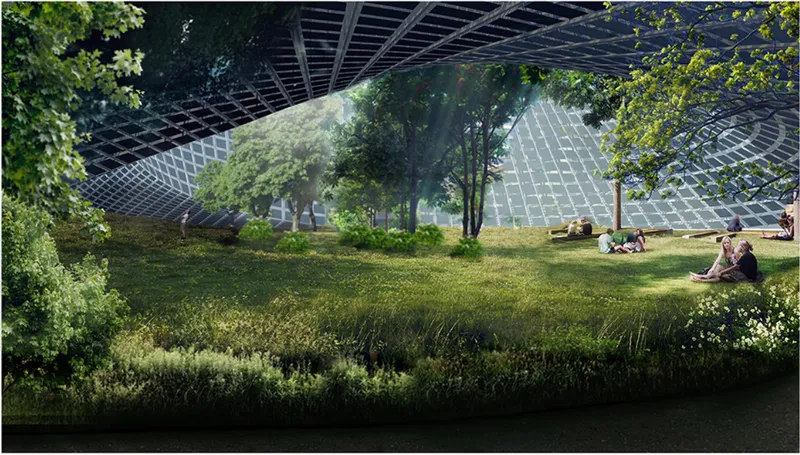
Beyond the architectural object, the thesis envisions large-scale land transformation. Phased redevelopment converts degraded landfill zones into landscaped public parks. Ash and vitrified slag are repurposed in controlled applications, reshaping topography and enabling ecological restoration.
Environmental Objectives:
- Mitigation of heat island effect
- Rehabilitation of lost biodiversity
- Air and soil quality improvement
- Creation of urban green lungs
The master plan strategically situates the structure to minimize vehicular circulation while maximizing open public space. Over time, the site evolves from an operational waste facility into a thriving urban park integrated with educational, recreational, and social amenities.
Public Engagement and Awareness
A core aim of the project is to dissolve the psychological divide between citizens and waste infrastructure. By introducing museums, resource centers, auditoriums, cafés, and interactive galleries, the proposal cultivates environmental literacy.
The architecture makes waste visible, not to normalize pollution, but to inspire responsibility and behavioral change. Visitors observe the transformation of garbage into energy, materials, and landscape, reinforcing the idea of a circular urban metabolism.
Technology and Performance
The project explores various waste management technologies including gasification, pyrolysis, and incineration, ultimately focusing on plasma arc gasification for its efficiency and reduced landfill dependency.
Benefits of Plasma Arc Gasification:
- Minimal pre-sorting requirements
- High thermal efficiency
- Production of usable syngas
- Reduction in toxic emissions
- Elimination of long-term landfill expansion
The integration of structural systems, parametric surface morphology, and environmental simulation tools ensures optimized thermal absorption, wind interaction, and shadow performance.
Architecture as Catalyst
This thesis reframes infrastructure as an active participant in urban life. Instead of concealing waste processes, the design leverages architecture and landscape as communicative tools. It demonstrates that Waste-to-Energy Plant Architecture can transcend industrial functionality to become a symbol of ecological resilience.
By merging technology, public programming, and environmental remediation, Murtuza Mehdi’s proposal envisions a future where infrastructure is not hidden but celebrated: where waste reduction becomes spatial, visible, and transformative.
Sustainable Waste Management Architecture offers more than energy production. It redefines how cities perceive waste, infrastructure, and public space. Through architectural innovation and ecological restoration, the project positions waste as a driver of regeneration rather than decay.
In rethinking Karachi’s landfill landscapes, the thesis opens a broader discourse on the relationship between people, cities, and the waste they generate. It proposes a powerful model for future urban development: where landfill becomes landscape, energy, and civic life.




Popular Articles
Popular articles from the community

EW PARK: Sustainable Architecture Reimagines the Future of Urban Parking
EW PARK reimagines city parking as a modular wooden tower combining automation, solar energy, electric mobility, and adaptable urban design.

Conexión: Biophilic Design Reimagines High-Rise Living in Hong Kong
Conexión reimagines high-rise living in Hong Kong through biophilic design, green facades, shared spaces, daylight, water and nature within.

Hill & Cross Opera: Sculptural Opera House Architecture Shaped by Tallinn’s Landscape and Identity
Hill & Cross Opera reimagines opera house architecture in Tallinn through its sculptural hill, civic plaza, glass wave and a luminous cross.
AL-JANNAH: Sustainable Architecture and Permaculture for Afghan Widows
AL-JANNAH uses sustainable architecture and permaculture to create resilient oasis of housing, learning, work and renewal for Afghan widows.
Similar Reads
You might also enjoy these articles

Eco Chapel: A Green Architecture Pavilion Designed in Symbiosis with the Forest
Eco Chapel uses green architecture to weave prayer, learning and reuse into a forest pavilion shaped by modular hexagonal canopies for life.
Kaffeebühnen: Coffee Shop Architecture Designed as a Civic Stage Between Vienna’s City and Park
Kaffeebühnen turns coffee shop architecture into a civic stage, linking Vienna’s park edge, urban life, warm timber yards, and coffee craft.
Healing Façade: Sustainable Architecture for Reforestation, Community, and Sacred Ecology in Ethiopia
Healing Façade reimagines sustainable architecture as a living wall that restores soil, catches water and renews Ethiopia's forest churches.


Urban Forest: A Vertical Ecosystem for 5,000 Workers in Singapore's Changi Business Park
Radially stacked pods and layered green decks turn a 7-acre plot into 47 acres of ecological workspace projected for 2040.
Explore Architecture Competitions
Discover active competitions in this discipline



Challenge to reimagine the Iron Throne


Photograph architecture without architects


Illustrate the lost glory of Angkor Wat - Render Challenge


Design challenge to reuse E-waste
Comments (0)
Please login or sign up to add comments
No comments yet. Be the first to comment!