
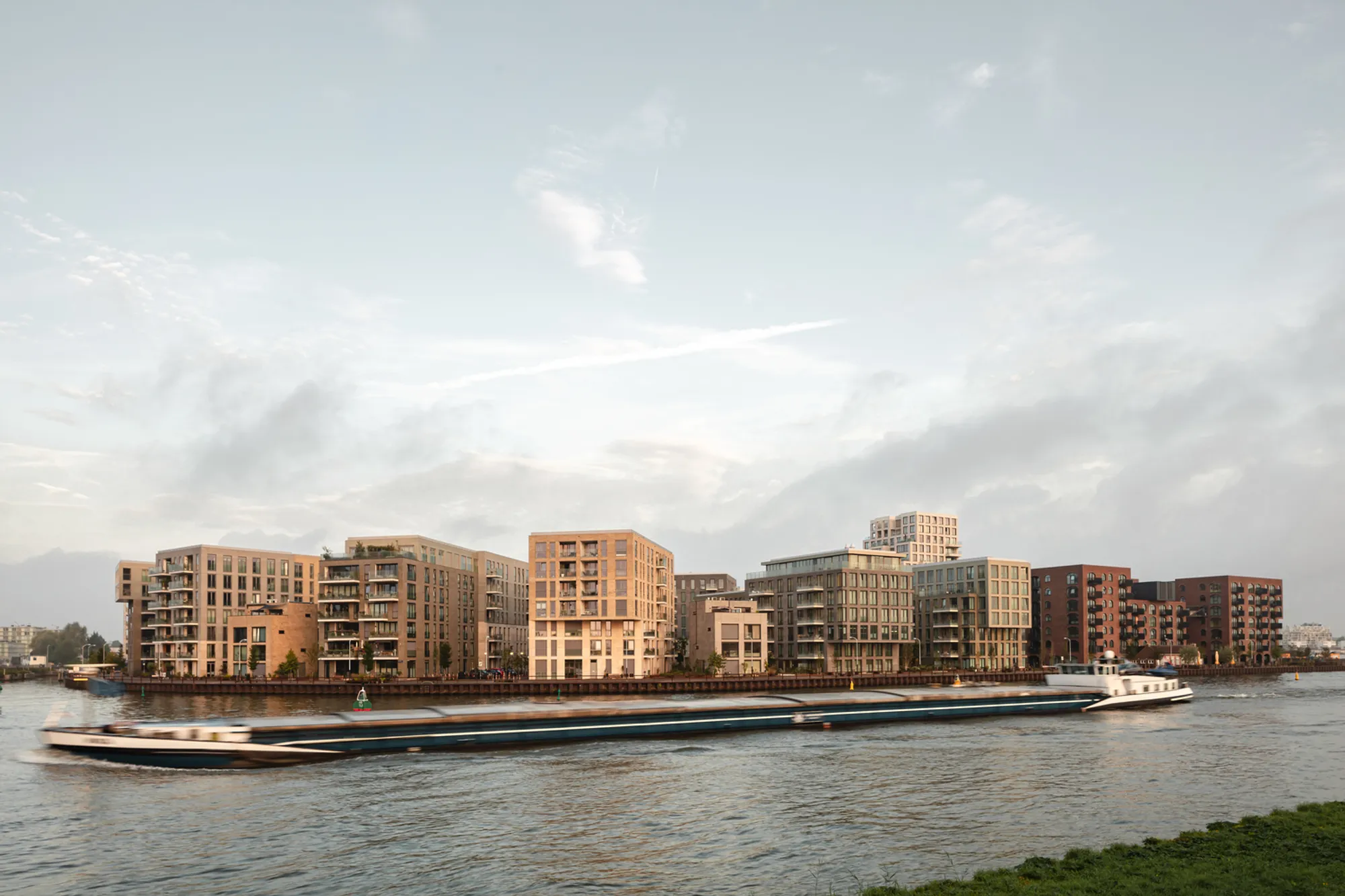
KCAP Stitches a New Neighborhood onto Amsterdam's Cruquius Island Waterfront
A cluster of brick housing blocks on an Amsterdam peninsula trades rigid grids for angled courtyards and a public promenade along the IJ river.


Post-industrial waterfronts have become the default site for European housing ambition, and the results often look the part: long slabs, uniform cladding, a token café on the quay. KCAP's housing on Cruquius Island, a narrow peninsula in Amsterdam's eastern docklands, resists that template without pretending to reinvent it. The blocks are mid-rise, the material palette centers on brick, and the rooflines stay civil. What changes is the geometry. Instead of parallel bars, the buildings splay outward from a shared spine, creating a fan of courtyards that narrow toward the interior of the site and widen as they reach the water. The move is simple on plan yet consequential in experience: every courtyard has a different proportion, and almost every apartment gets a sliver of canal view.
The project lands in a neighborhood still finding its identity. Cruquius Island was, until recently, a logistics zone wedged between the IJ river and the Amsterdam-Rijnkanaal. KCAP's contribution occupies the peninsula's western tip, where the fan-shaped plan turns the constraint of a tapering plot into a compositional asset. Rather than one monolithic block or a grid of towers, the scheme reads as a small cluster of distinct volumes, each with its own brick tone and balcony rhythm, gathered loosely enough to let daylight and greenery penetrate to the center. It is dense without feeling compressed, and collective without feeling anonymous.
A Fan Plan That Follows the Water
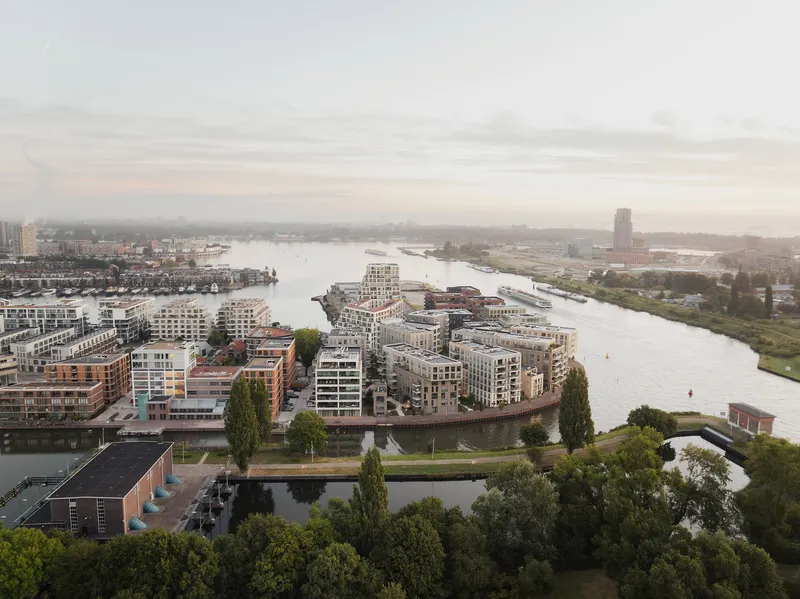
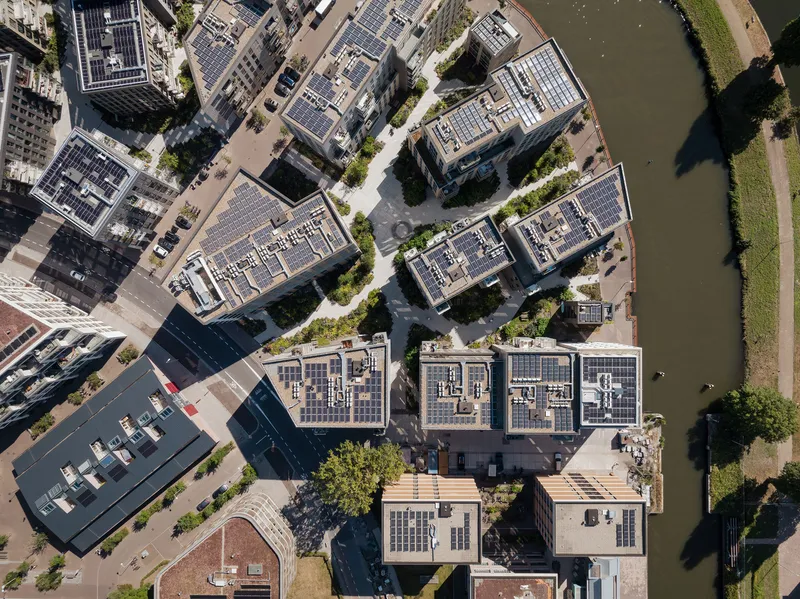
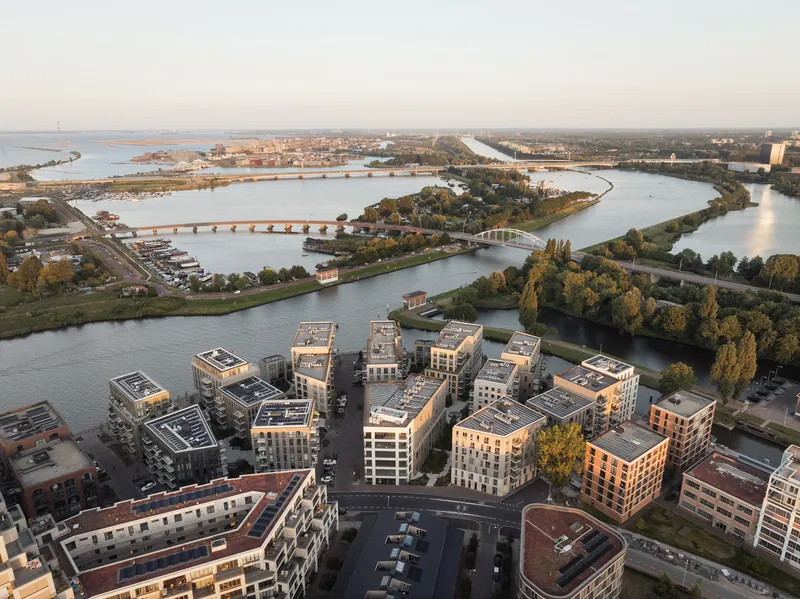
From above, the logic is legible. The residential blocks radiate from the site's narrow eastern edge toward the broad western waterfront, splaying like fingers reaching for the canal. Each building is slightly rotated relative to its neighbor, generating courtyards that are compressed on one side and open on the other. The result is a series of wedge-shaped outdoor rooms rather than the uniform voids that parallel-bar housing typically produces.
Drone views also reveal the scale of rooftop solar coverage. Nearly every flat roof is packed with photovoltaic panels, an infrastructural commitment that is easy to overlook from street level but significant in aggregate. KCAP treats the fifth elevation as productive surface rather than afterthought, a sensible stance on a site where the surrounding water multiplies reflected light.
Brick Variations Hold the Ensemble Together
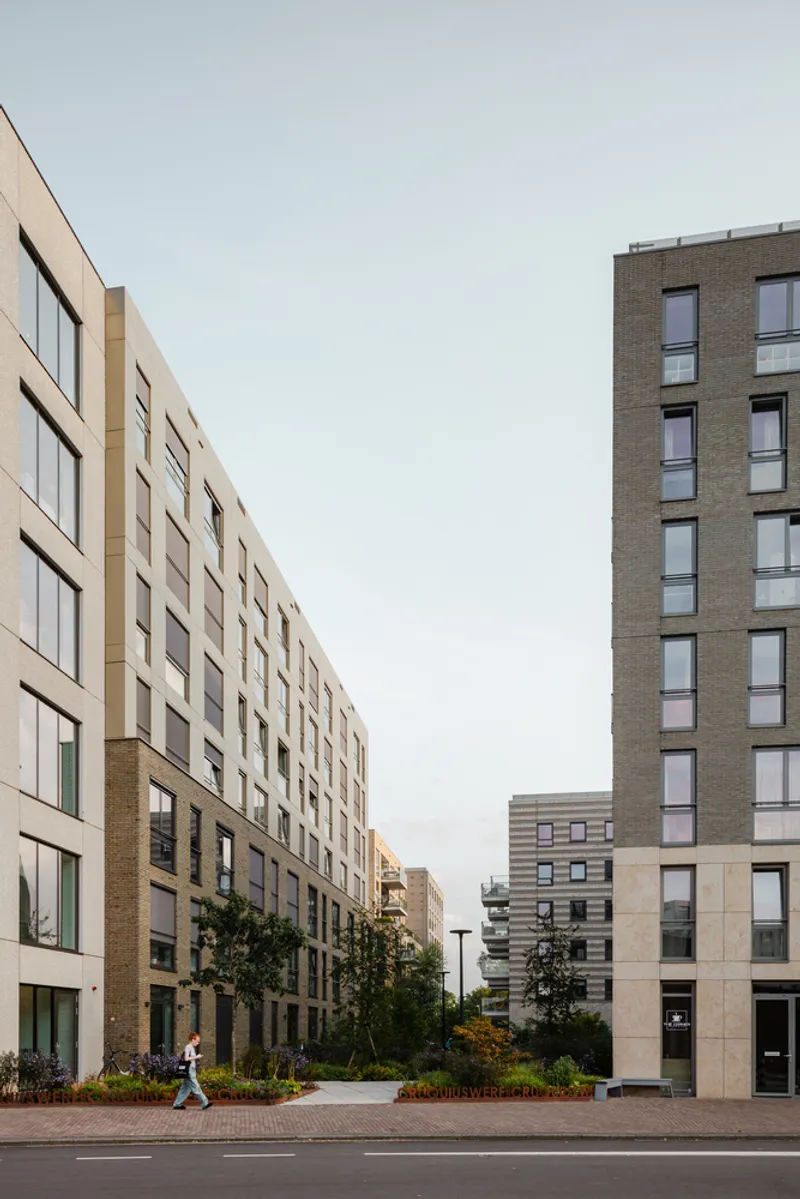
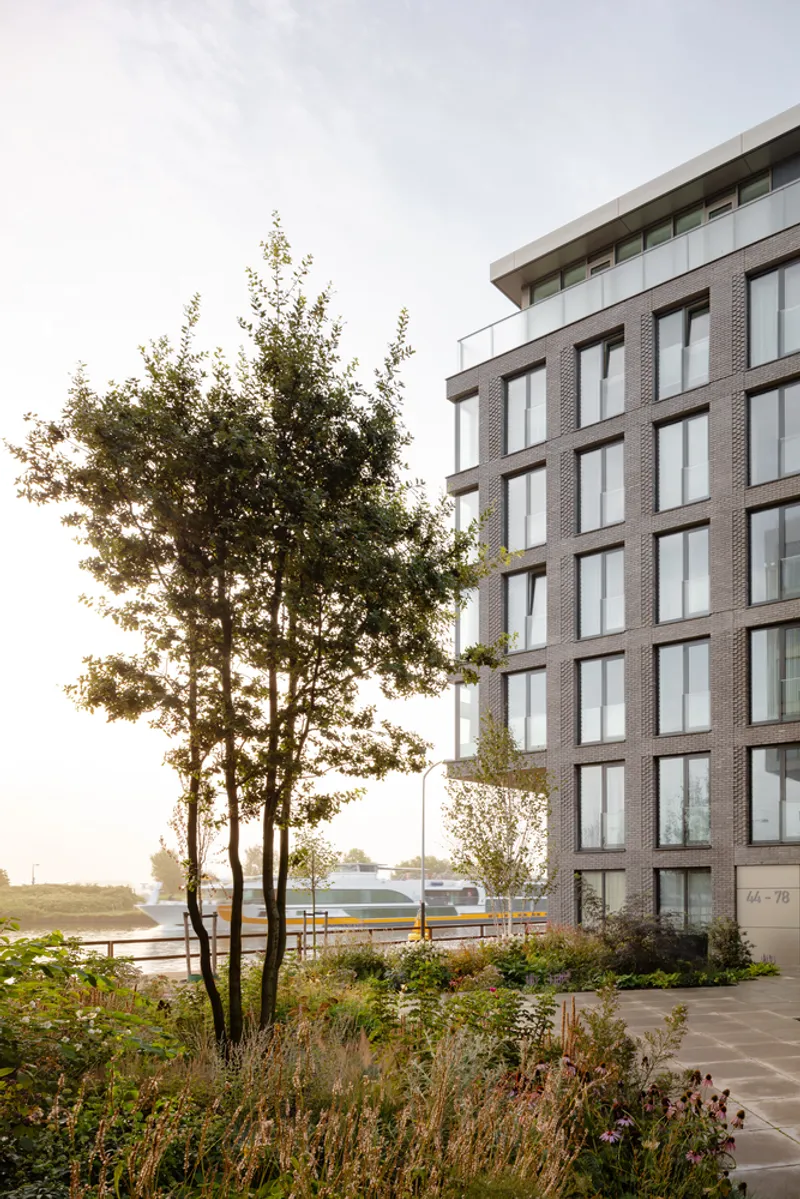
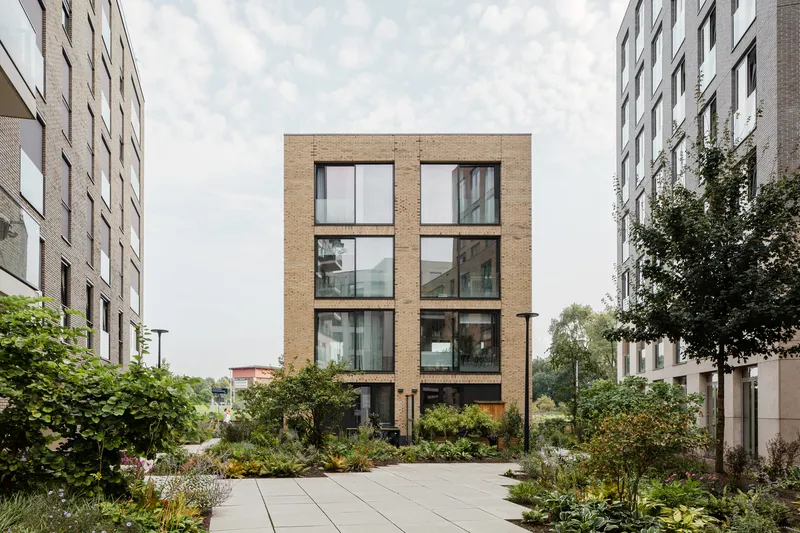
Amsterdam's housing tradition runs through brick, and KCAP leans into that lineage without mimicking historical detail. The blocks shift between warm buff, dark charcoal, and reddish tones. No two adjacent volumes share the same shade, which gives each building an identity while the common material keeps the ensemble cohesive. Window proportions vary too: some facades favor tall, paired openings; others use horizontal bands of glass. The differences are calibrated enough to read as deliberate rather than arbitrary.
Crucially, the variation happens at the block scale, not the unit scale. Individual apartments are not trying to announce themselves. The collective form does the expressive work, and the inhabitants simply occupy it. That restraint is worth noting in a market where developers often demand signature balconies or color-coded floors to signal individuality.
The Waterfront Promenade as Public Infrastructure
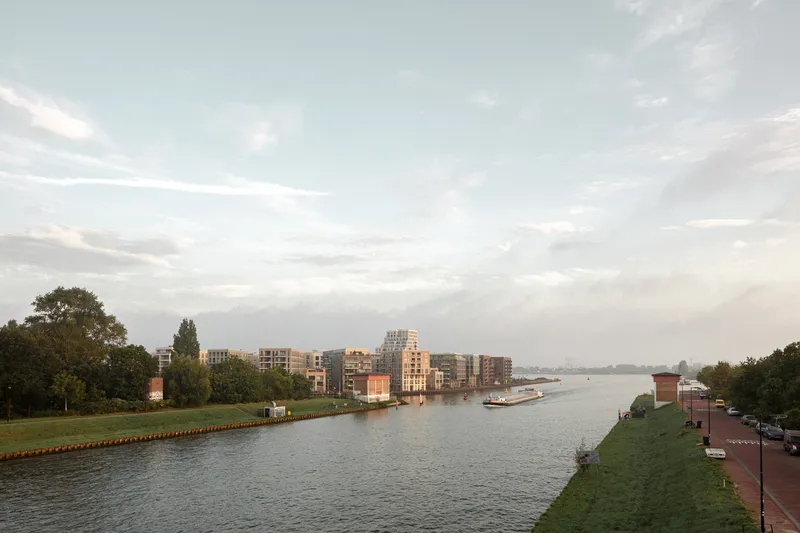
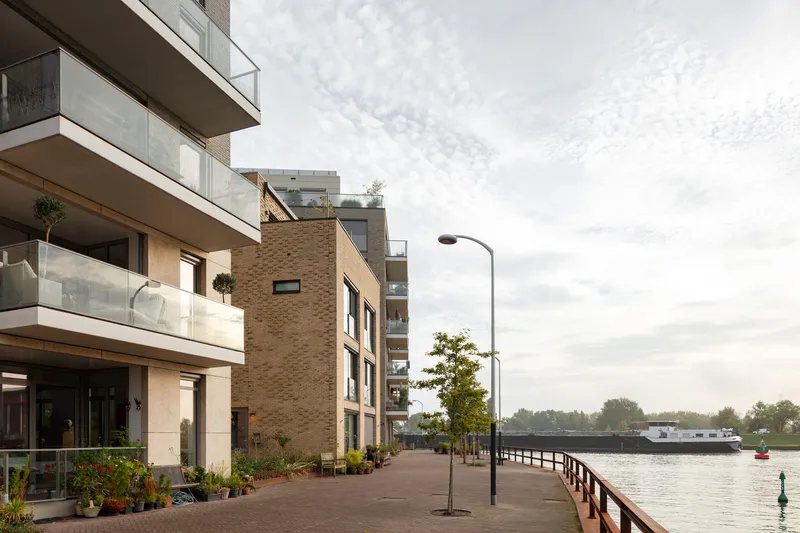
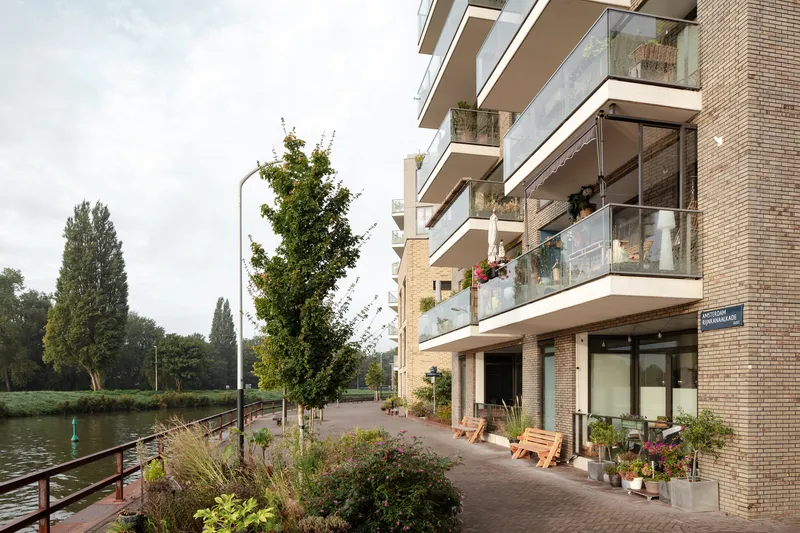
The canal edge is not gated. A continuous promenade wraps the site's southern and western perimeters, lined with timber pilings that reference the docklands heritage without nostalgia. Balconies stack above, angled to catch oblique views downriver. Glass railings keep the facades light and transparent at the waterfront elevation, a deliberate contrast to the more solid, punched-window treatment on the courtyard sides.
Planted beds soften the quay without cluttering it. The promenade is generous enough for walking and cycling side by side, and its integration with the ground-floor entrances means it functions as a real street rather than a decorative leftover. In a city where public access to the waterfront is fiercely debated, that continuity matters.
Courtyards That Earn Their Keep
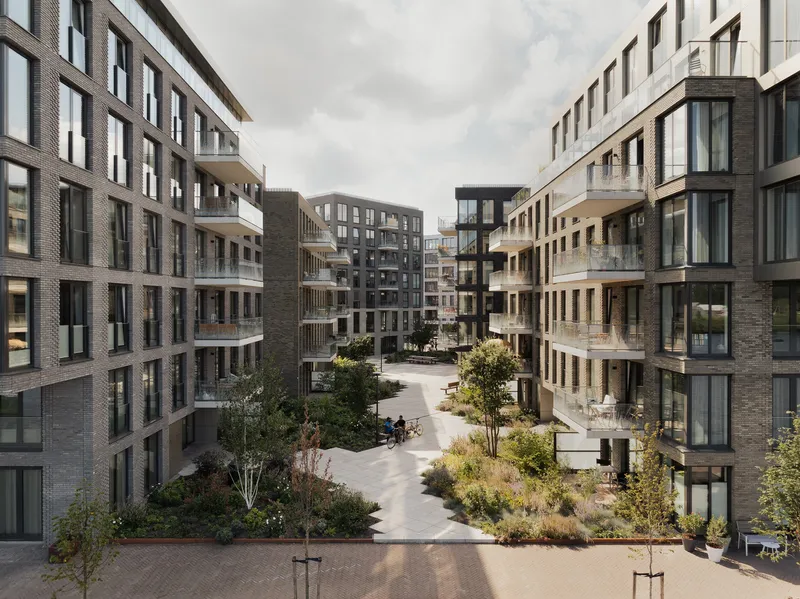
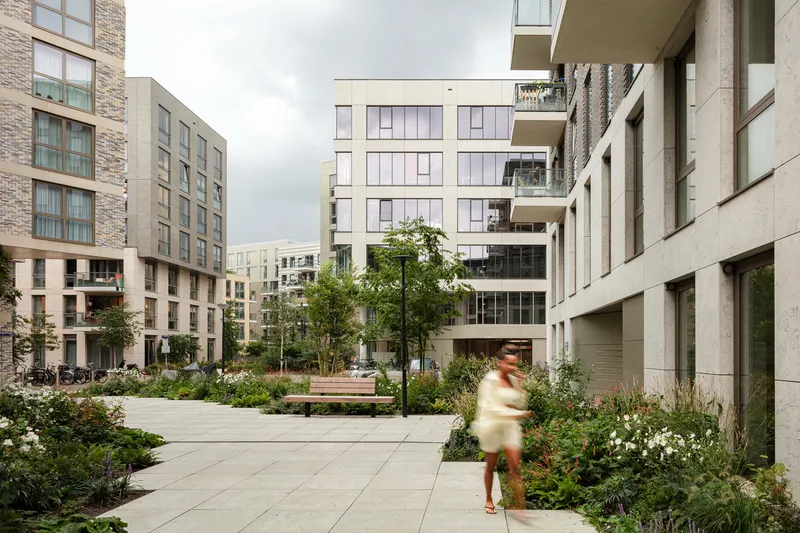
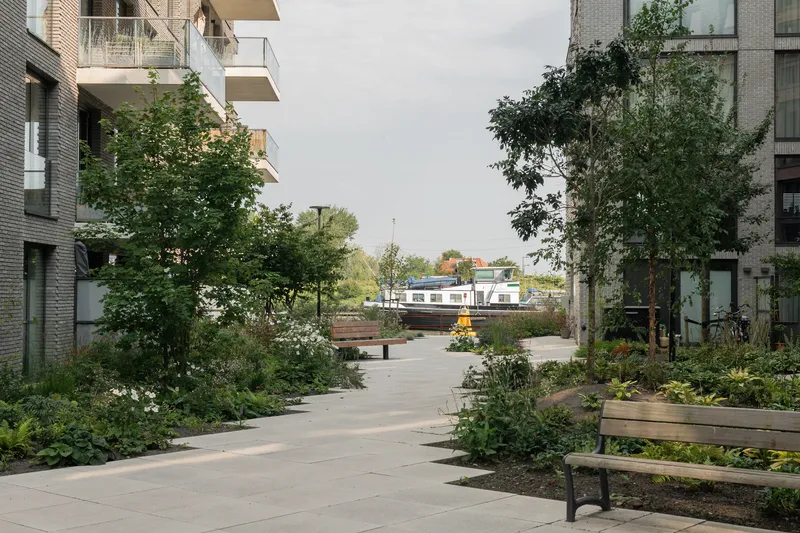
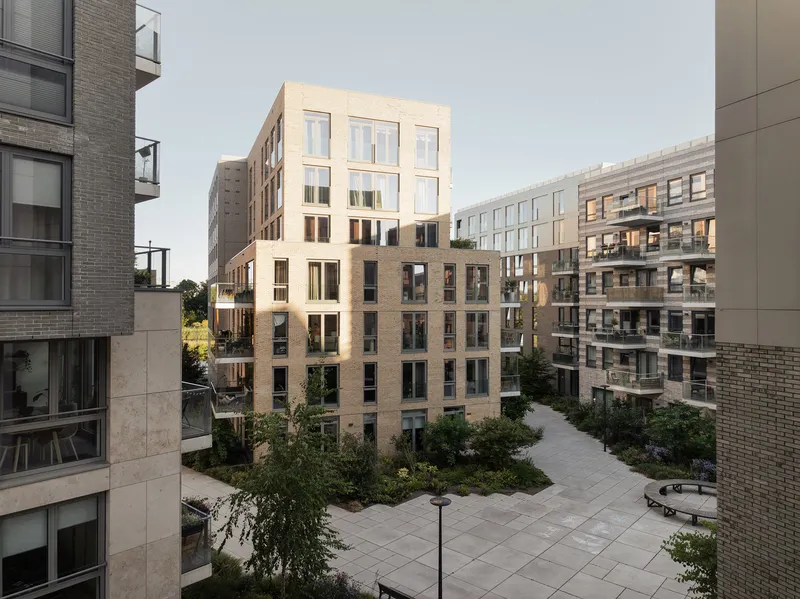
The interior courtyards are the project's quieter achievement. Raised planting beds, timber benches, young trees, and wildflower patches fill the spaces between blocks. Each courtyard has a slightly different character depending on its width, orientation, and the facades that frame it. Some are intimate and shaded; others are broad enough to catch afternoon sun. None of them feel leftover.
KCAP treats these spaces as the social infrastructure of the project. They are semi-private, visible from the apartments above but not directly accessible from the public promenade. That layering of threshold, from canal to path to courtyard to entrance, gives residents a gradient of exposure rather than a binary choice between public and private.
Thresholds and Passages
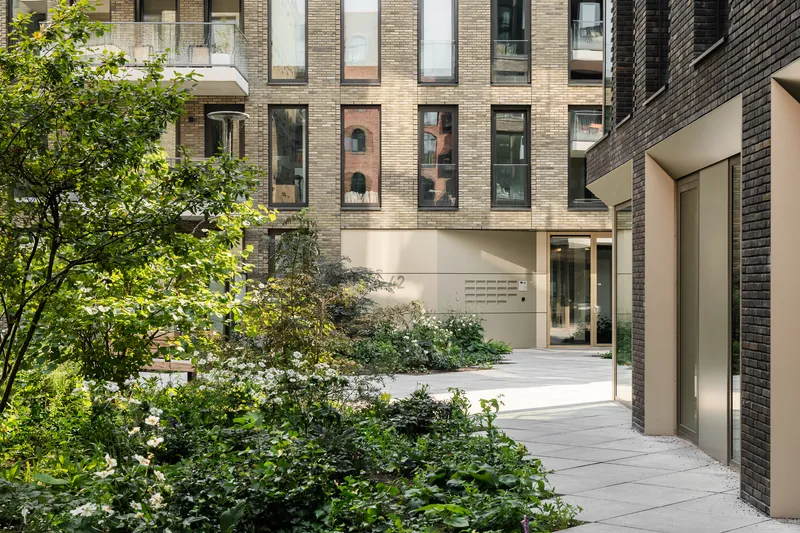
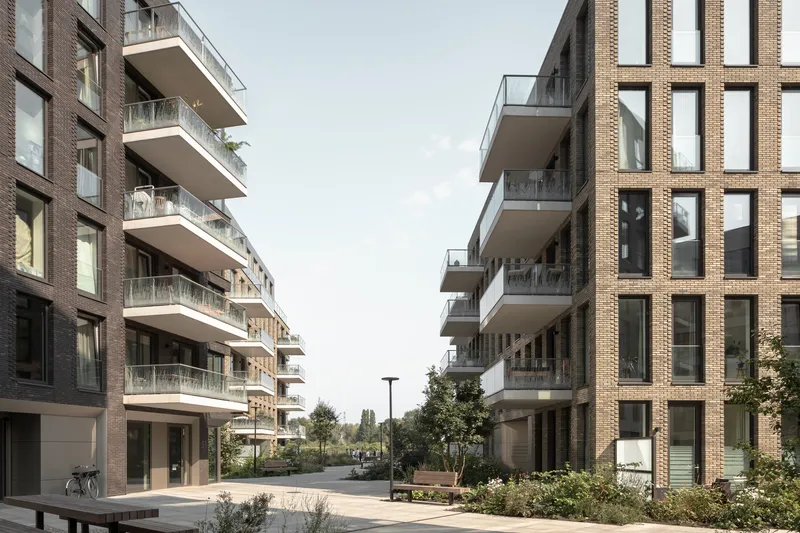
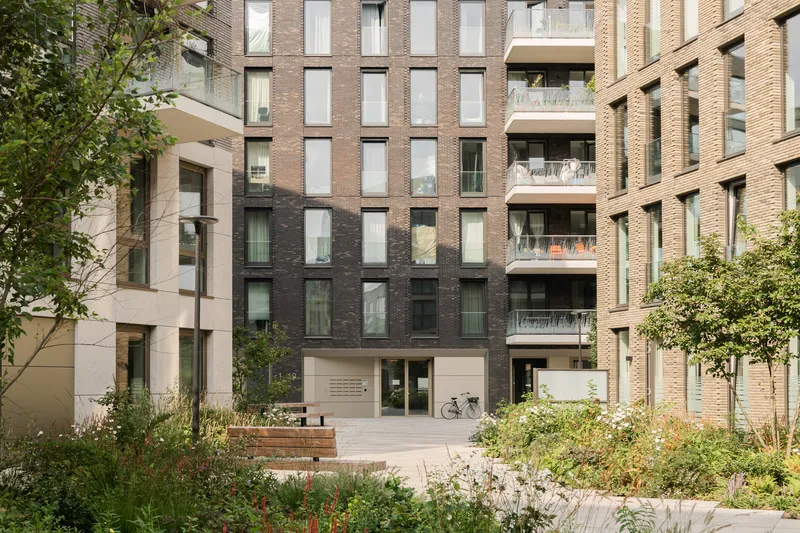
Narrow passages cut through the building volumes, connecting the waterfront promenade to the interior courtyards. Framed by dark brick walls and lined with planting, these breaks in the perimeter block are more than circulation shortcuts. They compress space before releasing it into the courtyard, creating a sense of arrival that a gap in a fence could never achieve. The sections where bicycles park alongside planted beds are unspectacular but functional: daily life is designed in, not bolted on.
Balconies, Light, and the Evening View
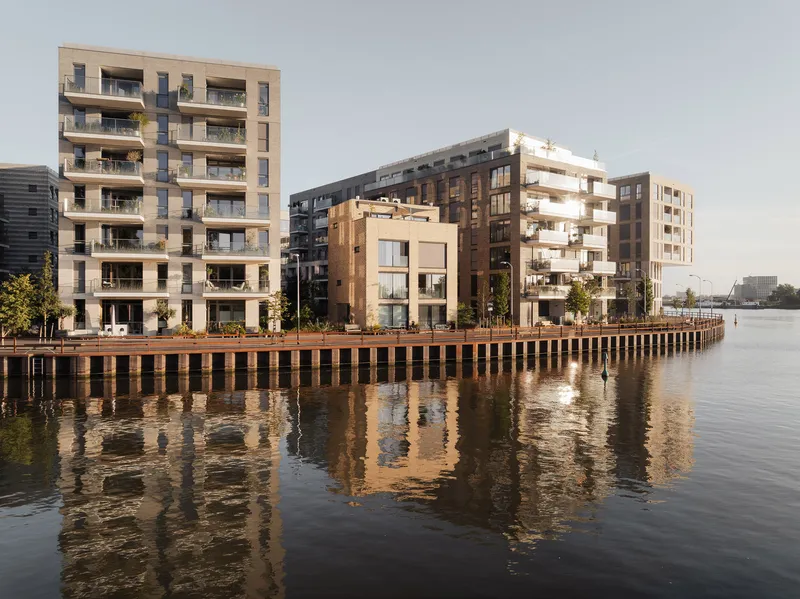
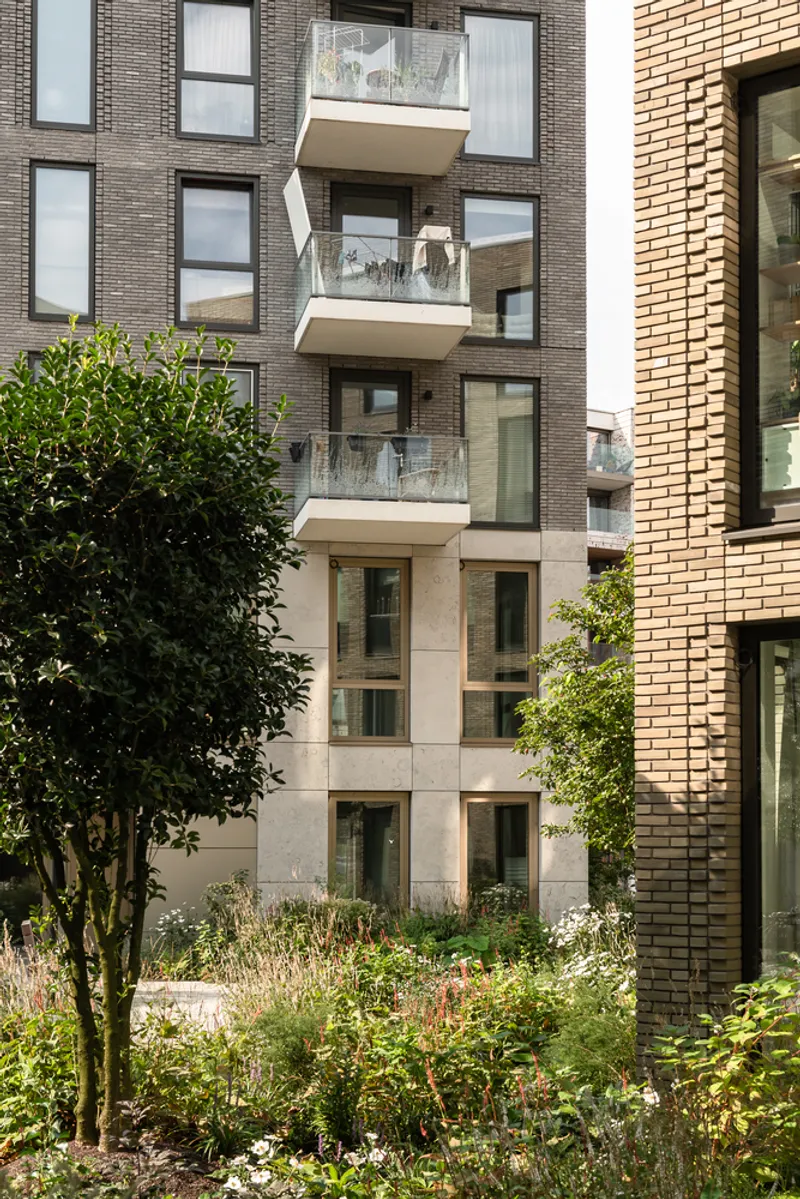
At dusk, the project reveals a different register. Warm interior light spills through the glass balcony railings, animating facades that read as solid and textured during the day. The cream-colored block in the ensemble glows against its darker neighbors. Recessed balconies create shadow lines that change with the hour, and the canal surface doubles everything in reflection. These are not accidental effects; the palette and massing are tuned to perform at multiple times of day.
Close-up, the stacked balconies reveal their depth. Glass railings, metal frames, and planted edges create a layered section at the facade that gives each unit a usable outdoor room rather than a decorative ledge. It is a familiar Amsterdam strategy, scaled up and delivered with enough material variety to avoid monotony.
Plans and Drawings
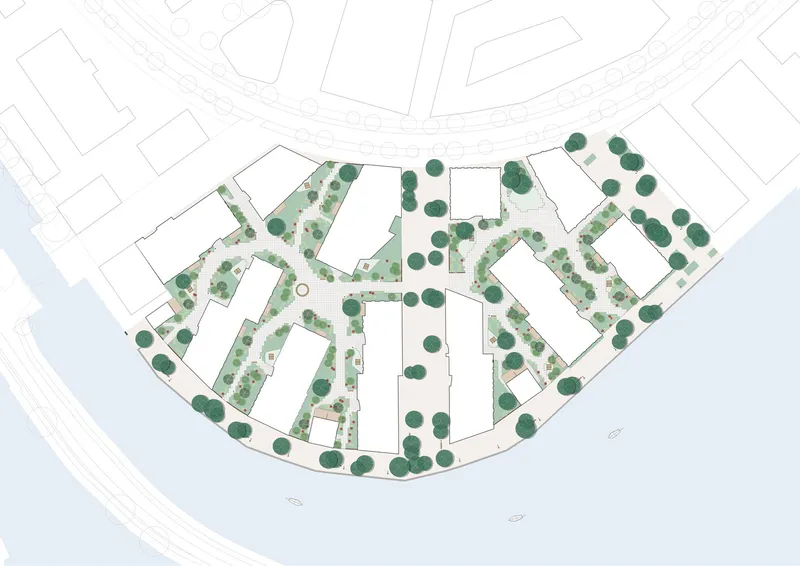
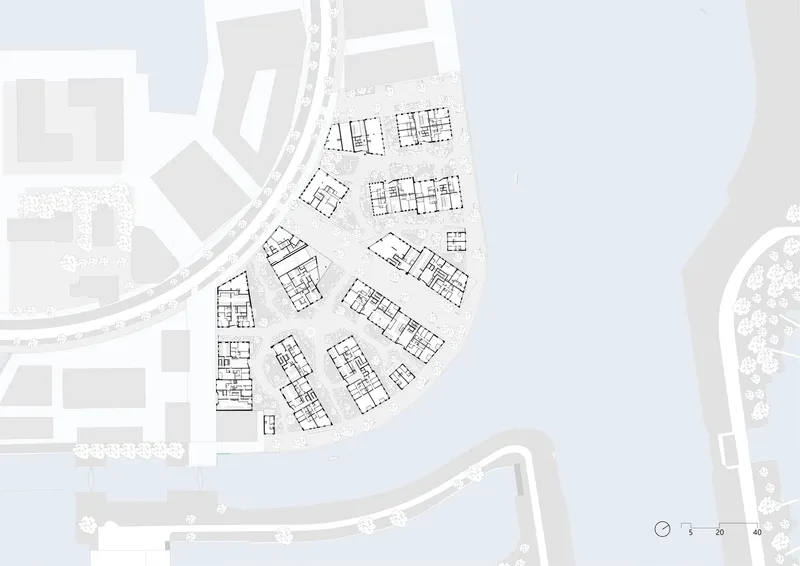
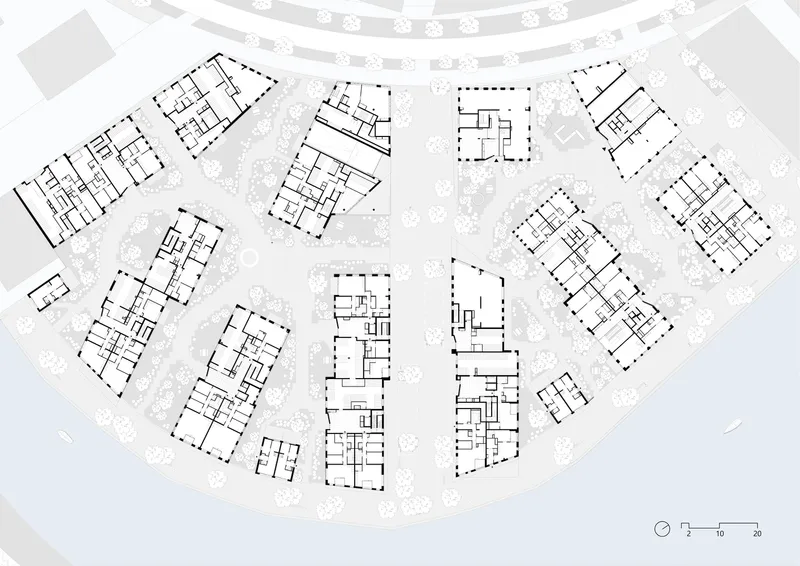
The site plan confirms what the aerial photographs suggest: the buildings are not arranged on a grid but on a series of angled axes that converge at the peninsula's eastern point. The fan configuration maximizes frontage along the canal while maintaining surprisingly deep courtyards at the center. Ground floor plans show how the block footprints interlock with perimeter tree planting and paved courtyard surfaces, establishing a clear hierarchy from public waterfront to semi-public garden to private entrance.
The floor plan drawing reveals the internal logic of the angled footprints. Apartments are organized to give the majority of units dual orientation, with living spaces facing the water and bedrooms overlooking the quieter courtyards. The rotation of each block creates slight irregularities in unit layouts that a strictly orthogonal plan would not permit, offering the kind of spatial variety that residents actually notice.
Why This Project Matters
Cruquius Island Housing does not advance a manifesto. It does something harder: it delivers a large quantity of housing on a constrained waterfront site without defaulting to the slab-and-podium formula that dominates comparable developments across Europe. The fan plan is the key move, turning a tapering plot into an asset and generating outdoor spaces with genuine character. KCAP's decision to vary brick tone and window rhythm across blocks gives the project the grain of a neighborhood rather than a single building, which is exactly what a former industrial peninsula needs to feel habitable.
The broader lesson is about choreography. Density is not just a number; it is a sequence of experiences. From the open canal promenade to the compressed brick passages to the planted courtyards to the private balcony, Cruquius Island offers residents and visitors a legible gradient of public and private space. That gradient is the difference between housing and a neighborhood. KCAP has delivered both.
Cruquius Island Housing, Amsterdam, The Netherlands, by KCAP. Photography by Marcel IJzerman and Sebastian van Damme.
About the Studio
Share Your Own Work on uni.xyz
If projects like this are the kind of work you want to make, uni.xyz is a place to publish your own, find collaborators, and enter design competitions.




Popular Articles
Popular articles from the community


The Earth Pod: 3D Printed Homes for Resilient Refugee Communities
The Earth Pod reimagines refugee housing through 3D printed homes made from clay, combining resilience, self-sufficiency, and rapid shelter.

Co-life: Sustainable Architecture for Age-Friendly Community Living
Co-life reimagines sustainable architecture for seniors through courtyards, rammed earth, shared gardens, and spaces designed for belonging.

Hill & Cross Opera: Sculptural Opera House Architecture Shaped by Tallinn’s Landscape and Identity
Hill & Cross Opera reimagines opera house architecture in Tallinn through its sculptural hill, civic plaza, glass wave and a luminous cross.

Co-Life: Senior Housing Design That Reconnects Older Adults With the City
Co-Life reimagines senior housing design through healing gardens, shared streets, workshops, and a sustainable community across generations.


Similar Reads
You might also enjoy these articles


Hodi-Mandai Geram
Project Function: Preservation and revitalization of the Intangible heritage and socio-spatial identity of the Hodi by Housing, Cultural Memory Center, Sacred Grove, landscape, local tourism economy


Olio Towers: A Mid-Rise for Performers That Fuses Housing, Rehearsal, and Stage
Located blocks from Houston's Theater District, this modular tower stacks living units around a central performance atrium.

Oasis: Modular Green Housing Carved into Dhaka's Urban Fabric
A shortlisted Plugin Housing entry reclaims unauthorized settlements in Dhaka with stepped concrete volumes, green roofs, and ventilation-driven design.

Black Hole: A Floating Megastructure for the Post-Physical Era
Emiliano Mazzarotto envisions a spherical, self-scaling arena where e-sports, digital hotels, and holographic stadiums replace traditional public space.


Explore Riverfront Development Competitions
Discover active competitions in this discipline


Challenge to design mud housing for contemporary communities


Challenge to reimagine the Iron Throne


Photograph architecture without architects


Illustrate the lost glory of Angkor Wat - Render Challenge
Comments (0)
Please login or sign up to add comments
No comments yet. Be the first to comment!