
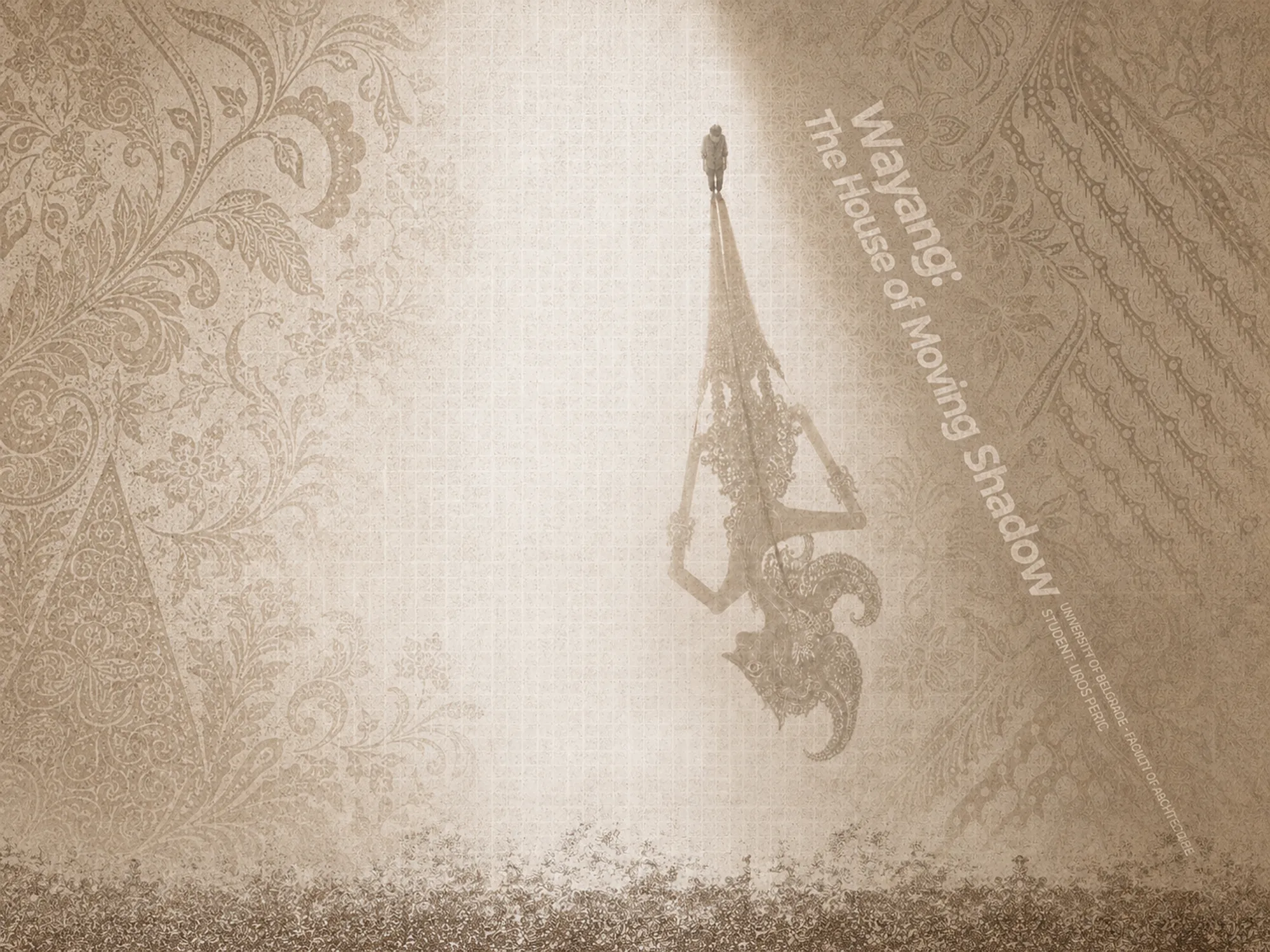
Wayang: The House of Moving Shadows
Where Shadows Become Architecture


A Visitor Center for Light, Craft and Living Heritage
The project begins with the Indonesian tradition of wayang, not simply as a visual reference, but as a complex cultural system. At first glance, wayang may appear to be a form of puppet theatre. However, through research, it becomes clear that it is much more than that. It combines craftsmanship, storytelling, movement, ritual, light, and shadow into one performative act. The puppet itself is only one part of the system. Its meaning appears through the hand that moves it, the rod that supports it, the joints that allow it to bend, the screen that separates performer and audience, and the light that transforms a material object into a projected image.
This relationship between object, movement, and projection became the starting point of the project. Rather than designing a museum that simply displays wayang as a preserved artifact, the ambition was to create a visitor center where the tradition becomes active again. The project does not attempt to represent every variation of wayang literally. Instead, it extracts its core principles: linear control, articulated movement, layering, perforation, translucency, and the transformation of material into shadow. These principles are translated into architecture, creating a space where visitors can experience wayang through movement, making, light, and atmosphere.
The site strategy also supports this idea. Located approximately three kilometers from the existing Wayang Museum in Jakarta, the project is imagined as a natural extension of the museum experience. While the museum preserves and exhibits the material heritage of wayang, this visitor center offers its interactive counterpart. It shifts the experience from looking at artifacts behind glass to engaging with the craft, its processes, and its spatial effects. The surrounding context, which includes a significant number of facilities and programs for children, further strengthens the relevance of the project. It creates an opportunity to introduce younger generations to their own cultural heritage in a way that is accessible, playful, and contemporary.

From Puppet Structure to Architectural Structure
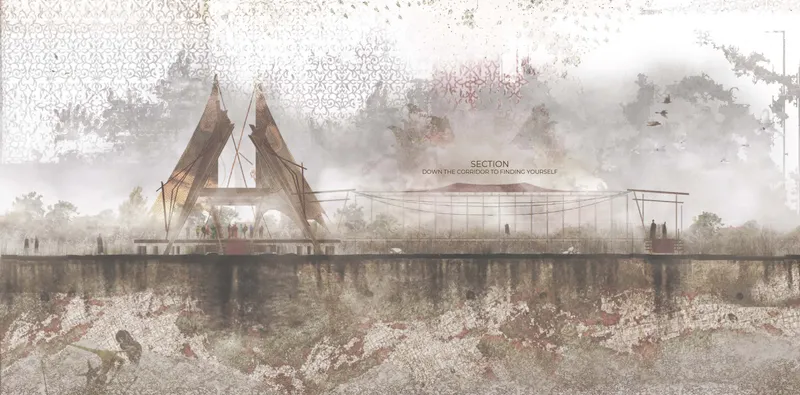
The formal and spatial development of the project comes from the structure of the wayang puppet itself. The long linear corridors are inspired by the central rod that holds and controls the puppet. In the project, these corridors become organizing elements: they guide movement, connect programs, and establish the main spatial direction of the building.
The sharper breaks and changes in direction are derived from the articulated joints of the puppet. In wayang, the joint is what allows expression. It creates gesture, tension, and sudden transformation. In the architecture, this idea becomes a system of intersections, shifts, and spatial cuts. The plan is therefore not treated as a static composition, but as a body in motion.
Another important reference is the screen. In traditional wayang performance, the screen is both a boundary and a medium. It separates the performer from the audience, but it also makes the performance possible. This duality is translated into the building through layered facades, canvas surfaces, and spaces that can be experienced from both sides. The visitor is not limited to the position of the audience. At certain moments, they can enter behind the screen and understand the mechanisms that create the image.
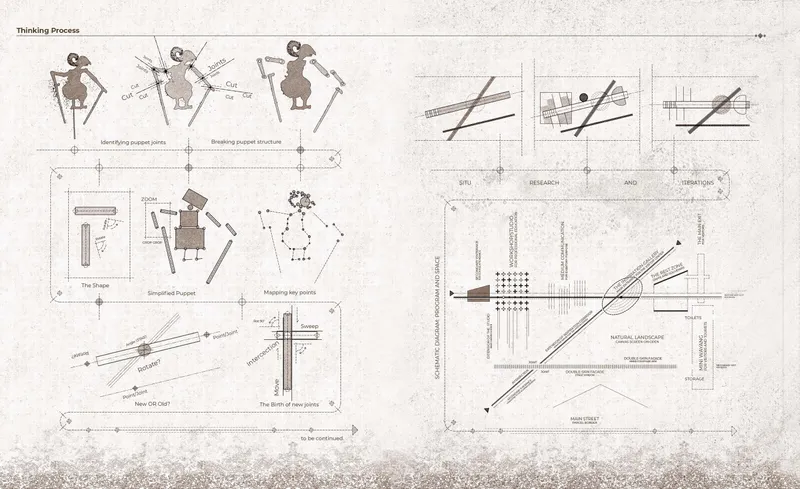
Program as a Living Craft System
The program of the visitor center is based on two different levels of participation. The first is designed for visitors, tourists, and children. It offers a short and accessible introduction to wayang making, where participants can create simplified paper puppets in workshops lasting around thirty to forty-five minutes. This allows the experience to remain immediate, playful, and memorable. The object made during the workshop can be taken home, extending the experience beyond the visit itself.
The second level is more serious and locally oriented. It is dedicated to professional craft education. This part of the center offers structured training in traditional puppet-making techniques, including cutting, perforating, painting, assembling, and controlling the figures. The goal is not only to present the craft, but to support its continuity by forming new generations of local artisans.
This dual program also responds to the question of economic sustainability. Many visitor centers depend mainly on ticket sales and seasonal tourism, which makes them financially fragile. Here, the building works as a hybrid institution: a cultural venue, an educational facility, a working workshop, and a production space. Revenue can come from tourist workshops, professional courses, the sale of handmade souvenirs, and planned production of craft objects made within the center. In this way, the project does not simply consume cultural heritage as a theme. It creates a system through which that heritage can be practiced, taught, and sustained.
The Double Corridor and the Space Behind the Screen
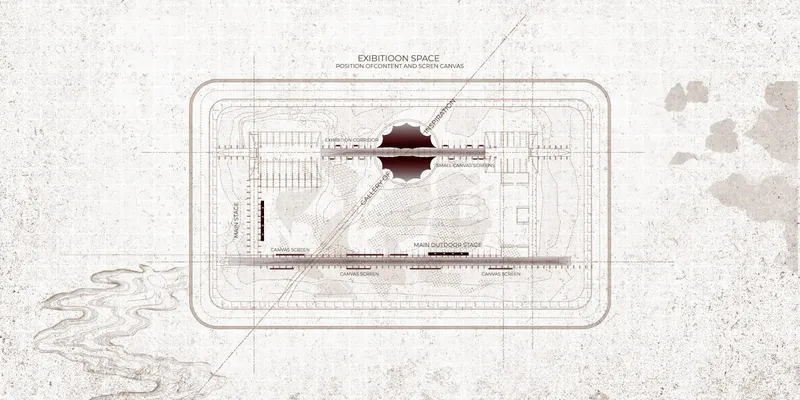
One of the key architectural elements is the double-layered corridor. It functions as circulation, facade, screen, and performance zone at the same time. From the inside, it can operate as a stage for wayang-inspired performances and projections. From the outside, it becomes a kind of urban window, allowing people passing by to glimpse the movement, light, and shadows inside.
The space between the two layers allows visitors to move through the facade itself. This creates an experience of being “behind the scene,” which is central to the concept. Wayang is not only about the final image seen by the audience. It is also about the hidden process that produces that image. By allowing visitors to pass through this threshold, the building reveals the backstage condition and makes the process part of the experience.
The Inner Courtyard: Nature as Counterpoint
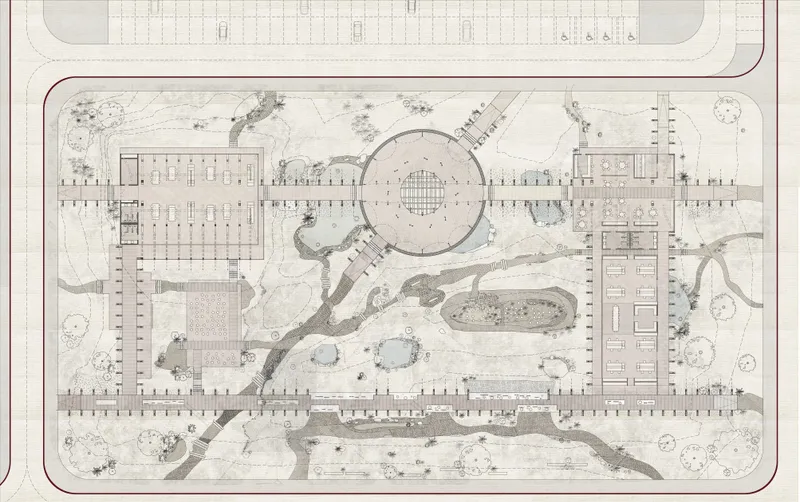
At the center of the project is an inner courtyard that is not designed as a formal park, but as a controlled interpretation of the Indonesian landscape. Tall grasses, shallow water surfaces, irregular stone paths, and native plant species create an atmosphere that feels spontaneous and almost untouched. The intention is not to create a decorative garden, but a natural counterpoint to the kinetic architecture around it.
While the building moves, rotates, filters light, and produces shadows, the courtyard remains still and rhythmic. It becomes a pause between programmatic zones, a place for reflection, and an ambient stage where light, water, vegetation, and shadow interact more quietly. This contrast is important: the project needs both movement and stillness. The architecture performs, while the landscape grounds it.
Expansion, Time and Long-Term Sustainability
The project is designed to remain active beyond the immediate visitor experience. Its expansion is not imagined only as a physical enlargement of the building, but as the gradual growth of its educational, productive, and cultural capacity. Because the craft education program can operate continuously throughout the year, the center has the potential to become a stable place of employment and professional development for the local community.
This gives the project a level of independence from seasonal tourism. While tourists contribute through short workshops and visits, the center can also sustain itself through long-term training groups, professional courses, and the production of handmade objects. Souvenirs made during workshops become part of the visitor economy, while professionally crafted wayang puppets can be produced and sold to collectors, performers, cultural institutions, and professionals working within the field of traditional theatre and craft.
During larger festivals and cultural events, the entire complex can expand its role. It can function not only as a visitor center, but also as a temporary production ground for puppets, scenographic elements, craft installations, and other related handmade objects. In this way, the project can adapt to moments of increased cultural activity, supporting both public events and local makers.
Over time, the building also transforms through light, weather, movement, and landscape. During the day, the direction and intensity of shadows change. During performances, rotating panels and figures activate the canvas surfaces. Across seasons, the courtyard vegetation grows, shifts, and softens the architecture. On a longer timescale, the educational and production programs allow the project to evolve with the community that uses it.
A House Where Shadows Move
“Wayang: The House of Moving Shadows” is a project about transforming tradition into experience. It does not treat wayang as a fixed image from the past, but as a living method for thinking about space. The puppet’s rod becomes a corridor. Its joints become spatial breaks. Its screen becomes a facade. Its perforated surface becomes a material strategy. Its shadow becomes the atmosphere of the building.
The visitor center is therefore not only a place for watching, but for entering, making, learning, and performing. It connects tourists, children, local residents, and artisans through different levels of participation. It offers a cultural experience, but also proposes an educational and economic model for keeping the tradition alive.
Ultimately, the project explores how architecture can behave like wayang itself: layered, kinetic, illuminated, and narrative. It is a house where light becomes material, movement becomes structure, and shadows continue to tell stories.




Popular Articles
Popular articles from the community


Riyadh For All: Intergenerational Urban Design for Active Aging in Rabat
Riyadh For All reimagines urban design in Rabat with intergenerational co-living, adaptive courtyards, and Moroccan cultural exchange today.

Conexión: Biophilic Design Reimagines High-Rise Living in Hong Kong
Conexión reimagines high-rise living in Hong Kong through biophilic design, green facades, shared spaces, daylight, water and nature within.

The Earth Pod: 3D Printed Homes for Resilient Refugee Communities
The Earth Pod reimagines refugee housing through 3D printed homes made from clay, combining resilience, self-sufficiency, and rapid shelter.
AL-JANNAH: Sustainable Architecture and Permaculture for Afghan Widows
AL-JANNAH uses sustainable architecture and permaculture to create resilient oasis of housing, learning, work and renewal for Afghan widows.

Similar Reads
You might also enjoy these articles

Day and Night Park: A Time-Based Urban Newsstand in Beijing
A temporary urban newsstand in Beijing blending travel, light, and reading through poetic colors, compact form, and community-focused design.

Modernist Patio Renovation in El Masnou, Barcelona by Oliver Segura Arquitectura + Cebrià Arquitectura
Modernist patio renovation blending tradition and innovation with a movable pool, leveled floors, and Catalan materials in El Masnou.

Alto Residencial Coop: Cooperative Housing Development in Santiago de Compostela by Carbajo Barrios Arquitectos
A linear cooperative housing complex blending white volumes and perforated metal façades, enhancing community living, natural light, privacy, and urban integration.
Vil Genis School by BPA ARCHITECTURE – Massy, France
Vil Genis School in Massy, France, features sustainable design, south-facing classrooms, community integration, accessible spaces, and modern educational architecture.


Explore Architecture Competitions
Discover active competitions in this discipline




Challenge to reimagine the Iron Throne


Photograph architecture without architects


Illustrate the lost glory of Angkor Wat - Render Challenge


Design challenge to reuse E-waste
Comments (0)
Please login or sign up to add comments
No comments yet. Be the first to comment!