
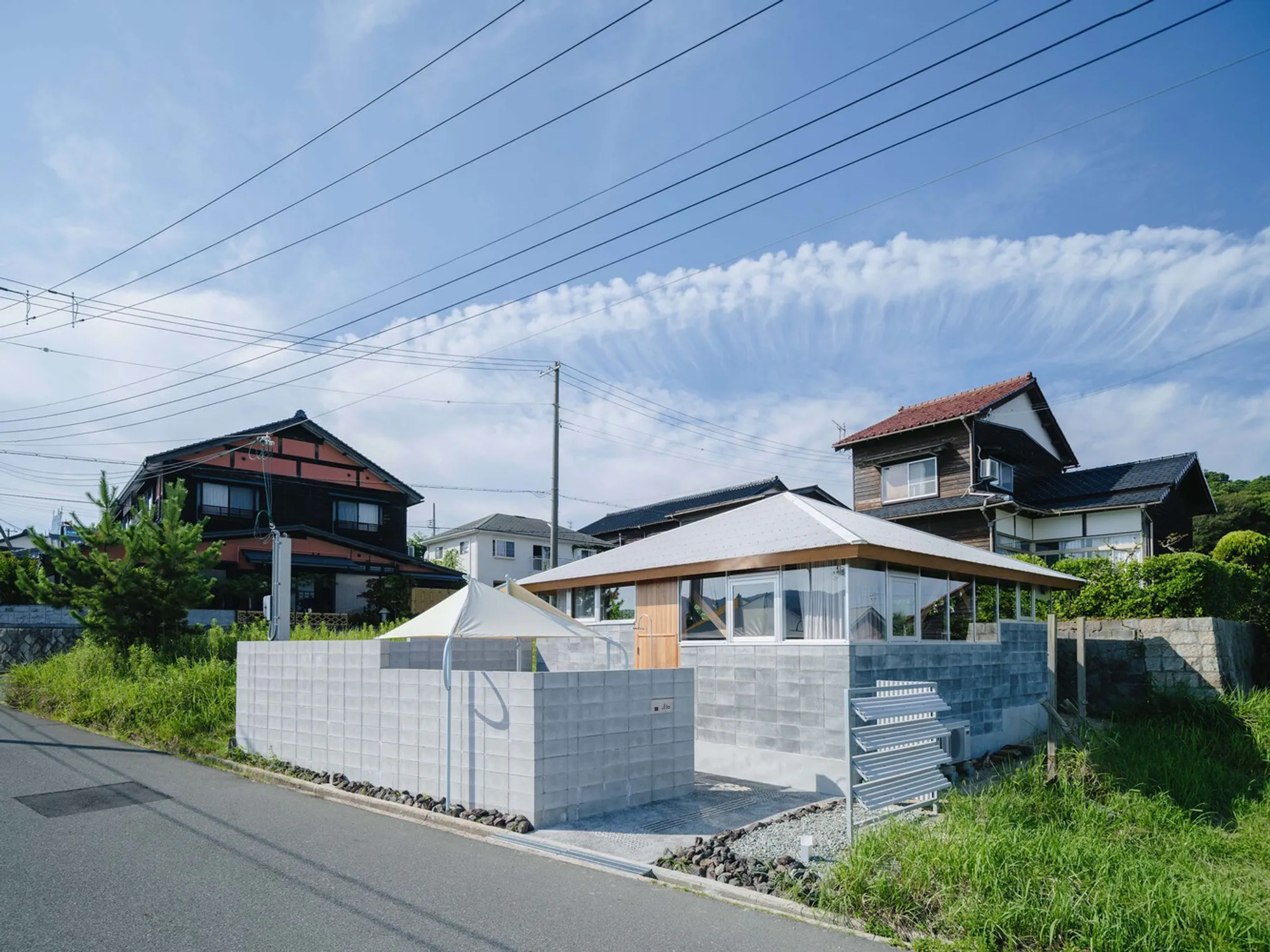
Weekend House in Kyotango by Hideo Arao Architects Office: A Coastal Surf Retreat Blending Minimalism and Nature
A minimalist 54 m² surf retreat in Kyotango by Hideo Arao Architects, blending concrete, wood, and nature seamlessly.


The Weekend House in Kyotango, designed by the innovative Hideo Arao Architects Office, is a striking 54 m² weekend retreat and guesthouse located on the rugged western edge of the Tango Peninsula in northern Kyoto Prefecture, Japan. Completed in 2023, this architectural gem offers a minimalist yet poetic response to its unique coastal context, designed as a base camp for a couple who share a passion for surfing and nature.
A Surf Haven at Hacchohama, Facing the Sea Breeze
Nestled near the famed Hacchohama surf spot along the Sea of Japan, the house is strategically positioned to capture the sound of crashing waves and the soft whisper of the sea breeze. Its proximity to both the ocean and the mountains gives it a dual character: part seaside retreat, part mountain hideaway. Rather than serving as a conventional vacation home, the design acts as a flexible, adaptive base for exploration, offering a retreat where the homeowners can fully immerse themselves in the surrounding natural beauty.
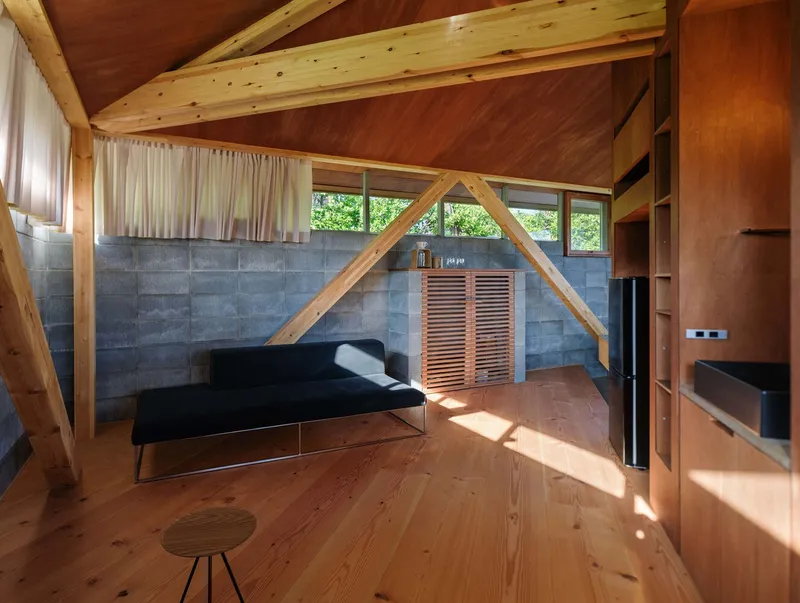
Architectural Concept: Beyond Prefabrication, Toward Universality with Identity
In a time of rising material costs and global lumber shortages, Hideo Arao set out to explore how architecture can balance universality with distinctive identity. Unlike mass-produced prefab houses, the Weekend House in Kyotango was envisioned as a second base — a prototype for creating similarly adaptable structures in different landscapes, each with its own character yet sharing a recognizable architectural DNA.
This approach departs from cookie-cutter vacation homes, focusing instead on localized material strategies and site-specific design responses that engage deeply with place and context.
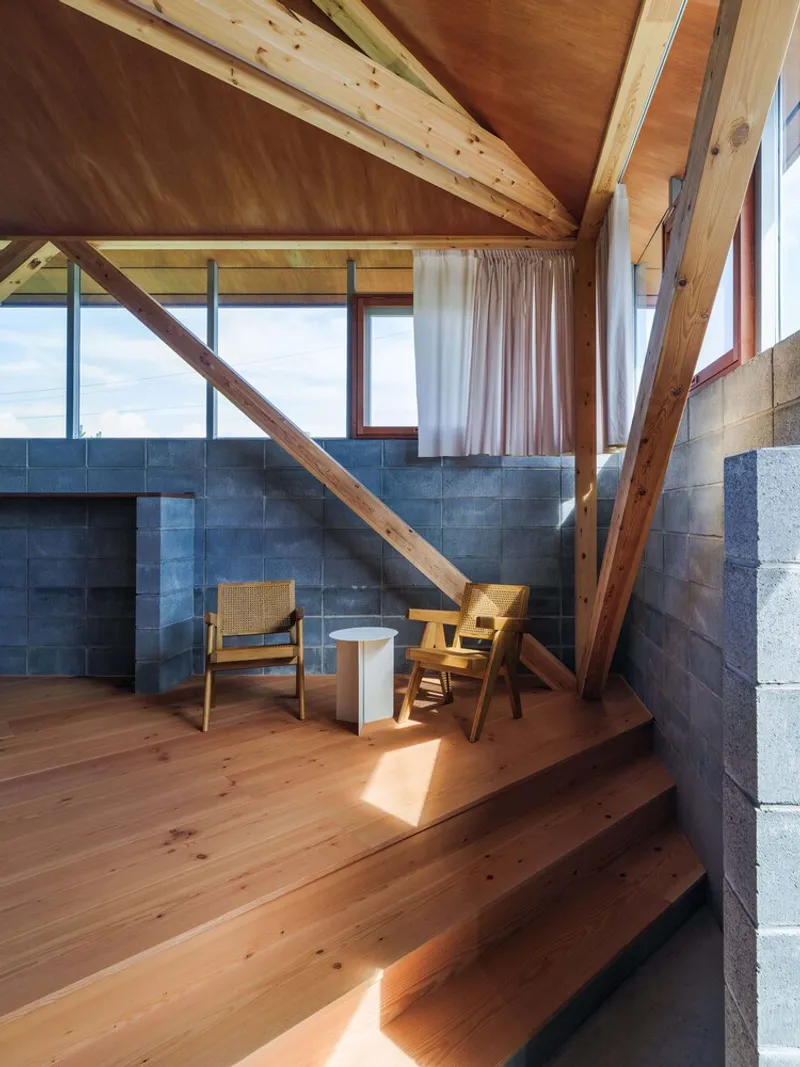
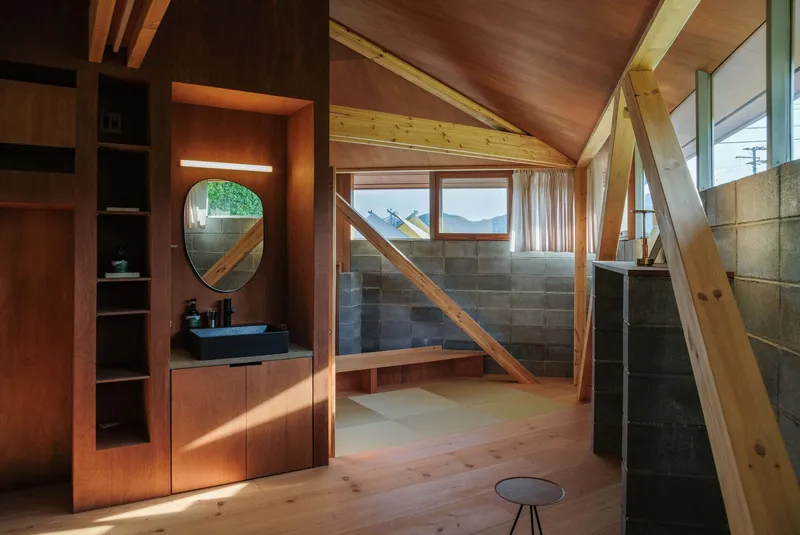
Materiality: Concrete Blocks, Glass, and Minimal Structural Framing
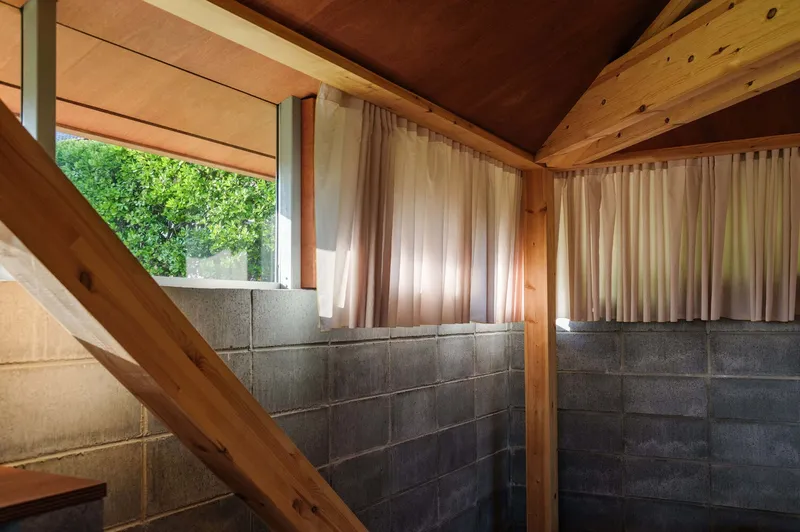
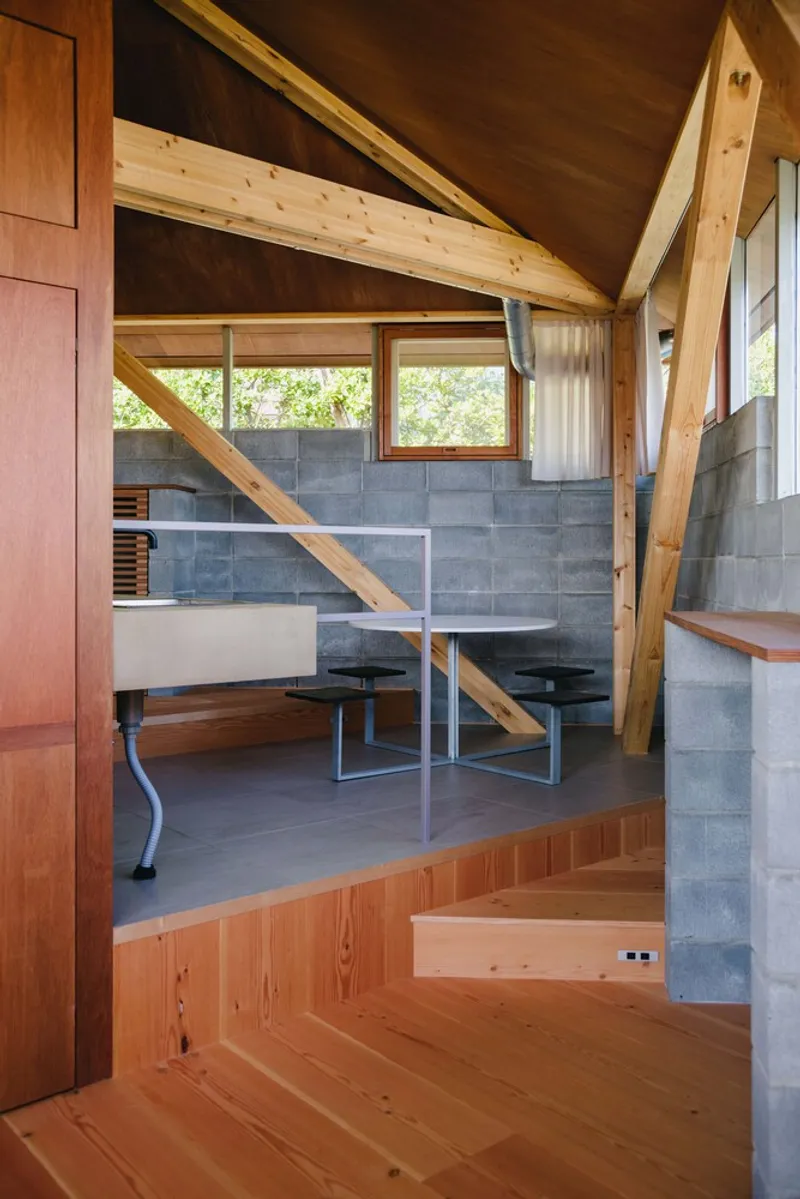
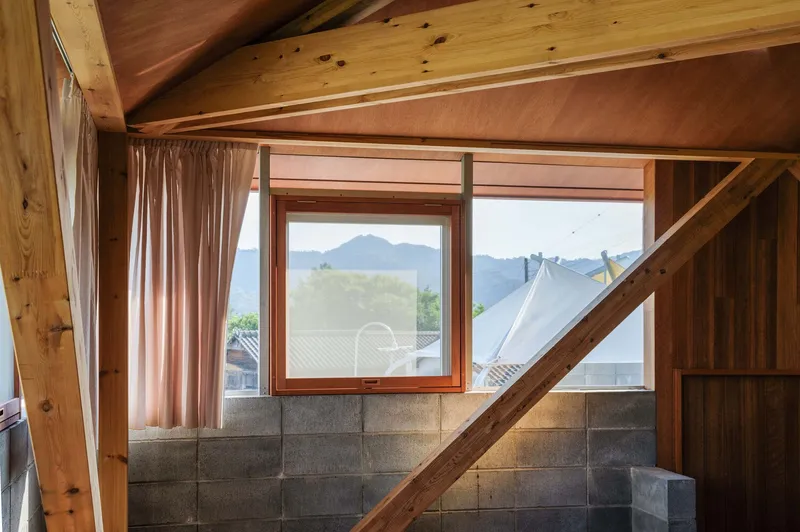
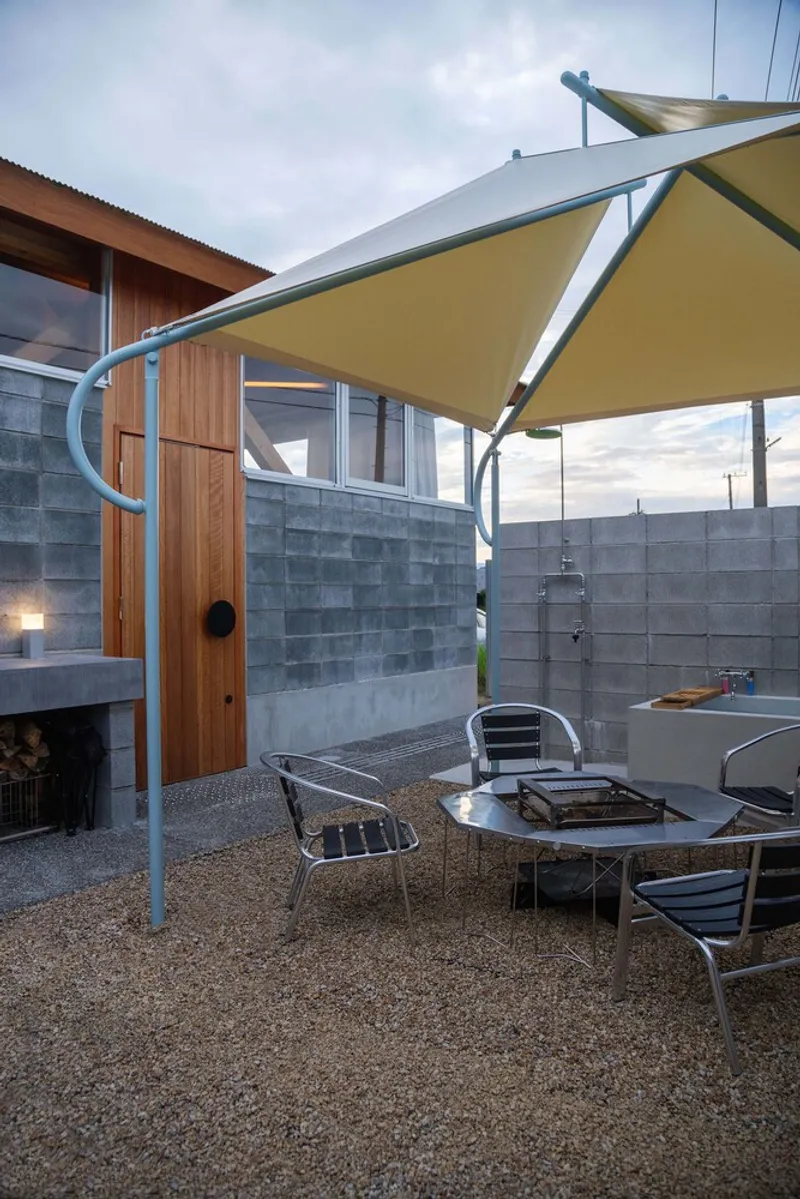
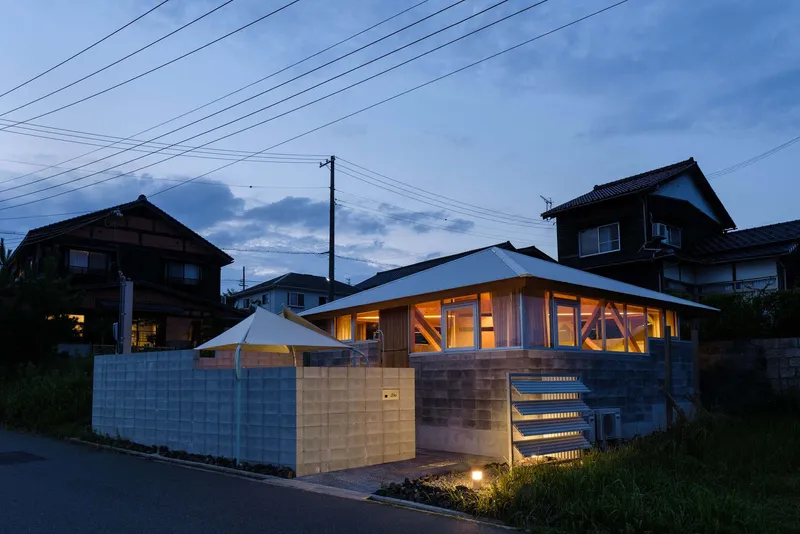
The house’s material palette is a study in simplicity and availability. Using readily accessible concrete blocks as curtain walls, the design minimizes the need for primary structural materials while achieving a robust and sculptural exterior. Glass inserts are delicately placed between these concrete blocks and the eaves, creating a luminous and visually porous envelope that connects the interior with the outside world.
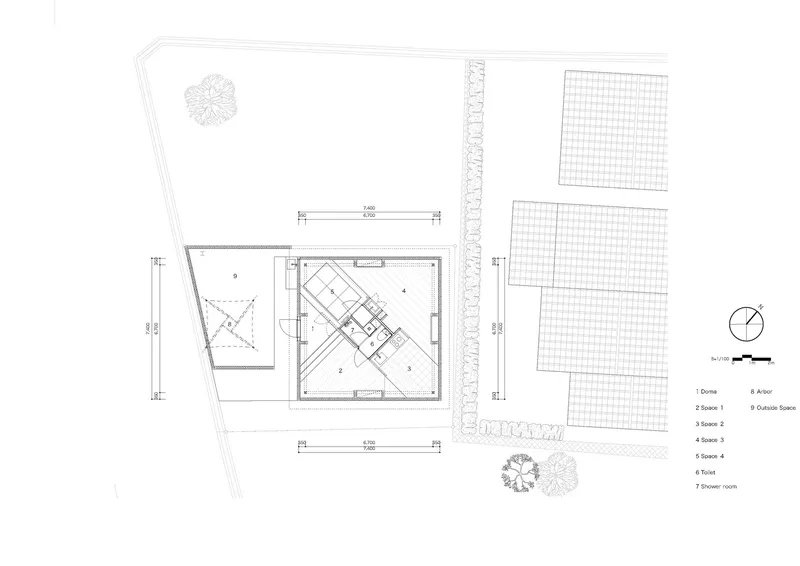
The building’s wooden frame structure is designed for maximum efficiency, keeping the footprint economical and the construction sustainable. The outer perimeter of the house forms a precise square, maximizing usable area within the compact site while maintaining cost-effectiveness.
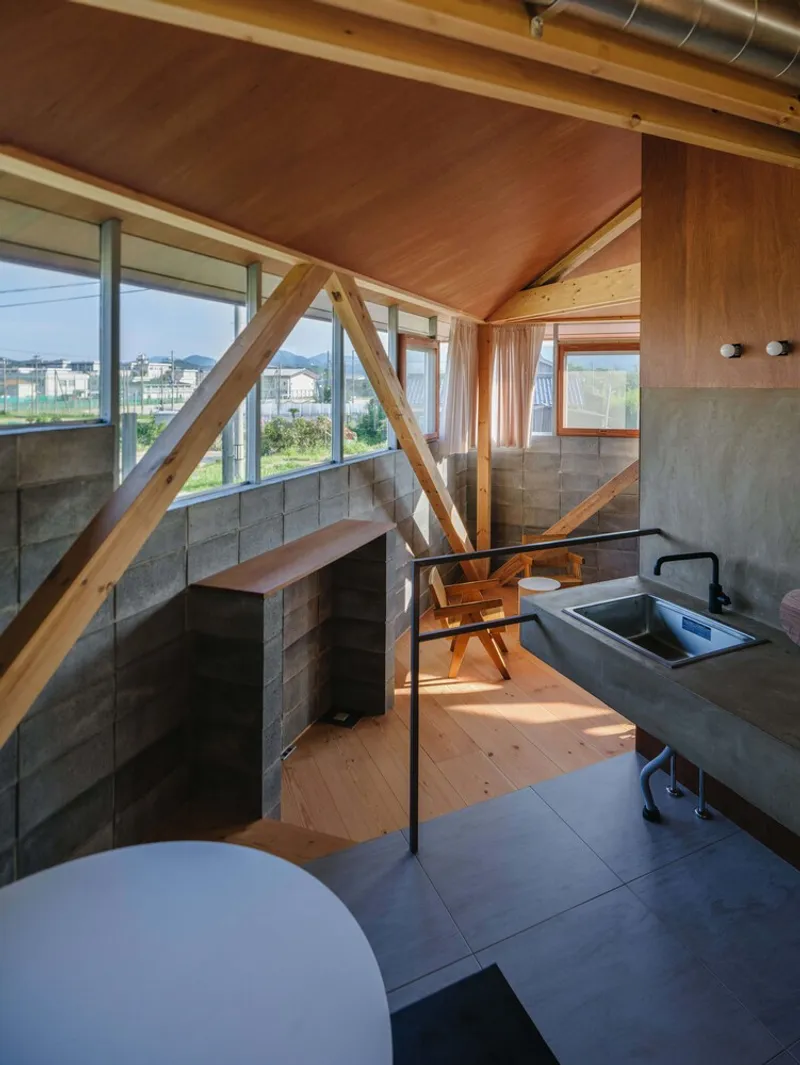
Spatial Dynamics: Diagonal Beams, Distorted Spaces, and Rhythmic Windows
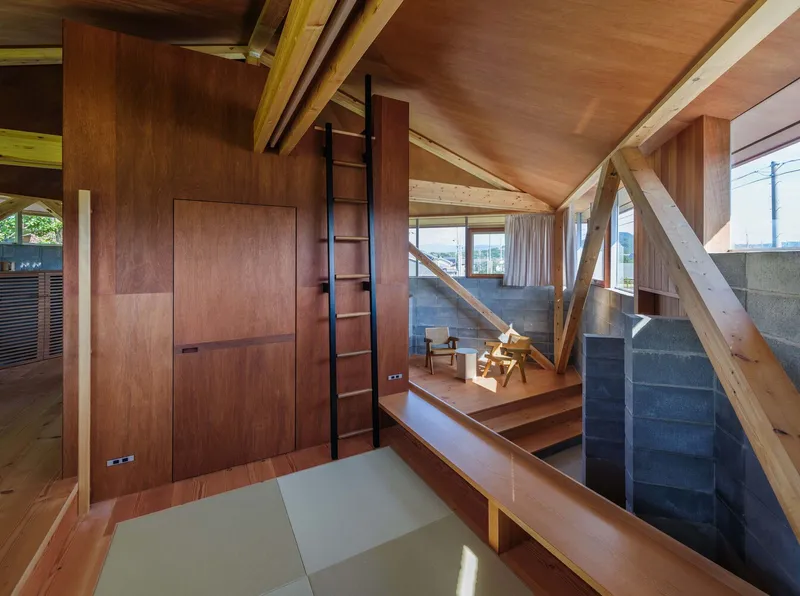
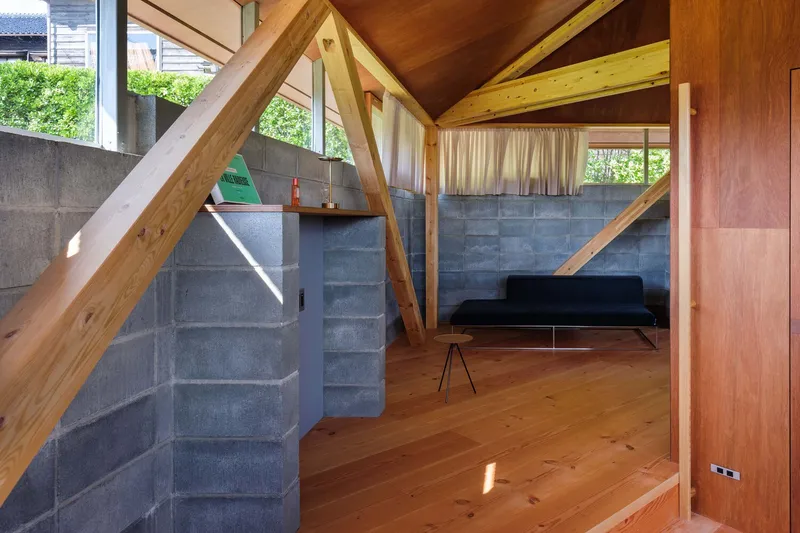
A distinctive feature of the Weekend House is the series of diagonal beams crossing the interior space at 45 degrees, aligning with the climbing beams of the square roof. This geometric choreography emerges from the positioning of the utility core, which acts as the spatial anchor of the house.
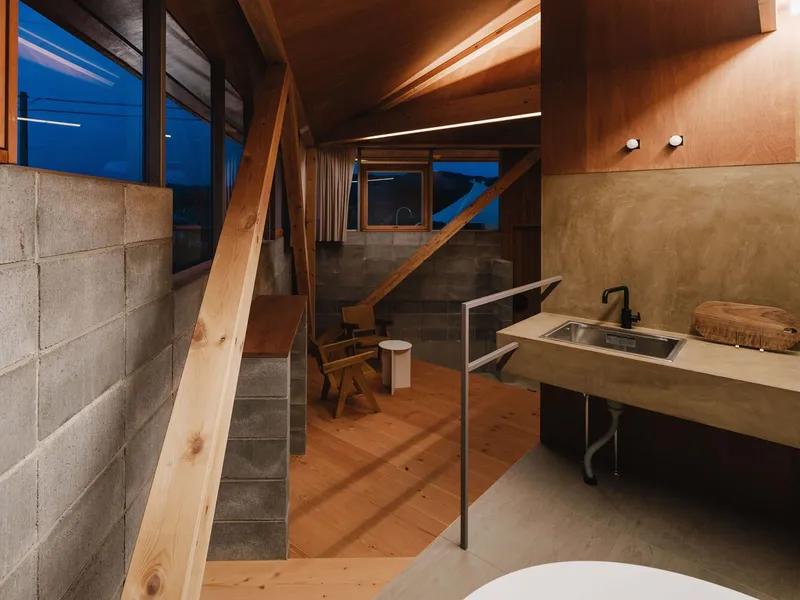
The formation of the utility core generates distorted spaces between the exterior concrete walls, wrapping around the core and responding to the site’s natural level differences through varied floor levels. This creates a dynamic and flowing internal landscape, where spaces unfold sequentially without being rigidly defined by the structural grid.
Horizontal ribbon windows extend continuously in all directions, their placement carefully calibrated to the height determined by the block specifications. This establishes a rhythmic proportionality, bringing in sweeping views, natural light, and visual connectivity while maintaining a sense of privacy.
Compact Footprint, Expansive Living
Despite its modest 54 m² size, the Weekend House in Kyotango feels anything but confined. Its clever layout and unobstructed spatial flow allow for a generous, open-plan living experience, blurring the boundaries between inside and out. The design prioritizes flexibility and openness, making it an ideal setting for the couple’s surfing adventures and tranquil weekends immersed in nature.
A Model for Future Nature-Based Retreats
This project is more than just a beautiful beach house — it serves as a prototype for future small-scale, site-sensitive retreats that combine sustainability, affordability, and architectural elegance. Hideo Arao Architects Office demonstrates that thoughtful design can transform humble materials into extraordinary spaces, offering homeowners not just a building, but a meaningful connection to place.
All Photographs are works of Yosuke Ohtake



Popular Articles
Popular articles from the community


The Ocean Hive: Sustainable Architecture for a Self-Sufficient Civilization at Sea
The Ocean Hive imagines sustainable architecture at sea, where modular habitats, algae, wave power and ocean waste sustain a growing colony.

The Musturak Paradise: Senior Living Architecture for a Connected Future in Temara, Morocco
The Musturak Paradise reimagines senior living architecture in Temara via private homes, social spaces, culture, community, and shared care.

Conexión: Biophilic Design Reimagines High-Rise Living in Hong Kong
Conexión reimagines high-rise living in Hong Kong through biophilic design, green facades, shared spaces, daylight, water and nature within.

Co-Life: Senior Housing Design That Reconnects Older Adults With the City
Co-Life reimagines senior housing design through healing gardens, shared streets, workshops, and a sustainable community across generations.


Similar Reads
You might also enjoy these articles


Hodi-Mandai Geram
Project Function: Preservation and revitalization of the Intangible heritage and socio-spatial identity of the Hodi by Housing, Cultural Memory Center, Sacred Grove, landscape, local tourism economy


Olio Towers: A Mid-Rise for Performers That Fuses Housing, Rehearsal, and Stage
Located blocks from Houston's Theater District, this modular tower stacks living units around a central performance atrium.

Oasis: Modular Green Housing Carved into Dhaka's Urban Fabric
A shortlisted Plugin Housing entry reclaims unauthorized settlements in Dhaka with stepped concrete volumes, green roofs, and ventilation-driven design.

Black Hole: A Floating Megastructure for the Post-Physical Era
Emiliano Mazzarotto envisions a spherical, self-scaling arena where e-sports, digital hotels, and holographic stadiums replace traditional public space.


Explore Tetsuo Kobori Architects Competitions
Discover active competitions in this discipline



Challenge to reimagine the Iron Throne


Photograph architecture without architects


Illustrate the lost glory of Angkor Wat - Render Challenge


Design challenge to reuse E-waste
Comments (0)
Please login or sign up to add comments
No comments yet. Be the first to comment!