
Wheeler Kearns Architects Grows a Working Greenhouse That Doubles as a Dining Hall on a Michigan Farm
A prefabricated Dutch Venlo greenhouse hosts seedling production, farm-to-table dinners, and community life in Three Oaks, Michigan.


Most greenhouse projects in architecture media exist as pristine pavilions, botanical follies designed to look good from one angle and never get dirt under their nails. The Granor Greenhouse, designed by Wheeler Kearns Architects, is not one of those buildings. It is a 7,336-square-foot prefabricated glass structure dropped onto the first certified organic vegetable farm in Southwest Michigan, and it gets used hard: seedling germination in the morning, baking bread at midday, hosting long-table dinners by evening. The building does not perform flexibility as a concept. It practices it as a daily condition.
What makes the project worth studying is less its form, which is honestly unremarkable from a distance, and more its organizational intelligence. Wheeler Kearns took a commercial Dutch Venlo greenhouse kit-of-parts system and layered program into it with precision: three distinct zones separated by glazing strategy, wood-clad service volumes that carve out a kitchen, office, and restrooms without ever feeling permanent, and a polished concrete floor that conceals most of the mechanical equipment beneath it. The result is a building that feels like infrastructure first and architecture second, which on a working farm is exactly the right order.
A Farm Building That Fits the Farm

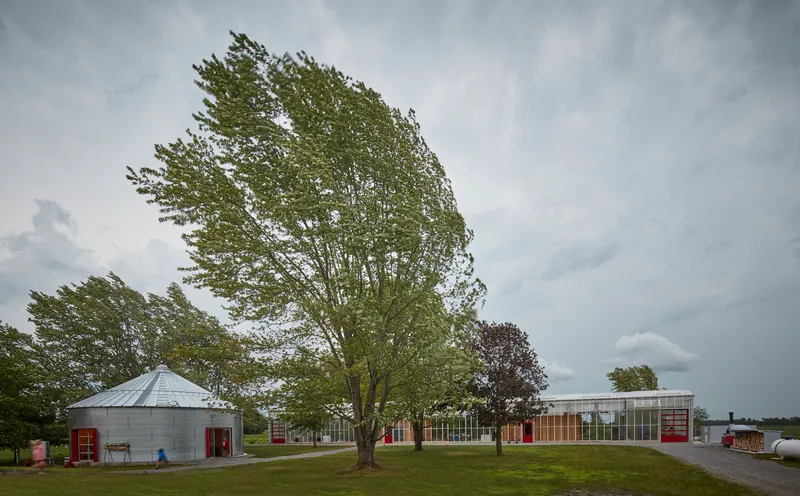
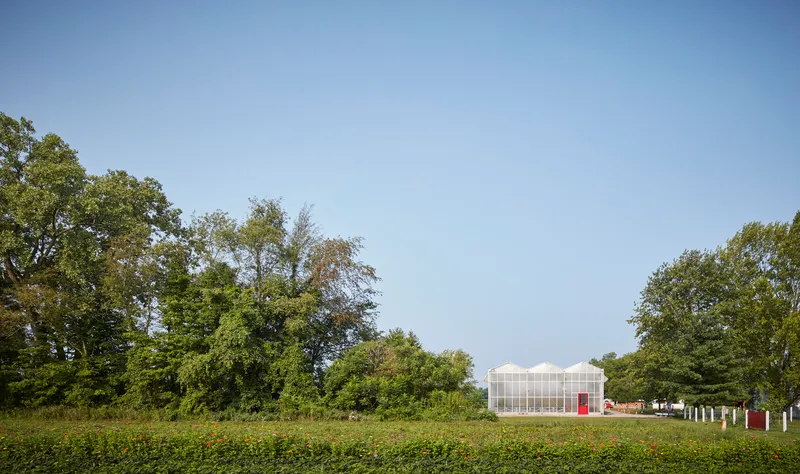
Granor Farm's campus has grown over more than a decade, and Wheeler Kearns has been the studio guiding that growth throughout. The greenhouse sits among repurposed grain silos, corrugated metal outbuildings, and cultivated fields, and it does not try to upstage any of them. Its galvanized steel frame and mill-finished aluminum read as agricultural vernacular rather than architectural statement. The red-painted access doors, an explicit nod to the Farmall tractors that define Midwestern farm life, are the building's only real gesture toward color.
This restraint matters. The farm's identity rests on its working character, and a conspicuous pavilion would have undermined it. By referencing the North/South Jeffersonian Grid in its orientation and broadside-south positioning, the greenhouse aligns with both the landscape logic and the solar geometry of its site. It looks like it belongs because its logic follows the same rules as the fields around it.
Three Zones, Three Glazing Strategies

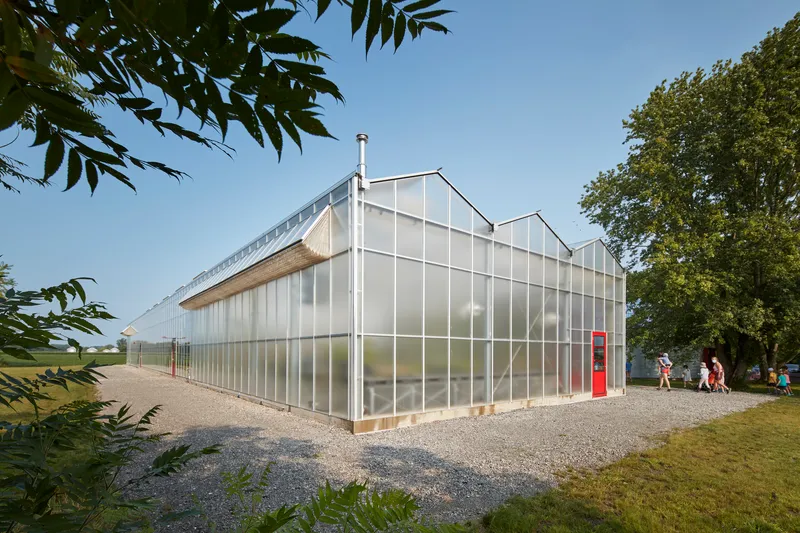
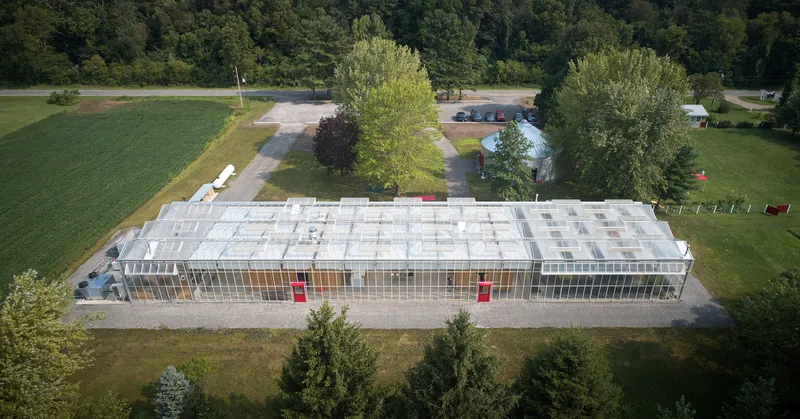
The building's plan is split into three clear zones, and each one gets its own relationship to light. The eastern and western wings are wrapped in translucent glass, creating a diffuse, even glow ideal for seedling production and experimental growing. These zones include automated venting systems that regulate temperature without visible mechanical apparatus. The central zone, by contrast, uses clear glass to open views to the surrounding fields and sky. This is the public-facing heart of the building, where the kitchen operates and where long tables are set for seasonal dinners.
It is a simple differentiation, but it accomplishes a lot. The translucent ends give plants what they need: consistent light without harsh exposure. The transparent center gives people what they need: a sense of place, connection to the landscape, and the theatrical quality of eating inside a glass structure as the sky changes above. The building performs two entirely different atmospheric conditions under a single continuous roof.
Growing Food Inside Architecture
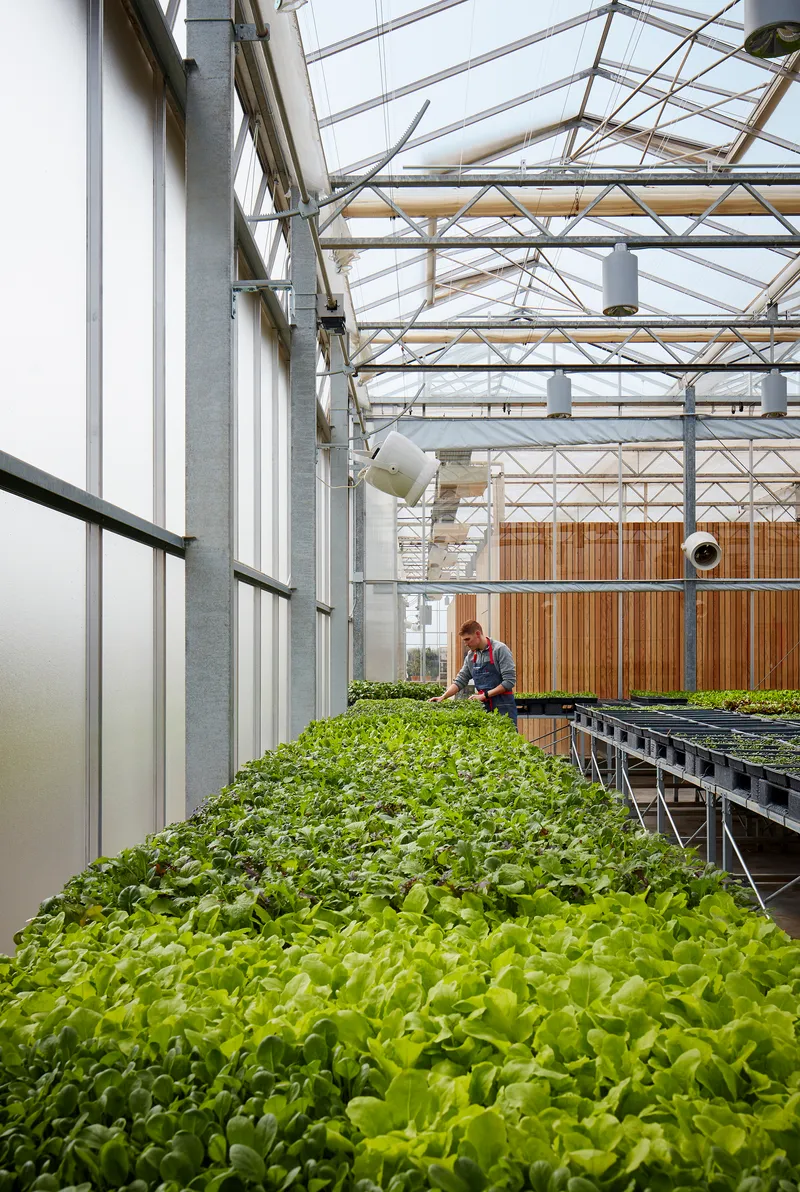

The eastern and western zones are outfitted for actual horticultural work. Rows of lettuce seedlings, mushroom cultivation, and germination trays fill these wings, tended by farm staff working beneath the exposed steel trusses of the Venlo system. There is no attempt to pretty this up. The trays sit on standard greenhouse benches, the hoses hang where they need to, and the whole thing reads as a productive landscape, not a curated display.
This is also where the farm's educational mission takes shape. Granor's Farmcamp program brings children onto the property to learn about organic agriculture, and the greenhouse gives that program a year-round home. Kids play on the surrounding lawn and learn inside a space where food is visibly, tangibly being grown. The building collapses the distance between production and pedagogy.
The Dinner Table Under Glass
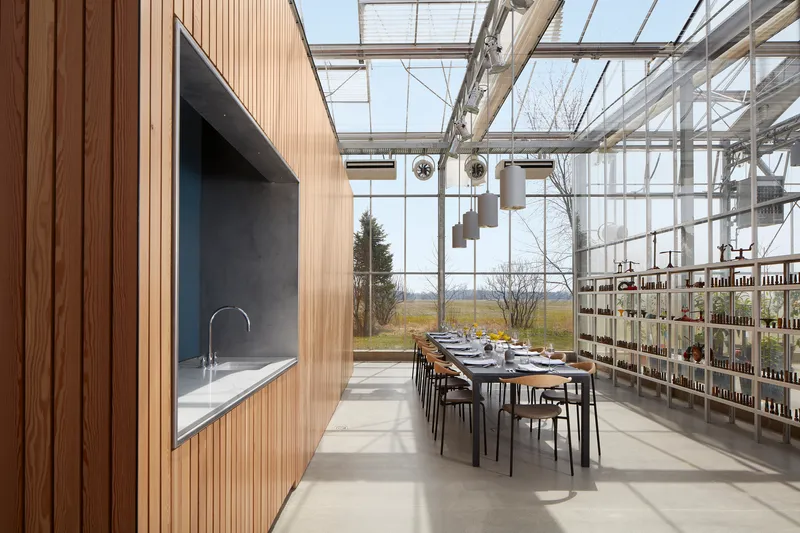
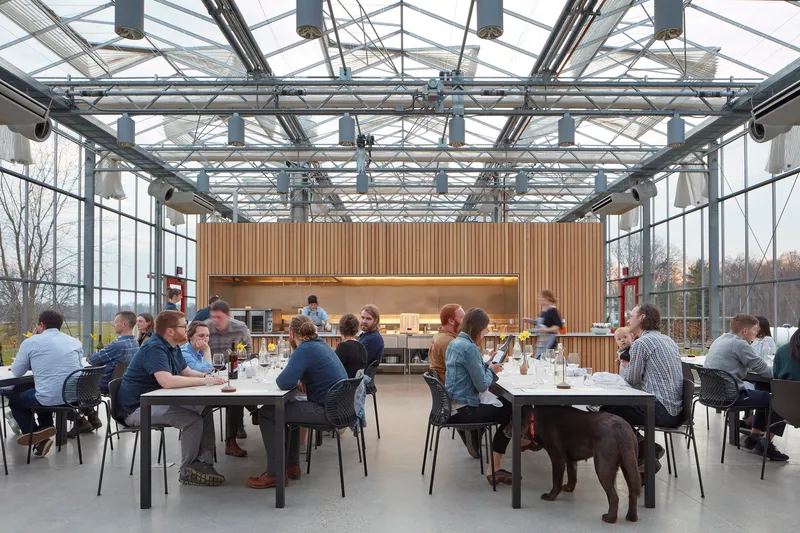

The central zone is where the greenhouse's most compelling spatial experience happens. Clear glass walls and roof panels dissolve the boundary between interior and exterior, so seated diners look directly out into the vegetable fields that produced the meal on their plates. The steel trusses overhead remain fully exposed, their rhythm establishing a structural cadence that gives the long dining tables a sense of procession.
Wood-clad volumes housing the kitchen, pantry, and restrooms are inserted into this zone as freestanding objects. They read as furniture at the scale of architecture: warm, precisely detailed, and deliberately impermanent against the industrial frame of the greenhouse. Vertical wood slats wrap these volumes, offering visual texture without competing with the transparency of the envelope. It is a smart material move. The wood gives the dining space warmth and scale without domesticating it.
Multipurpose as a Material Fact


The term "multipurpose" gets thrown around carelessly in architecture. Here it is literal. The same space that hosts a seated dinner for sixty can, hours later, accommodate a ping-pong table and casual gathering. Movable furniture allows the central zone to transform from food production facility to community events venue without renovation, without storage nightmares, and without compromising either function. The polished concrete floor is the unifying surface: durable enough for greenhouse carts, attractive enough for seated service.
Adjacent to the greenhouse, existing farm structures like the corrugated metal silo with its oversized red sliding doors continue to serve their own purposes. The campus operates as an ecosystem of buildings, each with a clear role, rather than a single monument expected to do everything.
Dusk Reveals the Building's Second Life
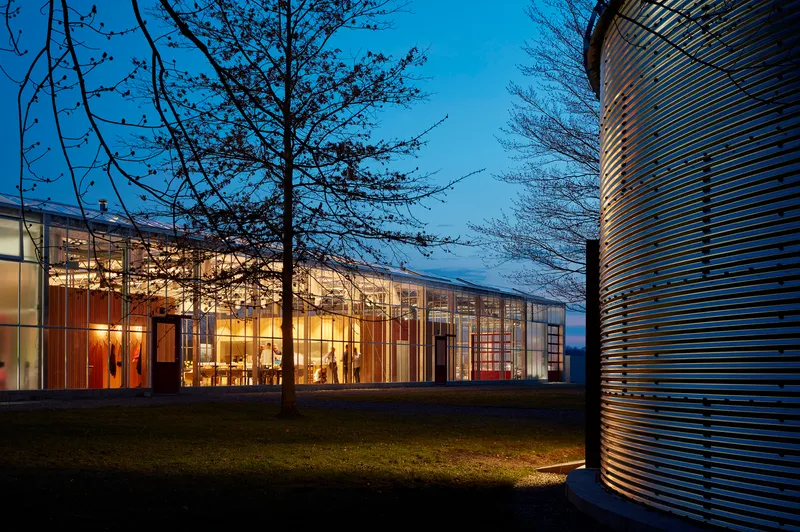
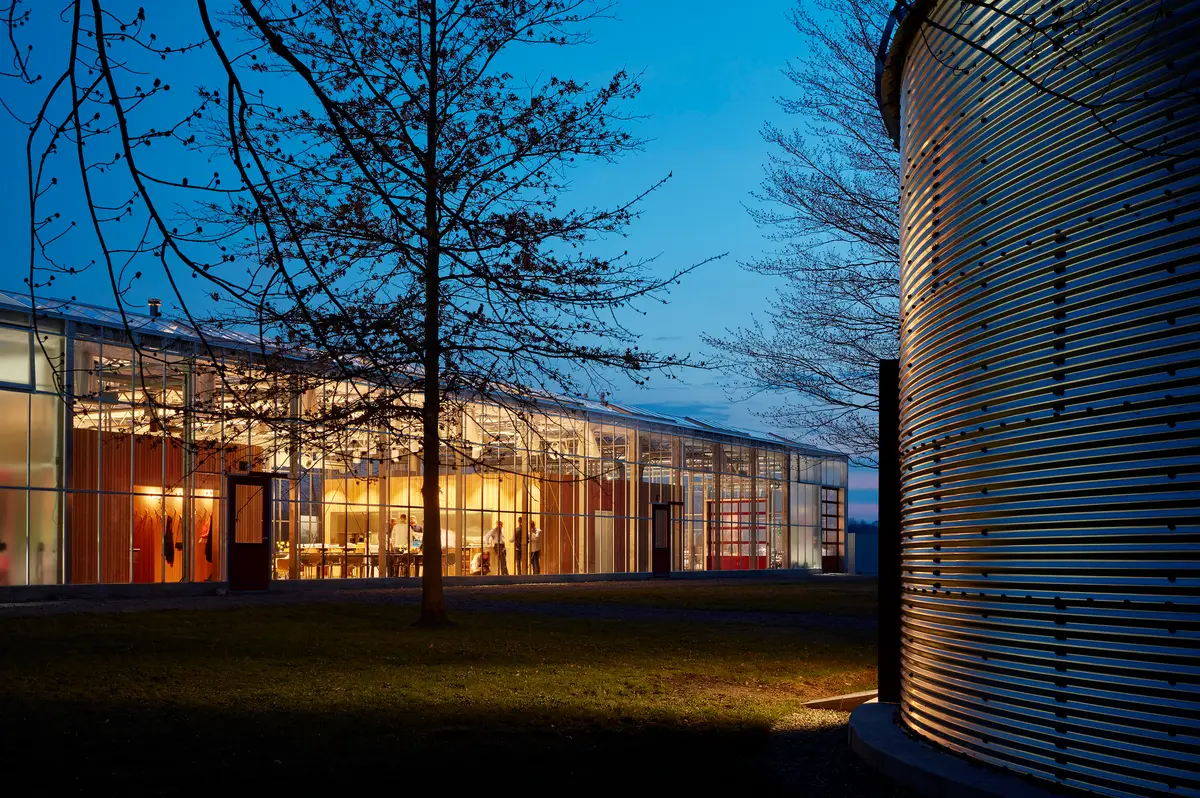
At dusk, the greenhouse transforms. The translucent and clear glass panels glow from within, turning the structure into a lantern set against the darkening treeline. The cylindrical form of the neighboring silo stands nearby in silhouette. It is the kind of image that sells the project, but it also reveals something genuine: this building operates well past daylight hours. The farm-to-table dinners that define Granor's reputation happen in the evening, under artificial light filtered through the same glass that grows seedlings by day.
The dusk condition also exposes the honesty of the Venlo system. There is no secondary facade, no cladding applied for aesthetic reasons. What you see at night is the steel skeleton, the glass skin, and the life happening inside. The architecture holds nothing back.
Plans and Drawings
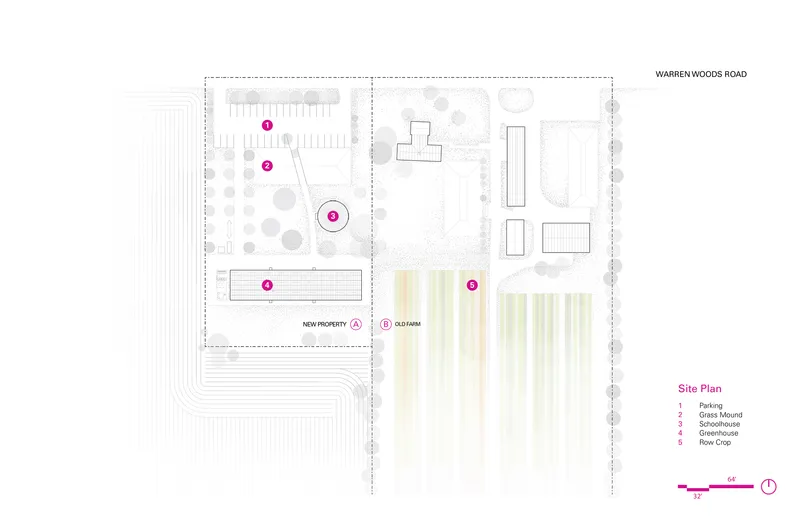

The site plan reveals how deliberately the greenhouse is positioned within Granor Farm's broader campus: parking to the west, a grass mound buffering the approach, and row crop fields extending to the east. The building's long axis runs roughly east-west, presenting its broad south face to the sun. The floor plan clarifies the tripartite organization. The mushroom room and planted beds occupy the ends, while the kitchen, pantry, and service volumes cluster in the center. There is a legibility to this layout that echoes the orthogonal logic of the surrounding agricultural grid.
Why This Project Matters
The Granor Greenhouse makes a case that agricultural architecture does not need to choose between production and experience. By adopting a prefabricated commercial greenhouse system and programming it with the specificity of a custom building, Wheeler Kearns has created a space that serves farmers, chefs, students, and diners equally well. The building resists the temptation to aestheticize farm life. It simply provides the right conditions for farm life to happen, and invites the public to witness it.
At a moment when farm-to-table culture risks becoming pure branding, this project offers the real thing. You eat in the same structure where the seedlings are germinated. You see the fields through the glass walls. The architecture does not narrate the connection between food and place; it constructs it. That directness, achieved through disciplined material choices, smart climate strategy, and genuine programmatic overlap, is what makes this project more than a pretty greenhouse. It is a working model for how architecture can support local food systems without pretending to be something it is not.
Granor Greenhouse by Wheeler Kearns Architects, Three Oaks, Michigan, United States. 7,336 sq ft. Completed 2021. Photography by Tom Harris and Steve Hall.
About the Studio
Share Your Own Work on uni.xyz
If projects like this are the kind of work you want to make, uni.xyz is a place to publish your own, find collaborators, and enter design competitions.


Popular Articles
Popular articles from the community


Aquadapt: An Underwater Habitat That Rewrites Its Rooms by the Hour
Curved modules ring the seabed while one shell shifts from breakfast room to cinema, farm and football pitch as residents' needs change.

The Amber Palace Opera: A Geological Fiction Surfaces on Tallinn's Baltic Waterfront
Pierre Brillard reimagines a Baltic legend as a public landscape, opera house, and waterfront promenade rooted in Tallinn's coastal identity.

Manzana Morphosis: Stretching Barcelona's Grid into a Living Landscape for 2050
A radical reworking of the Eixample manzana turns density into a tool for generous public space, vertical ecology, and environmental performance.


ETEH Reworks the Shared Spaces of São Domingos School in Brazil Around Timber, Color and Hanging Plants
At São Domingos School in Brazil, 436 m² of hall, refectory and library are recast with timber joinery, a yellow and blue code and trailing greenery.

Similar Reads
You might also enjoy these articles

LAVA Architecten Gives Vocational Education a Sawtooth-Roofed Face on a Mechelen School Campus
In Mechelen, Belgium, a 2,053 m² STEM school on a 6×6 m grid turns workshops and classrooms into rooms that can be rearranged as teaching changes.

KEMA Studio Turns a Derelict Marvila Attic into a 60 m² Lighthouse Apartment Above Lisbon
In Lisbon's Marvila district, a rebuilt roof, four skylights and two plywood volumes turn an unlivable attic into a bright home facing the Tagus.

Pixel Gardens: One Repeated Module Stacked Into a Terraced Social Housing Tower for Famagusta
Salem Bader's shortlisted housing tower builds a vertical neighbourhood from one repeated module, offsetting units to carve terraces, light and air.

Bao Huynh Watercolor Atelier: A Serene Art Retreat in Hội An
Bao Huynh Watercolor Atelier in Hội An blends multifunctional art spaces, sustainable design, local materials, and family-friendly living in a serene environment.

Explore Green Houses Competitions
Discover active competitions in this discipline

Challenge to reimagine the Iron Throne

Photograph architecture without architects

Illustrate the lost glory of Angkor Wat - Render Challenge

Design challenge to reuse E-waste
Comments (0)
Please login or sign up to add comments
No comments yet. Be the first to comment!