
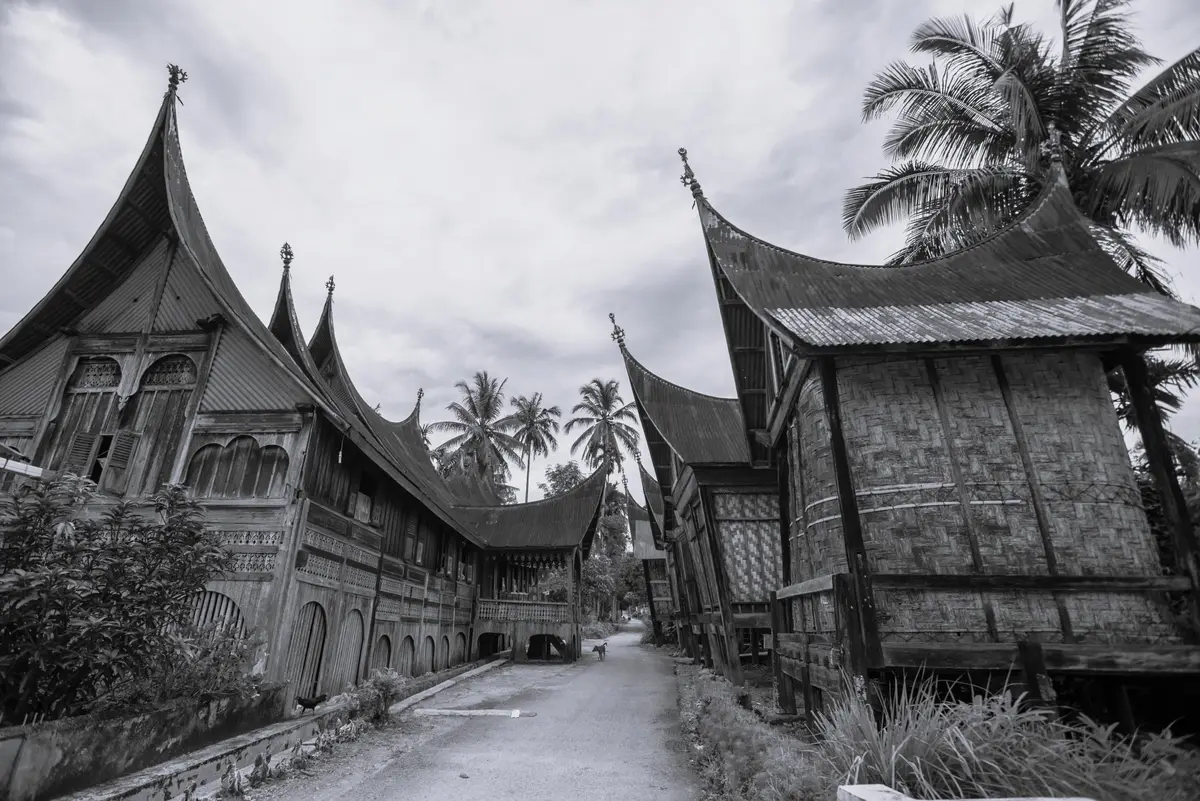
Where winds converge
Introduction the syncretic roots of Indonesian's Architecture Heritage

Indonesia's architectural landscape is far more than a collection of dwellings. It is a vivid, living chronicle born from the nation's singular position as a historic maritime crossroads - a place where indigenous ingenuity met centuries of global exchange, forging one of the most remarkably diverse residential legacies in the world.
At the heart of this heritage lies the brilliance of the early Austronesian expansion. The pioneers of the archipelago developed and perfected the Rumah Panggung, or stilt house, a structural system that would become the backbone of Indonesian vernacular architecture for millennia. Far from a primitive solution, it was a highly sophisticated response to the region's intense tropical humidity and frequent seismic activity. By raising living spaces off the ground, the design promoted essential airflow, shielded inhabitants from seasonal floods, and provided a degree of flexibility when the earth trembled beneath.
Over the centuries, this resilient local tradition was continuously enriched by the many cultures that navigated the global spice and trade routes. Indian influence arrived early, introducing sturdy masonry techniques and deeply symbolic spatial layouts that grounded domestic design in spiritual geometry. Chinese migration brought with it distinctive sweeping roof curvatures and centralized courtyard arrangements, blending aesthetic ambition with communal practicality in ways that proved deeply compatible with existing sensibilities. Arab traders, meanwhile, wove intricate Islamic geometric ornamentation and graceful arched forms into the visual vocabulary of the islands, leaving a mark that remains legible across the archipelago to this day.
What distinguishes Indonesia's built heritage is not merely the breadth of these influences, but the manner in which they were absorbed. Foreign aesthetics were never simply imposed upon a passive local culture. They were, instead, seamlessly woven into the fabric of existing tradition, reinterpreted, hybridized, and made entirely Indonesian. The result is a breathtaking architectural syncretism that reveals itself in forms as dramatic as the towering buffalo-horn rooflines of the Minangkabau people and as intricate as the carved, colorful facades of the Peranakan shophouse.
Today, Indonesia stands as a masterful showcase of design history, a living archive in which every sweeping roofline and hand-carved beam quietly narrates the story of a world brought together.
References (2)
Image


Popular Articles
Popular articles from the community


Conexión: Biophilic Design Reimagines High-Rise Living in Hong Kong
Conexión reimagines high-rise living in Hong Kong through biophilic design, green facades, shared spaces, daylight, water and nature within.

Lunar Spiral: Space Architecture Shaped by the Mathematics of the Universe
Lunar Spiral reimagines space architecture through Fibonacci geometry, lunar regolith, levitating habitats, and self-sustaining Moon living.

The Musturak Paradise: Senior Living Architecture for a Connected Future in Temara, Morocco
The Musturak Paradise reimagines senior living architecture in Temara via private homes, social spaces, culture, community, and shared care.

ALGAL REALM: A Bio-Integrated Lunar Habitat Design for Life Beyond Earth
ALGAL REALM reimagines lunar habitat design with algae-powered life support, 3D-printed regolith, and vertical living for a lunar future.

Similar Reads
You might also enjoy these articles

Day and Night Park: A Time-Based Urban Newsstand in Beijing
A temporary urban newsstand in Beijing blending travel, light, and reading through poetic colors, compact form, and community-focused design.

Modernist Patio Renovation in El Masnou, Barcelona by Oliver Segura Arquitectura + Cebrià Arquitectura
Modernist patio renovation blending tradition and innovation with a movable pool, leveled floors, and Catalan materials in El Masnou.

Alto Residencial Coop: Cooperative Housing Development in Santiago de Compostela by Carbajo Barrios Arquitectos
A linear cooperative housing complex blending white volumes and perforated metal façades, enhancing community living, natural light, privacy, and urban integration.

Vil Genis School by BPA ARCHITECTURE – Massy, France
Vil Genis School in Massy, France, features sustainable design, south-facing classrooms, community integration, accessible spaces, and modern educational architecture.

Explore Architecture Competitions
Discover active competitions in this discipline


Challenge to reimagine the Iron Throne

Photograph architecture without architects

Illustrate the lost glory of Angkor Wat - Render Challenge

Design challenge to reuse E-waste
Comments (0)
Please login or sign up to add comments
No comments yet. Be the first to comment!