

Fieldwork Design and Architecture Perches a Pool House on a Bluff Above the Willamette River
An 802-square-foot retreat in Newberg, Oregon, splits open and closed volumes to frame sweeping river views through floor-to-ceiling glass.


An outbuilding that wins a national design award usually earns it by doing something a main house cannot. The Willamette Pool House by Fieldwork Design and Architecture sits west of its parent residence on a bluff in Newberg, Oregon, overlooking the Willamette River. At just 802 square feet, it packs a lounge, kitchenette, changing room, steam shower, bathroom, and pool equipment room into two linked volumes, one opaque and one almost entirely glazed. The split is the project's central idea: hide what needs hiding, reveal what deserves framing.
What makes the building worth studying is how aggressively it dissolves its own enclosure. Stacking floor-to-ceiling glass panels slide away to convert the lounge into a covered terrace, while a wood-slat soffit of locally sourced Oregon White Oak runs from the interior ceiling out to an exterior canopy of metal-slat sunscreens. The ceiling never stops; it just changes material, pulling the eye from the kitchenette straight through to the pool deck. The result is a building that reads as shelter more than as room, which is exactly right for a structure whose job is to keep you close to the water.
Two Volumes, One Flat Roof
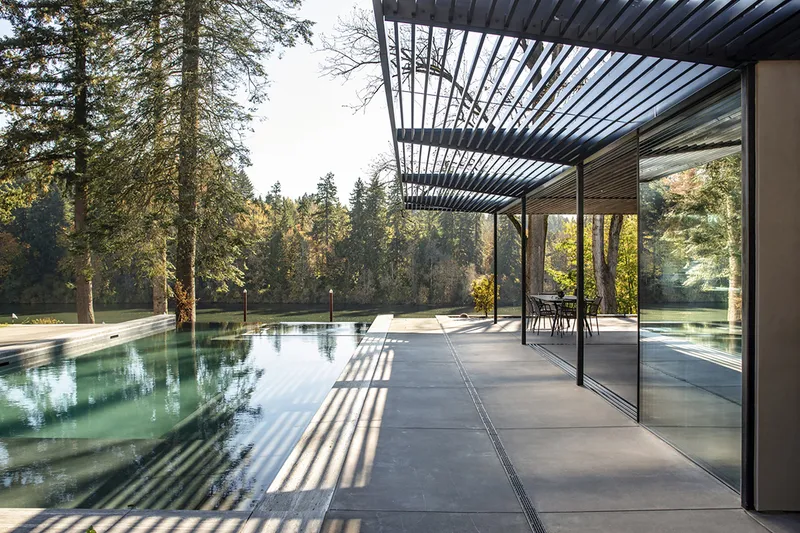
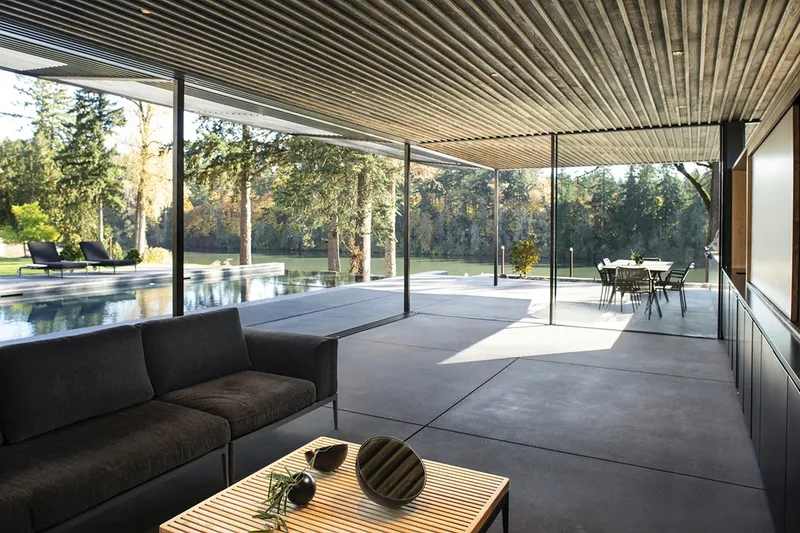
The pool house organizes itself as a diptych. The closed volume, finished in natural plaster walls and dark metal trim, conceals the steam shower, bathroom, and mechanical equipment. The glazed volume faces the pool and the river beyond, its transparency designed to make the lounge feel like part of the landscape rather than separated from it. A flat roof ties the two together, reading as a single horizontal plane that hovers above the bluff.
From the pool deck, the steel-louvered canopy casts sharp shadow lines across the concrete paving, a kinetic effect that shifts throughout the day. The canopy is not decorative; it controls solar gain on the glass wall while letting filtered light into the outdoor dining zone. It is functional shading that also happens to produce beautiful geometry.
A Ceiling That Becomes a Canopy
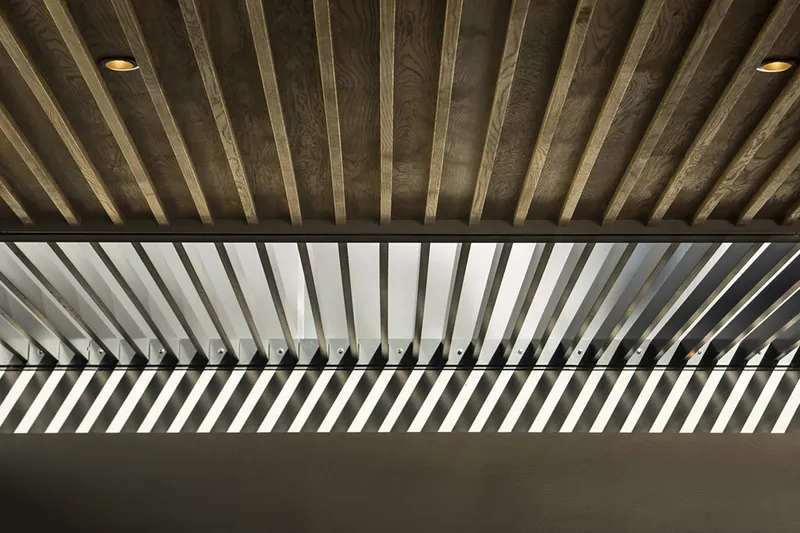
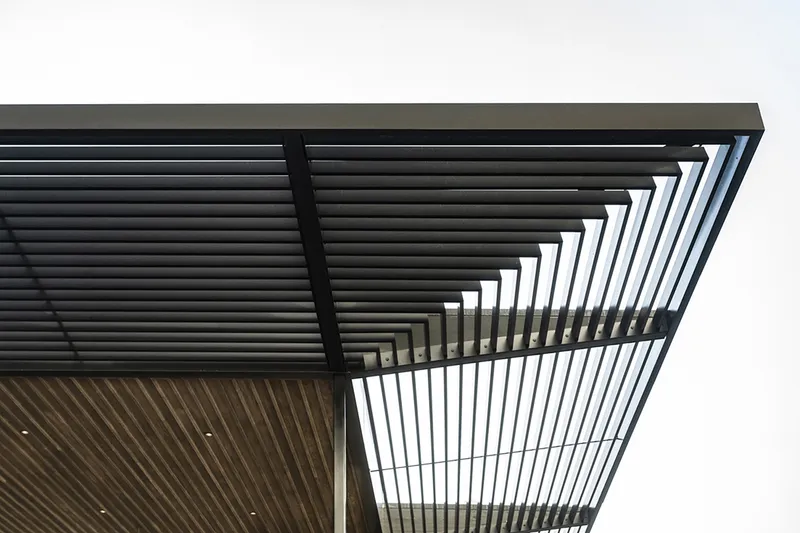
The most compelling detail here is the overhead plane. Inside, Oregon White Oak battens run in tight parallel lines. At the building's edge, the material shifts to steel slats without changing the rhythm. The steel beam at the transition is frankly expressed, not hidden behind a soffit panel or a fascia. You see the structural reality and the material swap in the same glance, which makes the continuity feel honest rather than illusionistic.
Fieldwork's decision to source Oregon White Oak locally anchors the material palette to the region. The wood ages into a silver-grey tone that will eventually approach the color of the steel slats, meaning the two materials will converge over time. It is a long-game move, a detail that rewards patience rather than demanding attention at first occupancy.
The Outdoor Kitchen and Covered Patio
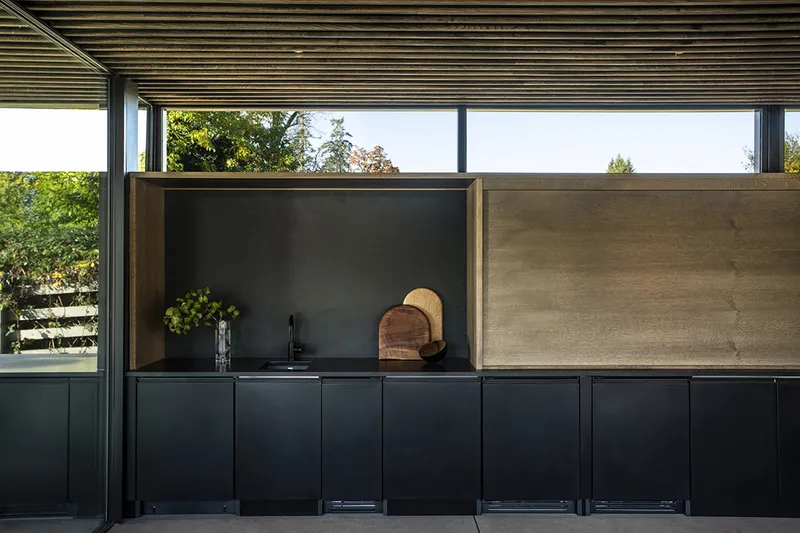
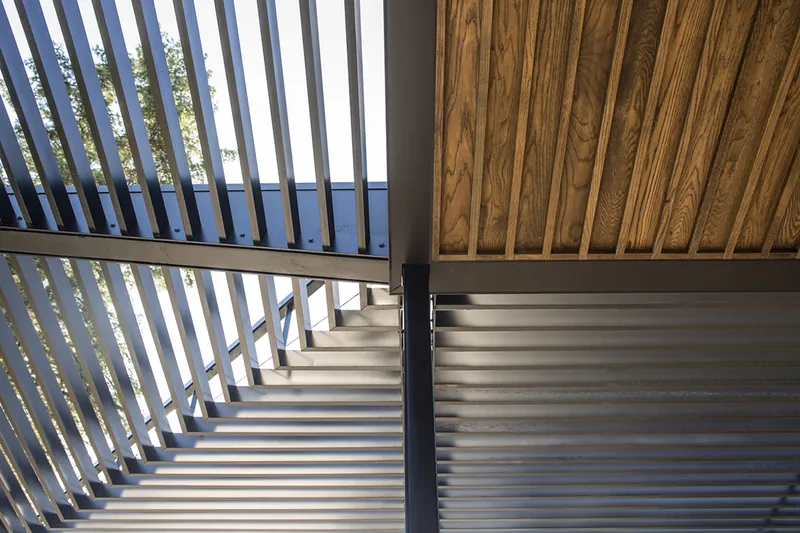
Beneath the slatted timber ceiling, the outdoor kitchen holds its own as a finished space. Black cabinetry sits below a wood backsplash, maintaining the same restrained palette found inside. The countertop is a workstation, not a display case, designed for grilling and prep rather than showing off. There is no island, no bar seating for twelve. It is sized for the kind of cooking you actually do next to a pool.
A vertical metal-slat screen at the staircase filters daylight and provides a visual buffer between the pool level and whatever lies below the bluff. The screen uses the same language as the overhead canopy, a family of parallel lines in steel that recurs at every scale. Repetition here is not laziness; it is discipline. One detail vocabulary governs the entire project, which is why the building feels resolved at 802 square feet.
Steam Shower as Micro-Spa
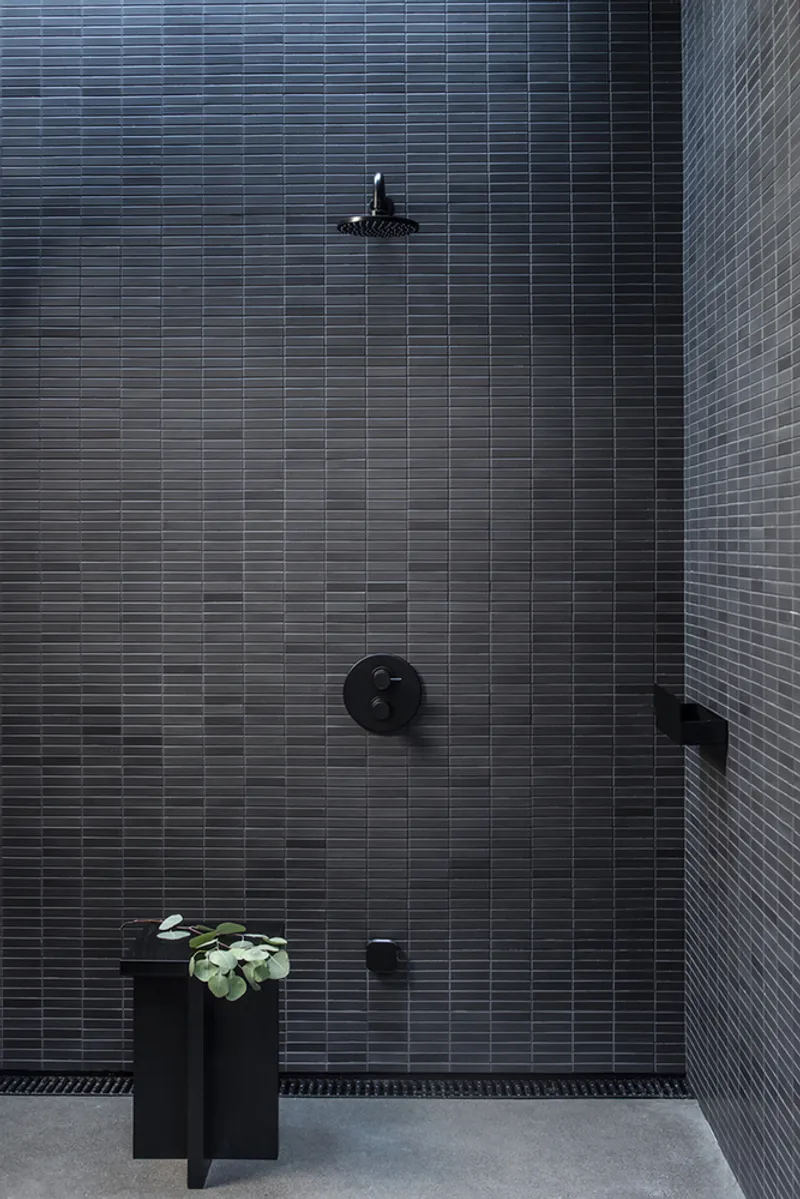
The opaque volume earns its opacity. The steam shower is lined in narrow horizontal dark grey tiles, with matte black fixtures and a custom concrete sink. Skylights overhead deliver natural light into a space that could easily have felt like a closet. Instead it reads as a distilled spa, a room where every surface is waterproof and every joint is deliberate. The plant stand in the corner is a small human touch that keeps the space from tipping into clinical severity.
Fieldwork used Sky-Frame and Fleetwood glazing systems for the transparent volume and Velux skylights for the closed one. The hardware choices matter: Sky-Frame's frameless sliding panels are what allow the lounge to open completely to the terrace, and the Velux units in the shower room are operable, providing ventilation as well as light. Good architecture at this scale often comes down to specifying the right products and then letting them do their work.
Why This Project Matters
Pool houses occupy a strange position in residential architecture. They are too small to be primary structures and too visible to be sheds. The temptation is to miniaturize a house, replicating living rooms and kitchens at reduced scale. Fieldwork avoids that trap by treating the pool house as infrastructure: a canopy, a shower, a set of sliding walls, and a place to store pumps. There is no attempt to create another living room. The lounge exists only so you have somewhere to sit between swims, and it opens fully when you do not need walls at all.
The 2024 Residential Architect Design Award in the Outbuilding category recognized what the project gets right. It proves that a support structure can have its own architectural identity without competing with the main house. The material palette complements rather than copies the primary residence. The siting on the bluff takes advantage of views the main house may not even claim. And the detail vocabulary, those relentless parallel lines in wood and steel, gives the building a coherence that most structures ten times its size never achieve.
Willamette Pool House by Fieldwork Design and Architecture, Newberg, Oregon. 802 sq ft. Completed 2022. Structural Engineer: Grummel Engineering. General Contractor: Thomas Clarke Construction. Photography by Dana Klein Photography.
About the Studio
Share Your Own Work on uni.xyz
If projects like this are the kind of work you want to make, uni.xyz is a place to publish your own, find collaborators, and enter design competitions.


Popular Articles
Popular articles from the community


Jaramillo Van Sluys Arquitectura and Urbanismo Turn a Demolished Registry Lot in Quito into an Orchard Plaza
In Quito's Centro Histórico, a 2,800 m² plaza exposes the San Agustín convent wall and redraws its lost Augustinian orchard in volcanic stone.

Architekt Andreas Gruber Scatters 23 Dark Timber Chalets Across a South Tyrolean Forest Edge
In Molini di Tures, Amonti Chalets breaks a resort into a hamlet of gabled timber houses, with parking, storage and services pushed into the slope.

longwave studio Reorganizes a 112 m² Tainan Apartment Around the Daily Routines of a Family and Two Cats
In Tainan, Taiwan, birch plywood, rust-red furniture and a freestanding plaster wall link arrival, storage, work and family life in one apartment.

David Macias Steps a Doorless Stone and Plaster House Down a Tropical Colombian Hillside
In the humid hills of Colombia, Threshold House replaces the front door with an open void and terraces its 850 m² down the slope instead of fighting it.

Similar Reads
You might also enjoy these articles


Hodi-Mandai Geram
Project Function: Preservation and revitalization of the Intangible heritage and socio-spatial identity of the Hodi by Housing, Cultural Memory Center, Sacred Grove, landscape, local tourism economy


Olio Towers: A Mid-Rise for Performers That Fuses Housing, Rehearsal, and Stage
Located blocks from Houston's Theater District, this modular tower stacks living units around a central performance atrium.

Oasis: Modular Green Housing Carved into Dhaka's Urban Fabric
A shortlisted Plugin Housing entry reclaims unauthorized settlements in Dhaka with stepped concrete volumes, green roofs, and ventilation-driven design.

Black Hole: A Floating Megastructure for the Post-Physical Era
Emiliano Mazzarotto envisions a spherical, self-scaling arena where e-sports, digital hotels, and holographic stadiums replace traditional public space.

Explore Housing Competitions
Discover active competitions in this discipline

Challenge to reimagine the Iron Throne

Photograph architecture without architects

Illustrate the lost glory of Angkor Wat - Render Challenge

Design challenge to reuse E-waste
Comments (0)
Please login or sign up to add comments
No comments yet. Be the first to comment!