

Yemail Arquitectura Anchors a Timber Cabin and Brick Tower in Colombia's Rolling Highlands
Wills House sits among the green pastures of Colombia's mountainous terrain, merging rough masonry and warm timber into a quiet retreat.


On a sloping pasture in the Colombian highlands, Yemail Arquitectura has planted a house that reads less like a domestic building and more like a small agricultural compound: a long gabled timber volume intersected by a cylindrical brick tower, the whole composition settled into the hillside as if it has been there for decades. Wills House refuses the glass-box trope that dominates rural retreat design in Latin America. Instead, it leans into the vernacular palette of the region, using dark wood cladding, handmade brick, and steeply pitched roofs that shed rain and echo the silhouettes of local barns.
What makes the project genuinely interesting is the tension between its two primary elements. The horizontal timber body is domestic, warm, and transparent, while the brick tower is opaque, vertical, and almost ecclesiastical. The T-shaped plan that emerges from their intersection creates distinct zones for living, sleeping, and gathering without the need for conventional hallways. Every room terminates in a view of the surrounding hills, but the house never dissolves into its landscape. It insists on being an object, a marker on the terrain, and that confidence is what elevates it beyond the typical countryside cabin.
A Silhouette Built for the Landscape
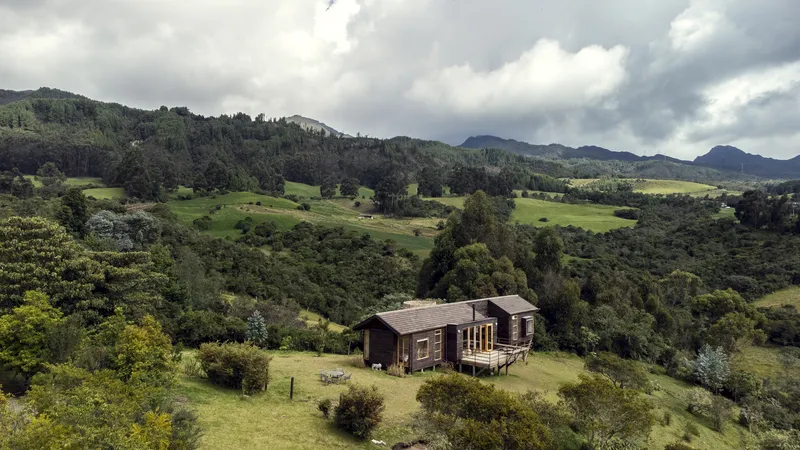
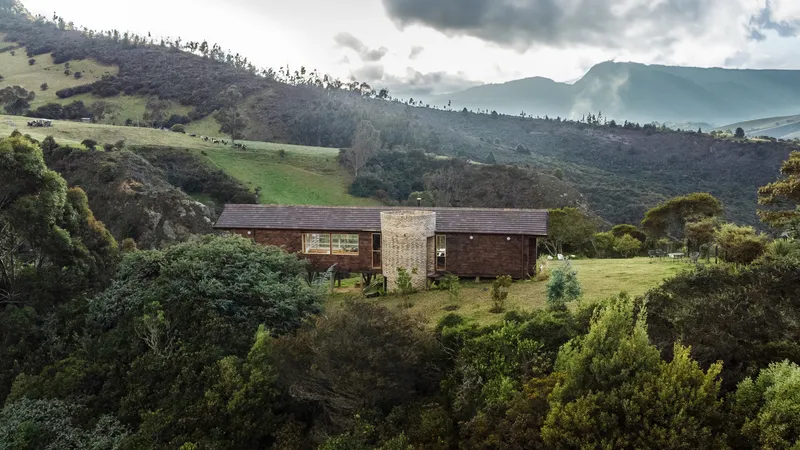
From a distance, Wills House registers as two forms: a long horizontal bar and a stubby cylinder. The timber volume stretches along the natural contour of the hill, its dark cladding absorbing light under overcast skies and letting the steep gable dissolve into the mountain ridges behind. The brick tower, by contrast, punches upward and catches your eye. It functions as an anchor point, grounding the composition and giving the house a civic presence that a simple cabin would never achieve.
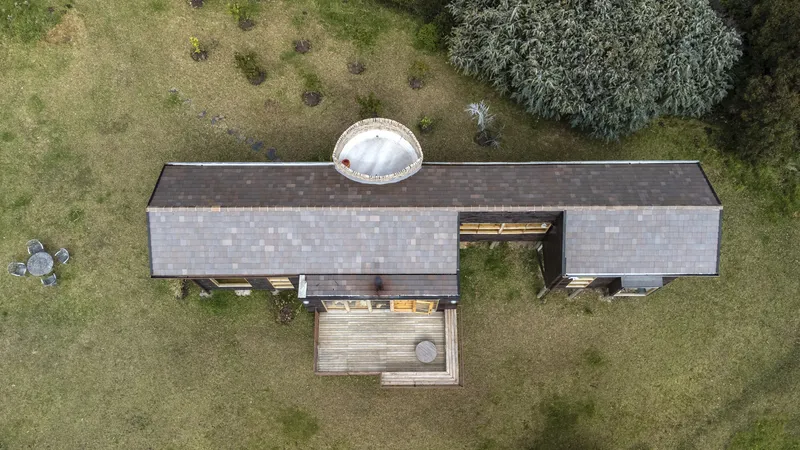
Seen from above, the T-shaped plan reveals how the two volumes cross. The roofline of timber shingles flows continuously across the gabled body, while the tower breaks free with its own circular geometry. A small skylight dome at the junction draws light down into the heart of the plan, marking the point where the house's two logics meet.
Brick and Timber: A Material Dialogue
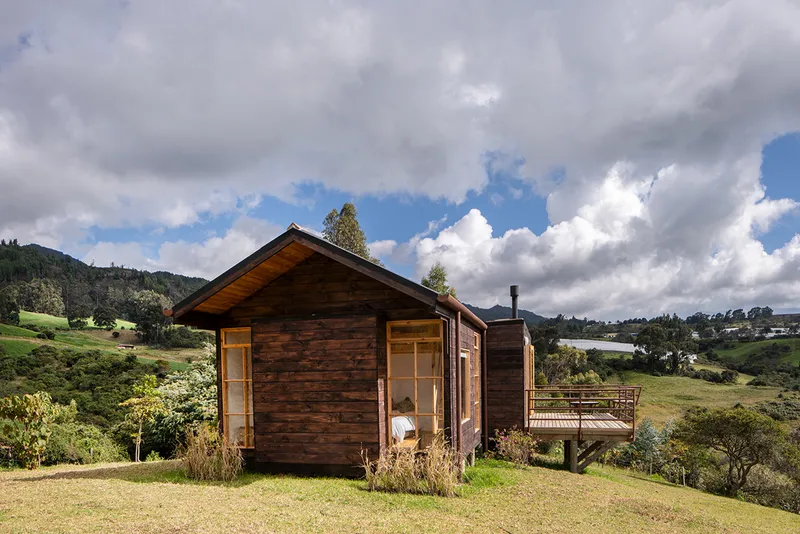
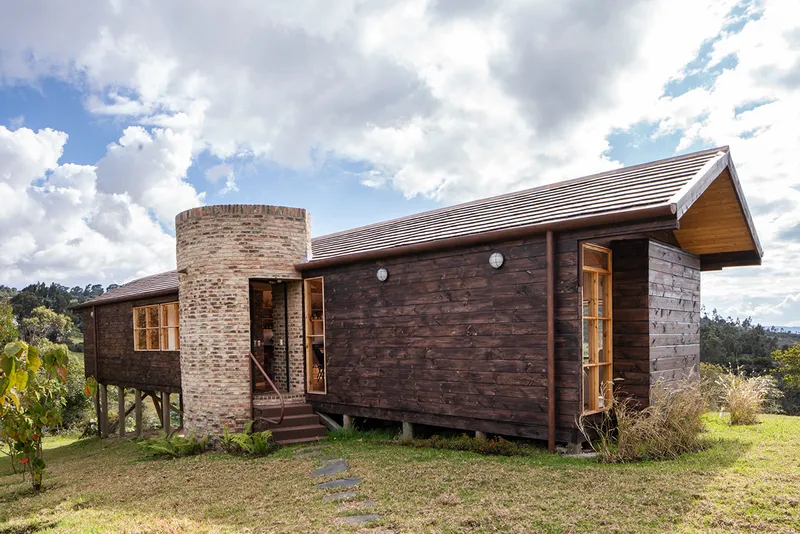
Yemail Arquitectura's material strategy is straightforward but well executed. The cabin volume is clad entirely in dark wood boards that weather naturally, giving the building a tone that shifts between charcoal and brown depending on the light. Raised slightly off the ground on a simple platform, the timber body feels light and provisional, a structure that could, in theory, be disassembled.
The brick tower counters all of that. Its cylindrical form is massive, its walls thick, its expression permanent. At the entry, the tower and the timber deck meet under a generous covered porch, and the juxtaposition of rough masonry against smooth pine is immediate and tactile. The architects clearly understand that a rural house needs weight. The tower provides it.
Living Under the Truss
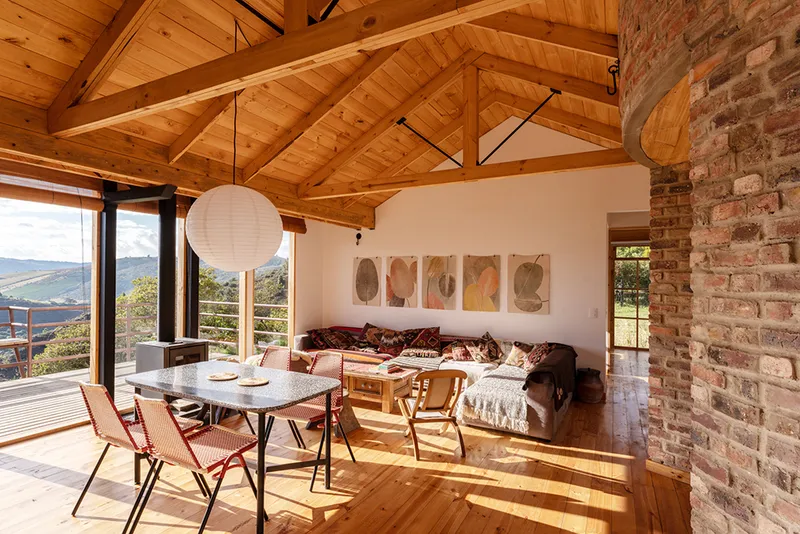
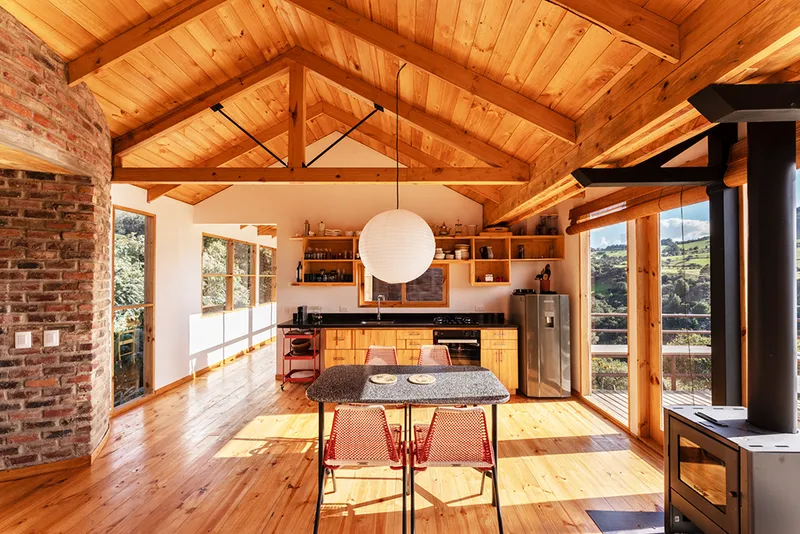
Inside the gabled volume, the roof structure does most of the architectural work. Exposed timber trusses span the full width of the living and dining areas, creating a vaulted ceiling that is tall enough to feel generous but not so high that it loses intimacy. The living room centers on a full-height brick fireplace wall that doubles as the interior expression of the tower's masonry. Sunlight pours across the pine floor from glazed doors on both long sides, keeping the space bright even on cloudy highland mornings.
The kitchen and dining zone occupies the opposite end of the same volume, with built-in cabinetry tucked beneath the truss line and a long table positioned to take advantage of the view through the glazed doors. There is nothing fussy about the detailing. The timber is left natural, the joinery is honest, and the cabinetry is simple and rectilinear. The architecture trusts its structure to carry the space, and it does.
The Brick Alcove and Tower Interior
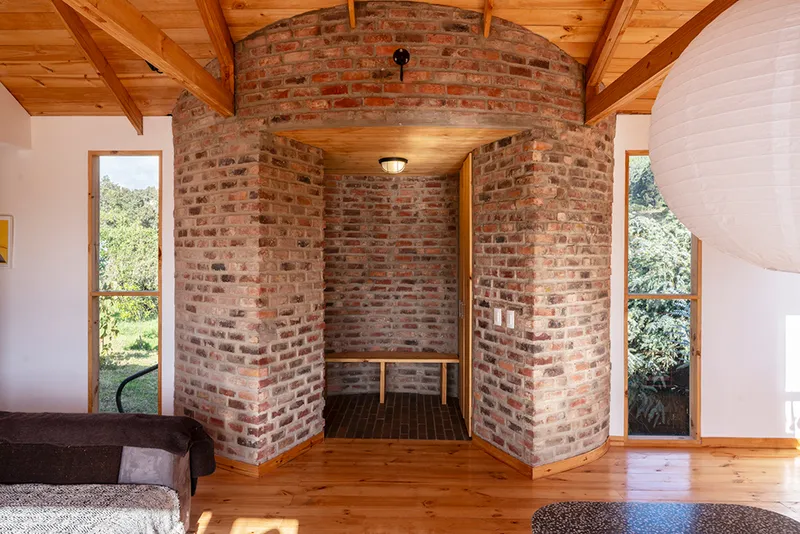
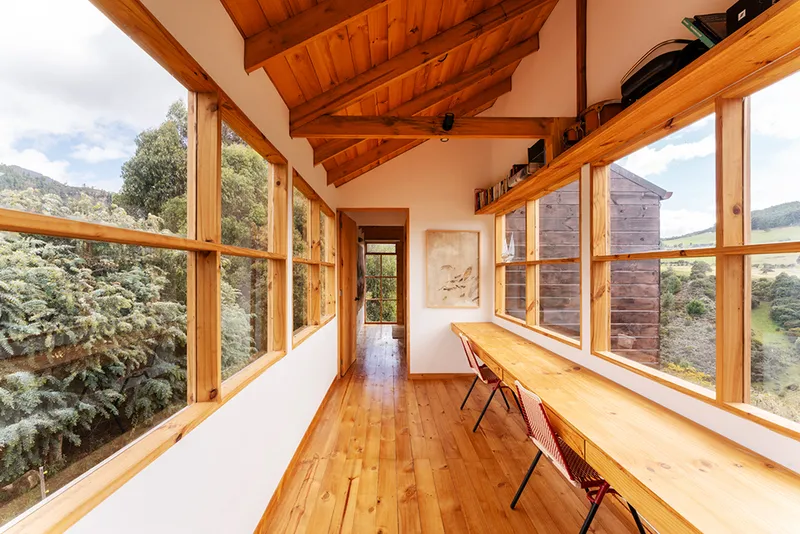
The tower's interior is the most spatially charged moment in the house. A vaulted masonry arch creates a deep alcove framed by tall, narrow windows that admit controlled shafts of light. The atmosphere here shifts completely from the bright openness of the timber rooms. It is cooler, darker, more contemplative. The arch itself is a bold move for a contemporary house, borrowing from a pre-modern construction tradition that Yemail Arquitectura handles with genuine skill rather than nostalgia.
Connecting the two zones, a corridor lined with floor-to-ceiling glass runs along the hillside edge of the plan. The exposed trusses overhead maintain the structural rhythm, while the pine flooring unifies the journey from tower to cabin. Standing in this corridor, you are simultaneously inside and outside: the glass pulls the green slope right up to your feet.
Quiet Rooms with Long Views
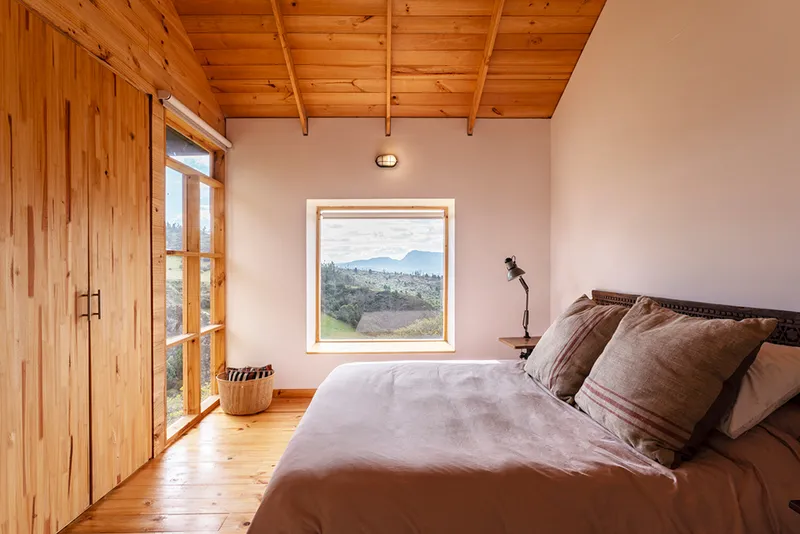
The bedrooms occupy the quieter wing of the T, away from the social spaces. Each room is finished in the same pine and exposed timber as the rest of the house, but the scale drops considerably. Ceilings are lower, windows are fewer, and the effect is protective rather than expansive. A single square window in the bedroom frames a carefully composed view of the distant hillside, proving once again that restraint in fenestration can be more powerful than a wall of glass.
The overhead drone view confirms how the plan separates public and private zones. The long bar of the main volume contains the living spaces, while the perpendicular wing, sheltered by its own gable, holds the bedrooms. The skylight dome at the intersection floods the crossing point with natural light, acting as a hinge between the two halves of the house.
Why This Project Matters
Wills House succeeds because it takes a position. Where many rural retreats try to disappear into the landscape, Yemail Arquitectura's design insists on being visible, on establishing a relationship with the terrain rather than mimicking it. The cylindrical brick tower is the clearest expression of this confidence: it announces the house from a distance and gives it an identity that persists in memory. The timber body, meanwhile, does the hard work of making the interior warm, functional, and connected to the surrounding pastures.
The project also demonstrates that vernacular materials can be used rigorously without falling into pastiche. The brick vaults, the timber trusses, and the wood shingle roof are all drawn from local building traditions, but they are deployed with a clarity of plan and a discipline of detail that is entirely contemporary. For architects working in rural Latin American contexts, Wills House offers a compelling model: respect the landscape, use the local palette, and then build something that is unmistakably yours.
Wills House by Yemail Arquitectura, Colombia. Photography by Mateo Pérez.
About the Studio
Share Your Own Work on uni.xyz
If projects like this are the kind of work you want to make, uni.xyz is a place to publish your own, find collaborators, and enter design competitions.


Popular Articles
Popular articles from the community


Cube Design Draws an Ecological Corridor Between Two Shenzhen Hills with the Nankai Building
Beside Shenzhen's container docks, the Nankai Building pairs stacked balconies with a climbing green screen to connect two hillsides across its height.

GROUP A Strips a 1969 Rotterdam Harbor Headquarters to Its Frame and Wraps It in Timber Louvers
In Rotterdam's M4H harbor district, Ferro Offices reuses a 1969 frame, adds one timber storey and reaches BREEAM-NL Outstanding.

Juan García Correa, John González and Claudia Rueda Sink a Circular Amphitheater into a Manizales Engineering Building
On the La Nubia campus in Manizales, Colombia, the S1 Building folds labs and offices into a hillside of ramped lawns that double as a campus route.

David Ortega Stacks a Two-Story Mexico City Penthouse Around a Steel Stair and a Pergola-Shaded Roof Terrace
In Colonia Roma, a 300 m² penthouse uses oak joinery, a planted steel stair and a slatted roof pergola to make a new-build apartment feel like a house.

Similar Reads
You might also enjoy these articles


Hodi-Mandai Geram
Project Function: Preservation and revitalization of the Intangible heritage and socio-spatial identity of the Hodi by Housing, Cultural Memory Center, Sacred Grove, landscape, local tourism economy


Olio Towers: A Mid-Rise for Performers That Fuses Housing, Rehearsal, and Stage
Located blocks from Houston's Theater District, this modular tower stacks living units around a central performance atrium.

Oasis: Modular Green Housing Carved into Dhaka's Urban Fabric
A shortlisted Plugin Housing entry reclaims unauthorized settlements in Dhaka with stepped concrete volumes, green roofs, and ventilation-driven design.

Black Hole: A Floating Megastructure for the Post-Physical Era
Emiliano Mazzarotto envisions a spherical, self-scaling arena where e-sports, digital hotels, and holographic stadiums replace traditional public space.

Explore Architecture Competitions
Discover active competitions in this discipline

Challenge to reimagine the Iron Throne

Photograph architecture without architects

Illustrate the lost glory of Angkor Wat - Render Challenge

Design challenge to reuse E-waste
Comments (0)
Please login or sign up to add comments
No comments yet. Be the first to comment!