
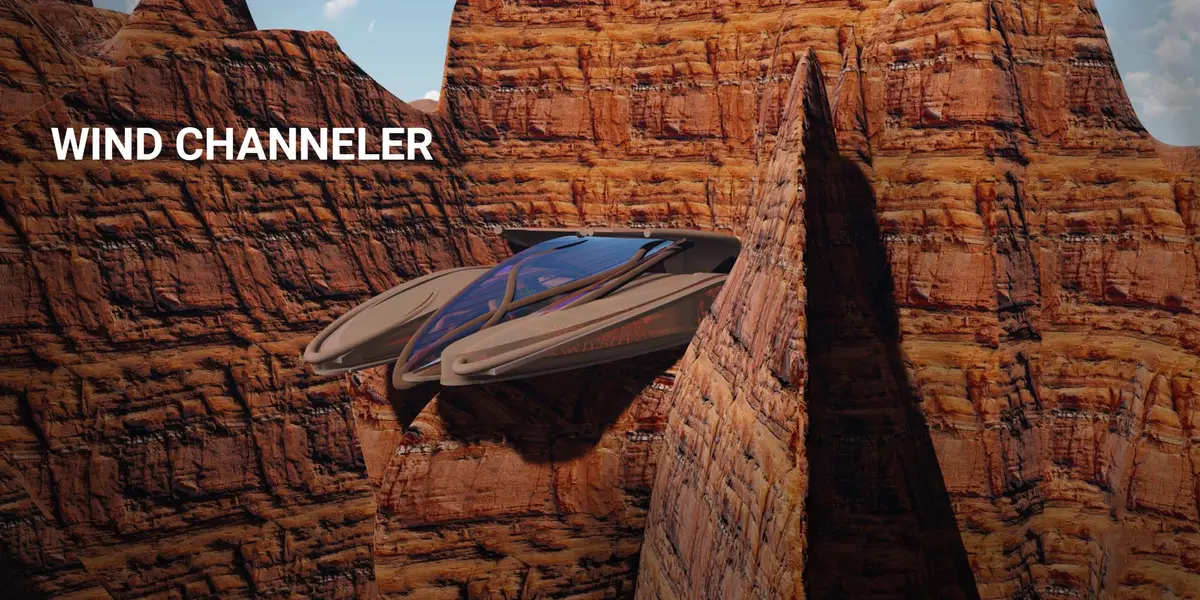
Wind Channeler
Competition Concept

The concept behind this project was to create an educational leisure hub in mars. The structure is designed in order for the community inside the hub to be able to vacation while learning and experiencing the red planet. The hub would be housing people for leisure purposes, enjoying the green dome and viewing deck overseeing the Valles Marineris. While there, people are also offered educational opportunities, such as excursions that take alongside the canyon, as well as down into the valley. The architecture organization was based on a concept centralized on the Green Dome. The Green Dome is to provide food for the forty inhabitants to ensure their survival therefore it serves as the central space, with the addition of a second floor observatory. The Observatory was put in place due to the location of the Hub on Mars. The Hub is located above on a cliff overlooking the valley of Valles Marineris. The support structure for the hub was developed through the organization of bendable pipes that run around the whole hub. The pipes have different purposes. Some are only structure base, others work to filter out water or air waste and the others filter in clean air and water. Several iterations were tried in order to arrive at the final outcome. We constructed over fifteen study models before getting to our final take for the concept. In order to reach the final outcome for the Wind Channeler, we researched topography and weather conditions for our chosen site, Valles Marineris. We then began sketching out ideas for what the hub could look like. To achieve the concept of aerodynamics we studied the egg and sports cars. We sketched out various possible aerodynamic shapes for our hub. We then began to model these shapes and redefined them until we landed on the final concept. After rendering our hub we brought it into post work production and used photoshop to finalize the concept. After designing the novelty components, which are bent and shredded, we used it to create spatial moments in the hub. Since the start of this project, we thought of having an aerodynamic structure. The martian environment is very windy, so we wanted to take advantage of the wind and tie it to our overall concept. After attempting many versions of our model, we arrived at our most aerodynamic structure and one that not only worked with the wind, but captured the wind to sustain the whole hub. The materials chosen for the conceptual design were elements already found on Mars for example, Iron, Aluminum, Nickle, Sulfur, Chlorine, Calcium, Titanium, and Silicon Dioxide. Silicon Dioxide would work best for the creation of glass and fiberglass which will be required to create a feeling of transparency and openness from inside the Mars Hub to the exterior landscape. Another important material we will be using is Regolith, pulverized dusty rock, which is Silicon Dioxide and Ferric Oxide. Regolith will be used to create a viable alternative to concrete for the construction of the Martian Hub. Wind on mars captured and redirected into the concept for wind energy. This objective was met by creating a cantilever long span structure at the back of the hub that acts as a wind scoop. The scoop collected the wind that passes through the valley. The wind is then transported within the pipes of the hub and used to create wind energy. To make the structure aerodynamic we took the shape of the egg and redefined it so that the top of the Hub assisted in the redirection of the Hub into the wind scoop. The novelty components were also manipulated in order to create a module element which allows the hub to expand as the community grows. We chose pipes as a novelty component, since they are easy to manipulate into any shape and are able to be ‘shredded’ in order to create different spaces. This technique allows for an easy way to form new spaces whenever there is a need to expand the Wind Channeler. Eventually the Wind Channeler will need to grow as the community grows. The hub will need more spaces for additional programs in order to accommodate its inhabitants. With that in mind, the Wind Channeler is designed to keep growing along the edges of the canyon. With the novelty components’ ability to bend and shred, new spaces can be created to fit those additional and necessary programs.

Popular Articles
Popular articles from the community


Temporary Home for Dogs: A Reversed Zoo Rethinks Animal Shelter Architecture
In Bucharest, a sinuous corridor and freed landscape flip the logic of containment, designing a shelter that works to make itself unnecessary.

Tsunami Convergenics: Turning Catastrophic Ocean Forces into Underwater Housing Infrastructure
A speculative underwater settlement off the coast of Onagawa, Japan, treats tsunamis and typhoons as energy sources rather than threats.

The Amber Palace Opera: A Geological Fiction Surfaces on Tallinn's Baltic Waterfront
Pierre Brillard reimagines a Baltic legend as a public landscape, opera house, and waterfront promenade rooted in Tallinn's coastal identity.

Singing Woman: An Opera House That Performs Before the Curtain Rises
Ovidiu Cristian Pavel's conceptual opera house translates Estonia's choral identity into a sculpted waterfront landmark facing the Baltic Sea.

Similar Reads
You might also enjoy these articles

Shakur's House: Exposed Brick as an Interior Organiser in a 168 m² Mashhad Residence
Brick moves indoors in this Mashhad residence, where masonry walls, glass partitions and teal planes sequence a compact home without closing it off.

Day and Night Park: A Time-Based Urban Newsstand in Beijing
A temporary urban newsstand in Beijing blending travel, light, and reading through poetic colors, compact form, and community-focused design.

Modernist Patio Renovation in El Masnou, Barcelona by Oliver Segura Arquitectura + Cebrià Arquitectura
Modernist patio renovation blending tradition and innovation with a movable pool, leveled floors, and Catalan materials in El Masnou.

Alto Residencial Coop: Cooperative Housing Development in Santiago de Compostela by Carbajo Barrios Arquitectos
A linear cooperative housing complex blending white volumes and perforated metal façades, enhancing community living, natural light, privacy, and urban integration.

Comments (0)
Please login or sign up to add comments
No comments yet. Be the first to comment!