
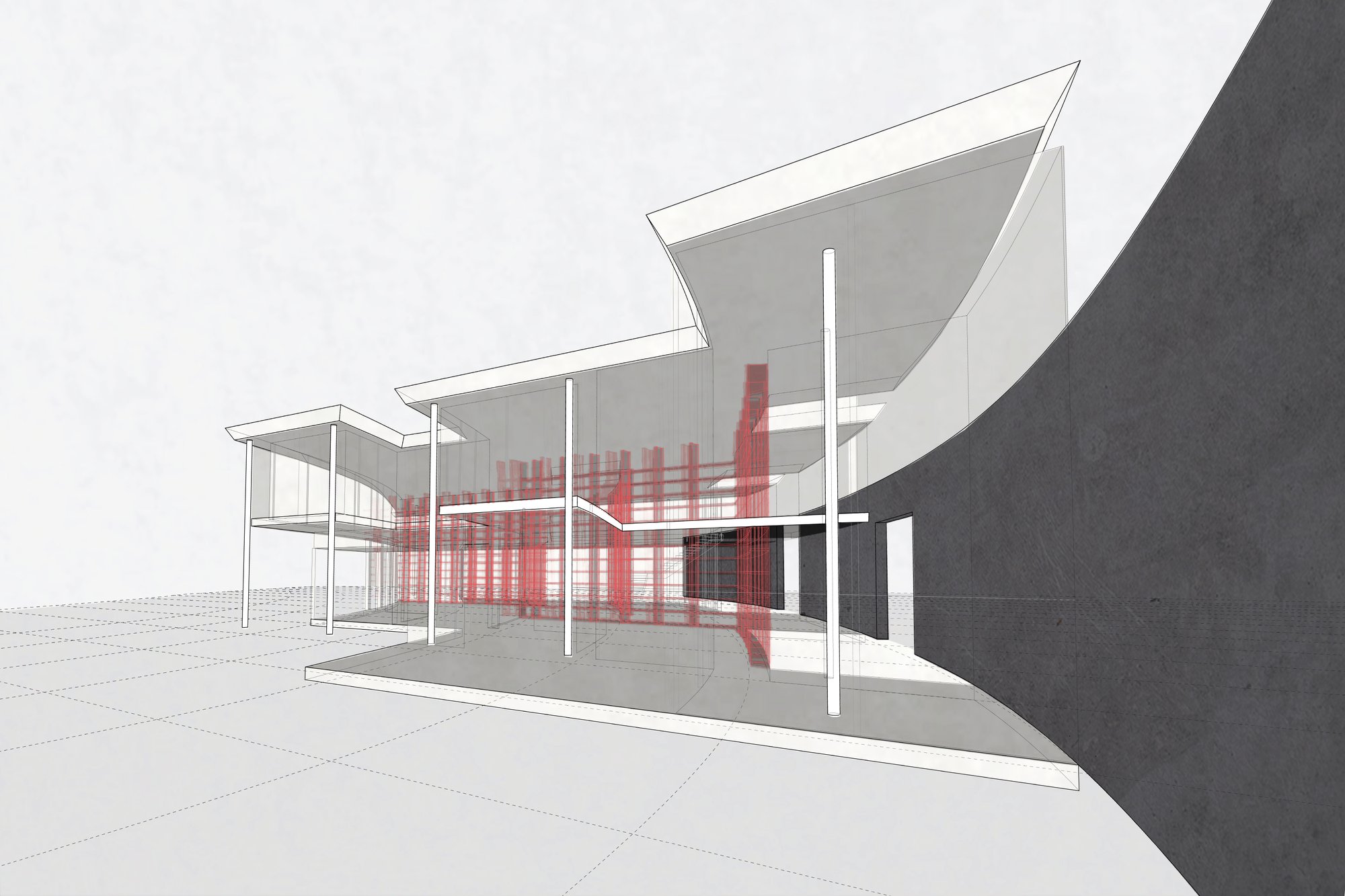
Wonderwall
A Collaborative Landscape for Contemporary Sculptors.
A contemporary artist guild harbors spaces for making and community gathering by providing different types of conditions that enable collaboration. Collaboration is crucial to an artist guild, and Wonderwall aims to promote shared resources through material functionality and overlays. Our design investigation started by studying the most important aspect of an artist guild: collaboration through making and sharing. We learned that shared resources, whether intellectual or physical, are key to streamline the process of making. By layering and refining information as we passed along sketches, plans, sections and 3D models, we began to build on the idea of iteration as a concept for architecture.
At Wonderwall, partitions are not seen as elements that subdivide space, but rather they are seen as additive contributions to the creative process. Walls are articulated with varying openness, and are used for different purposes. Thresholds are iterated with the intention that at any given moment, space can be transformed into large collaborative areas or smaller, intimate work spaces.
We started with an idea to integrate the building and artwork to the landscape, creating analogue sketches and models in order to achieve a site concept and programmatic breakdown. The design of the site is a holistic patchwork of layers that merges landscape and architecture into a cohesive experience. The grid through which the building is organized is an abstraction of the site’s geometry, distorted to create sharp focal points and elongated fields of vision. Maintaining the forestry and integrity of the site is important, and it is implemented by delineating a clear distinction between built and untouched landscape. We defined where the building starts with the addition of a sculptural wall and then blurred the building’s boundaries to the forest by creating a permeable landscape that embraces nature and art. While the wall is a monumental statement that conceals the building and creates a surface space for installation, the garden is meant to celebrate the work.
Focusing our attention on sculpture as our chosen medium for this contemporary guild, we condensed our program to hold spaces for large-scale production, and digital workshops that embrace contemporary ways of making and fabricating. The architectural proposal is defined by a sculptural wall at the entrance, which hides the building and artwork behind. Upon entering the building, the heavy exterior is juxtaposed by a light, glass enclosure and thin columns. The main structure of the building is a social element as much as it is an architectural element. Mass timber waffle frames function as the main structural walls, but also as common-resource and display locations. With the intent to promote collaboration and shared knowledge in the guild, we embraced structure as the social focal points of our building. Tools and prototypes as well as artwork will be available and displayed in the thickened wall cavities. These walls define the boundaries of workshop spaces, which house large machinery and equipment for sculpture and wood-working processes. The workshops are where different artists use the same space and tools for different crafts. These spaces are the woodshop, digital production lab, and sculpture lab.
Anyone can visit the workshops and speak with specialists who can assist them with their vision. In between the workshops, an open plan and floor-to-ceiling curtains allow for the flexible appropriation of work and observation space. The softness of the curtains and hardness of the concrete and timber work together to give artists creative freedom to collaborate in public spaces, or discuss their work in more private and airy spaces. An overhanging roof creates covered outdoor space, where artists can work and exhibit their sculptures in fresh air.
The flexibility inherent to the curtains and porous timber walls, allows Wonderwall to grow and change throughout time. Displays can change, and more space can be created for installations or collaborative workshops with the public. The building invites ephemeral programs, and promotes fluidity and collaboration through the constant rearrangement of architectural elements.
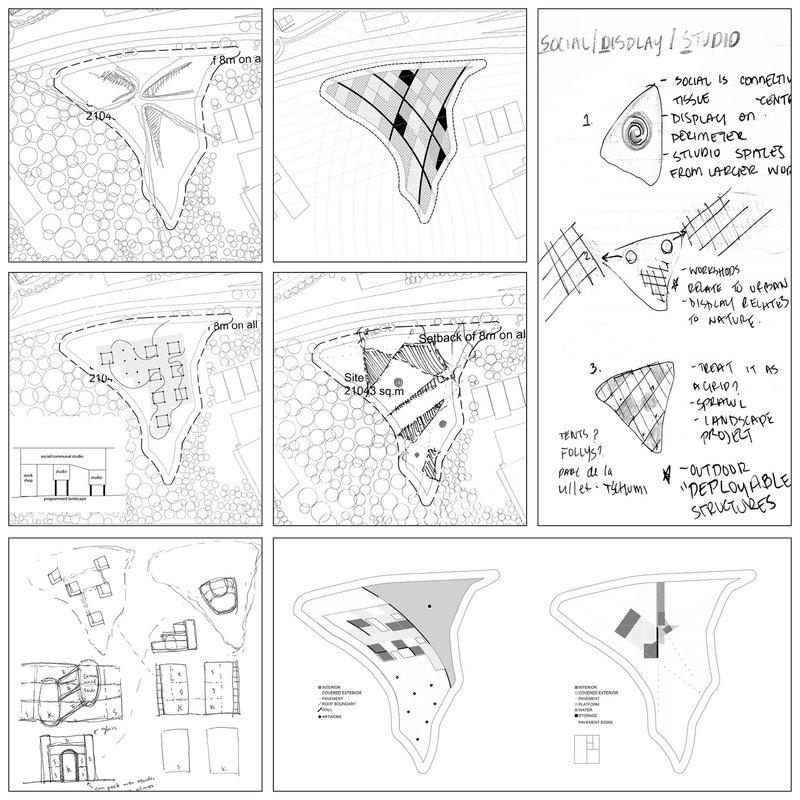
Early Analogue Sketches based on site analysis and programmatic subdivisions
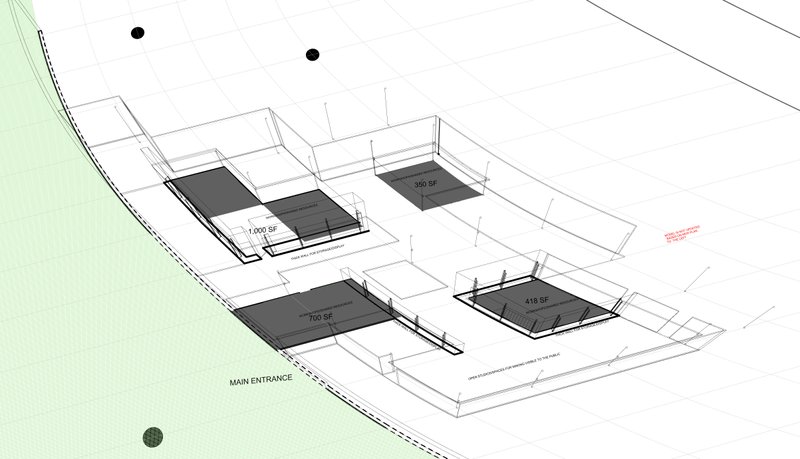
Ground coverage and square footage capacity study.
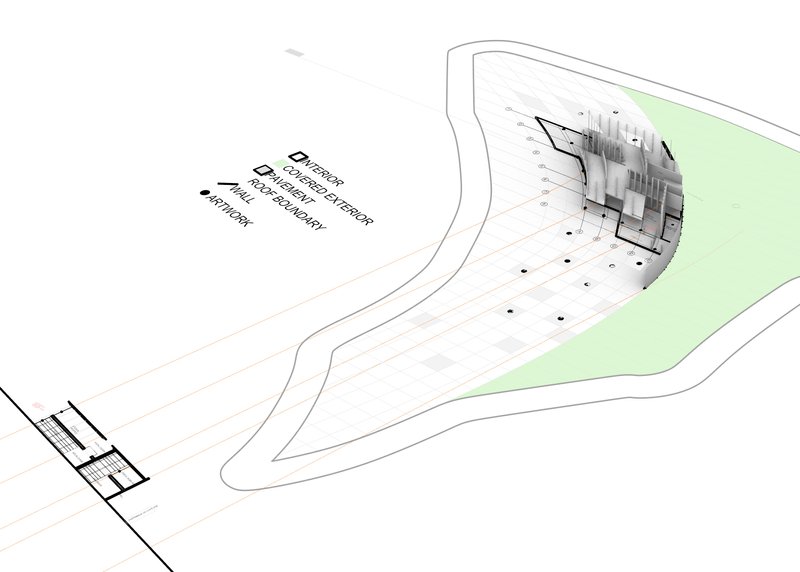
Designing between plan, section projections, and 3D models.
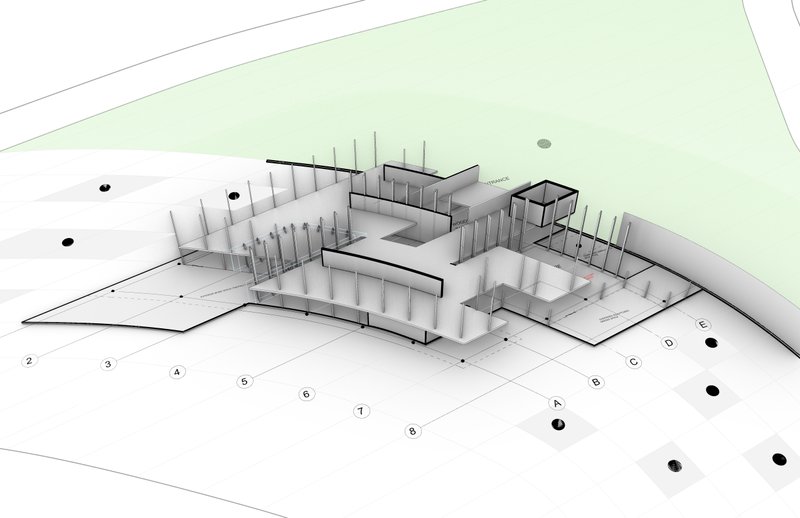
Formal and structural study. Exploring figure/ground cut outs.


Popular Articles
Popular articles from the community

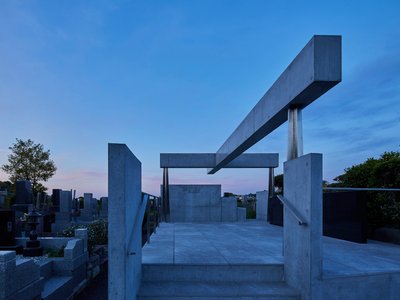
Takeshi Hosaka Architects Suspends a Concrete Cross Above a Yokohama Cemetery
A 28-square-meter burial renovation in Yokohama lifts the symbol of resurrection into the sky so mourners see it against heaven.
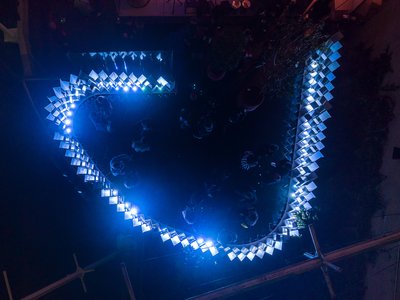
Rojkind Arquitectos and Think Parametric Build a Glueless Pavilion from 67 Interlocking Panels
A serpentine fiber-cement installation in Chapultepec Park celebrates a decade of architectural media in Mexico City.

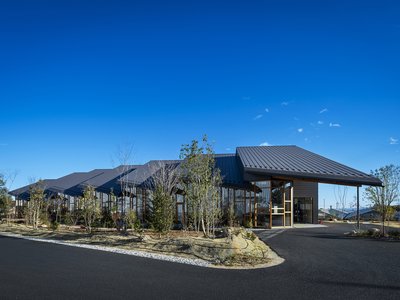
20 Most Popular Office Building Projects of 2025
From biophilic workspaces in India to net-positive energy offices in New Delhi, 20 office building projects that defined architecture in 2025.
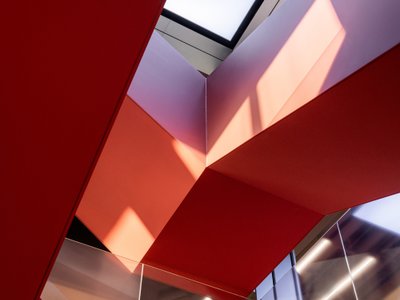
Ippolito Fleitz Group Identity Architects Turn Eight Floors in Shanghai into a Vertical Creative City
Publicis Groupe's new headquarters in Xintiandi reimagines the office as a courtyard-driven urban landscape stacked across eight floors.
Similar Reads
You might also enjoy these articles

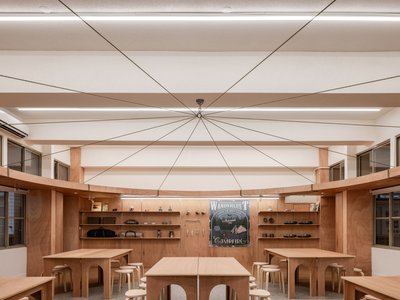
317studio Turns an 87 m² Classroom into a Forest Clearing for Scouts in New Taipei City
A rope canopy, student-made specimens, and campfire geometry replace rows of desks in this Scouting classroom in Xizhi District.
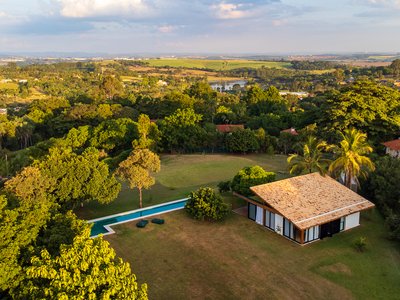
24 7 Arquitetura Builds a Timber Pavilion as a Family's First Act on a 5,000 m² Brazilian Plot
In Jaguariúna, a prefabricated glulam house nestles among mature trees as the opening move of a larger residential masterplan.
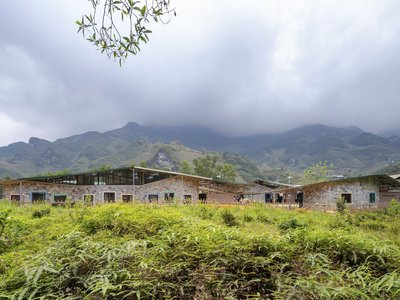
1+1>2 Architects Build a School from 900 Blocks of Hmong Stone on Vietnam's Rocky Plateau
On a barren valley in Ha Giang province, a community quarried its own stone to raise a kindergarten and primary school rooted in Hmong identity.
100A Associates Builds a Volcanic Stone Retreat on Jeju Island Rooted in Ritual and Restraint
Watarstay [Wa:Tar] in Bongseong-ri channels Jeju's basalt, reed, and hemp into a 150 m² hospitality space shaped by contemplation.

Explore Architecture Competitions
Discover active competitions in this discipline




The International Standard for Design Portfolios


The Global Benchmark for Architecture Dissertation Awards


The Global Benchmark for Graduation Excellence


Challenge to design an urban locus of culture and heritage
Comments (0)
Please login or sign up to add comments
No comments yet. Be the first to comment!