
Worship Space FAQ
FAQ

1. What kind of emotions does your design intend to resonate among the visitors?
The project intends to evoke the emotions of calmness, humbleness, and solitude within a quiet atmosphere that invites visitors to perceive history, nature, and oneself.
2. How does material play a role to generate these emotions in your design?
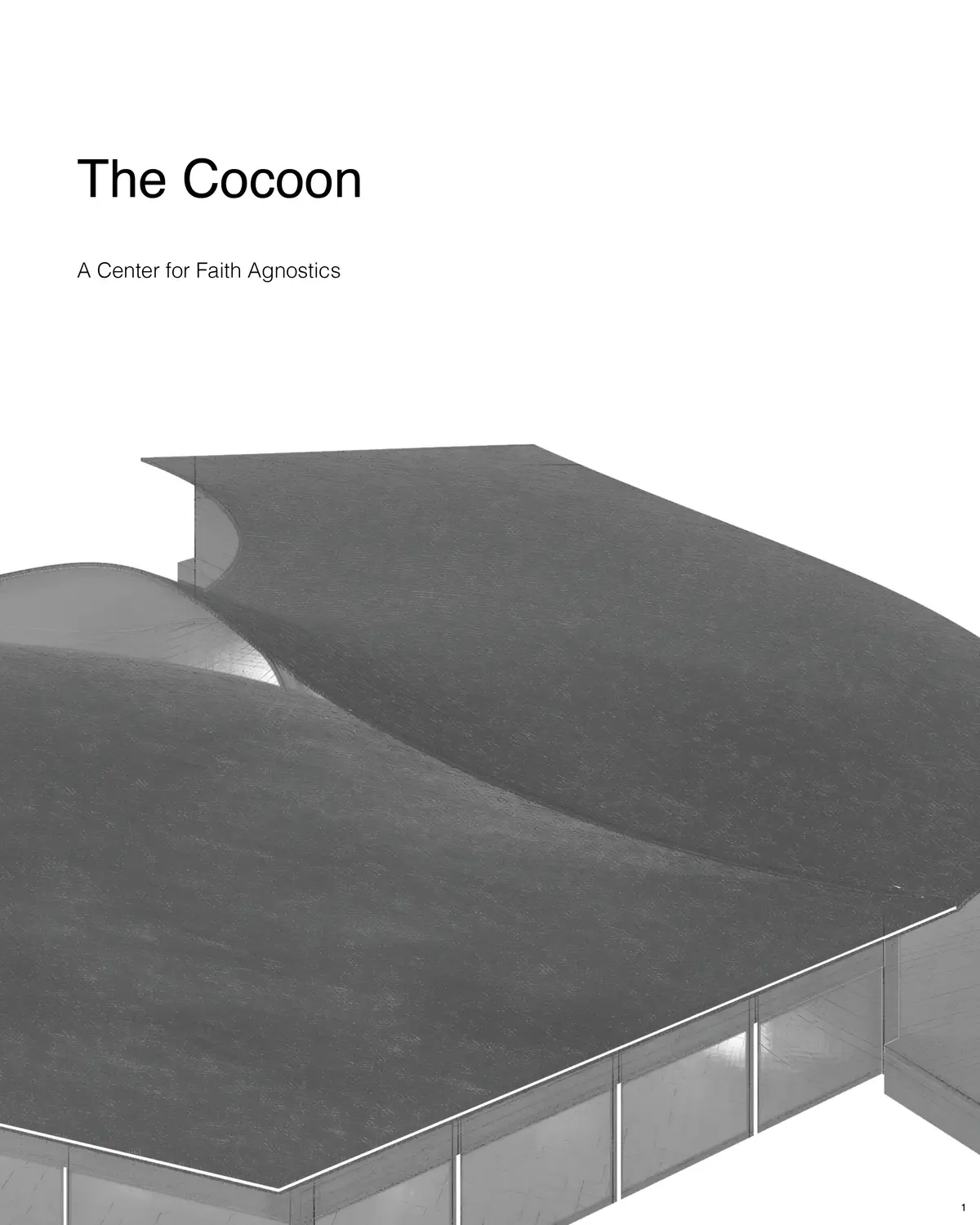
The project uses materials that have natural textures and subtle colors. They are simple and remain modest sitting beside the relic of the Ming dynasty city walls while echoing with the local culture. The roof material is slate, which is a common material in traditional Chinese architecture, and its natural rock texture and its layerings resonate with the brick city walls. The large slate roof gives the building a rooted feeling that helps with the settled atmosphere. The wall material is concrete, the solidity, and thickness of which encloses a quiet and secluded space that calms people down.
3. How does your design evolve with the changing seasons?
The project has large areas of windows where the changing seasons reflecting on the nature in the park can be observed from the worship space within. The layered curved roofs are intentionally left with gaps in between where the changing temperature might be felt from within.
Within the project, there’s a half-underground cave-like space where there’s a sloped wall extending from a controlled opening at the edge of the ceiling. Above the opening, there is planted a large tree. When the season changes, the tree and the shadow of the tree would change too. In spring, leaves flourish and the shadow would cover a large range. In autumn, leaves fall down and some of them would fall into the building. In winter, when it snows, snow would also get into the building. All those changes related to season changing could be seen inside the building.
4. How does the design respond to the existing Heritage Wall Relic of the Ming Dynasty?
Besides the material choices that resonate with the layered brick city walls, the project provides a visual sequence relating to the wall relic. Inspired by the technique “Guo Bai” of traditional Chinese architecture (a technique that frames the distant view or landscape to reach an intriguing visual effect by controlling the distance between architectural elements like doors and eaves), the gap between the layered curved roof of the building is used to guide the view of the visitors. The visitors would view the landscape beyond the city walls, at the city walls, and below the city walls. The project hopes to evoke thinkings from the experience of the passing of time by looking at history.
5. What are the design strategies involved in making the space act as a shell from the exterior/ everyday life?
It welcomes everyone to visit with a curved wall entry. Along the long and narrow corridor, visitors experience changes in view and light, which gradually draws them to a settled atmosphere. After the corridor and the main space facing the wall, visitors have the choice to sit down facing the city wall ruins, going underground to the dim cave-like space, or exit. Different from what we see in daily life where our perception is unfocused within the combination of modern and historic architecture and nature, this project isolates different experiences of “time.” Individualizing the experiences of looking up between layers of the roof to the modern landscape, looking only at the relic of the city walls, and situating in the dimly lighted underground space encourages visitors to reflect upon the gradation of history, passing of times.

Popular Articles
Popular articles from the community


Opera by the Sea Estonia: Three Shells Dissolving Architecture into Tallinn's Coastline
A winning opera house proposal replaces monumental form with interconnected shells that blur the boundary between building, park and Baltic Sea.

Faces of the Soviet Avant-Garde: Turning Moscow's Street Names into an Open-Air Museum
A network of sculptural installations across a Moscow residential district transforms forgotten architect names into spatial encounters with cultural memor

Singing Woman: An Opera House That Performs Before the Curtain Rises
Ovidiu Cristian Pavel's conceptual opera house translates Estonia's choral identity into a sculpted waterfront landmark facing the Baltic Sea.

Extended Shell: Retrofitting Kolkata's Balconies as Living Urban Thresholds
A modular retrofit system recovers the social and environmental intelligence of Kolkata's historic verandas for contemporary Park Street residents.

Similar Reads
You might also enjoy these articles
The Rhythm of Seasons
A Farmers' Market Connecting Nature and the City

More Than a Building-Designing a Living System
More Than a Building-Designing a Living System
Base Beyond
DESERT COMPOUND ARID: TOURISM OF ABSENCE AND ABUNDANCE

Comments (0)
Please login or sign up to add comments
No comments yet. Be the first to comment!