

Yangjia River Greening Enhancement – Building No.4 by YIIIE Architects
A flowing, double-curved public building that merges park, commerce and river circulation, redefining urban greening through continuous open-air architecture


Along the Yangjia River axis in Jinan High-tech East District, Building No.4 stands as one of the most critical interventions in the Yangjia River Rainbow Lake Small Architecture Series—a system of civic infrastructure, slow-mobility routes and ecological public spaces planned to renew the district’s identity. In a landscape where large commercial zones and engineered waterfronts traditionally dominate, this project challenges the conventional separation between nature and urban development. Rather than appearing as an inserted object, Building No.4 emerges from the site as a connective tissue—linking river to city, movement to pause, public to commercial, daily life to greenery.

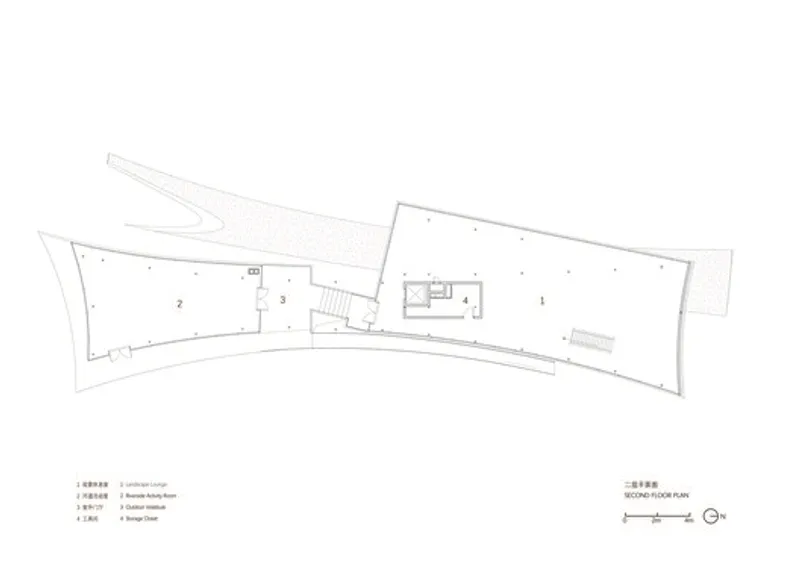
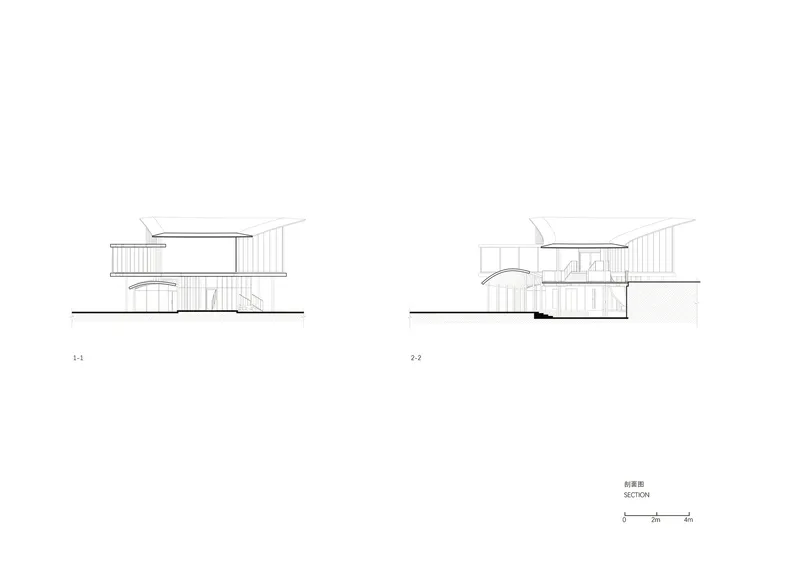
The site occupies a long and narrow plot where Kechuang Road meets Kewen Road, a strategic position in the emerging central district. The design mandate—issued under the directive to strengthen supporting facilities, enhance urban quality, stimulate innovation vitality, and increase development radiance—was not simply to construct a building, but to establish a spatial catalyst. Its role: to prototype how architecture, landscape, slow traffic and commerce could coexist and mutually generate value.


Rethinking The Relationship Between Built Form and Landscape
Urban greening projects commonly struggle with the conflict between publicly accessible parkland and revenue-driven functions. Buildings often operate as isolated volumes, while the green space becomes mere leftover foreground. YIIIE Architects reversed this model. Their core question was how a piece of architecture could soften its presence so that parks and buildings reinforce one another rather than compete.

Their guiding principle was defined as making the landscape beheld, creating space in between. It is not the volume itself that becomes the protagonist, but the edges—the gaps, thresholds, corridors and shaded transitional rooms where city users naturally gather. Instead of a single monolithic program, Building No.4 becomes an interwoven field of activity: shade, path, slope, plant, shop, seat, water, wind.
In this sense, the building is not merely a structure to shelter programs, but a facilitator of public life. Its spatial flows, curving planes and branching corridors serve as the tactile expression of the invisible social fabric of the new district.
Architecture That Moves Like The River
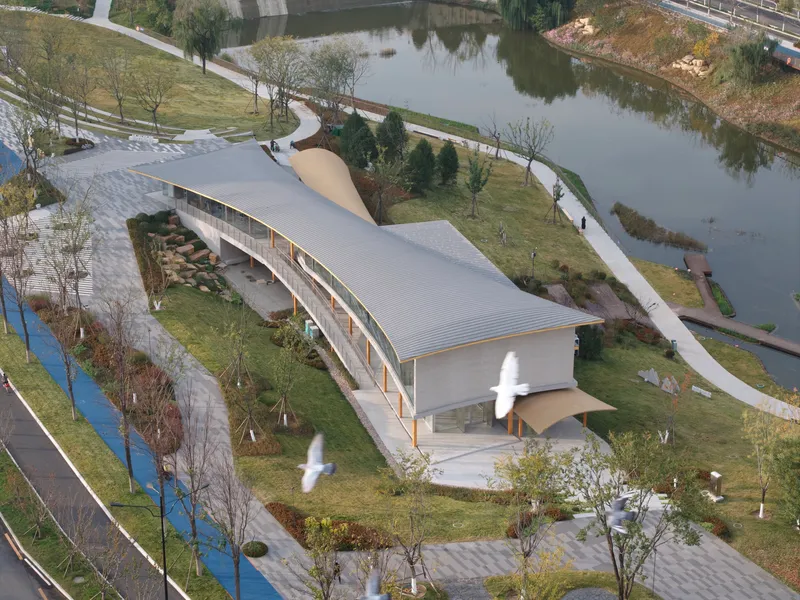
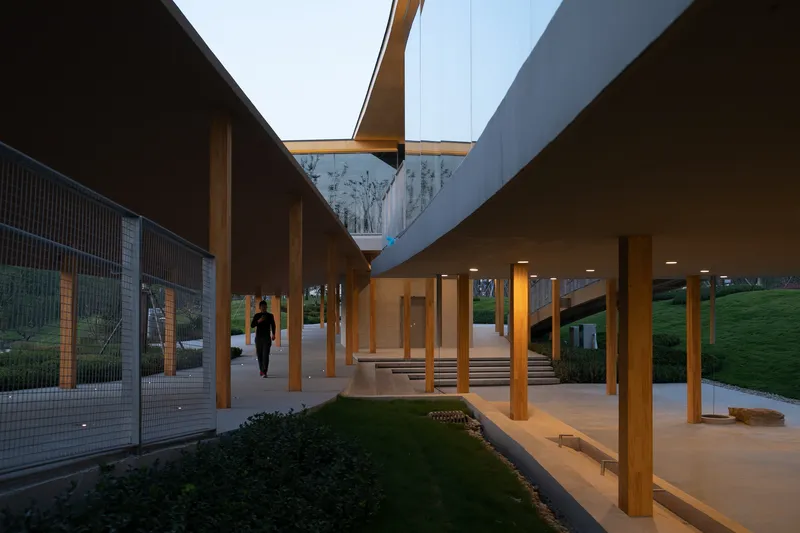
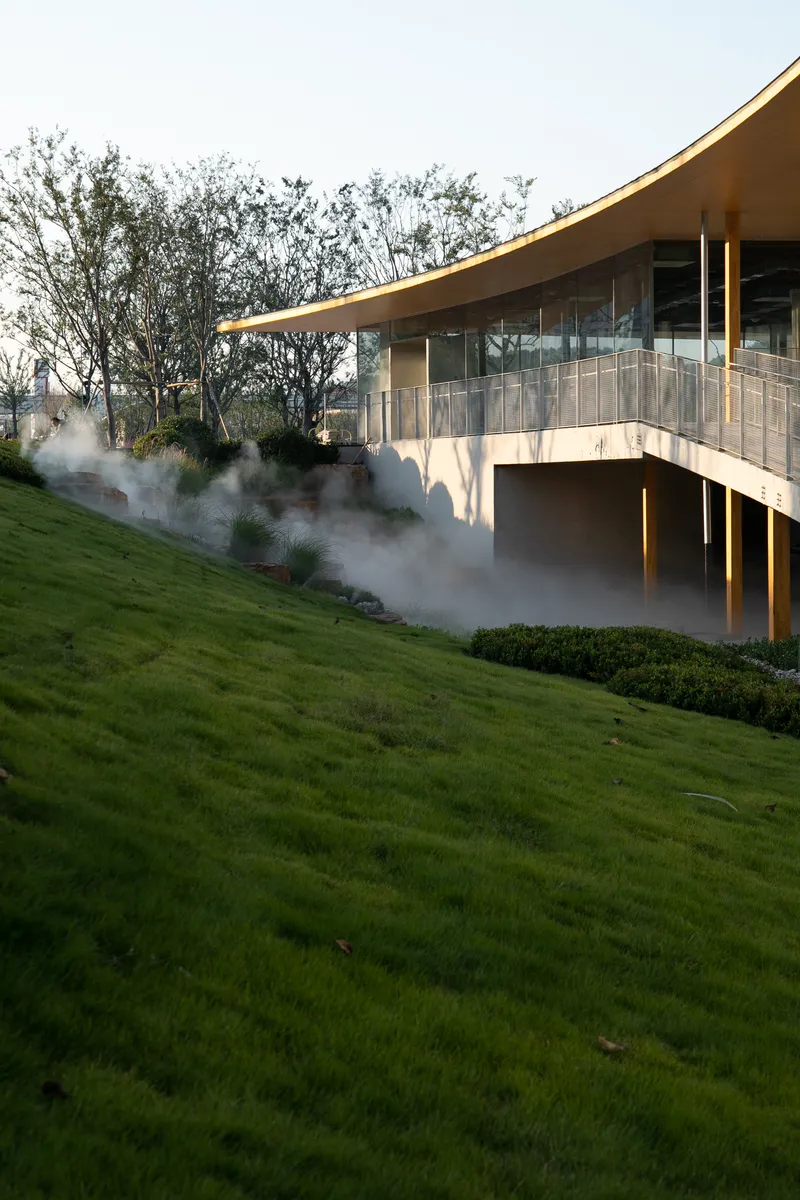
The form of the project takes inspiration from the Yangjia River’s linear fluidity. It does not stand orthogonal to nature—it travels with it. With gestures described as flow, stretch, rotate and open, the building reacts to topographic movement. Edges pull forward toward the riverbank, lift above the lawn, wrap onto walkways, then loosen outward into viewing decks and shaded resting platforms.
This continuous motion transforms building mass into landscape extension. Slopes and curves maintain public circulation rather than hinder it. The interior is not sealed behind glass; instead, the envelope breathes, opening at intervals to dissolve into the greenbelt.

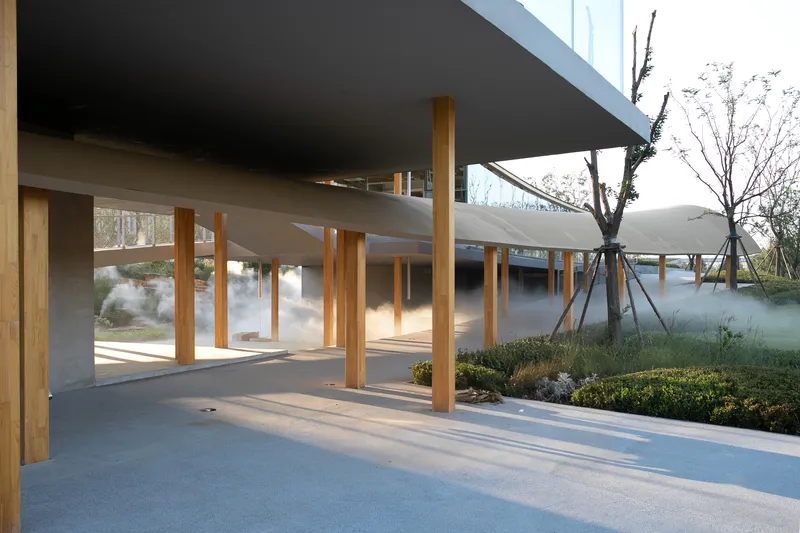
As seasons change, these flows adapt. Summer shade cools public life under the structure. Autumn winds move through corridors. During spring, planted gaps sprout with new growth where the undulating pathways intersect. In winter, the building becomes a sculptural trace of motion, its soft canopy curving against the low sun, collecting snow and shadow like a topographical contour line.

Interlacing Circulation as Urban Strategy
Building No.4 sits on a sloping linear plot. Instead of fighting it, the architects let the terrain dictate movement. To express this attitude architecturally, a hyperbolic plate truss system forms the primary roof-corridor—a difficult geometry chosen not as formal spectacle but as structural metaphor for fluid continuity.
The elongated circulation spine creates numerous contact points between river, commercial interior, open lawn and sheltered sitting spaces. Unlike conventional public buildings where pedestrian movement is linear and segmented, here circulation is the program. The corridors weave, dip, overlap and bifurcate. The movement resembles river branch patterns—never singular, always branching.
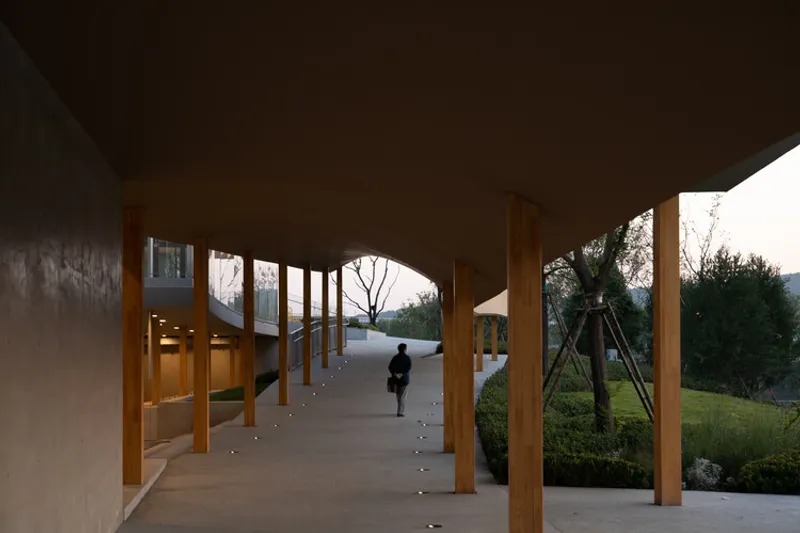
Where these paths intersect, residual spaces appear—irregular pockets where plants take root. Instead of subtracting them as awkward leftover, the architects use them as courtyards, gardens and social nodes. The built volume becomes an urban ecosystem where architecture generates natural growth instead of crowding it out.
A New Typology For Public-Commercial Integration
Commerce in parks typically functions as an add-on: a shop inserted beside greenery, not within it. Building No.4 challenges this model by placing commercial programs inside continuity rather than behind boundaries. Shops and flexible service spaces merge into public corridors. One may walk through the building to reach the river, sit beneath the roof without purchasing anything, or encounter an open event space activated by seasonal programs.
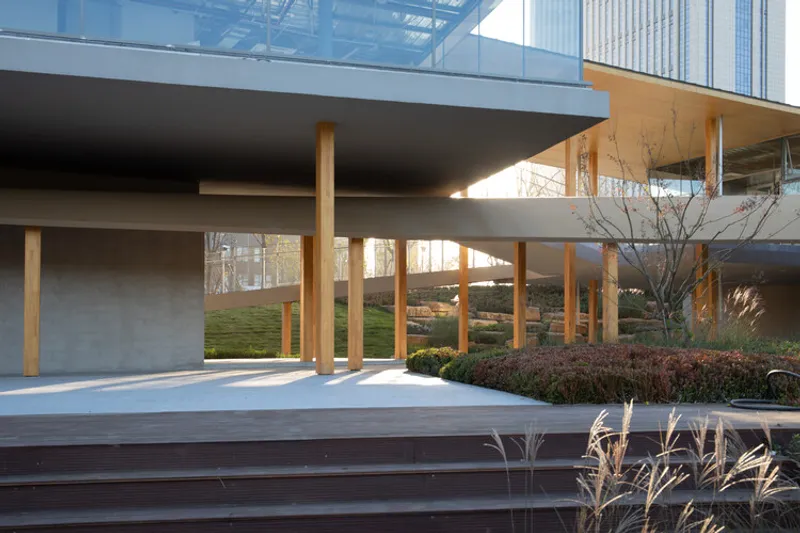
This dissolving of thresholds transforms consumption into an optional layer rather than a gatekeeping requirement. People come for green space but encounter commerce naturally, without forced entry. The architecture proves that commercial activity can grow from public generosity, not exclusivity.
Structural Execution: The Double-Curved Truss Corridor
The signature roof is a double-curved plate truss approximately 6 meters in span and only 100 mm in structural thickness. Its creation demanded advanced fabrication strategies far beyond standard flat roof assemblies. TANDD’s digital lofting process made it possible to cut each irregular component with precision, ensuring curvature consistency across the twelve large truss pieces.
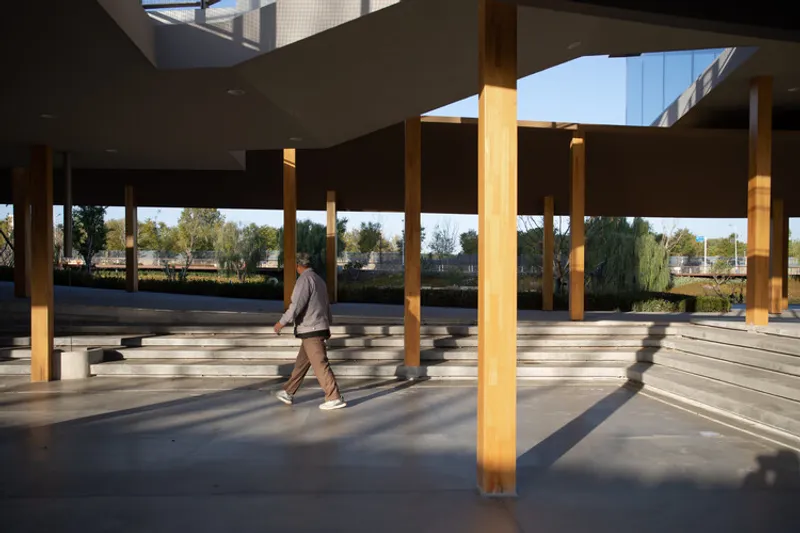

Transportation required custom packaging frames to avoid deformation. On site, the team performed a rapid but highly coordinated assembly: base plate embedding, steel column placement, truss lifting, onsite welding and curvature adjustment—all completed within 20 days. The achievement is not merely technical; it represents a new construction methodology for public architecture aiming to deliver sculptural form at infrastructural efficiency.
The result is a corridor that reads as light and impossibly thin, and under sunlight it behaves like a flowing matte ribbon—soft in appearance, structurally sophisticated beneath.

Public Space As Social Framework
The architecture’s greatest success lies in its social behavior. People do not treat Building No.4 as a singular destination but as a passage, a shortcut, a shelter, a viewpoint and sometimes a place to meet, exercise, wait or linger.


Parents use shaded paths while children run across lawns. Cyclists glide beneath the canopy before merging onto the pedestrian river route. Seniors walk slowly along gentle slopes, stopping at courtyards to rest. Office workers cut through the building on lunch breaks. Evening light draws photographers toward terrace overlooks. During weekends, flexible interior nodes host small markets, community workshops and water-edge performances.
By encouraging incidental encounters, Building No.4 becomes a living instrument of urban rhythm. It not only serves the Yangjia River corridor—it animates it.

A Future-Facing Urban Prototype
As Jinan expands eastward, this project serves as prototype rather than completed gesture. It tests how ecological renewal can coexist with urban intensification. It demonstrates that commercial-public synthesis need not erase green space but can activate it. It offers a new index for density—where density is not measured in buildings but in experiences, routes, activities and interwoven landscapes.

More importantly, Building No.4 illustrates that future urban expansion need not be heavy. Lightness—spatial, ecological, material—can lead progress. Instead of monuments, we may build flows. Instead of sealed rooms, we may build corridors. Instead of dividing green from structure, we may grow one through the other.
This philosophy positions Building No.4 not as an isolated pavilion but as a seed species for a future where city and river interdepend rather than oppose.



Popular Articles
Popular articles from the community


The Ocean Hive: Sustainable Architecture for a Self-Sufficient Civilization at Sea
The Ocean Hive imagines sustainable architecture at sea, where modular habitats, algae, wave power and ocean waste sustain a growing colony.

Co-life: Sustainable Architecture for Age-Friendly Community Living
Co-life reimagines sustainable architecture for seniors through courtyards, rammed earth, shared gardens, and spaces designed for belonging.

Riyadh For All: Intergenerational Urban Design for Active Aging in Rabat
Riyadh For All reimagines urban design in Rabat with intergenerational co-living, adaptive courtyards, and Moroccan cultural exchange today.

The Musturak Paradise: Senior Living Architecture for a Connected Future in Temara, Morocco
The Musturak Paradise reimagines senior living architecture in Temara via private homes, social spaces, culture, community, and shared care.

Similar Reads
You might also enjoy these articles


Hodi-Mandai Geram
Project Function: Preservation and revitalization of the Intangible heritage and socio-spatial identity of the Hodi by Housing, Cultural Memory Center, Sacred Grove, landscape, local tourism economy


Olio Towers: A Mid-Rise for Performers That Fuses Housing, Rehearsal, and Stage
Located blocks from Houston's Theater District, this modular tower stacks living units around a central performance atrium.

Oasis: Modular Green Housing Carved into Dhaka's Urban Fabric
A shortlisted Plugin Housing entry reclaims unauthorized settlements in Dhaka with stepped concrete volumes, green roofs, and ventilation-driven design.

Black Hole: A Floating Megastructure for the Post-Physical Era
Emiliano Mazzarotto envisions a spherical, self-scaling arena where e-sports, digital hotels, and holographic stadiums replace traditional public space.

Explore Riverfront Development Competitions
Discover active competitions in this discipline


Challenge to design locus for the upliftment of human rights


Challenge to reimagine the Iron Throne


Photograph architecture without architects


Illustrate the lost glory of Angkor Wat - Render Challenge
Comments (0)
Please login or sign up to add comments
No comments yet. Be the first to comment!