
YARCH and ATELIERII Turn a Taipei School Foyer into a Cork-Terrazzo Learning Landscape
A 265-square-meter secondary school entry in Taipei becomes an active spatial core where circulation and learning overlap.


School foyers rarely get a second thought. They exist to sort bodies from outdoors to indoors, to absorb mud and noise, and to funnel students toward classrooms. At a secondary school in Taipei, YARCH and ATELIERII rejected that premise entirely. Their Little Aesthetic Hub, completed in 2025, recasts 265 square meters of transitional space as a shared spatial core: part amphitheater, part lounge, part informal classroom. The foyer no longer simply connects; it hosts.
What makes the project genuinely interesting is the conviction that circulation itself can be pedagogical. Rather than adding program rooms off a corridor, the design team sculpted the circulation zone into a topography of cork-clad terraces, curved screens, and mobile partitions. Students don't pass through on the way to something better. They stop, sit, organize gear, gather in clusters. The threshold becomes the destination, and the school gains a flexible commons without sacrificing a single classroom.
A Cork Topography at the Center
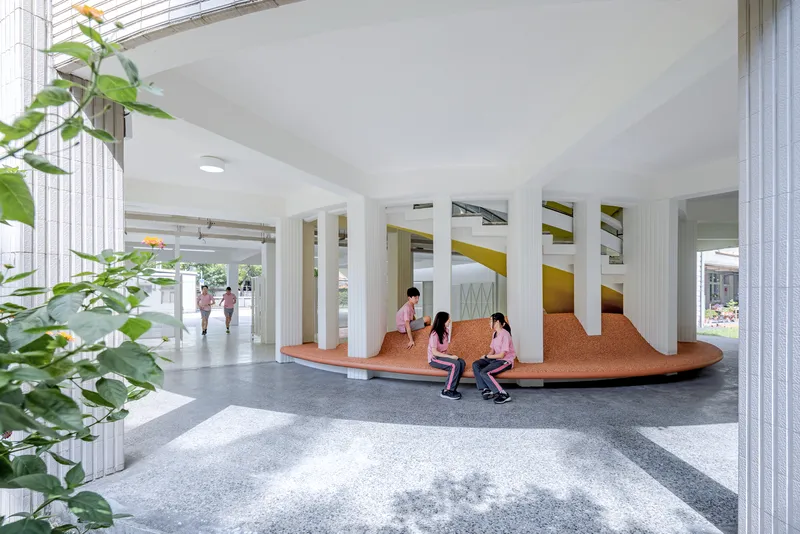
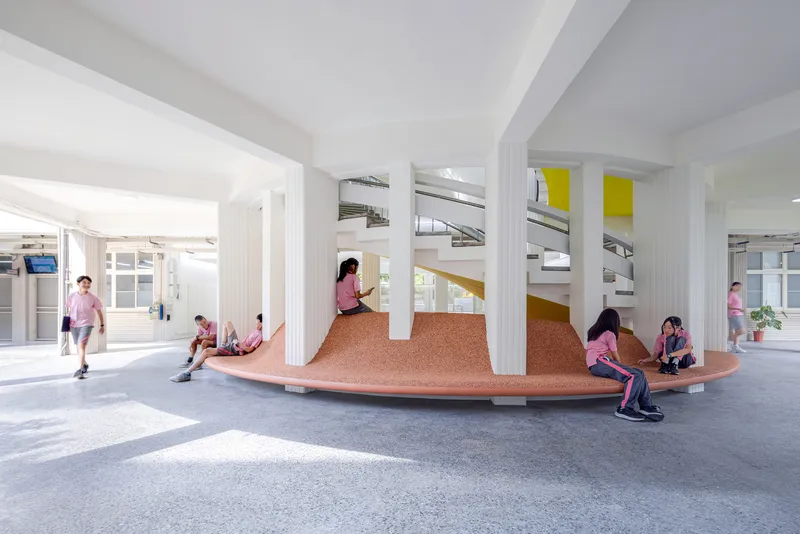
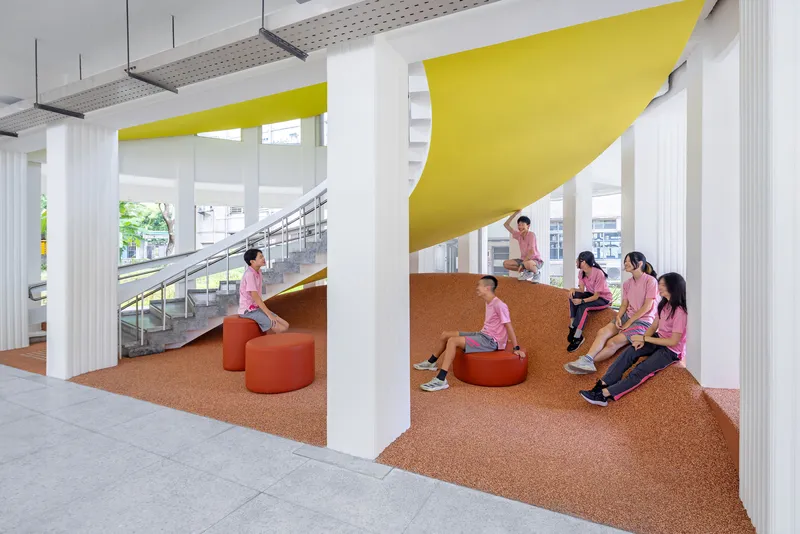
The defining gesture is a curved, terraced seating platform clad in cork, rising from the ground floor like a soft geological formation. Ringed by white fluted columns that carry the building's existing structure, the platform introduces level changes that turn a flat foyer into a landscape with distinct zones. Students perch on its steps in groups of three or fifteen. Cork's warmth underfoot and to the touch gives the surface a domestic quality that most institutional interiors avoid.
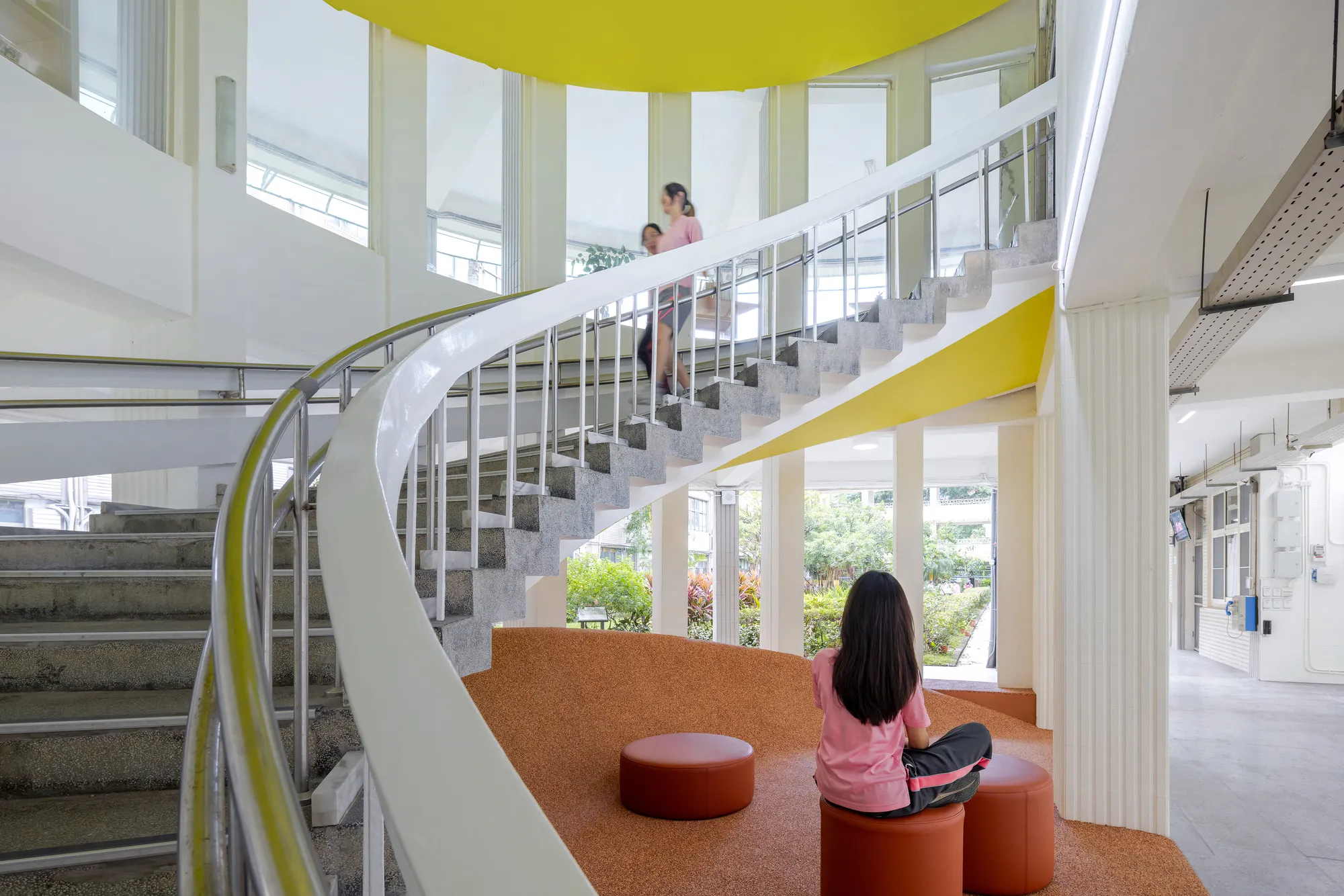
Yellow ceiling panels and orange upholstered stools punctuate the neutral cork and white palette with bursts of color that read as playful without tipping into childishness. The material strategy is restrained: cork terrazzo for sitting surfaces, rubber for stair treads, perforated metal for screens. Each material is chosen for durability under adolescent use and for the specific sensory register it contributes.
Perforated Screens and Moving Walls
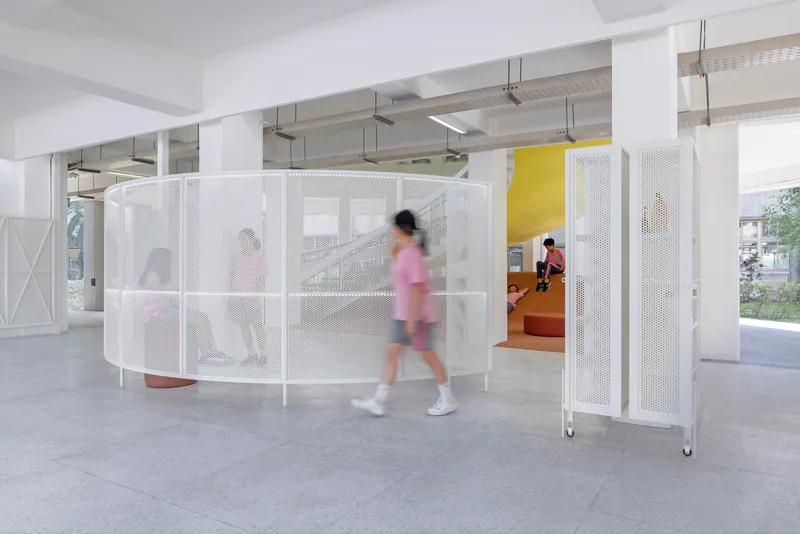
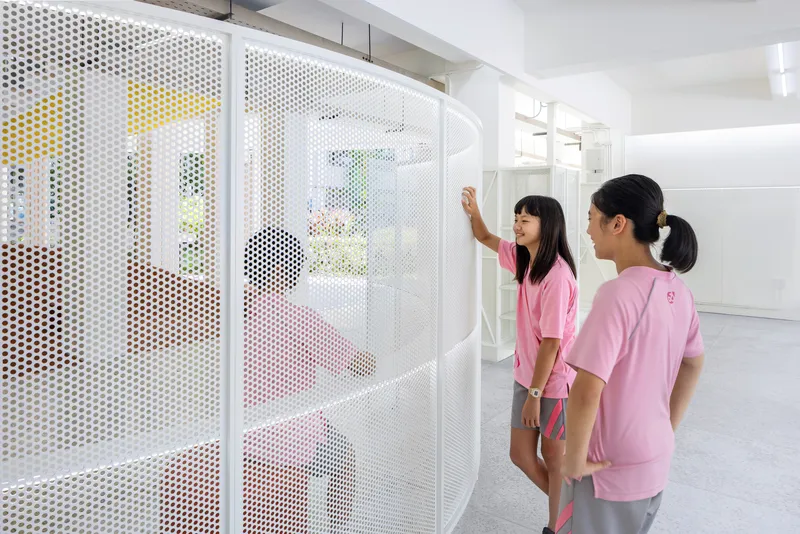
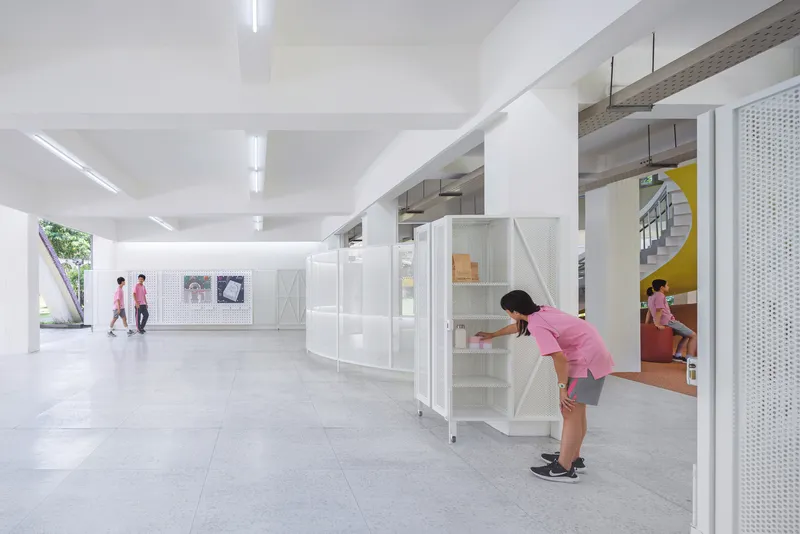
White perforated metal screens curve around the seating terraces, filtering sightlines without sealing them off. The perforations let color and movement bleed through, so students on either side of the screen remain visually connected. It is a partition that acknowledges rather than denies the life happening around it. Two students examining the screen in close-up reveals how the punch pattern frames colorful fragments of activity beyond, turning the boundary into a kind of animated wallpaper.
Alongside the fixed screens, white modular storage units on wheels introduce a genuinely movable infrastructure. These perforated-panel carts can be rearranged by teachers or students to carve temporary enclosures, exhibition walls, or storage bays within the open column grid. The flexibility is not hypothetical; the wheels and lightweight construction mean a single person can reconfigure the layout in minutes.
The Yellow Staircase as Vertical Anchor


A helical staircase with bright yellow metal railings spirals upward beside the cork platform, connecting ground floor to upper levels. Its yellow disc ceiling overhead acts as a beacon, marking the vertical core from across the foyer. The stair is not tucked into a fire escape; it is positioned as the spatial event that organizes everything around it. Orange rubber treads continue the tactile logic of the floor surfaces, softening the climb and muffling footfall.
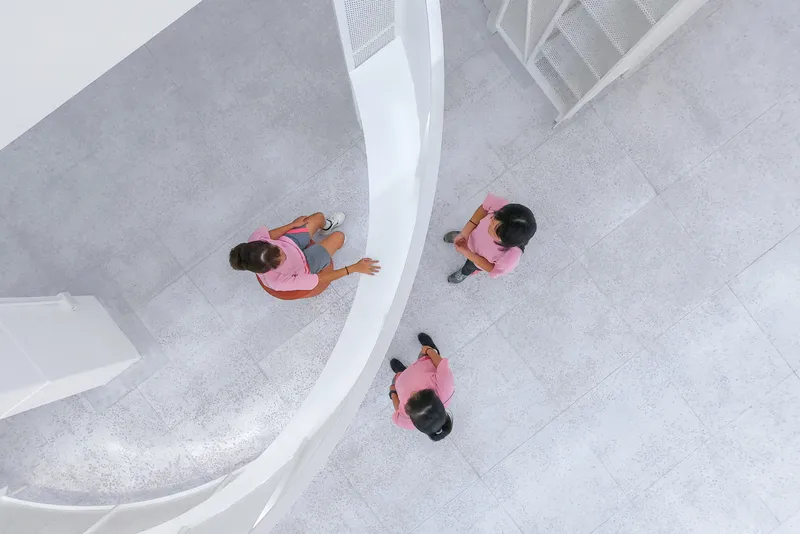
From the staircase landing, the view down reveals the full plan in action: white columns marching in a grid, translucent partitions shifting between them, students scattered across the pale terrazzo floor. It is a vantage point the architects clearly intended. The landing becomes a balcony, and the foyer below becomes a stage for the casual choreography of school life.
Everyday Occupation
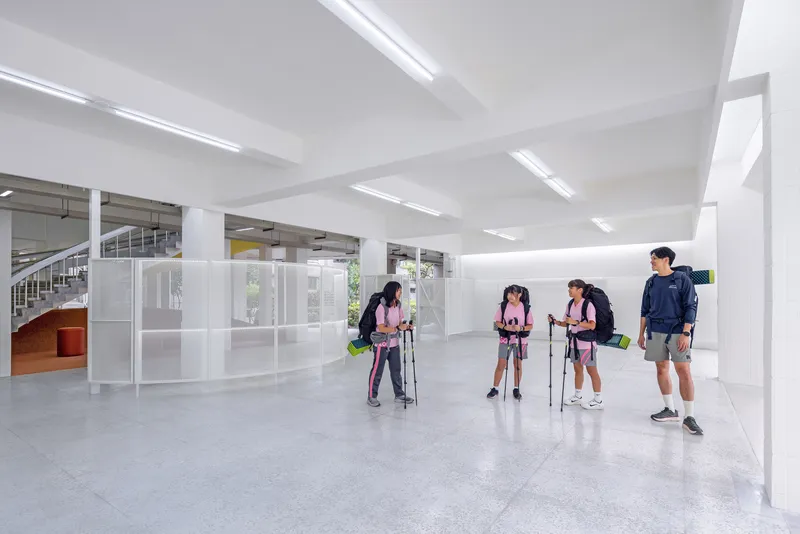

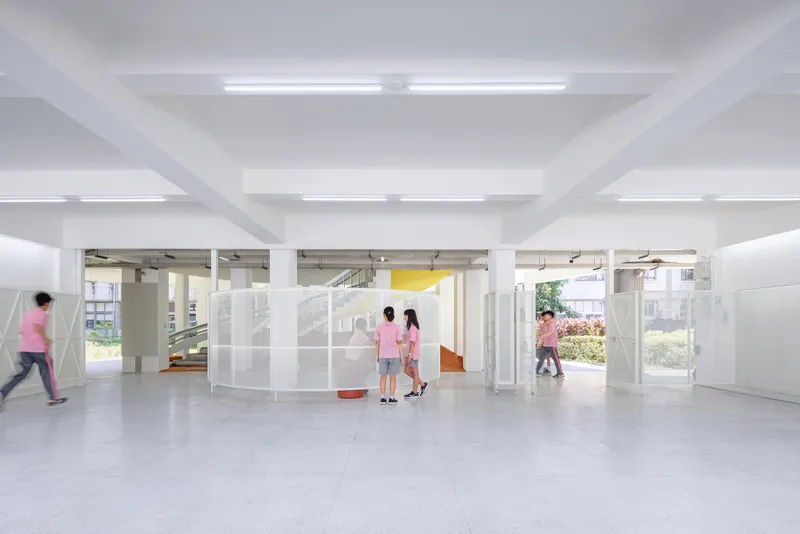
The most telling images show students not posing but using: sitting on the terrazzo floor to organize hiking backpacks, moving past the cork nook on the way to class, clustered beneath fluorescent lighting to sort gear. These scenes confirm that the space is genuinely flexible rather than merely photogenic. A foyer that can host a pre-hike equipment check with the same ease as an informal reading group has earned its claim to multifunctionality.
Exposed concrete ceiling beams and mechanical ductwork overhead keep the space honest about its institutional bones. The architects did not plaster over the building's infrastructure; they let it coexist with the new insertions. The contrast between raw concrete above and warm cork below gives the hub a layered character, new elements sitting inside old ones without pretending the old ones were never there.
A Glowing Threshold
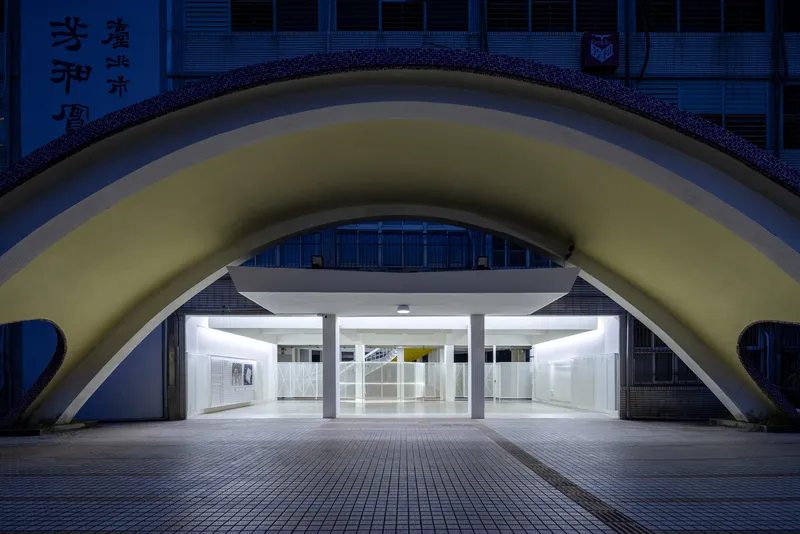

At twilight, the arched entrance reads as a luminous vault, its white interior spilling warm light onto the pavement. The curved profile signals arrival and frames the interior as something worth looking into. From the street, the foyer is no longer a dark gap between doors but a visible room with depth and activity. The architects understood that for a school hub to work socially, it also has to work as an invitation.
Inside the white corridor, exposed mechanical systems run overhead while students move past the cork seating nook. The corridor's generous width and even lighting make movement comfortable rather than congested, and the seating nook pulls people to the edges, keeping the central path clear. It is a simple spatial trick, but it resolves the tension between sitting and passing that plagues most school common areas.
Plans and Drawings

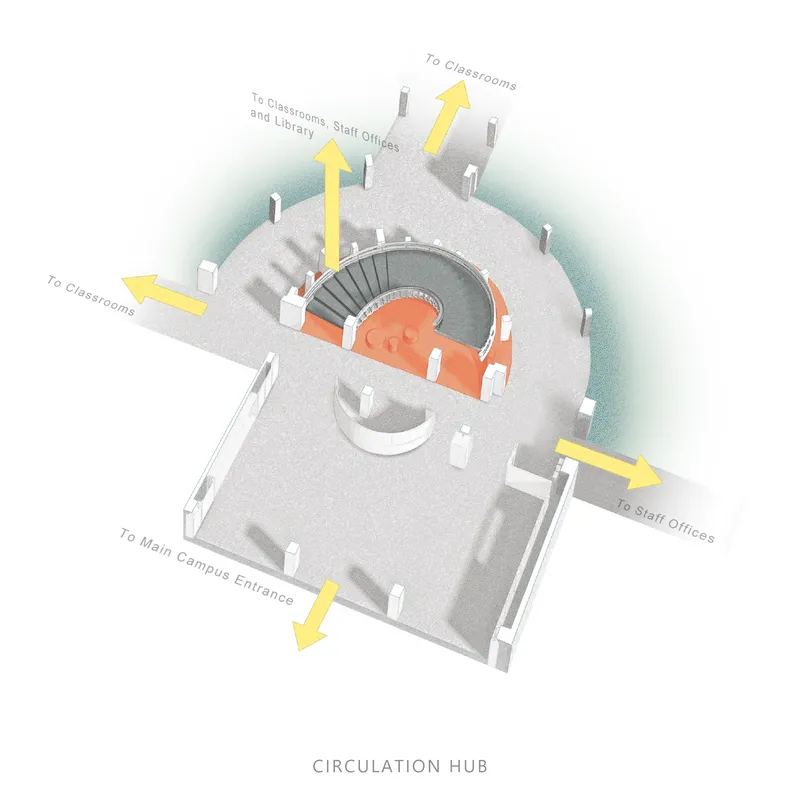
The plan diagrams lay out the transformation clearly: the original layout funneled students through a corridor with minimal pause, while the renovated scheme opens a semicircular central space that anchors gathering and redistributes circulation around it. Yellow arrows in the axonometric drawing trace how movement flows from the entry through the hub and outward to surrounding program areas, confirming that the design treats the foyer as a distributor rather than a bottleneck.
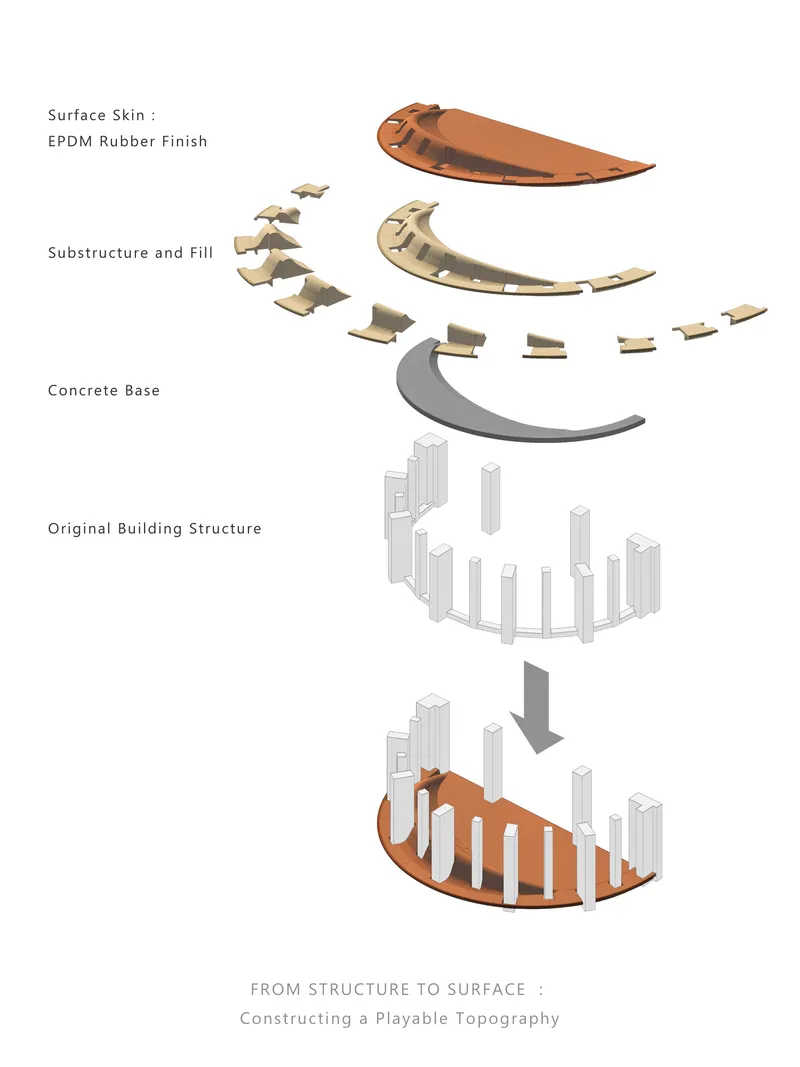
An exploded axonometric breaks the assembly into layers, from the existing building structure through new partitions to the rubber-finished surface skin. The drawing reveals how few new elements the architects actually introduced: a platform, a stair, a set of screens, and a surface layer. The lightness of the intervention is its strength. The project works with the existing column grid and ceiling height rather than fighting them, adding just enough material to shift how the space is occupied.
Why This Project Matters
Schools around the world are rethinking what happens between classrooms, recognizing that hallways, lobbies, and foyers shape a student's day as much as any lesson plan. The Little Aesthetic Hub offers a compact, replicable argument for treating these leftover spaces as design opportunities. At 265 square meters, the intervention is modest in footprint but ambitious in its claim that a foyer can host learning, socializing, and circulation simultaneously without privileging any one function.
YARCH and ATELIERII demonstrate that the tools required are not exotic: cork surfaces for comfort, perforated metal for filtered transparency, mobile units for adaptability, and a single expressive staircase to anchor the composition. The real design intelligence lies in reading the existing structure's column grid as an opportunity rather than an obstacle, and in trusting that students will occupy a well-made landscape without being told how. That trust, materialized in cork and terrazzo, is what makes the project worth studying.
Little Aesthetic Hub, designed by YARCH and ATELIERII (lead architects Yu Wu, YenjuCHEN, Linju Chien, Chichang Chung). Taipei, Taiwan. 265 m². Completed 2025. Photography by Yuchen Chao Photography.
About the Studio
Share Your Own Work on uni.xyz
If projects like this are the kind of work you want to make, uni.xyz is a place to publish your own, find collaborators, and enter design competitions.


Popular Articles
Popular articles from the community


The Ocean Hive: Sustainable Architecture for a Self-Sufficient Civilization at Sea
The Ocean Hive imagines sustainable architecture at sea, where modular habitats, algae, wave power and ocean waste sustain a growing colony.
EW PARK: Sustainable Architecture Reimagines the Future of Urban Parking
EW PARK reimagines city parking as a modular wooden tower combining automation, solar energy, electric mobility, and adaptable urban design.

Hill & Cross Opera: Sculptural Opera House Architecture Shaped by Tallinn’s Landscape and Identity
Hill & Cross Opera reimagines opera house architecture in Tallinn through its sculptural hill, civic plaza, glass wave and a luminous cross.

Co-Life: Senior Housing Design That Reconnects Older Adults With the City
Co-Life reimagines senior housing design through healing gardens, shared streets, workshops, and a sustainable community across generations.


Similar Reads
You might also enjoy these articles

Bao Huynh Watercolor Atelier: A Serene Art Retreat in Hội An
Bao Huynh Watercolor Atelier in Hội An blends multifunctional art spaces, sustainable design, local materials, and family-friendly living in a serene environment.

Atelier Macri Concept Store Interior Design by CASE-REAL
Atelier Macri store features a "ko" counter, walnut wood details, cork displays, blending retail, gallery, and seamless customer experiences.

Manuel Vargas Izquierdo Stadium and High-Performance Sports Center: Architectural Excellence in Jalpa de Méndez
The Manuel Vargas Izquierdo Stadium blends sustainable design, inclusive sports facilities, and cultural-inspired architecture, revitalizing Jalpa de Méndez’s public spaces.

KAKR Buluh Awar Hall: Revitalizing Community and Ecology Through Bamboo Architecture
Community built bamboo hall revitalizes Buluh Awar village, empowering youth, restoring ecology, celebrating vernacular craftsmanship through sustainable architecture and culture.





Comments (0)
Please login or sign up to add comments
No comments yet. Be the first to comment!