

Yegna Bet: A Corridorless Home for Three Generations in Addis Ababa
Wrapping stairs around a central atrium, this compact house in Merkato turns vertical circulation into shared light, air, and family life.


Strip out every corridor and you gain something far more valuable than square meters: you gain relationships between rooms, between floors, between people. Yegna Bet, Amharic for "our home," takes that premise seriously. Designed for a six-person, three-generation family on a tight urban plot in Addis Ababa's Merkato district, the house replaces hallways with stair landings that orbit a central atrium, letting light, air, and conversation travel vertically through the entire section. It is a small building that refuses to feel small.
The project is the work of Bek Tezera, submitted to the UNI Nano Nest competition. Set in Sebategna, one of the densest neighborhoods within Merkato's bustling commercial core, the site imposes strict height and footprint constraints. Rather than treating those limits as obstacles, Tezera treats them as the generator of the design: every square meter of the footprint is activated, circulation becomes inhabitable space, and a skylight-fed atrium transforms what could have been a dark, narrow shaft into the house's luminous heart.
Tilet on the Street: A Facade that Speaks Amharic

The street view reveals a concrete volume punctuated by tall red vertical panels on the south facade, a deliberate translation of "Tilet," a traditional Ethiopian geometric pattern found in woven garments and everyday objects. These panels do double duty: they encode cultural identity into the building's fenestration while controlling solar gain on the facade most exposed to direct sunlight. Above the living floors, a planted rooftop terrace spills greenery over the parapet, signaling the biophilic strategy that runs through the entire section. Against a backdrop of tightly packed neighbors, the house reads as both contextual and unmistakably intentional.
Six People, Three Generations, One Compact Footprint
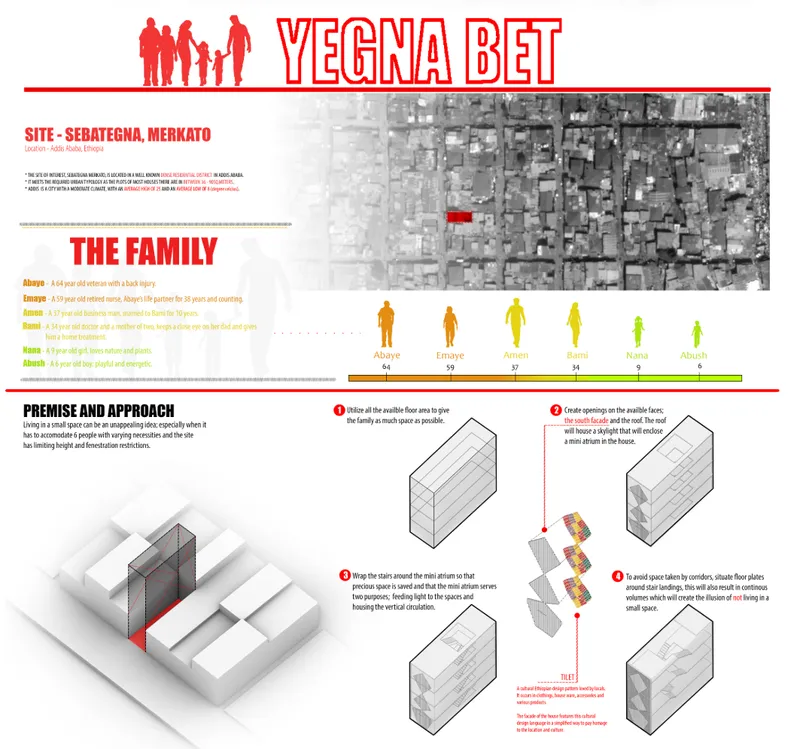
The presentation board lays out the family demographic with precision. Abaye, a 64-year-old retired veteran with a back injury, and Emaye, his 59-year-old partner of 38 years, occupy a barrier-free ground floor bedroom with an accessible bathroom. Their son Amen, a 37-year-old businessman, and his wife Bami, a 34-year-old doctor who treats her father at home, share a bedroom on Landing 4. Two children, nine-year-old Nana and six-year-old Abush, occupy rooms on Landing 3 where the atrium delivers the most generous daylight. The isometric massing studies on the board show how the aerial site plan's constraints translate into a stacked, interlocking section, with each landing calibrated to the needs and mobility of its occupants.
What emerges is an inclusive spatial hierarchy that does not segregate generations but layers them. Elders stay close to the street and to grade, children float in the light above, and the shared kitchen, dining, and living zones at Landings 1 and 2 sit in between, literally and socially the center of gravity.
The Atrium as Engine: Light, Air, and Spatial Continuity
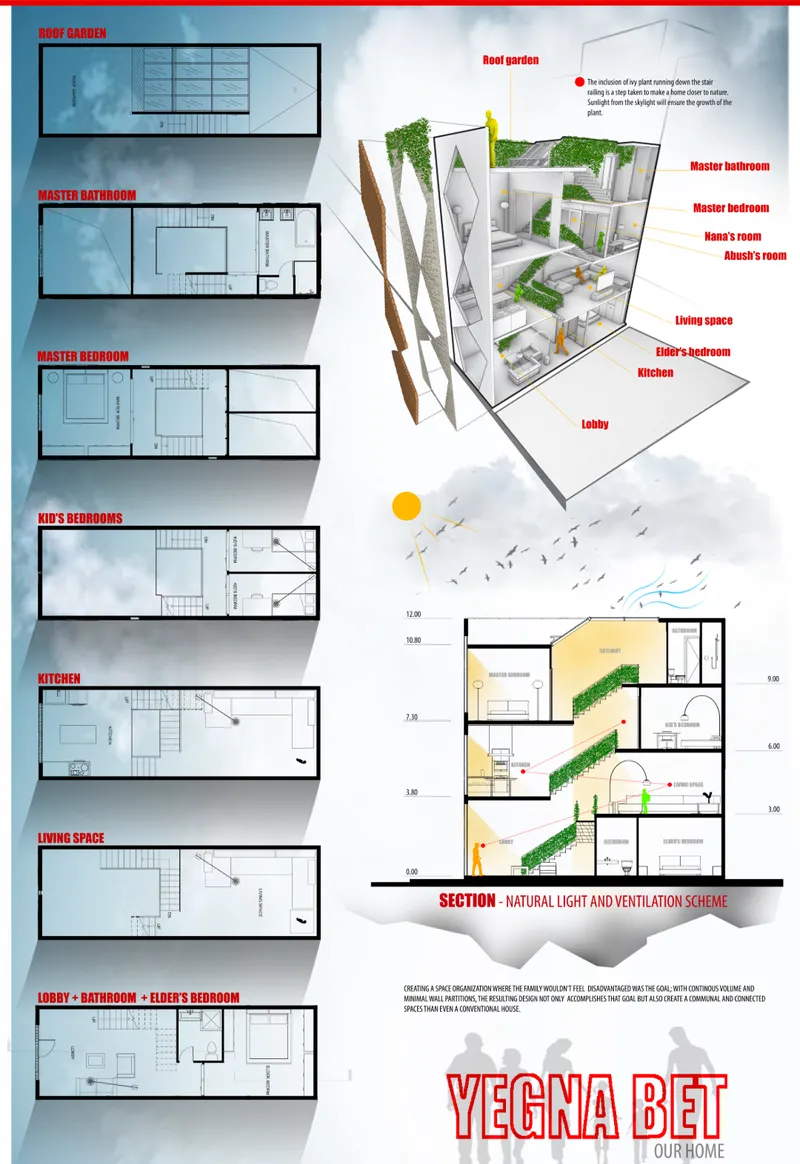
The cutaway axonometric and building section on this board reveal the project's defining move. A skylight at the roof feeds a mini atrium that runs the full height of the house. Stairs wrap around this void, acting simultaneously as vertical circulation, a daylight well, and a passive ventilation chimney. Warm air rises through the open shaft and exits at the roof, pulling cooler air through the south facade openings below. The result is a house that breathes without mechanical systems.
Floor plans confirm the corridorless logic. Rooms open directly onto stair landings rather than branching off a hallway, which means every step between floors passes through shared light and sight lines. Visual continuity across levels makes the interior feel considerably larger than its footprint suggests. At the top, a roof garden and vertical plant wall irrigated by rainwater collected near the skylight complete the biophilic loop, turning the house's highest point into a communal outdoor room.
Affordable Replicability in a Dense Urban Fabric
Tezera is explicit about cost. Yegna Bet avoids expensive materials and complex construction techniques, relying instead on local building methods and basic, readily available materials. That restraint is strategic: the design is intended as a replicable model for dignified housing across similar high-density neighborhoods in Addis Ababa and beyond. The innovation here is organizational, not technological. By rethinking how circulation, light, and program interlock within a minimal envelope, the project demonstrates that spatial generosity is not a function of budget but of intelligence in section.
Why This Project Matters
Housing competitions often reward formal novelty. Yegna Bet earns attention for something harder to achieve: genuine fit between a specific family's life and a specific site's constraints. A retired veteran who needs barrier-free access, a doctor who treats her father at home, two children who crave daylight and play space, a couple who need privacy within a communal household. Each of these conditions is legible in the section. The architecture does not impose a lifestyle; it emerges from one.
More broadly, the project reframes the conversation around small house design in rapidly urbanizing African cities. Rather than miniaturizing a conventional plan, Tezera eliminates the conventional plan altogether, replacing corridors with landings, walls with light shafts, and mechanical systems with passive airflow. The Tilet facade grounds the whole effort in Ethiopian culture, reminding us that efficient housing need not be culturally neutral. Yegna Bet is proof that constraint, handled with care, can produce architecture that is at once compact, humane, and unmistakably rooted in place.
View the Full Project
About the Designers
Designer: Bek Tezera
Enter a Design Competition on uni.xyz
uni.xyz runs architecture and design competitions year-round that reward proposals with spatial conviction and real site intelligence.
Project credits: Yegna Bet by Bek Tezera.



Popular Articles
Popular articles from the community


Co-Life: Senior Housing Design That Reconnects Older Adults With the City
Co-Life reimagines senior housing design through healing gardens, shared streets, workshops, and a sustainable community across generations.

Hill & Cross Opera: Sculptural Opera House Architecture Shaped by Tallinn’s Landscape and Identity
Hill & Cross Opera reimagines opera house architecture in Tallinn through its sculptural hill, civic plaza, glass wave and a luminous cross.

Riyadh For All: Intergenerational Urban Design for Active Aging in Rabat
Riyadh For All reimagines urban design in Rabat with intergenerational co-living, adaptive courtyards, and Moroccan cultural exchange today.

Co-life: Sustainable Architecture for Age-Friendly Community Living
Co-life reimagines sustainable architecture for seniors through courtyards, rammed earth, shared gardens, and spaces designed for belonging.


Similar Reads
You might also enjoy these articles

Bao Huynh Watercolor Atelier: A Serene Art Retreat in Hội An
Bao Huynh Watercolor Atelier in Hội An blends multifunctional art spaces, sustainable design, local materials, and family-friendly living in a serene environment.

Atelier Macri Concept Store Interior Design by CASE-REAL
Atelier Macri store features a "ko" counter, walnut wood details, cork displays, blending retail, gallery, and seamless customer experiences.

Manuel Vargas Izquierdo Stadium and High-Performance Sports Center: Architectural Excellence in Jalpa de Méndez
The Manuel Vargas Izquierdo Stadium blends sustainable design, inclusive sports facilities, and cultural-inspired architecture, revitalizing Jalpa de Méndez’s public spaces.

KAKR Buluh Awar Hall: Revitalizing Community and Ecology Through Bamboo Architecture
Community built bamboo hall revitalizes Buluh Awar village, empowering youth, restoring ecology, celebrating vernacular craftsmanship through sustainable architecture and culture.
Explore Housing Competitions
Discover active competitions in this discipline



Challenge to reimagine the Iron Throne


Photograph architecture without architects


Illustrate the lost glory of Angkor Wat - Render Challenge


Design challenge to reuse E-waste
Comments (0)
Please login or sign up to add comments
No comments yet. Be the first to comment!