

Brick&Cube Architects Nest a Timber Guesthouse into a Chinese Hillside Forest
Youli B&B pairs a glazed timber frame with vernacular stone walls to welcome travelers on a forested mountain road in rural China.


Most bed-and-breakfast designs try to split the difference between cozy and contemporary, and most of them fail. Youli B&B, designed by Brick&Cube Architects, succeeds because it refuses to compromise. The building sits on a hillside road flanked by deciduous forest, and rather than mimicking a farmhouse or defaulting to a glass box, the architects built a hybrid: a diagrid glazed facade set behind rough stone retaining walls, topped by timber-clad rooftop volumes that read like oversized dormers. The result is a guesthouse that looks indigenous from a distance and startlingly precise up close.
What makes the project worth studying is the way its structural timber frame does triple duty as structure, ornament, and spatial organizer. Every major interior moment, from the central staircase to the mezzanine railings to the sleeping pavilions, is articulated in the same warm timber, creating a continuous material logic that ties the whole building together without ever feeling monotonous. The architects clearly understand that a guesthouse lives or dies by its transitions: between public and private, inside and outside, ground and sky. Here, every one of those transitions is handled with care.
A Facade That Earns Its Complexity
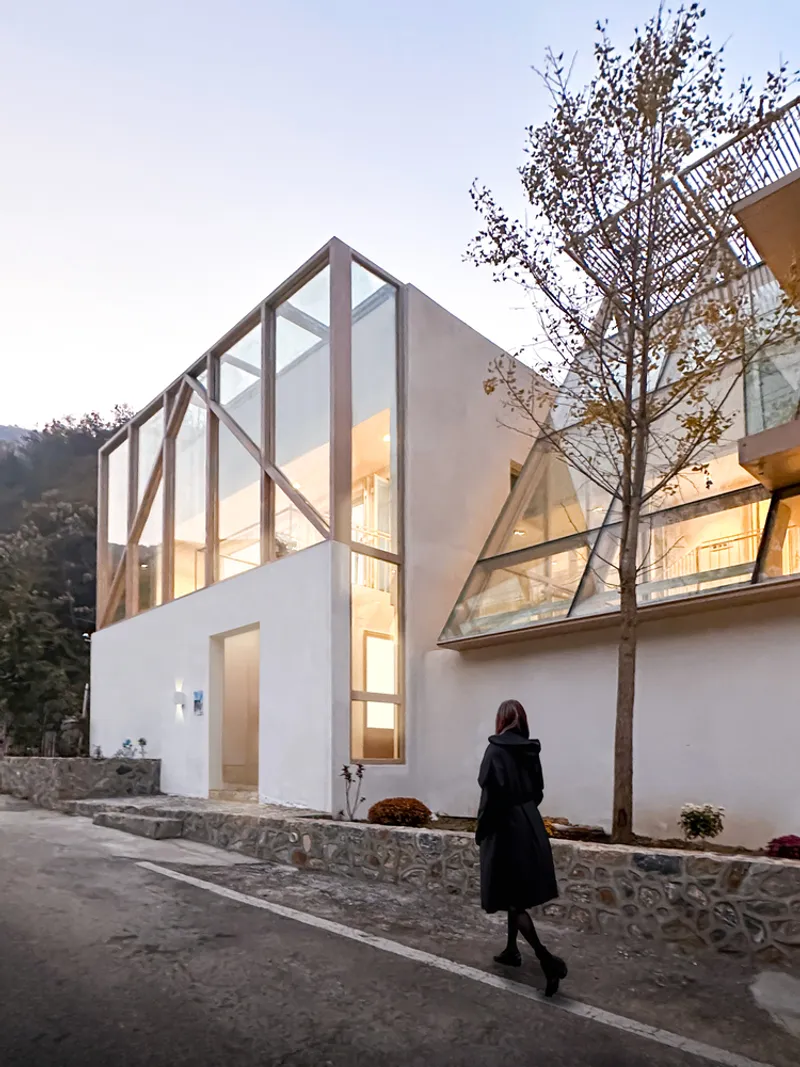
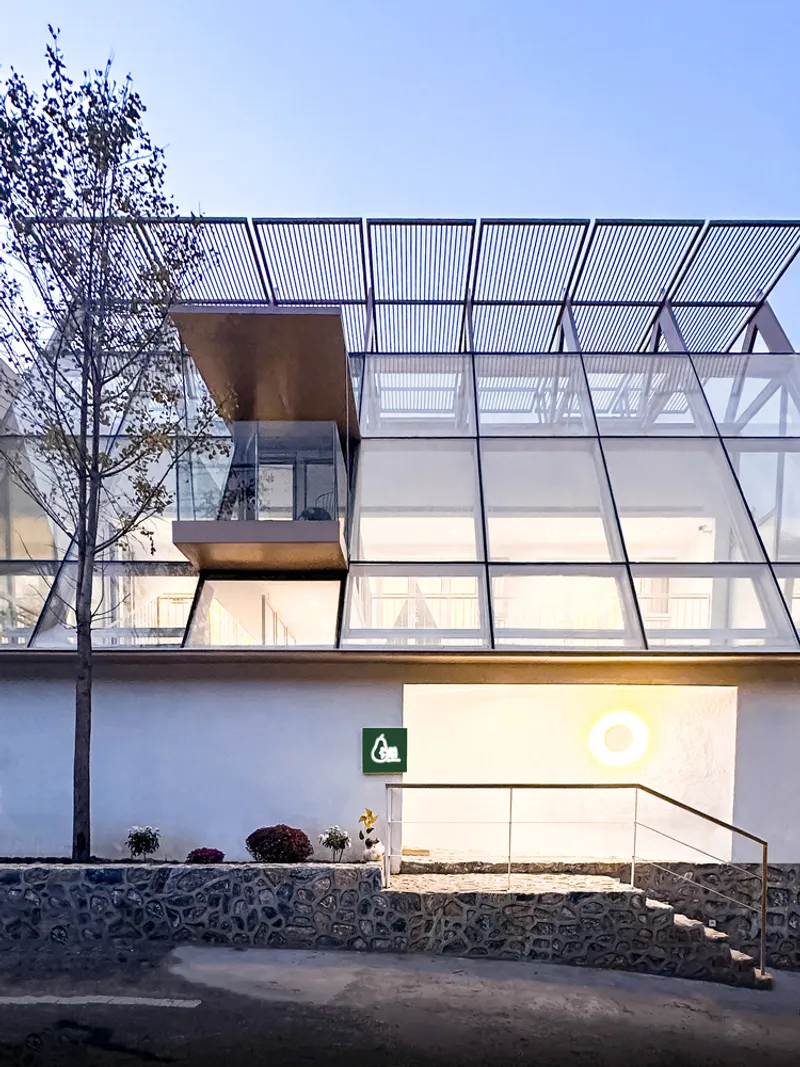
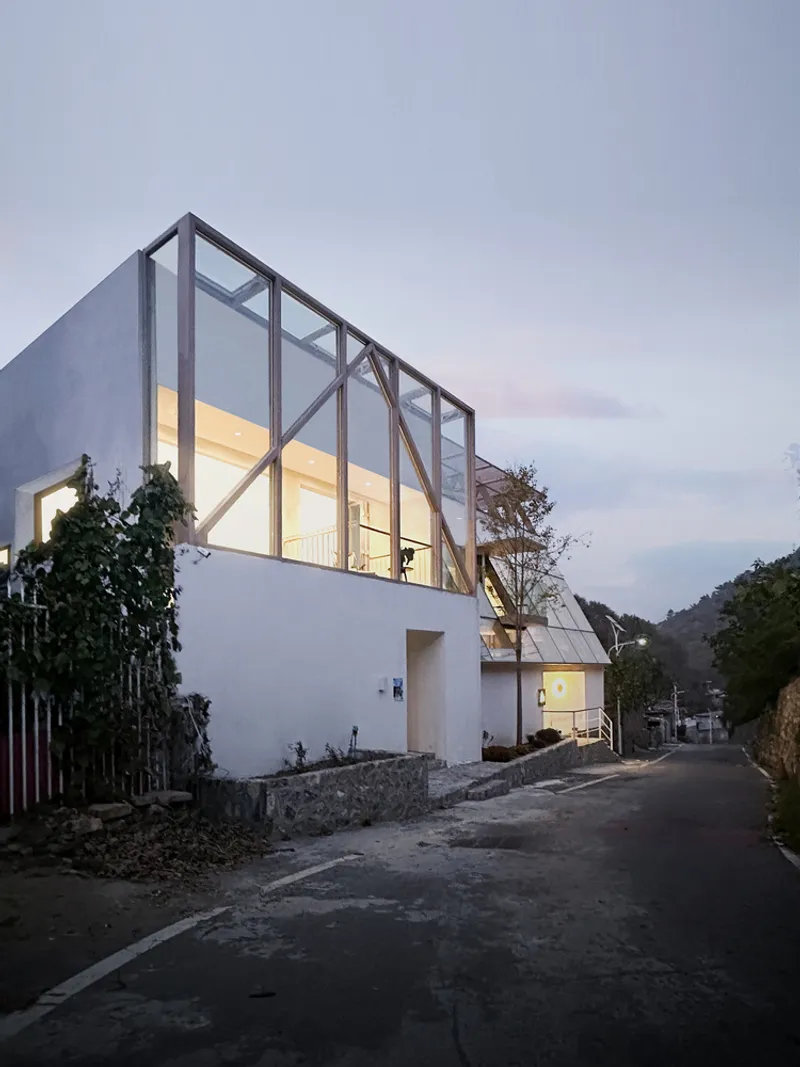
The street-facing elevation is the building's calling card: a full-height glazed gable criss-crossed by a diagonal timber grid that sits proud of the glass. At dusk the interior light transforms this surface into a lantern, broadcasting warmth to the quiet residential road outside. A slatted timber overhang at the base provides a porch-like threshold, softening the scale and sheltering arrivals. The diagonal grid is not just decorative; it braces the tall glazed wall while breaking down reflections, so the facade reads as layered rather than flat.
Behind and below this glass wall, a rough stone wall runs along the property edge, grounding the building in the local material palette. The juxtaposition is deliberate: stone below for mass and permanence, timber and glass above for lightness and transparency. It is a simple idea executed with real discipline.
Hillside Presence
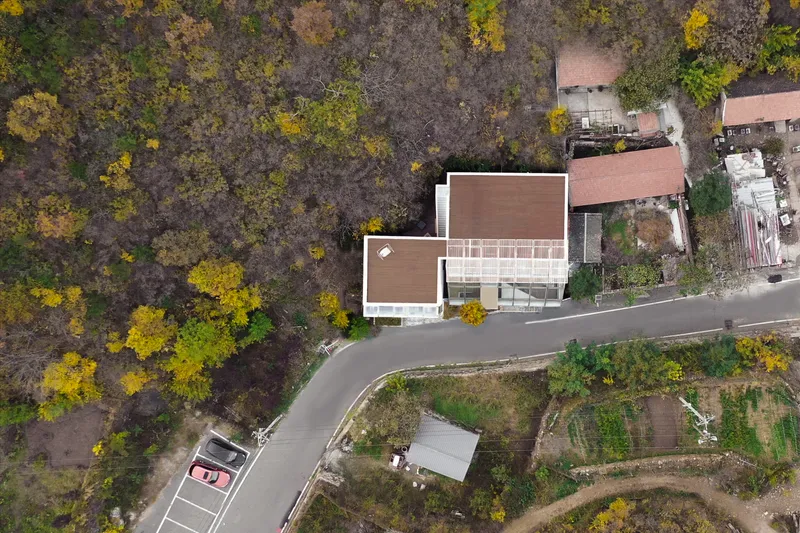
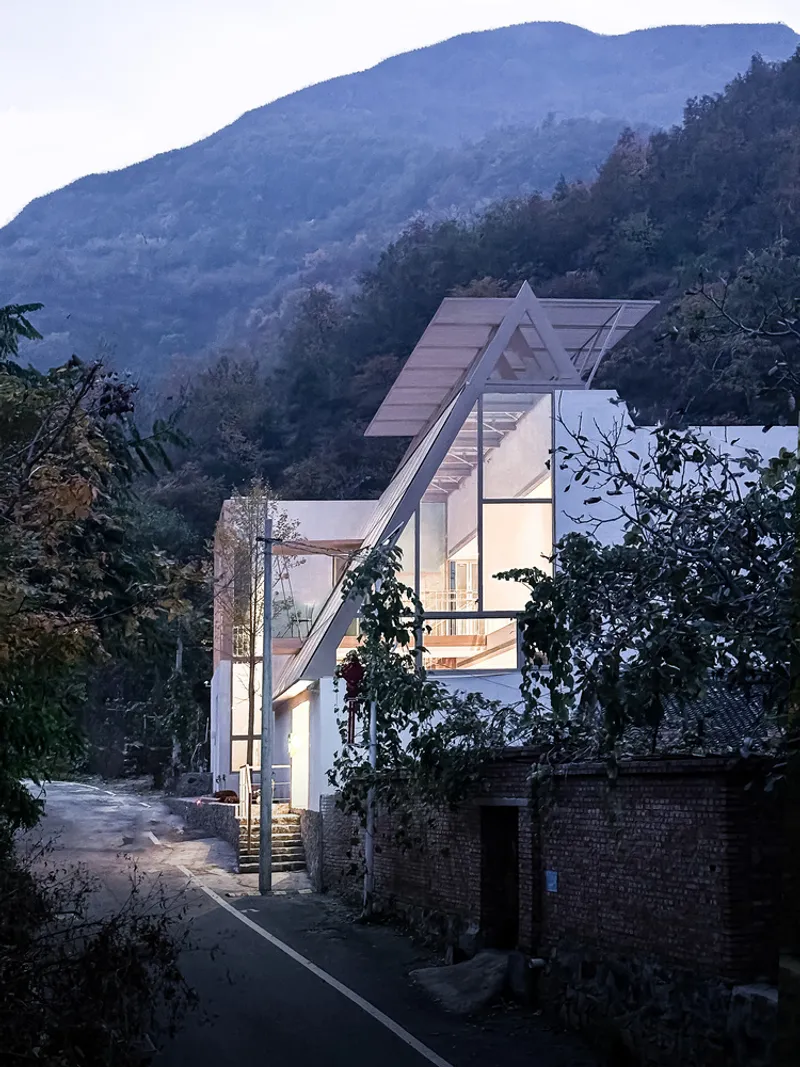
Seen from across the valley or from the winding road below, the building reads as a cluster of timber-clad rooftop volumes stepping down the slope, partially absorbed by the autumn canopy. The massing strategy is smart: rather than presenting one large block, the architects broke the program into smaller pitched forms that echo the scale of surrounding houses and the rhythms of the ridgeline. The illuminated facade at dusk turns the building into a warm signal point on the darkening hillside, inviting without being ostentatious.
The Staircase as Spine
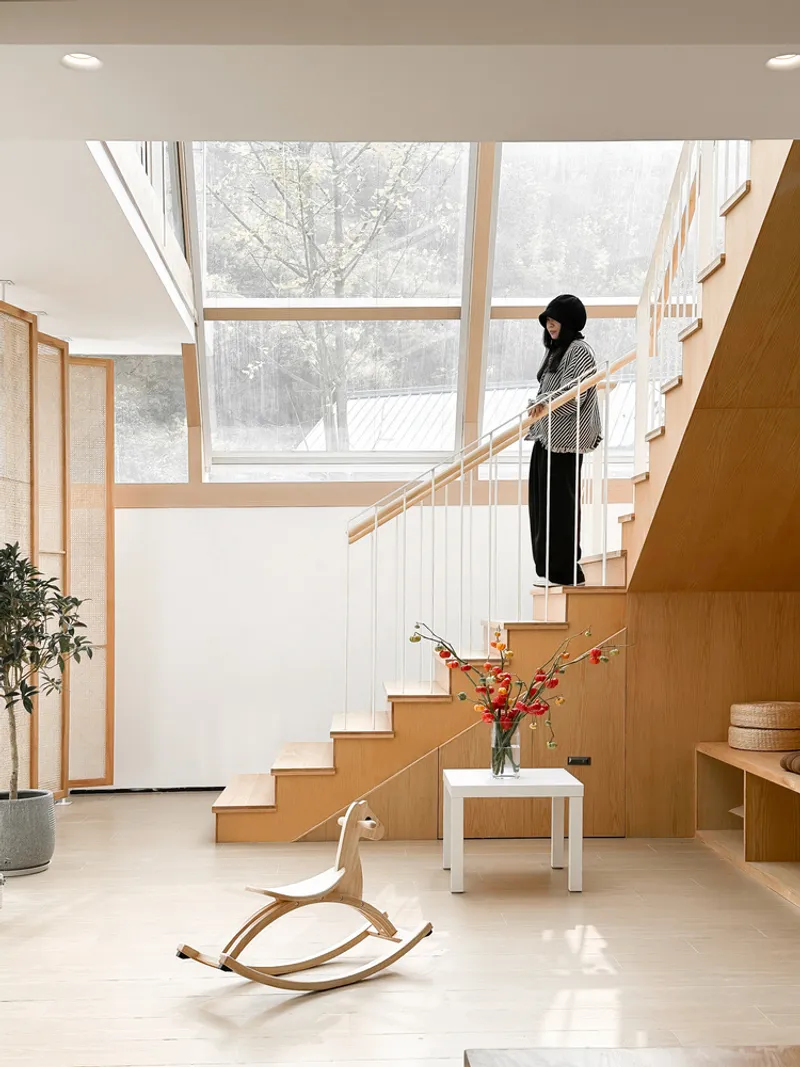
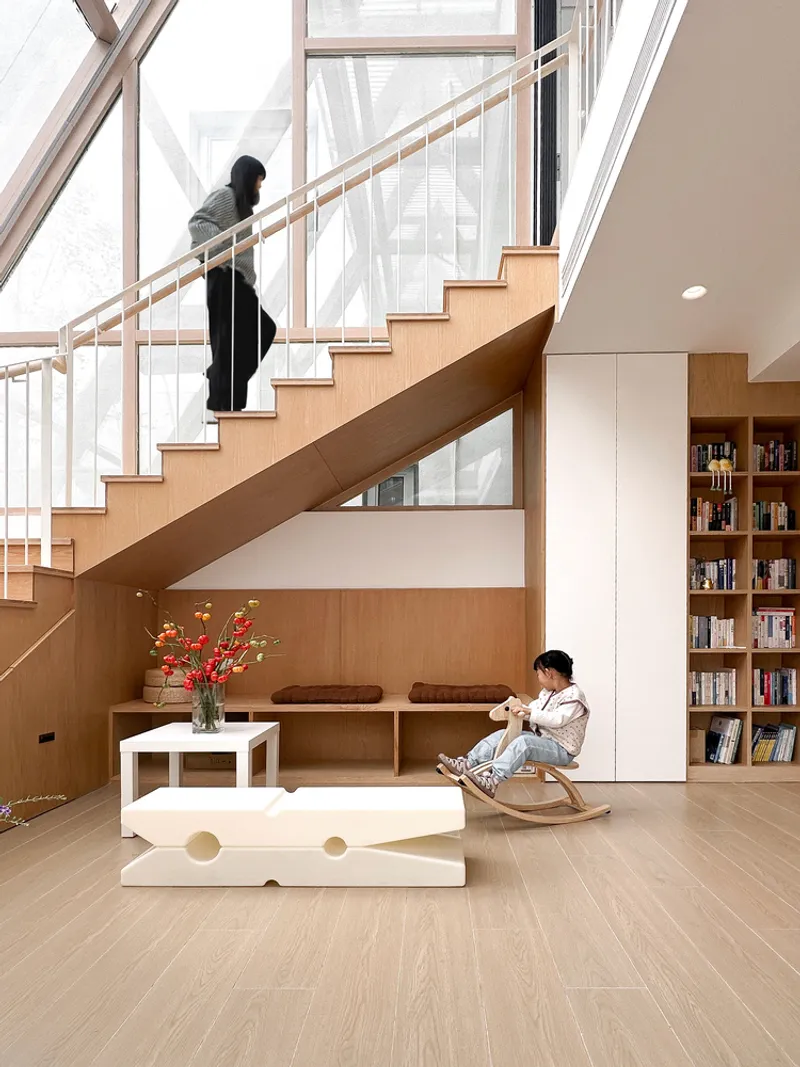
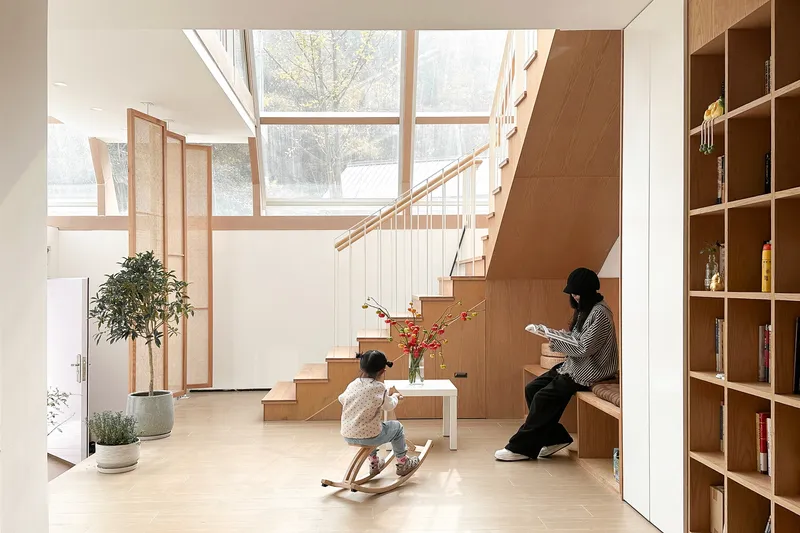
The central staircase is the project's key spatial device. Built entirely in light-toned timber, it rises through a double-height volume punctuated by skylights, connecting the ground floor public areas to the upper sleeping levels. Tall windows on one side frame the winter landscape like a scroll painting that changes as you ascend. The stair treads widen at the base to form integrated seating, blurring the line between circulation and lounge space. A child on a rocking horse in the double-height void below captures the atmosphere Brick&Cube clearly intended: relaxed, luminous, domestic without being precious.
Structurally, the stair is self-supporting, its treads cantilevered from a central timber stringer so the whole assembly feels buoyant. The skylight above washes the wood in shifting daylight, making the stairwell the brightest room in the house even on overcast days.
Domestic Details That Work Hard
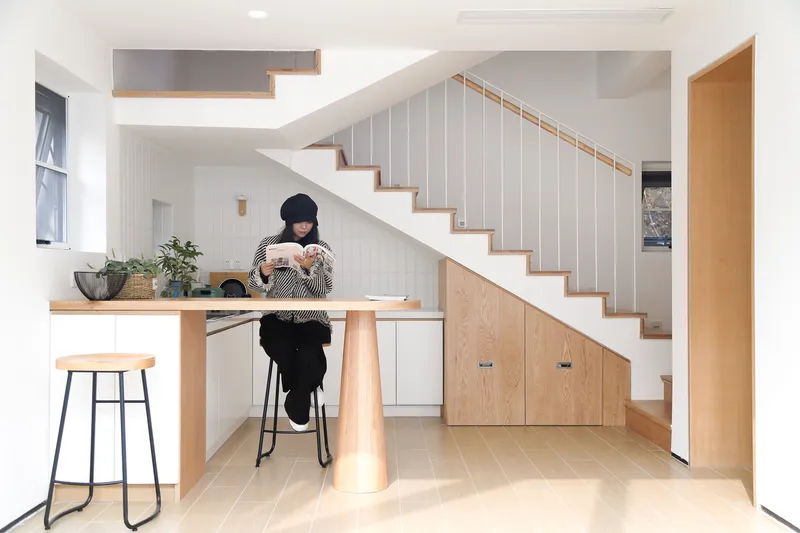
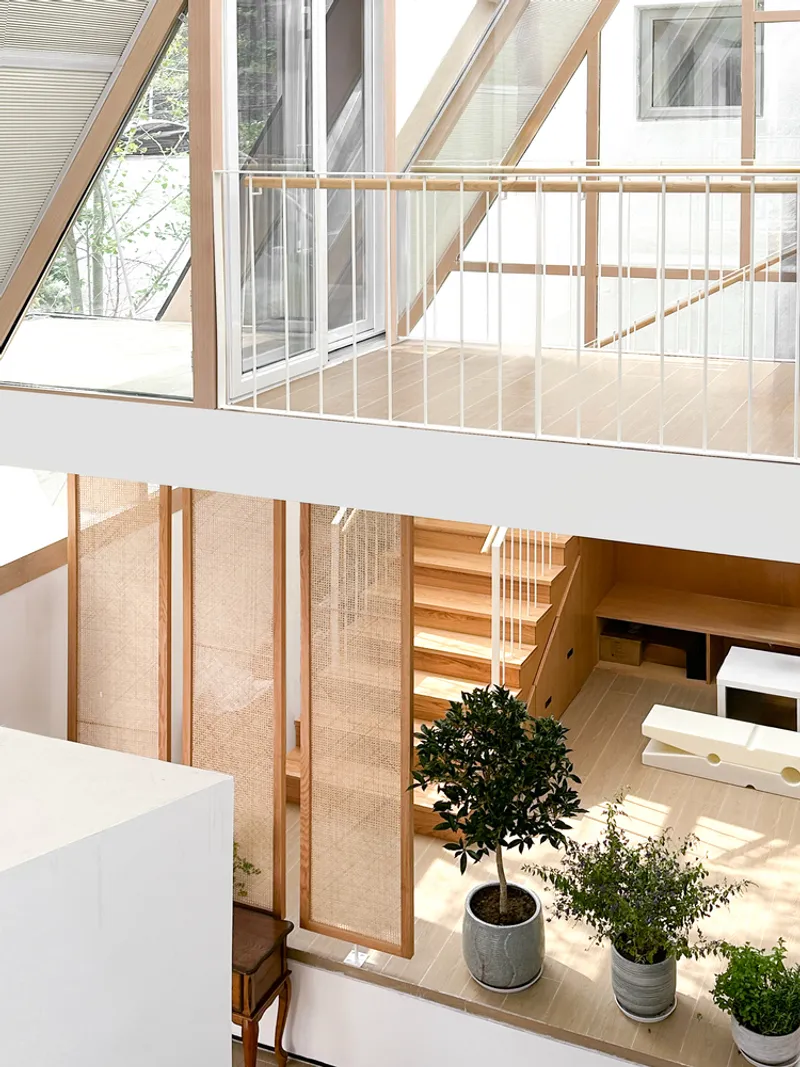
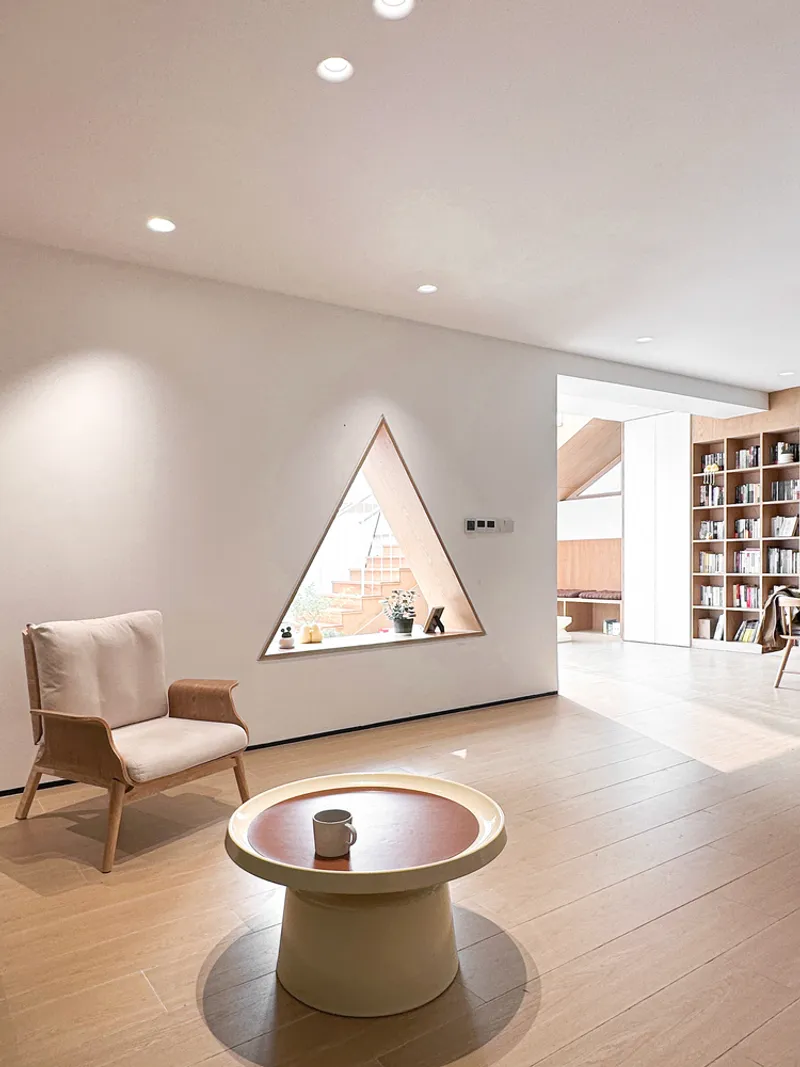
Look at the kitchen counter: a conical timber leg supports the worktop beneath the white-paneled underside of the staircase, turning leftover space into something genuinely useful. The mezzanine level deploys timber guardrails, planters, and sliding screen panels to create a semi-private zone that can be opened or closed depending on occupancy. Even the triangular recessed niche in an otherwise blank white wall, furnished with nothing but a low pedestal table and pale flooring, demonstrates the architects' confidence in restraint.
These are details that serve a bed-and-breakfast program particularly well. Guests move through a sequence of moments that feel curated but never staged. The material palette stays narrow, timber and white plaster, so nothing competes with the forest views outside.
Sleeping Rooms as Individual Worlds
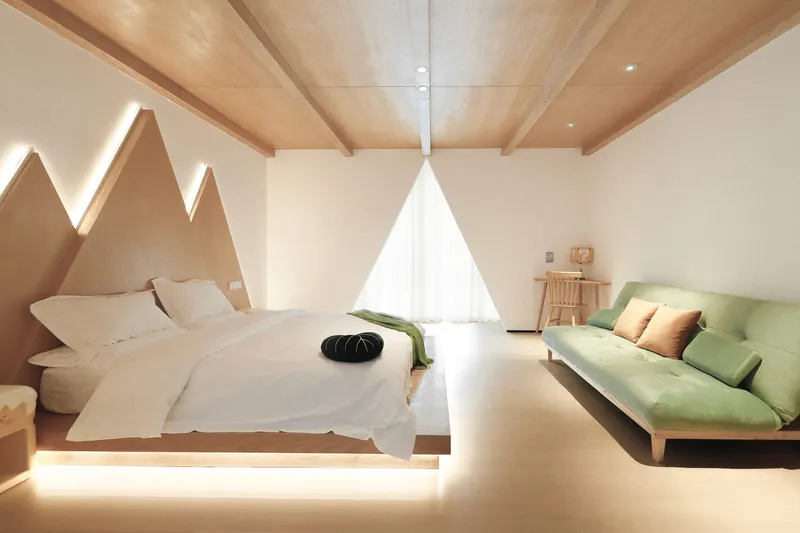
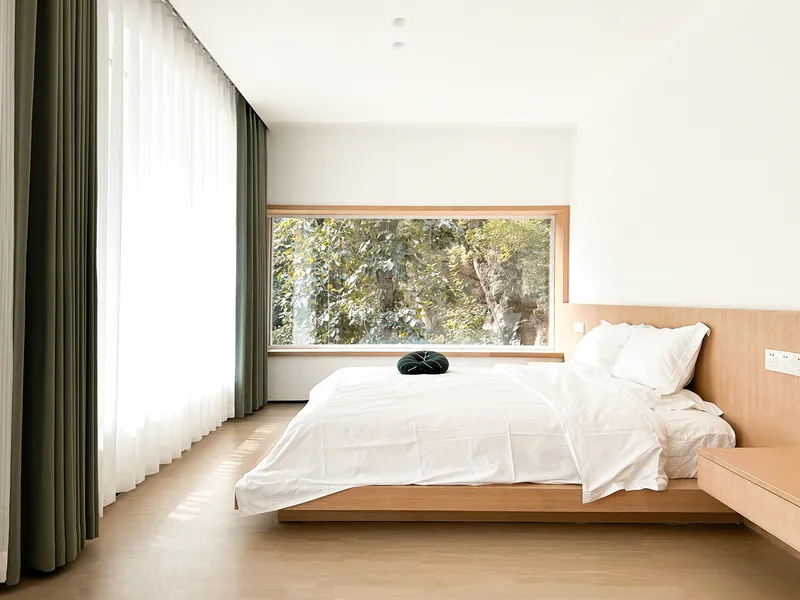
The guest rooms are where the project's poetic ambitions surface most clearly. One suite places a floating platform bed beneath a vaulted timber ceiling, its headboard wall shaped and backlit to silhouette a mountain range. It is a theatrical gesture, but the room's soft lighting and restrained furnishing absorb the drama without tipping into kitsch. Another room deploys a timber-framed horizontal window aimed directly into the leafy canopy, with sheer grey curtains softening the adjacent full-height glazing so that daylight arrives filtered and calm.
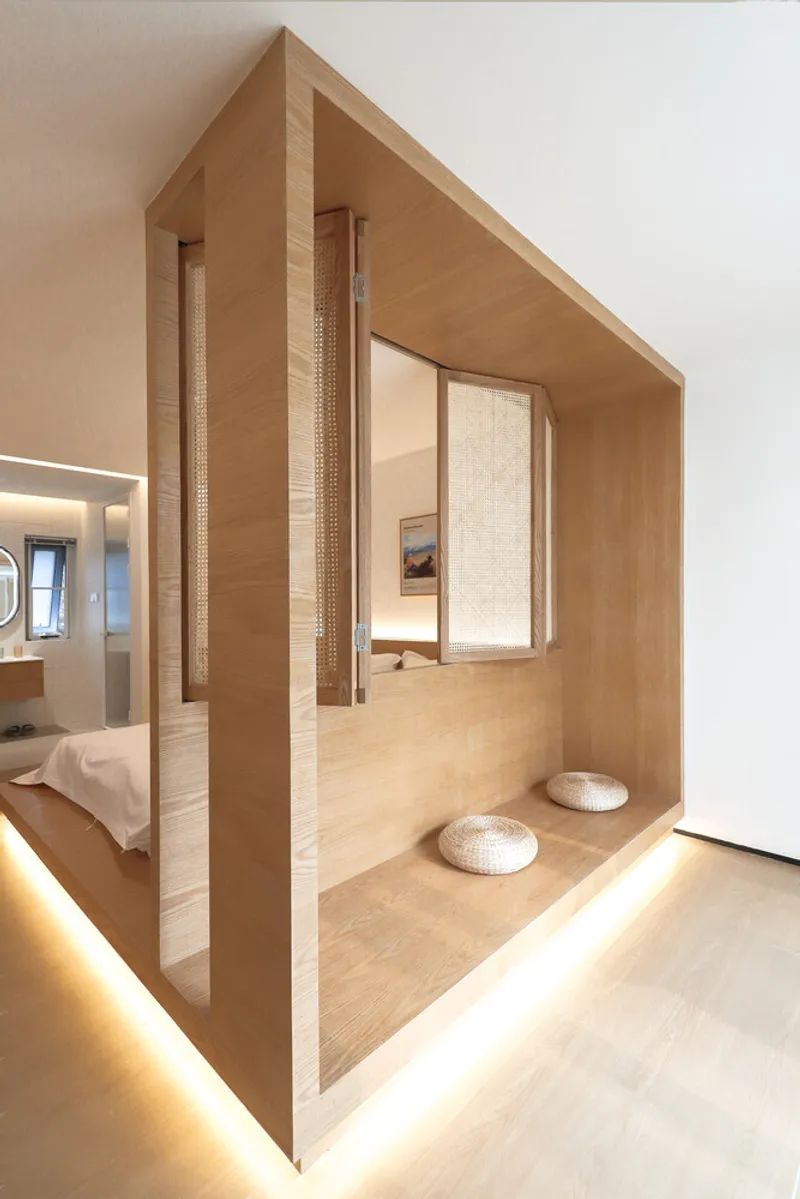
The most inventive sleeping space is the timber pavilion with a house-shaped profile and sliding woven screens. Raised on an elevated platform and furnished with floor cushions, it operates like a room within a room, a miniature shelter that gives guests the sensation of sleeping in a treehouse. The woven screens modulate privacy and light with a single gesture. It is the kind of spatial idea that makes guests remember a place long after they leave.
Inside Meets Outside
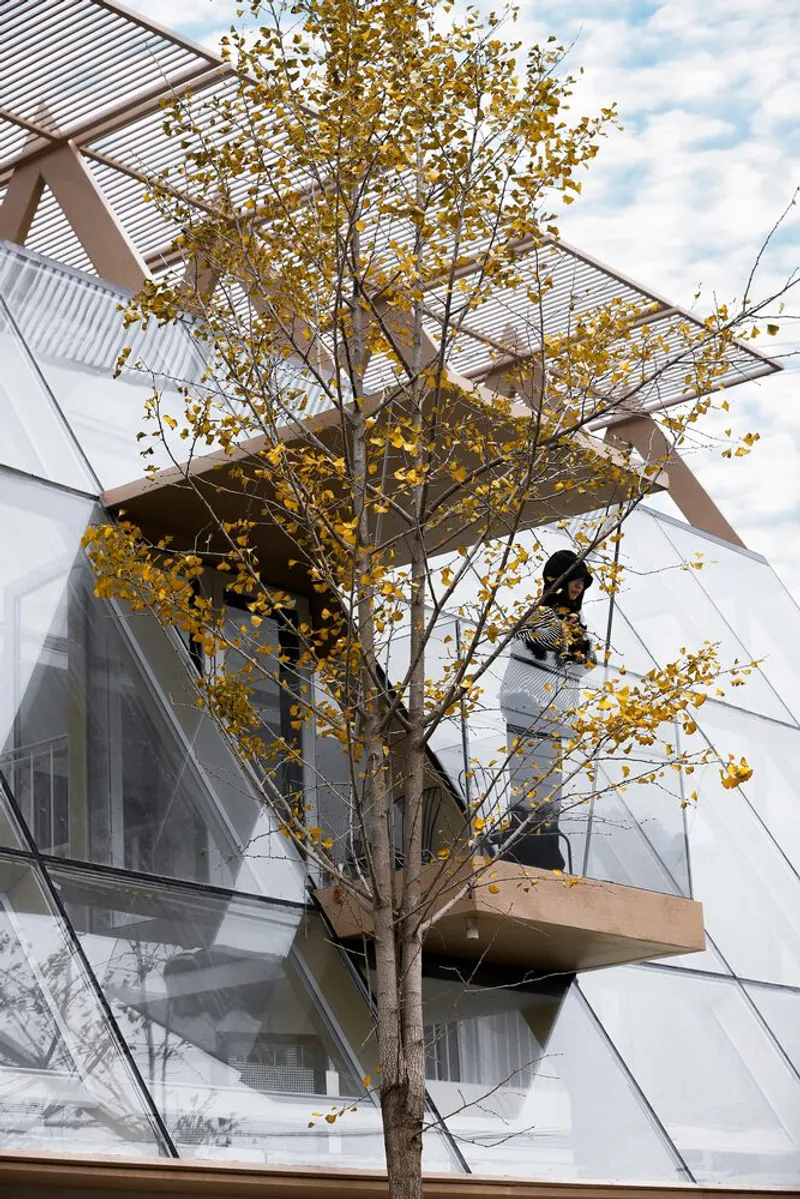
A cantilevered balcony pushes out beside a deciduous tree, its autumn-yellow leaves brushing the glazed facade. The moment is picturesque, but the detail is practical: the cantilever gives upper-floor guests private outdoor space without adding footprint at ground level, and the proximity of the tree means the balcony is dappled in shade through the warmer months. At twilight, the slatted overhang and diagonal glazing grid at the entrance level create layered shadows that animate the facade even when the building is quiet inside.
Why This Project Matters
Rural hospitality architecture in China has boomed in the last decade, and much of it falls into two camps: over-designed boutique hotels that parachute urban aesthetics into the countryside, or earnest heritage restorations that feel more like museums than places to sleep. Youli B&B carves out a productive middle ground. Its diagrid facade, inventive stair, and house-shaped sleeping pavilion are genuinely contemporary moves, yet the stone base, timber cladding, and pitched rooflines keep the building rooted in its hillside context.
Brick&Cube Architects show that a small-scale hospitality project can be architecturally ambitious without being alienating. The rooms are warm, the details are considered, and the forest is never more than a glance away. For architects working on similar programs, the lesson here is that material consistency and spatial specificity will always outperform stylistic novelty. A guesthouse should feel like an invitation, and this one does.
Youli B&B by Brick&Cube Architects. Rural hillside location, China.
About the Studio
Brick&Cube Architects
Share Your Own Work on uni.xyz
If projects like this are the kind of work you want to make, uni.xyz is a place to publish your own, find collaborators, and enter design competitions.


Popular Articles
Popular articles from the community


David Macias Steps a Doorless Stone and Plaster House Down a Tropical Colombian Hillside
In the humid hills of Colombia, Threshold House replaces the front door with an open void and terraces its 850 m² down the slope instead of fighting it.

longwave studio Reorganizes a 112 m² Tainan Apartment Around the Daily Routines of a Family and Two Cats
In Tainan, Taiwan, birch plywood, rust-red furniture and a freestanding plaster wall link arrival, storage, work and family life in one apartment.

Architekt Andreas Gruber Scatters 23 Dark Timber Chalets Across a South Tyrolean Forest Edge
In Molini di Tures, Amonti Chalets breaks a resort into a hamlet of gabled timber houses, with parking, storage and services pushed into the slope.

David Ortega Stacks a Two-Story Mexico City Penthouse Around a Steel Stair and a Pergola-Shaded Roof Terrace
In Colonia Roma, a 300 m² penthouse uses oak joinery, a planted steel stair and a slatted roof pergola to make a new-build apartment feel like a house.

Similar Reads
You might also enjoy these articles


Hodi-Mandai Geram
Project Function: Preservation and revitalization of the Intangible heritage and socio-spatial identity of the Hodi by Housing, Cultural Memory Center, Sacred Grove, landscape, local tourism economy


Olio Towers: A Mid-Rise for Performers That Fuses Housing, Rehearsal, and Stage
Located blocks from Houston's Theater District, this modular tower stacks living units around a central performance atrium.

Oasis: Modular Green Housing Carved into Dhaka's Urban Fabric
A shortlisted Plugin Housing entry reclaims unauthorized settlements in Dhaka with stepped concrete volumes, green roofs, and ventilation-driven design.

Black Hole: A Floating Megastructure for the Post-Physical Era
Emiliano Mazzarotto envisions a spherical, self-scaling arena where e-sports, digital hotels, and holographic stadiums replace traditional public space.

Explore Architecture Competitions
Discover active competitions in this discipline

Challenge to reimagine the Iron Throne

Photograph architecture without architects

Illustrate the lost glory of Angkor Wat - Render Challenge

Design challenge to reuse E-waste
Comments (0)
Please login or sign up to add comments
No comments yet. Be the first to comment!