
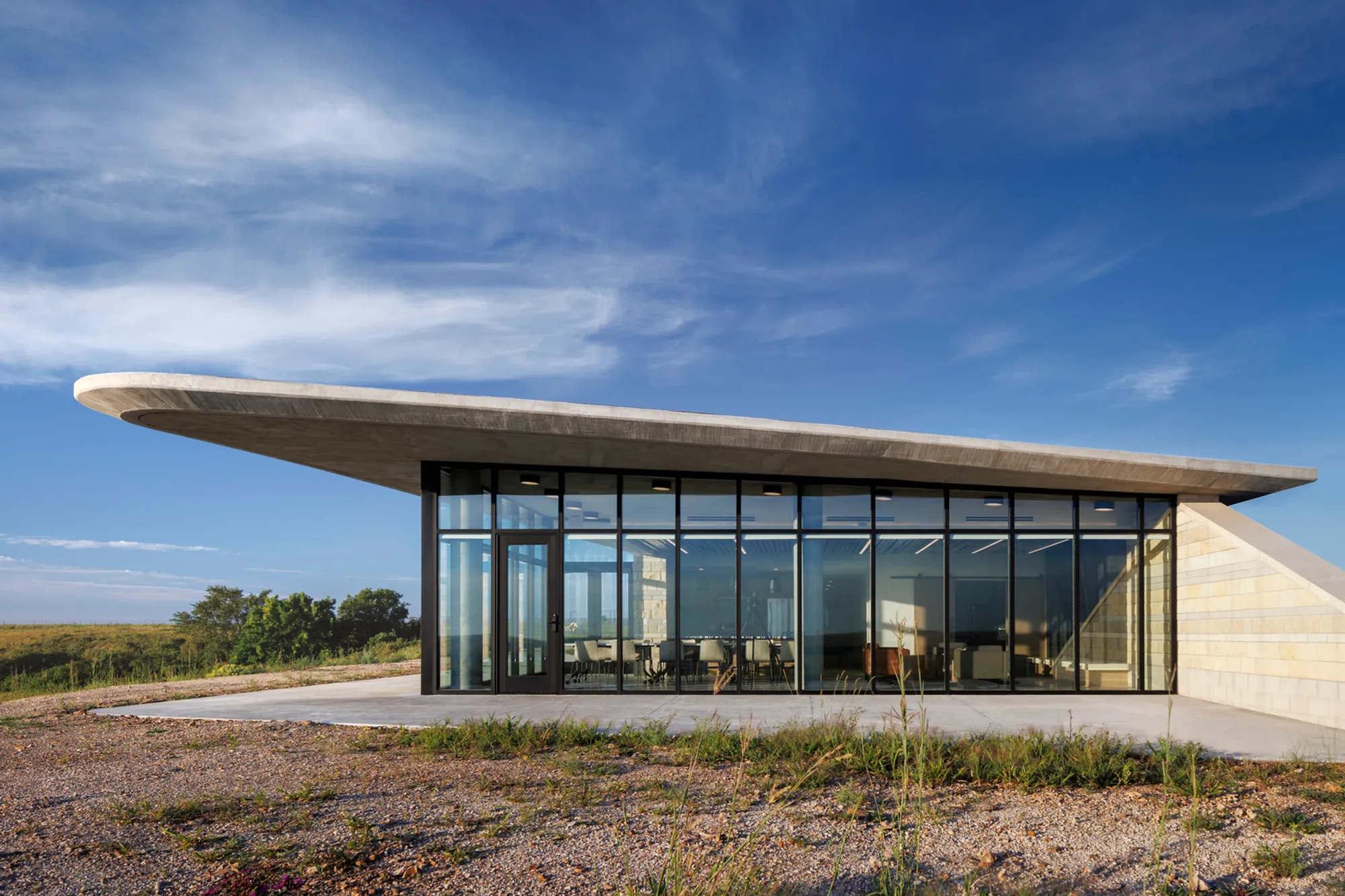
Youngmeyer Field Station by Hutton: A Sustainable Research Hub in the Heart of the Kansas Flint Hills
Off-grid research facility in Kansas Flint Hills, blending concrete and limestone to preserve prairie views and support ecological studies.


Reconnecting Architecture with Ecology
Designed by Hutton and completed in 2022, the Youngmeyer Field Station is a 3,400-square-foot off-grid research facility located on the vast 4,700-acre Youngmeyer Ranch in the Kansas Flint Hills, one of the last remaining strongholds of the North American tallgrass prairie. Operated by Wichita State University, the field station supports academic research across multiple disciplines, offering spaces for meetings, laboratories, and accommodation for up to six resident researchers.
The building is more than just a field laboratory—it's a physical manifesto of ecological responsibility and architectural harmony with nature.

A Rare Ecosystem, Thoughtfully Preserved
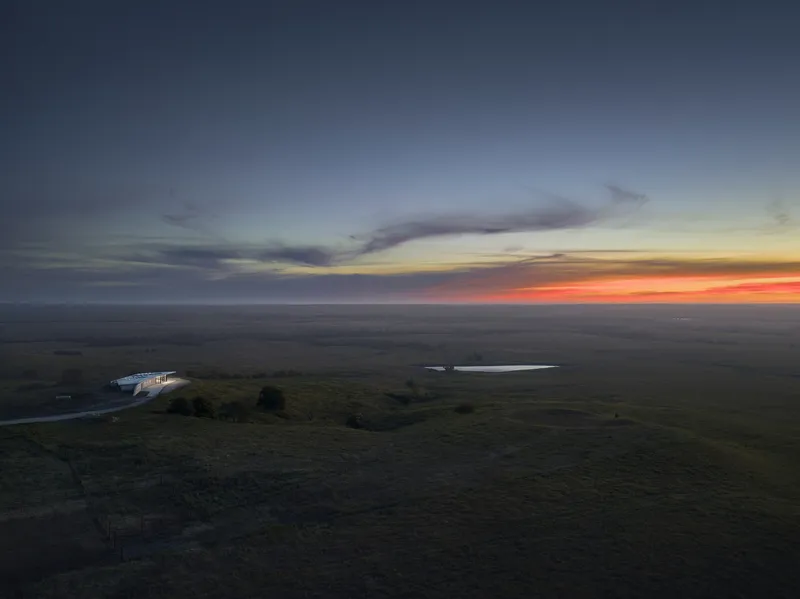
Once spanning over 150 million acres, the tallgrass prairie ecosystem now survives in less than 4% of its original range. Much of that remaining expanse lies in the Flint Hills, a region characterized by shallow, rocky soils and limestone-shale sublayers formed over 250 million years ago. These geologic conditions have historically deterred development and agriculture, inadvertently conserving the area’s biodiversity, wildlife habitats, and panoramic rolling landscapes.
The Youngmeyer Field Station was envisioned to blend into this landscape rather than disrupt it, aligning architectural form with environmental stewardship.

Off-Grid and Self-Sufficient Design
One of the project’s standout features is its completely off-grid infrastructure. There are no public or rural utility connections—power is generated on-site, and water is collected locally, ensuring the facility maintains minimal environmental impact.
To endure the extreme climate conditions of Kansas—including strong winds and wildfire risk—the entire structure, including the roof, is built from cast-in-place concrete, clad with noncombustible, durable materials such as limestone and high-performance glazing. This makes the station resilient while maintaining a low-profile aesthetic that’s respectful of the vast prairie views.
Embedded in the Earth, Inspired by the Land
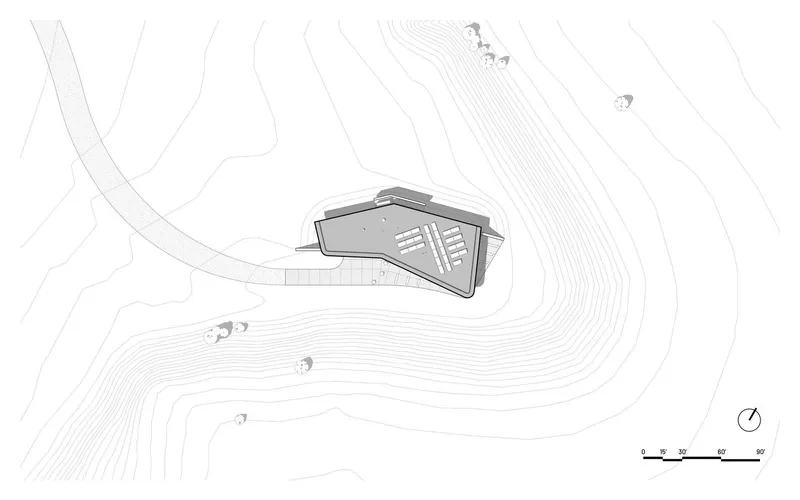
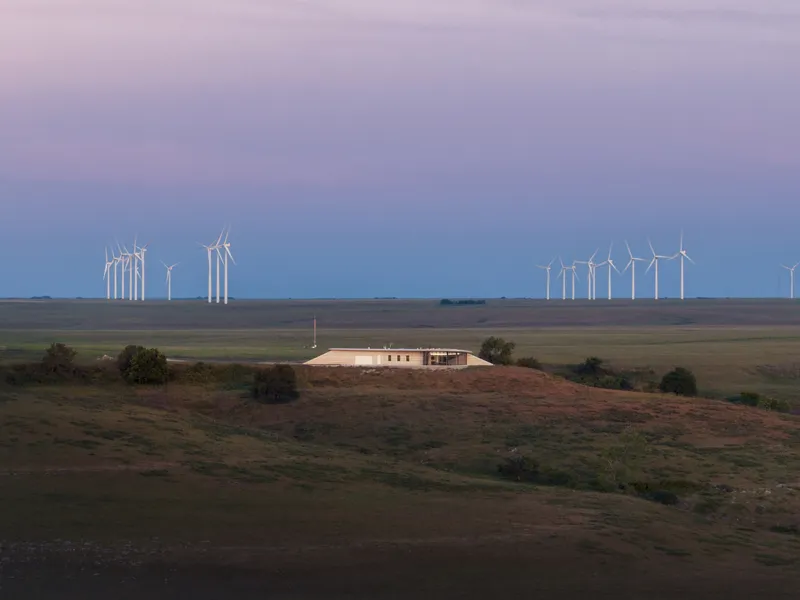
The building is partially embedded into the earth, taking cues from early frontier dugouts to improve insulation and provide natural protection against harsh northern winds. Its angular form opens eastward, orienting the main gathering space toward the sunrise and a nearby body of water, offering researchers daily inspiration from the surrounding wilderness.
The material palette draws directly from the Flint Hills' geological history. The exterior is wrapped in four distinct varieties of limestone, layered to mimic the sedimentary formations visible in the nearby hills. One variety, Prairie Shell, contains fossilized shells—a nod to the region's ancient marine origins. Fossils are even embedded visibly in the architecture, inviting researchers and visitors to engage with a literal slice of prehistory, including a perfect nautilus fossil displayed beside the main entrance.
Subtle Interiors, Natural Materials
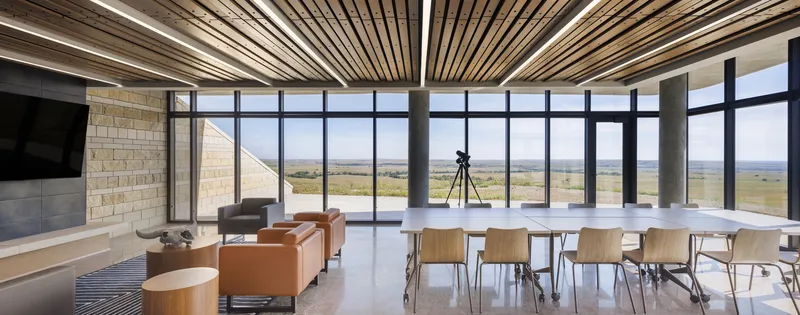
Inside, natural tones and textures dominate the interior finishes. Elements are carefully arranged in patterns that recall layers of soil, heads of prairie grass, and even the constellations of the Kansas night sky. The interior experience mirrors the landscape outside, reinforcing the building’s mission as a platform for environmental understanding and immersive research.
A Responsible Neighbor in the Flint Hills
Beyond its technical resilience, the field station was designed to be a “good neighbor”—a structure that respects and preserves the viewshed of the region. Its low, clean roofline and tapered concrete cantilever ensure that it disappears into the horizon when viewed from afar, especially from the nearest property several miles away. The building’s visual quietness underscores its ecological ethos: presence without intrusion.

All Photographs are works of Brad Feinknopf



Popular Articles
Popular articles from the community

EW PARK: Sustainable Architecture Reimagines the Future of Urban Parking
EW PARK reimagines city parking as a modular wooden tower combining automation, solar energy, electric mobility, and adaptable urban design.
Pangolin Can Help Mining: Biomimicry Architecture for an Asteroid Mining Habitat
Pangolin Can Help Mining explores biomimicry architecture through a modular 3D-printed habitat designed for asteroid mining and future life.

Riyadh For All: Intergenerational Urban Design for Active Aging in Rabat
Riyadh For All reimagines urban design in Rabat with intergenerational co-living, adaptive courtyards, and Moroccan cultural exchange today.
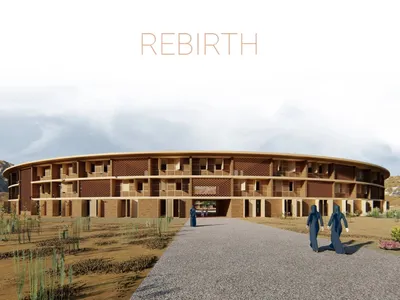
REBIRTH: Sustainable Architecture Shaped by Community, Resilience and Renewal
REBIRTH uses sustainable architecture, circular design, local materials and shared spaces to restore community, dignity and hope for widows.


Similar Reads
You might also enjoy these articles


Hodi-Mandai Geram
Project Function: Preservation and revitalization of the Intangible heritage and socio-spatial identity of the Hodi by Housing, Cultural Memory Center, Sacred Grove, landscape, local tourism economy


Olio Towers: A Mid-Rise for Performers That Fuses Housing, Rehearsal, and Stage
Located blocks from Houston's Theater District, this modular tower stacks living units around a central performance atrium.

Oasis: Modular Green Housing Carved into Dhaka's Urban Fabric
A shortlisted Plugin Housing entry reclaims unauthorized settlements in Dhaka with stepped concrete volumes, green roofs, and ventilation-driven design.

Black Hole: A Floating Megastructure for the Post-Physical Era
Emiliano Mazzarotto envisions a spherical, self-scaling arena where e-sports, digital hotels, and holographic stadiums replace traditional public space.

Explore Landscape Design Competitions
Discover active competitions in this discipline



The International Standard for Design Portfolios


The Global Benchmark for Architecture Dissertation Awards

The Global Benchmark for Graduation Excellence


Challenge to reimagine the Iron Throne
Comments (0)
Please login or sign up to add comments
No comments yet. Be the first to comment!