

Zhaohui: Where the Dead Become Trees in a Sunken Shanghai Park
A multi-faith funerary landscape lowers the ground plane to create a forest of living memorials from molecular decomposition.


What if the body of a loved one could become the root system of a tree, unmarked, unnamed, quietly breathing oxygen back into a city that desperately needs it? Zhaohui proposes exactly that: a sunken public park in Shanghai where the dead undergo molecular decomposition and are reintroduced into the soil as elemental components, oxygen, carbon, hydrogen, feeding trees that become living, anonymous memorials. No tombstones, no names etched in granite. Only a forest canopy visible from the street, hiding its deeper purpose from anyone not ready to find it.
Designed by İmre Bilgin and Ayça Şehnaz Demirel, Zhaohui is a conceptual project that confronts two problems simultaneously: Shanghai's chronic shortage of accessible green space and the unsustainable spatial demands of conventional burial. The result is a dual-identity site, part cemetery for the grieving, part peaceful park for the living, where ecological regeneration and ritual coexist in a single architectural gesture.
From Body to Element: The Logic of Molecular Return
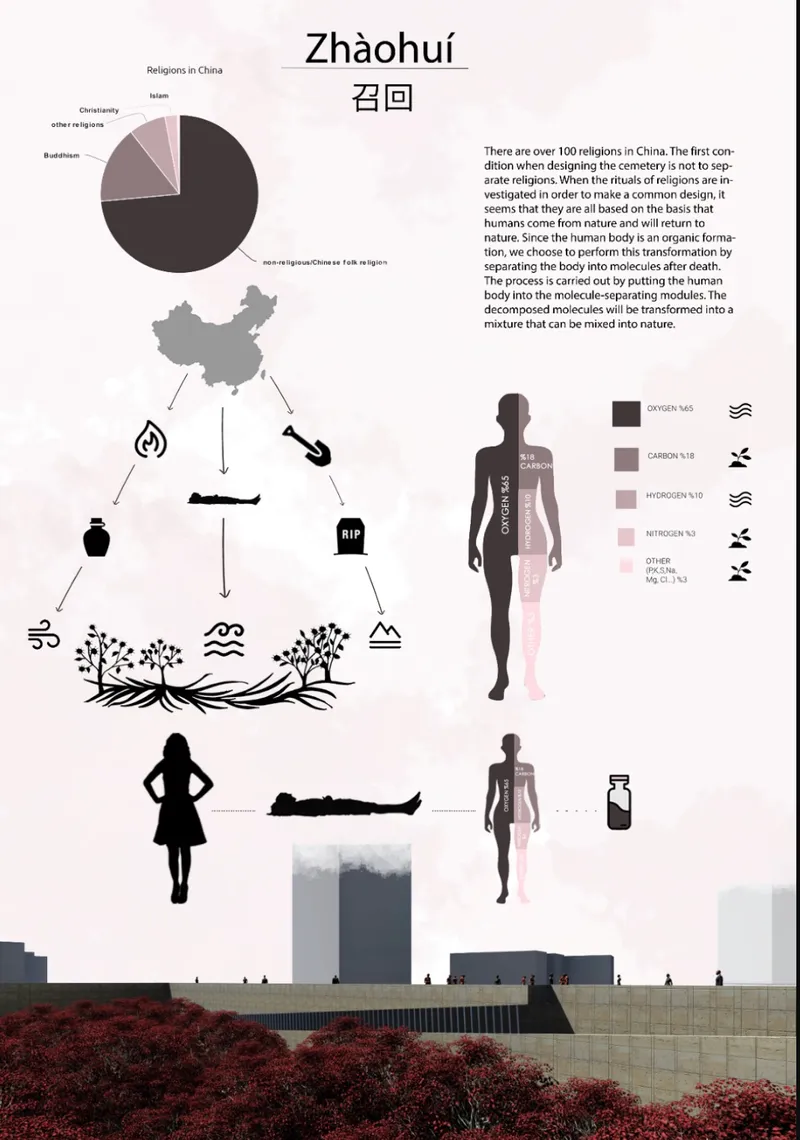
The conceptual diagram lays out the project's foundational premise with clinical clarity. The deceased are neither buried nor cremated in any traditional sense. Instead, the body is broken down into its molecular constituents and reintroduced into the soil to nourish a designated tree. Each tree can hold the remains of multiple individuals, compressing the spatial footprint of death while amplifying its ecological output. The process avoids religious separation entirely, anchoring itself in a universal biological truth shared across faiths: the body's return to earth.
What makes the diagram compelling is its matter-of-fact tone. Pie charts, silhouettes, and a building rendering sit together as if this were infrastructure planning, not funerary design. That deliberate restraint signals the project's broader ambition: to normalize the integration of death into urban life, treating it as a spatial and ecological opportunity rather than a problem to be sequestered at the city's edge.
A Canopy Ceiling That Erases the Line Between Interior and Forest
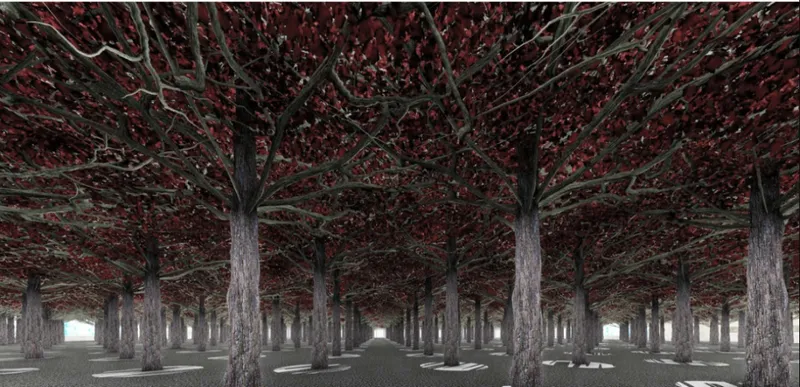
The interior hall reveals Zhaohui's most arresting spatial move. Tree-like concrete columns rise from the floor and branch outward to support a red canopy ceiling, lit by natural light filtering through perimeter openings. The effect is deliberate ambiguity: you are simultaneously inside a building and beneath a forest. The red tonality, visible across many of the project's renderings, operates as an emotional register, warm and solemn, distinct from the cool grays of typical memorial architecture.
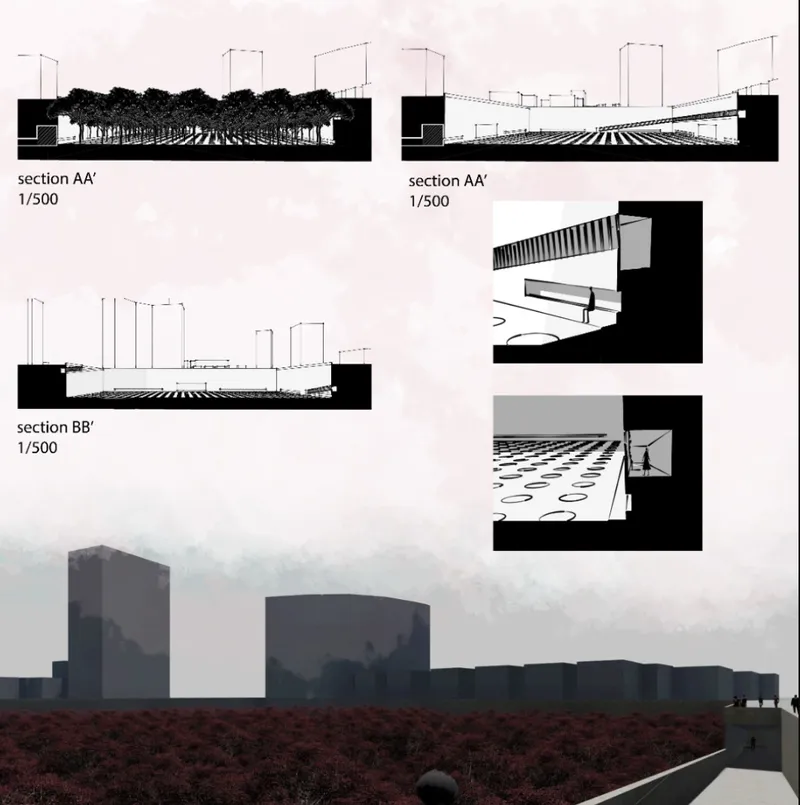
The section drawings clarify how this interior sits within its urban context. The ground plane is lowered to carve the site out of the city, creating a sunken landscape isolated from surrounding noise and architecture. Above ground, only the tree canopy is visible, a green surface that conceals the ritual spaces below. Distant tower volumes appear through a misty atmosphere, reinforcing the sense of psychological distance the design achieves even while remaining embedded in Shanghai's dense fabric.
Concrete Portals and the Choreography of Grief
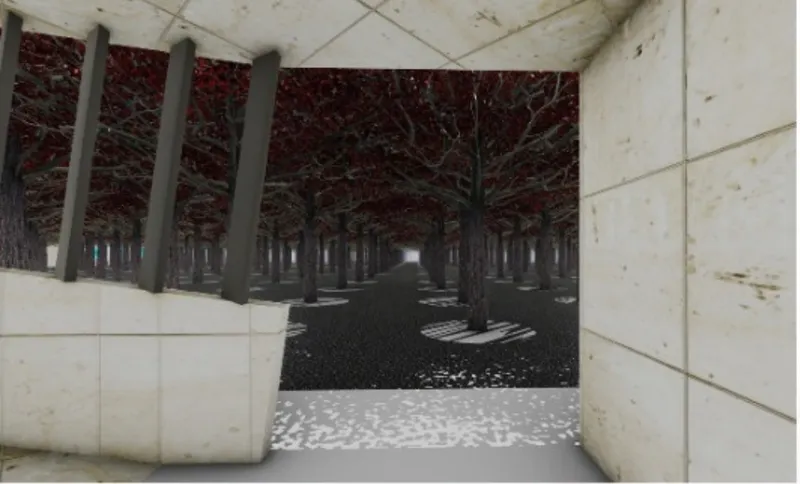
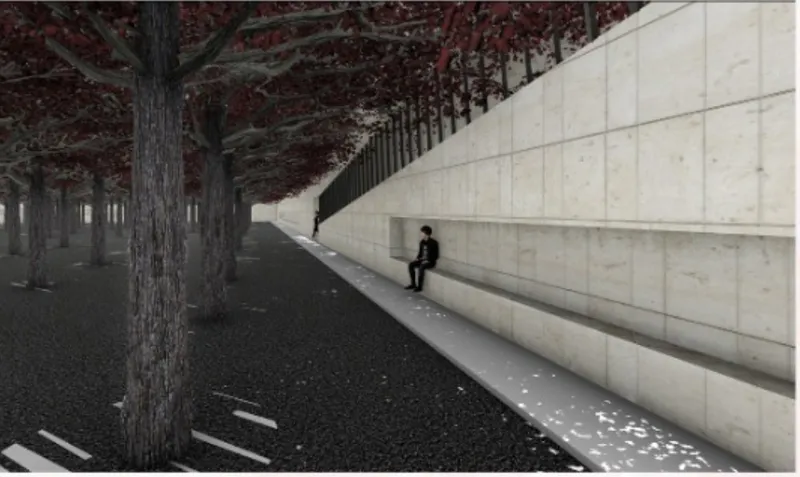
A lone visitor silhouette framed by a concrete portal tells you everything about the project's spatial choreography. The ritual path begins with a descending ramp that hides the interior from the city's view, creating a threshold between the mundane and the sacred. Niches in the wall hold the molecular mixture of the deceased, and water from the same niche can be used during subsequent visits to nourish the designated tree. These hidden, repeated gestures transform grief from a single event into a sustained relationship with a living organism.
The sloped concrete walls alongside tree trunks reinforce this choreography through material and angle. A seated figure on the angled surface suggests pause, contemplation, a body at rest among trees whose root systems hold the remains of others. The canopy overhead filters light in a way that is neither bright nor dark, an in-between condition that mirrors the emotional territory the project occupies. Tree shapes throughout the site are selected specifically to ensure visual privacy while maintaining ground-level airflow and openness, a calibration that turns the landscape into an intimate, immersive forest of remembrance.
A Public Sanctuary Hidden in Plain Sight
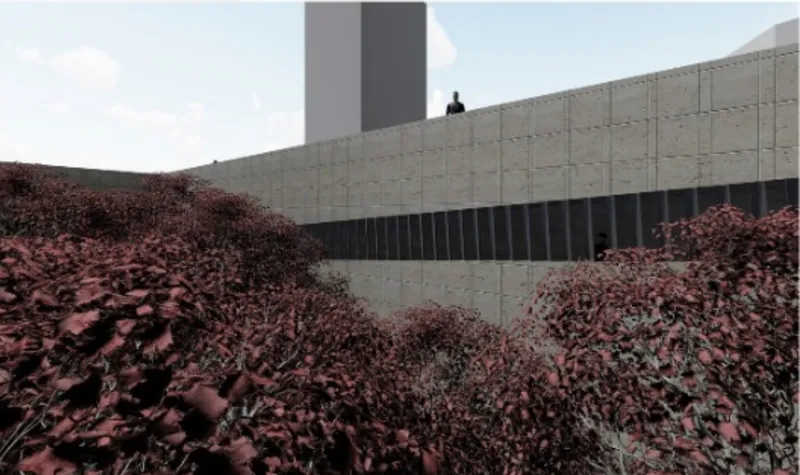
From the exterior, Zhaohui reads as a series of concrete volumes rising from red-toned planted slopes. A figure on the upper terrace surveys the landscape as though standing in any well-designed urban park. That ordinariness is the point. The project's dual identity, cemetery and public green space, is seamless by design. For the casual visitor, this is a rare pocket of nature in a high-density city. For the bereaved, it is a place where memory is stored not in stone but in photosynthesis.
Shanghai's scarcity of accessible parks makes Zhaohui's proposition pragmatic as much as poetic. The site contributes ecological and spatial value to the city while addressing the growing crisis of burial space in dense urban environments. By refusing to mark trees with names, the design enforces a kind of radical equality: in death, every person becomes the same elemental offering to the same soil, feeding the same canopy that shades the living above.
Why This Project Matters
Zhaohui is significant because it treats death not as a program to isolate but as an urban condition to design for. Most cities push cemeteries to the periphery, consuming land without returning ecological or social value. Bilgin and Demirel propose the opposite: a funerary landscape that generates green space, improves air quality, and welcomes the living alongside the dead. The molecular decomposition process, while speculative, points toward a genuinely different model of sustainable funerary architecture, one that eliminates the material waste of caskets and the emissions of cremation.
Perhaps more importantly, the project reconfigures the emotional architecture of mourning. The absence of names, the act of pouring remains into roots, the return visits with water: these rituals replace the static finality of a headstone with a dynamic, ongoing relationship between the living and the dead. In a world where cities are growing denser and greener space is shrinking, Zhaohui offers a quietly radical answer. Let the dead feed the forest, and let the forest belong to everyone.
View the Full Project
About the Designers
Designers: İmre Bilgin, Ayça Şehnaz Demirel
Enter a Design Competition on uni.xyz
uni.xyz runs architecture and design competitions year-round that reward proposals with spatial conviction and real site intelligence.
Project credits: Zhaohui by İmre Bilgin, Ayça Şehnaz Demirel.




Popular Articles
Popular articles from the community


The Ocean Hive: Sustainable Architecture for a Self-Sufficient Civilization at Sea
The Ocean Hive imagines sustainable architecture at sea, where modular habitats, algae, wave power and ocean waste sustain a growing colony.
EW PARK: Sustainable Architecture Reimagines the Future of Urban Parking
EW PARK reimagines city parking as a modular wooden tower combining automation, solar energy, electric mobility, and adaptable urban design.

The Musturak Paradise: Senior Living Architecture for a Connected Future in Temara, Morocco
The Musturak Paradise reimagines senior living architecture in Temara via private homes, social spaces, culture, community, and shared care.

The Earth Pod: 3D Printed Homes for Resilient Refugee Communities
The Earth Pod reimagines refugee housing through 3D printed homes made from clay, combining resilience, self-sufficiency, and rapid shelter.


Similar Reads
You might also enjoy these articles

Day and Night Park: A Time-Based Urban Newsstand in Beijing
A temporary urban newsstand in Beijing blending travel, light, and reading through poetic colors, compact form, and community-focused design.

Modernist Patio Renovation in El Masnou, Barcelona by Oliver Segura Arquitectura + Cebrià Arquitectura
Modernist patio renovation blending tradition and innovation with a movable pool, leveled floors, and Catalan materials in El Masnou.

Alto Residencial Coop: Cooperative Housing Development in Santiago de Compostela by Carbajo Barrios Arquitectos
A linear cooperative housing complex blending white volumes and perforated metal façades, enhancing community living, natural light, privacy, and urban integration.
Vil Genis School by BPA ARCHITECTURE – Massy, France
Vil Genis School in Massy, France, features sustainable design, south-facing classrooms, community integration, accessible spaces, and modern educational architecture.


Comments (0)
Please login or sign up to add comments
No comments yet. Be the first to comment!