
ZIL Hustle Hub: Vertical Neighborhoods for the Creative Class
A co-living complex stitched into Moscow's urban grid through carved massing, glazed atriums, and stacked programmatic diversity.


What happens when you stack an entire neighborhood vertically, then crack it open to let the city flow through? ZIL Hustle Hub answers that question with three slender towers organized not by floor number but by shared creative purpose: art studios, maker labs, micro-offices, communal kitchens, and terrace cafés all occupy distinct clusters within a single co-living ecosystem. The project treats residential architecture as infrastructure for collaboration, rejecting the isolated apartment block in favor of something closer to an inhabited street.
Designed by Сергей Киселев and Сергей Левченко, the proposal targets entrepreneurs, founders, designers, developers, and remote workers who structure their days around flexibility rather than routine. The masterplan positions the complex as a nodal extension of its surrounding urban fabric, mapping direct connectivity to schools, cultural facilities, metro infrastructure, commercial streets, and public plazas. Rather than sitting apart from the city, Hustle Hub acts as an anchor within it.
Massing That Carves Space for Light, Air, and Community

The axonometric drawing lays out the design logic clearly. Three interconnected volumes rise from a porous ground plane, their forms shaped through a process of extrusion and subtraction. Simple rectangular masses evolve into intricate structures with carved-out pockets, double-height voids, and multifunctional galleries. Programmatic icons hovering above each block telegraph the stacked diversity within: co-working lounges give way to fitness areas, event spaces sit above quiet working zones, and communal terraces punctuate the upper floors.
The massing strategy serves specific environmental goals. Slender tower profiles maximize natural light penetration and cross ventilation while opening visual corridors between the buildings. The lower levels remain deliberately open and permeable, hosting workshops, meeting rooms, cafés, and outdoor social environments that blur the threshold between the complex and its urban context. The ground plane reads less like a lobby and more like a public square that happens to have a building growing out of it.
A Plaza Framed by Perforated White Volumes

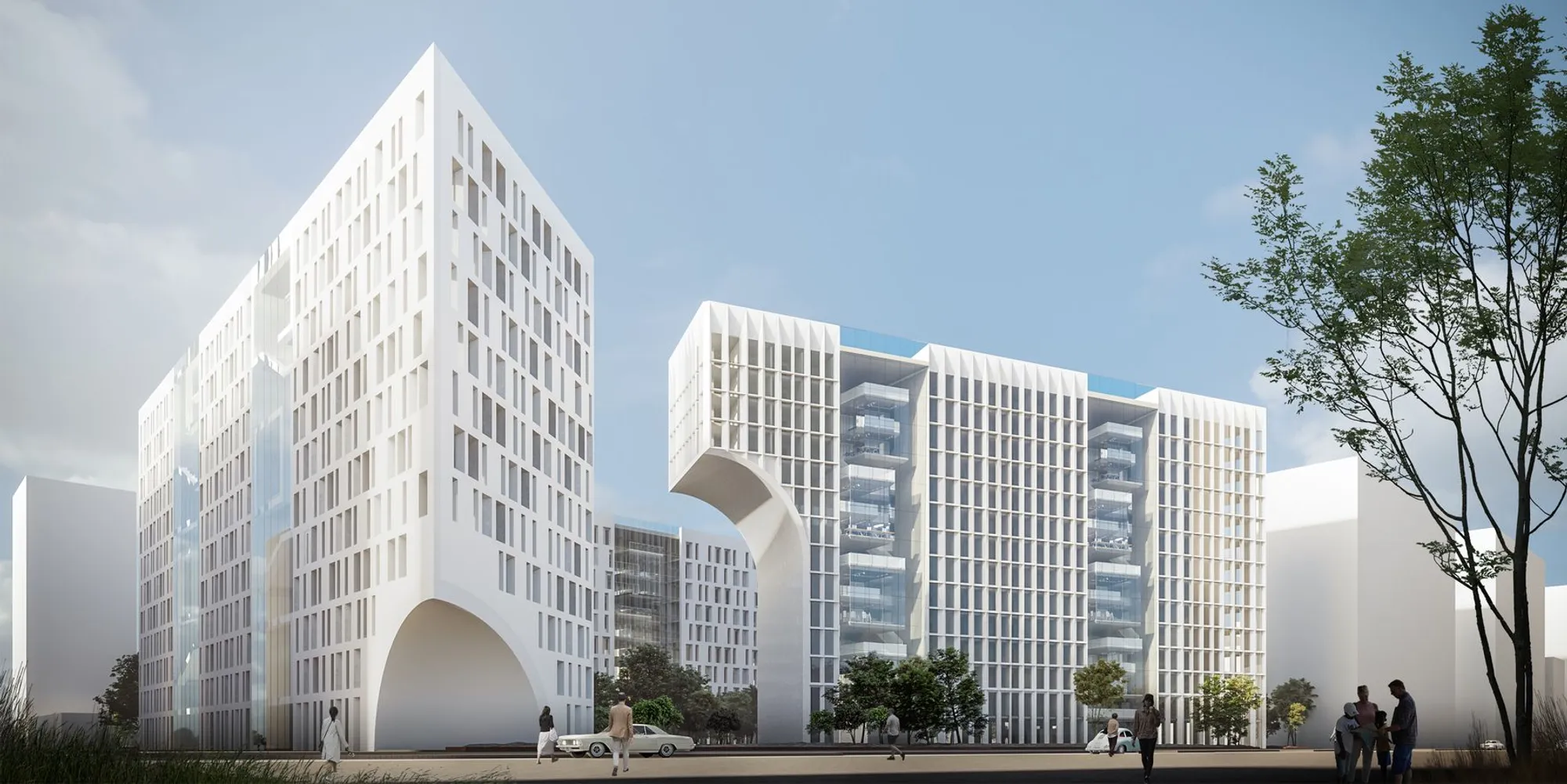
The rendered plaza view reveals the project's strongest formal move: crisp white façades punctured by a rhythmic grid of vertical apertures. The punched openings filter light in a controlled manner, lending the building a sculptural, almost textile quality at the urban scale. Pedestrians and trees populate the space between the buildings, confirming that the gaps between volumes are as carefully designed as the volumes themselves. These interstitial zones function as community plazas, pedestrian pathways, and active ground-level frontages that invite interaction from both residents and passersby.
Sectional Complexity: Scissor Stairs and Internal Streets
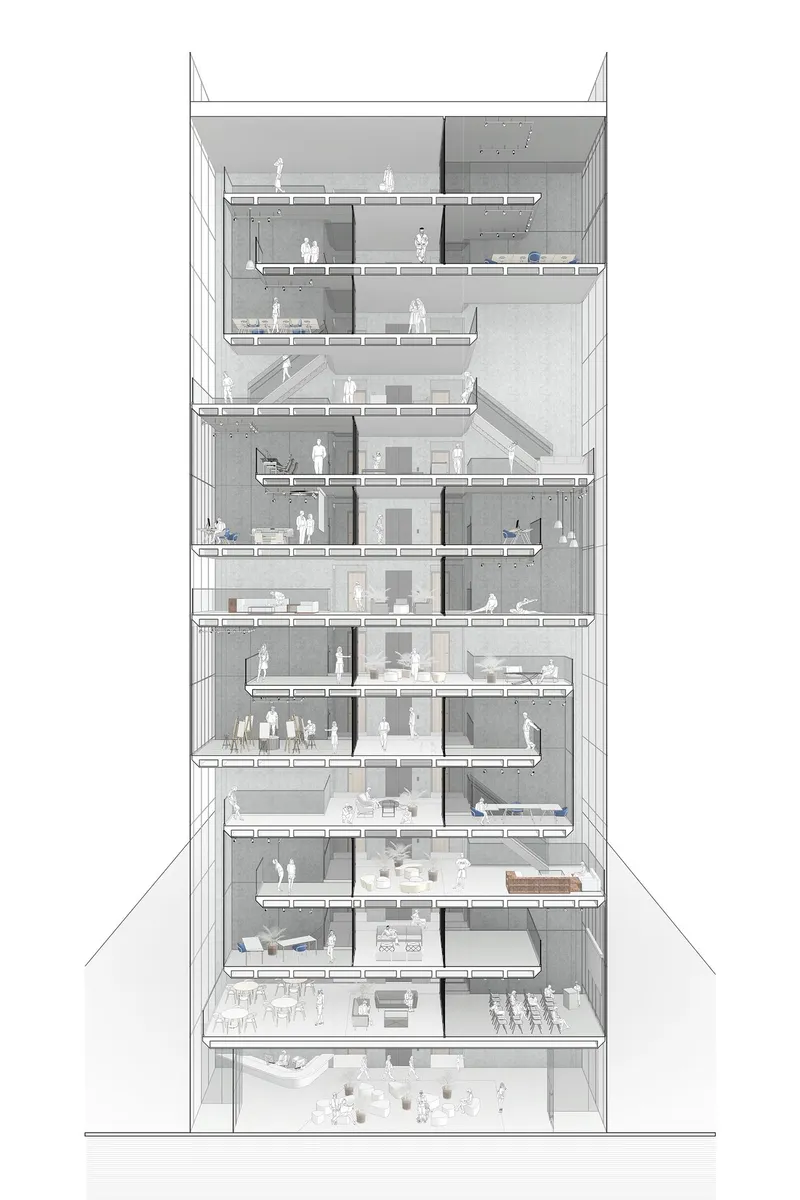
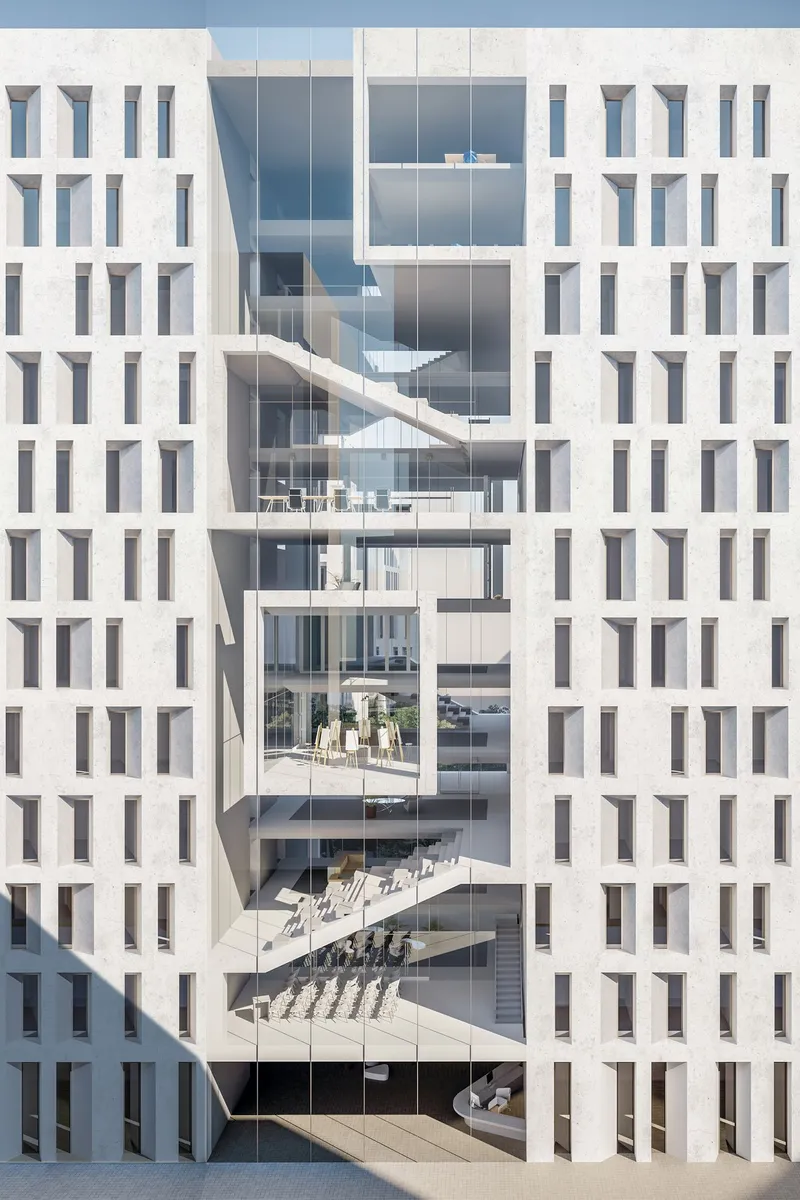
The section drawing is where the project's ambition becomes fully legible. Multi-storey interior volumes are stitched together by scissor staircases that zigzag through the building's depth, turning vertical circulation into a social choreography. Occupants appear on stepped platforms, open atriums, and double-height communal spaces, inhabiting the section the way people inhabit a hillside village: at varying levels, constantly visible to one another, with casual encounters built into every path of movement.
The façade cutaway confirms this reading from the exterior. Behind the white punched-window elevations, the zigzagging staircases are exposed through fully glazed central portions. The contrast between solid and transparent is deliberate: the opaque perforated skin signals private dwelling zones, while the glass reveals the dynamic interior ecosystem of floating meeting pods, multi-level stair pathways, open collaboration balconies, and indoor courtyards. Privacy and transparency coexist without compromise.
The Courtyard as Threshold Between Two Material Languages

The courtyard view captures a moment of material dialogue. On one side, a glass-paneled volume exposes its layered interior life; on the other, a textured precast façade anchors the composition with solidity and warmth. Pedestrians move through the space at ground level, reinforcing the project's commitment to permeability. The courtyard is not a leftover gap between buildings but a designed outdoor room, scaled to the human body and activated by the programs that open onto it.
This duality of expression, glass against precast, transparency against texture, runs through the entire project. It reflects the fundamental tension the designers are negotiating: how to give hundreds of residents a sense of shared community without erasing the need for personal retreat. The architecture resolves this not through compromise but through adjacency, placing collective and private conditions side by side and letting the section do the work of mediation.
Why This Project Matters
Co-living projects often default to marketing language: community, flexibility, connection. ZIL Hustle Hub translates those words into specific architectural conditions. The scissor-stair sections, the carved massing, the programmatic stacking, and the calibrated façade system all serve a clear spatial thesis: that a building's circulation and shared spaces can do more social work than any amenity lounge ever will. Киселев and Левченко understand that community is not a program listed on a floor plan; it is a consequence of how people move through space.
The project also offers a useful counterpoint to the prevailing trend of autonomous, object-like towers. By mapping its connectivity to schools, metro stations, cultural venues, and commercial streets, Hustle Hub insists that mixed-use architecture must be genuinely mixed into its context. The urban grid does not stop at the building's edge; it passes through the ground floor and up the scissor stairs. That integration, more than the white façades or the maker labs, is the project's most transferable idea.
View the Full Project
About the Designers
Designers: Сергей Киселев, Сергей Левченко
Enter a Design Competition on uni.xyz
uni.xyz runs architecture and design competitions year-round that reward proposals with spatial conviction and real site intelligence.
Project credits: ZIL Hustle Hub by Сергей Киселев, Сергей Левченко.



Popular Articles
Popular articles from the community


The Earth Pod: 3D Printed Homes for Resilient Refugee Communities
The Earth Pod reimagines refugee housing through 3D printed homes made from clay, combining resilience, self-sufficiency, and rapid shelter.

The Musturak Paradise: Senior Living Architecture for a Connected Future in Temara, Morocco
The Musturak Paradise reimagines senior living architecture in Temara via private homes, social spaces, culture, community, and shared care.

The Ocean Hive: Sustainable Architecture for a Self-Sufficient Civilization at Sea
The Ocean Hive imagines sustainable architecture at sea, where modular habitats, algae, wave power and ocean waste sustain a growing colony.

Co-Life: Senior Housing Design That Reconnects Older Adults With the City
Co-Life reimagines senior housing design through healing gardens, shared streets, workshops, and a sustainable community across generations.

Similar Reads
You might also enjoy these articles
The Musturak Paradise: Senior Living Architecture for a Connected Future in Temara, Morocco
The Musturak Paradise reimagines senior living architecture in Temara via private homes, social spaces, culture, community, and shared care.

The Leaf Center: Cultural Center Architecture for Social Integration in Amsterdam
Cultural center architecture becomes a bridge at The Leaf Center, connecting international students with Amsterdam through art and exchange.

Conexión: Biophilic Design Reimagines High-Rise Living in Hong Kong
Conexión reimagines high-rise living in Hong Kong through biophilic design, green facades, shared spaces, daylight, water and nature within.

Wander to Wonder: Modular Playground Design for Children in Kutupalong Refugee Camp
Wander to Wonder uses modular playground design to create flexible, imaginative play spaces for children in Kutupalong refugee camp.



Comments (0)
Please login or sign up to add comments
No comments yet. Be the first to comment!