
ZOOM Architecten Transforms a Belgian Moat Farm into a Flexible Community Center in Eeklo
At the Huysmanhoeve site in Eeklo, two historic barns and two new structures form an open gathering place rooted in regional farm typology.


The moat farm is one of those building types so embedded in the Flemish landscape that you can drive past a dozen of them without registering how precisely they organize land, water, and shelter. At the Huysmanhoeve site in Eeklo, ZOOM Architecten seized on that typology as both a conceptual framework and a practical constraint, turning a cluster of agricultural buildings dating from the 13th century onward into a regional center called HUYS. The result is a 1,064 m² complex spread across four buildings: two existing barns that have been carefully restored and two entirely new structures that read as belonging to the same farmstead without pretending to be old.
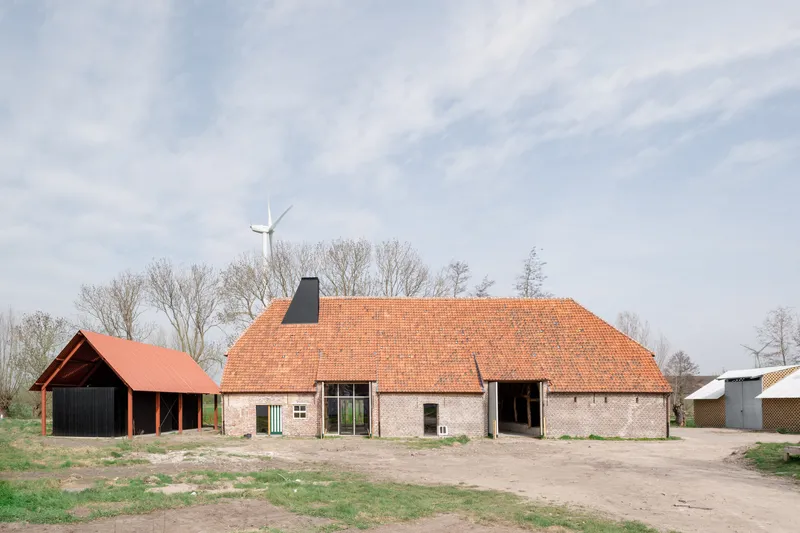
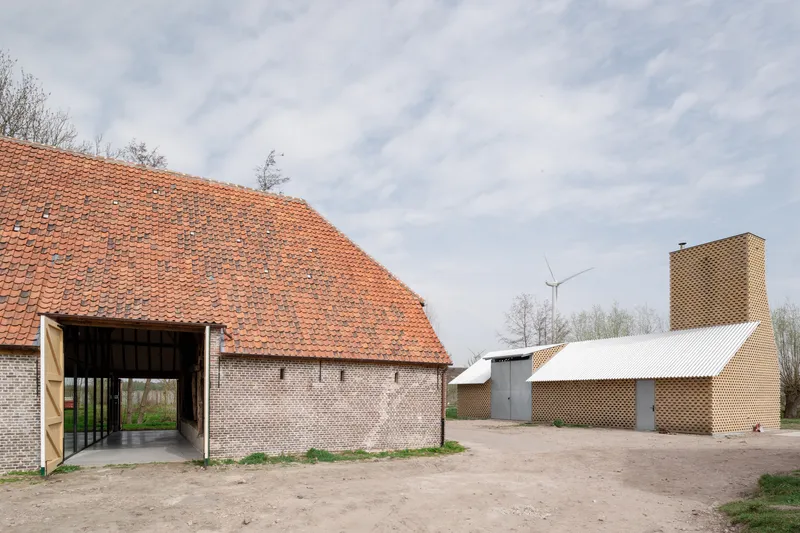
What makes the project genuinely interesting is how it calibrates the relationship between doing nothing and doing something. The existing transverse barn and a 1958 cowshed retain their spatial character while absorbing new program: a cafeteria in one, multi-purpose classrooms in the other. The new shed and shack, meanwhile, take their color, proportions, and gabled profile from the existing structures but use open steel framing and perforated brickwork to announce their contemporary origins. Sustainability here is not a bolt-on strategy; it is embedded in the decision to preserve first and build only where necessary, powered by a wood-chip stove housed in a chimney tower that doubles as a storage silo.
Farmstead as Framework
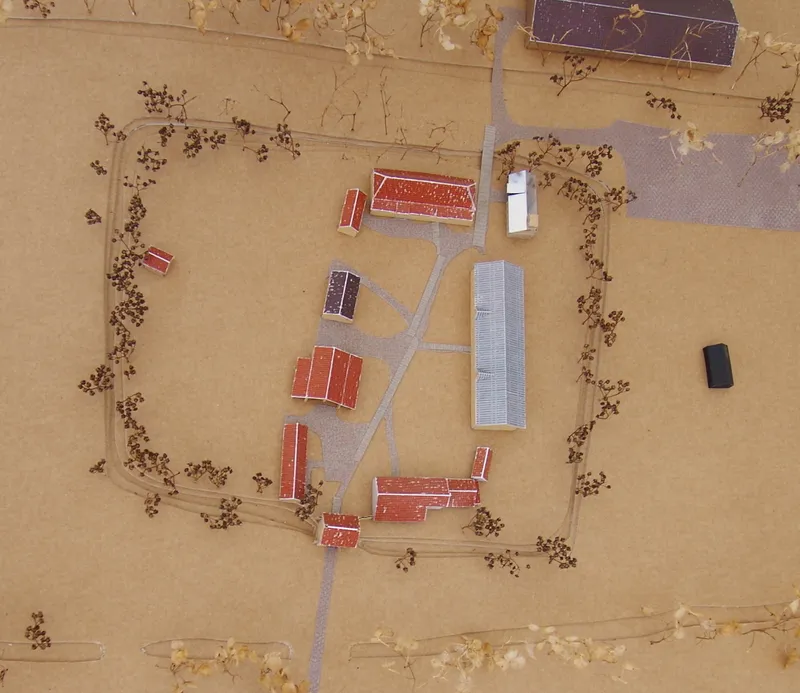
The aerial view reveals how the master plan reactivates the site's historical two-gate system: a southern main entrance with a gatehouse and access drive, and a smaller northern gate that once served as a service entrance. Since the 13th century, the moat farm functioned as a closed agricultural system organized around these thresholds. ZOOM Architecten preserved that spatial logic, using the paths and clearings between buildings as primary circulation rather than adding corridors. The outdoor space is the building's connective tissue.
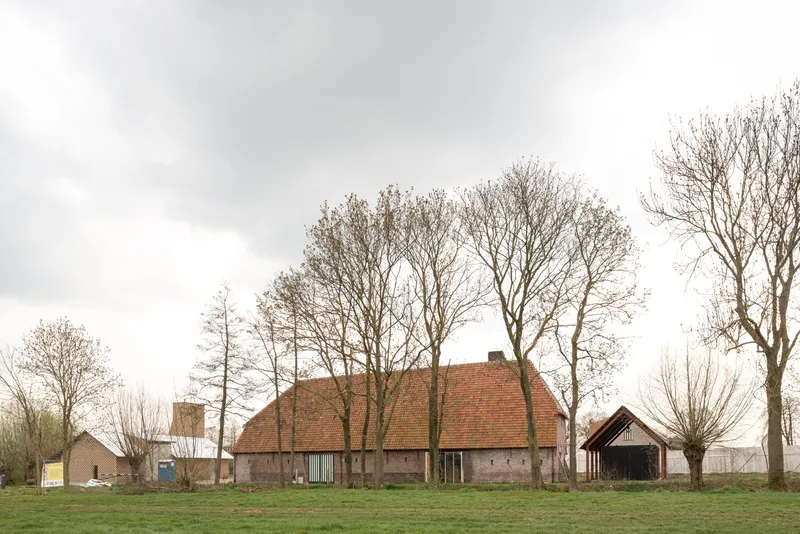
Seen from a distance, the complex reads as a coherent cluster of clay-tile roofs, brick volumes, and mature trees. The wind turbine on the horizon is a reminder that Eeklo has long been a testing ground for progressive energy policy, and the HUYS Center extends that tradition by anchoring its sustainability strategy in local materials and a CO2-neutral heating system.
Restoring the Existing Barns

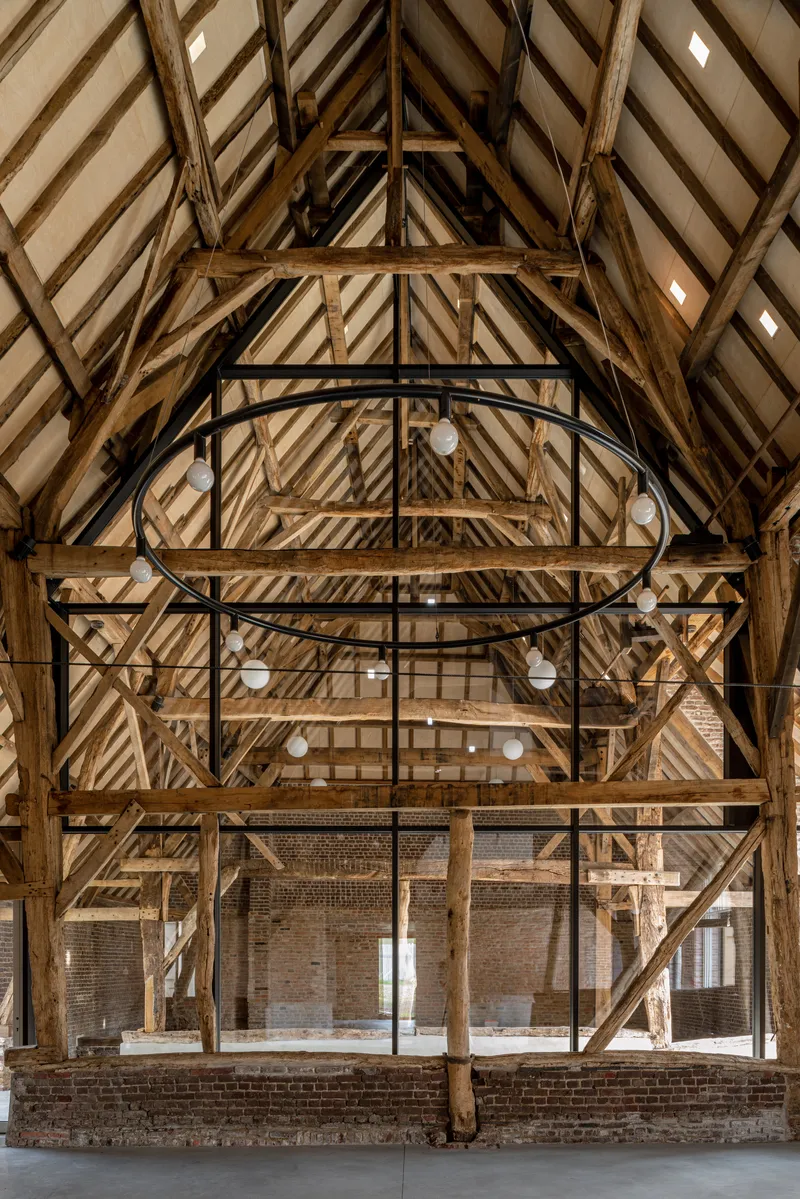

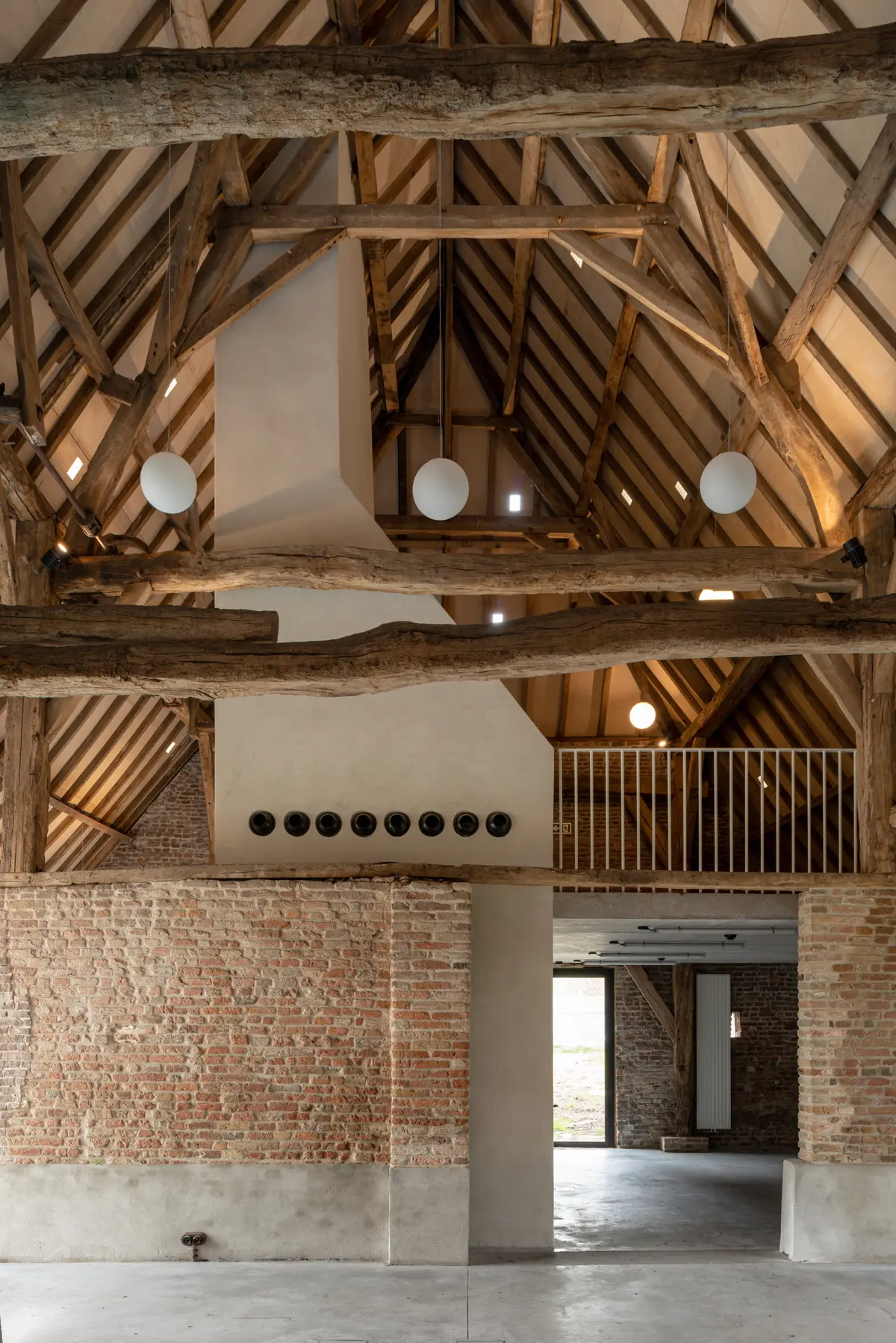
The interior of the existing transverse barn is the project's most spatially charged moment. Exposed timber trusses with diagonal bracing span the full width of the volume, their dark patina contrasting with white plaster insertions below. The restoration work is legible without being theatrical: new pendant lights hang from the ridge, a black steel circular walkway provides mezzanine-level access, and reclaimed brick walls ground the space in its agricultural past. The decision to strip finishes back to structure was not decorative. It was about revealing the intelligence already present in the building.
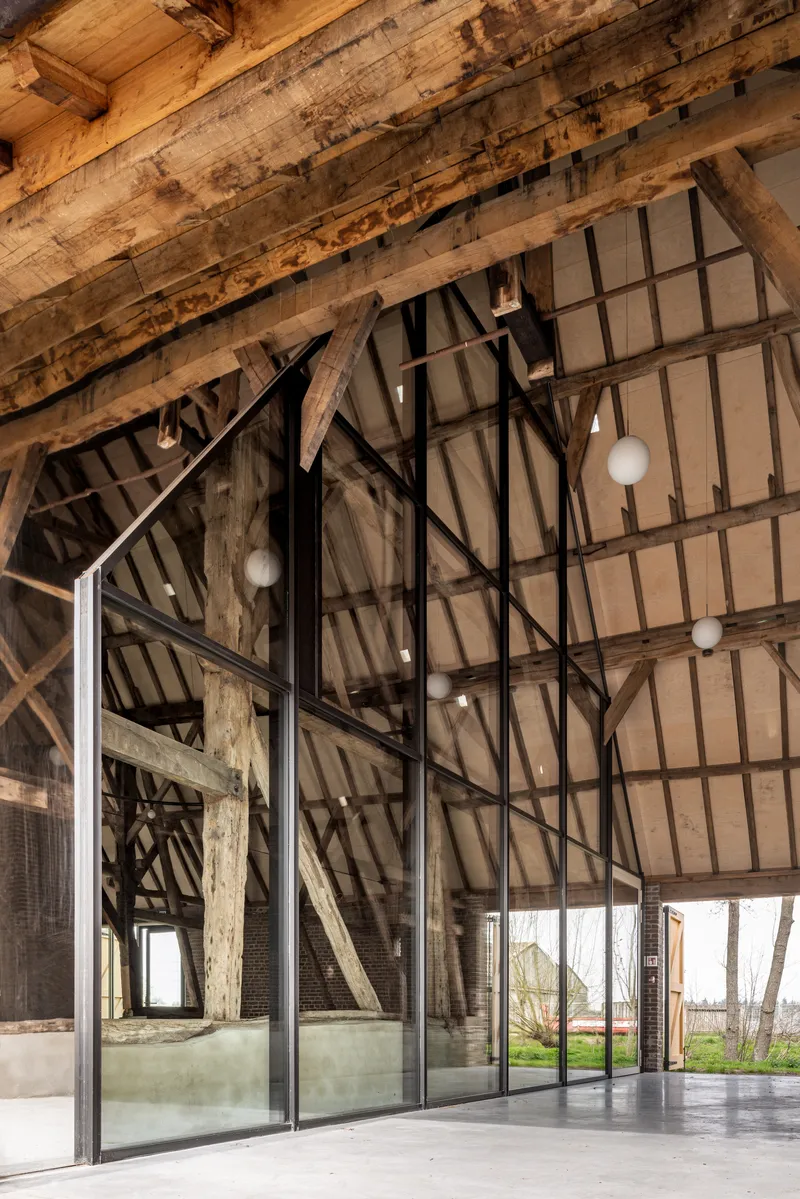
In the cowshed, a glass facade divides the barn interior into a covered outdoor zone and a conditioned indoor zone. The upper floor has been cut away at the entrance gate in the center of the building, creating a double-height void that houses the main vertical circulation. This single surgical move transforms a long, repetitive livestock shed into a building with a spatial center.
The Flexible Classroom Wing
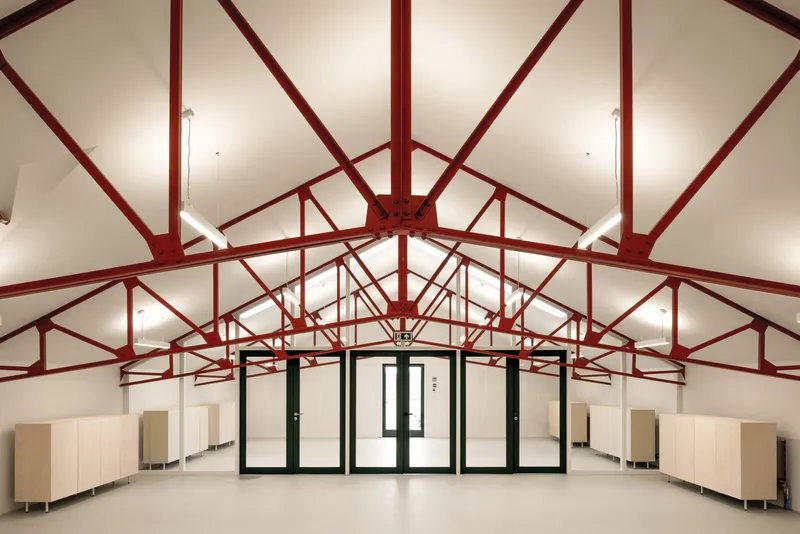
The cowshed's multi-purpose classrooms are separated by four glass walls that can open completely, allowing the individual rooms to function as a single continuous hall. When closed, the glass partitions maintain visual continuity while providing acoustic separation. Red steel trusses radiate from the central ridge under a vaulted white ceiling, giving the interior a rhythmic order that reads as both industrial and civic.
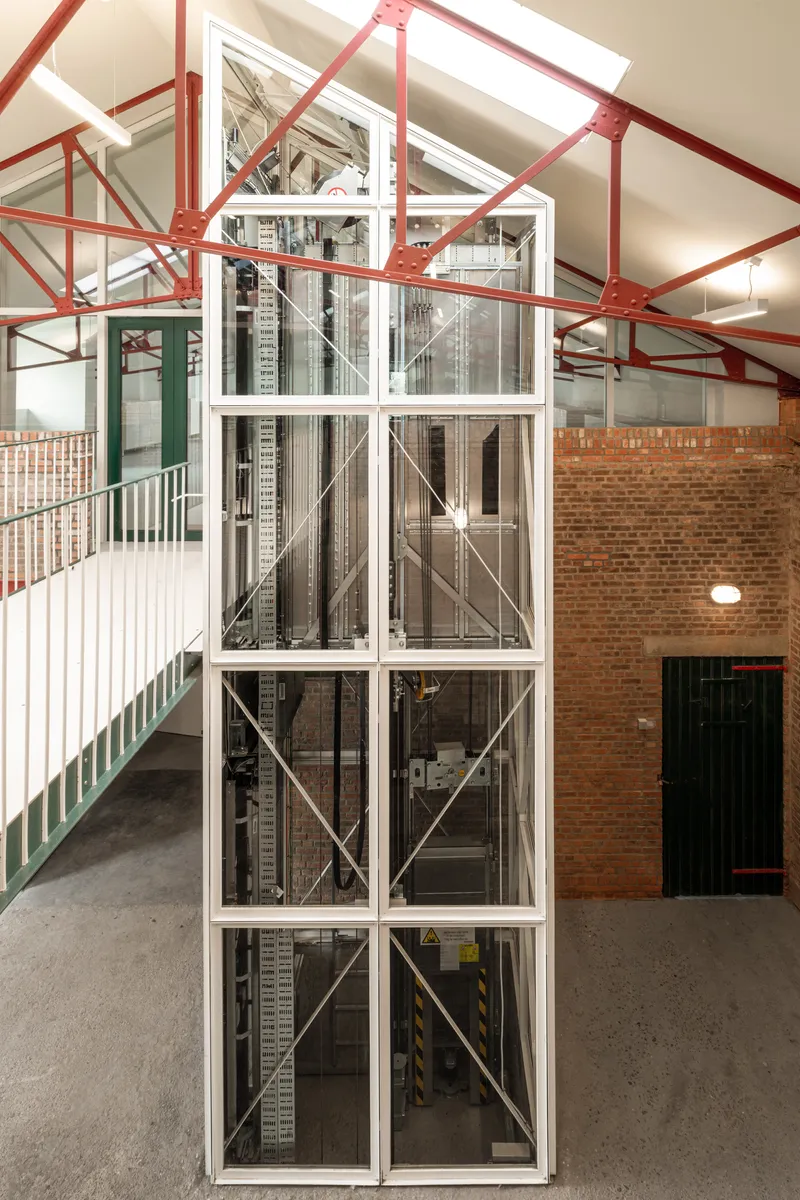
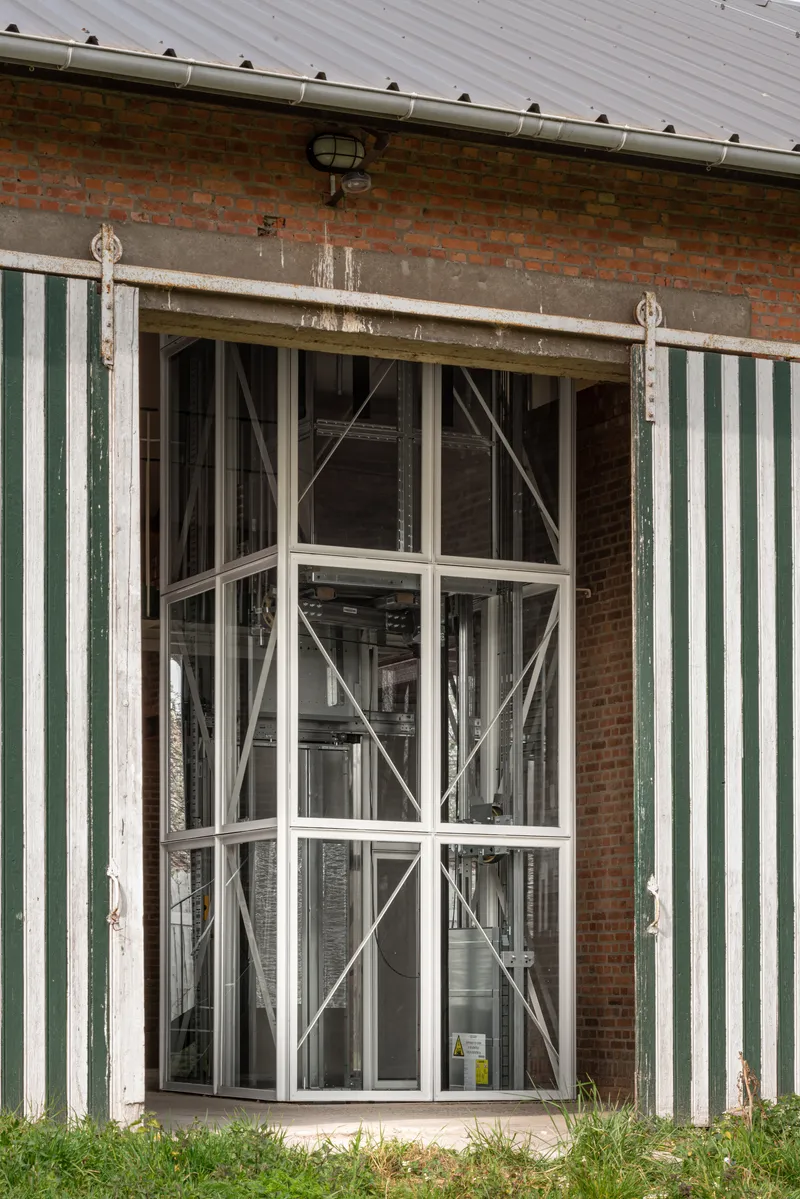
A glass-enclosed elevator shaft with exposed steel cross-bracing has been inserted into the existing structure, its transparency making it feel more like a piece of furniture than an intrusion. The green-and-white striped corrugated metal cladding that appears on the exterior walls of this wing is a playful nod to the agricultural vernacular of painted barn doors, visible in the sliding panels that frame a spiral staircase elsewhere on site.
Vertical Circulation as Event
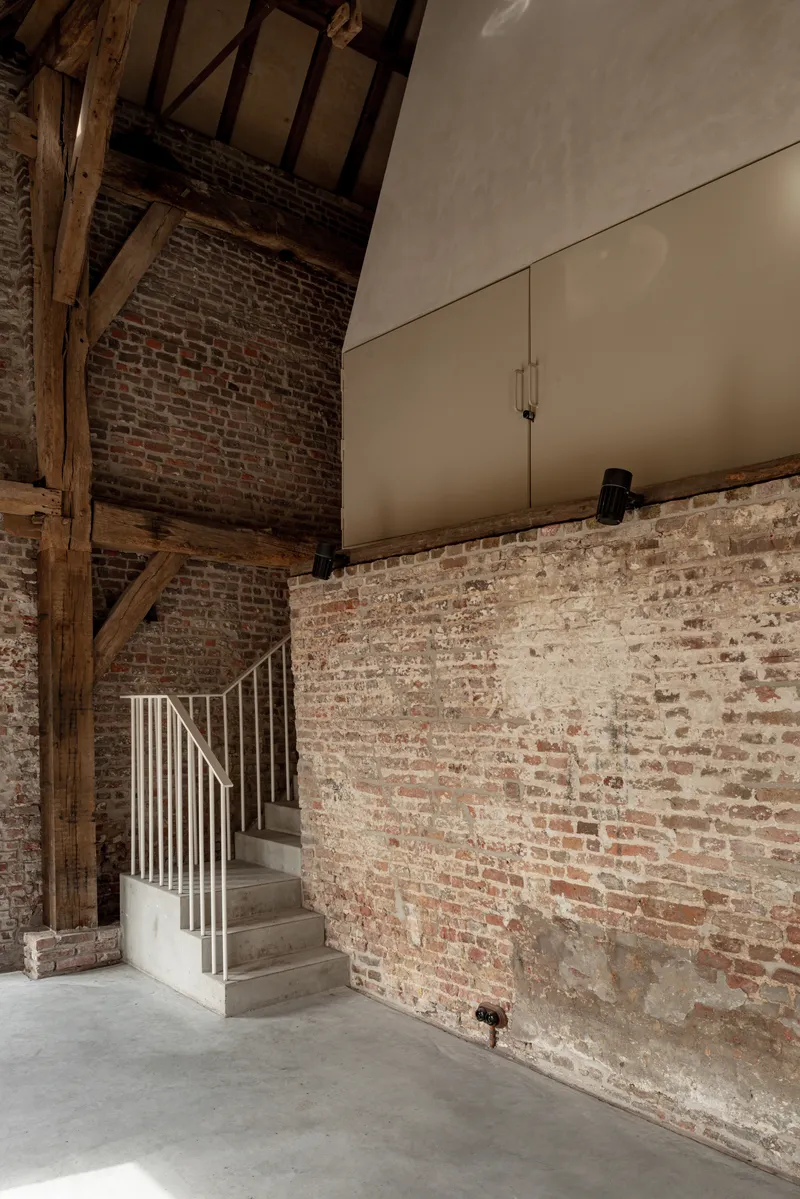

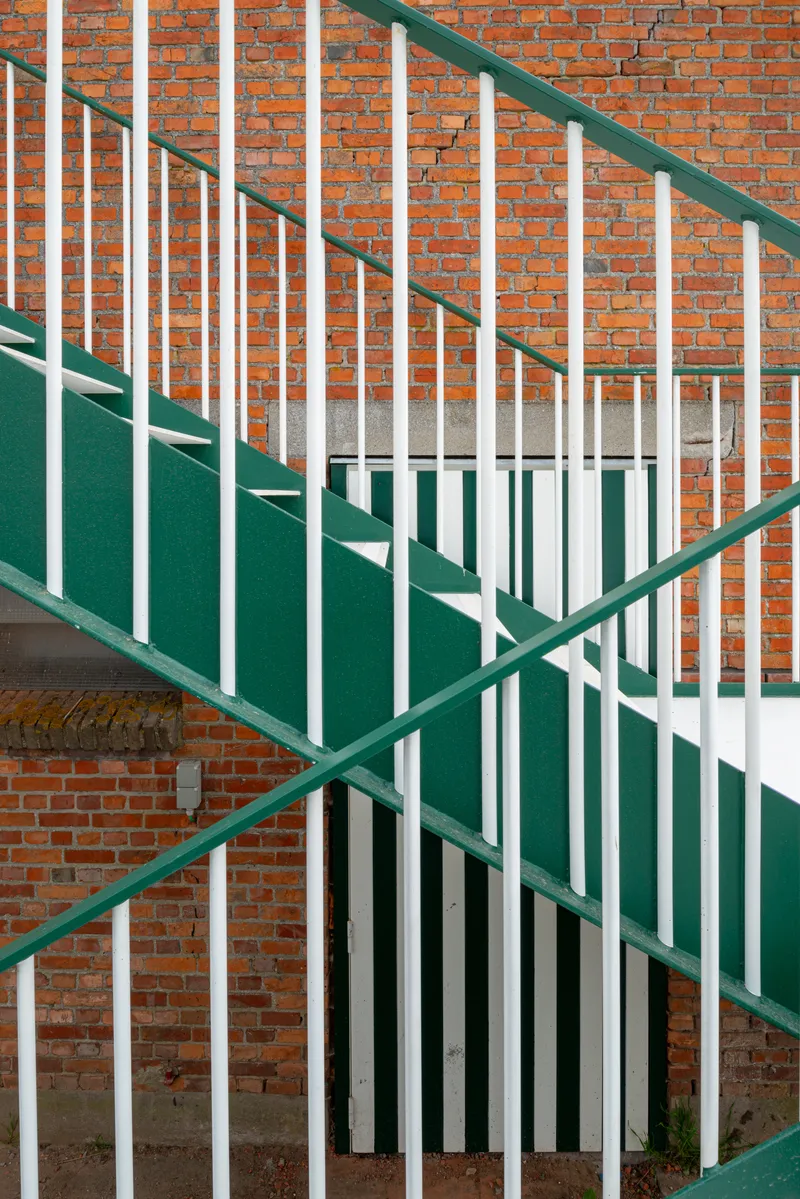
ZOOM Architecten treats stairs not as obligatory service elements but as architectural events. A concrete and steel staircase with white balustrades rises against exposed brick and timber beams in the transverse barn, its materiality deliberately distinct from the historic fabric. Elsewhere, green-and-white painted steel stairs with vertical bar railings ascend against raw brickwork. The two external staircases added at the building ends keep the floor plates clear for flexible use.
The green-and-white striped sliding barn doors that frame one spiral staircase are a detail worth pausing on. They reference the agricultural shutters visible across the courtyard elevations while introducing a graphic boldness that signals the building's new public role. These are working doors, not decorative panels.
The New Shed and Shack
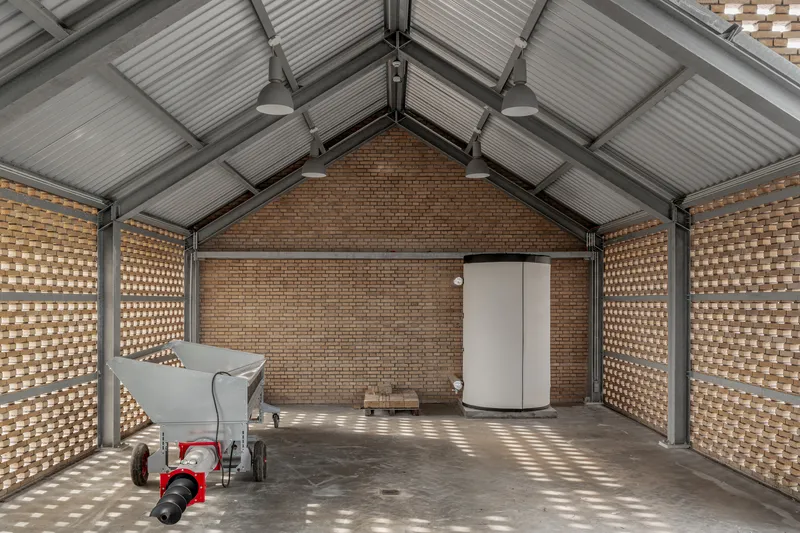
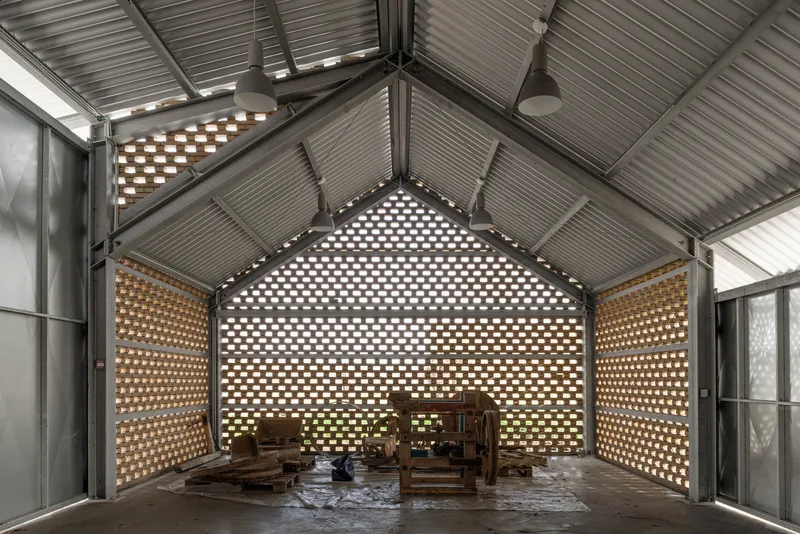
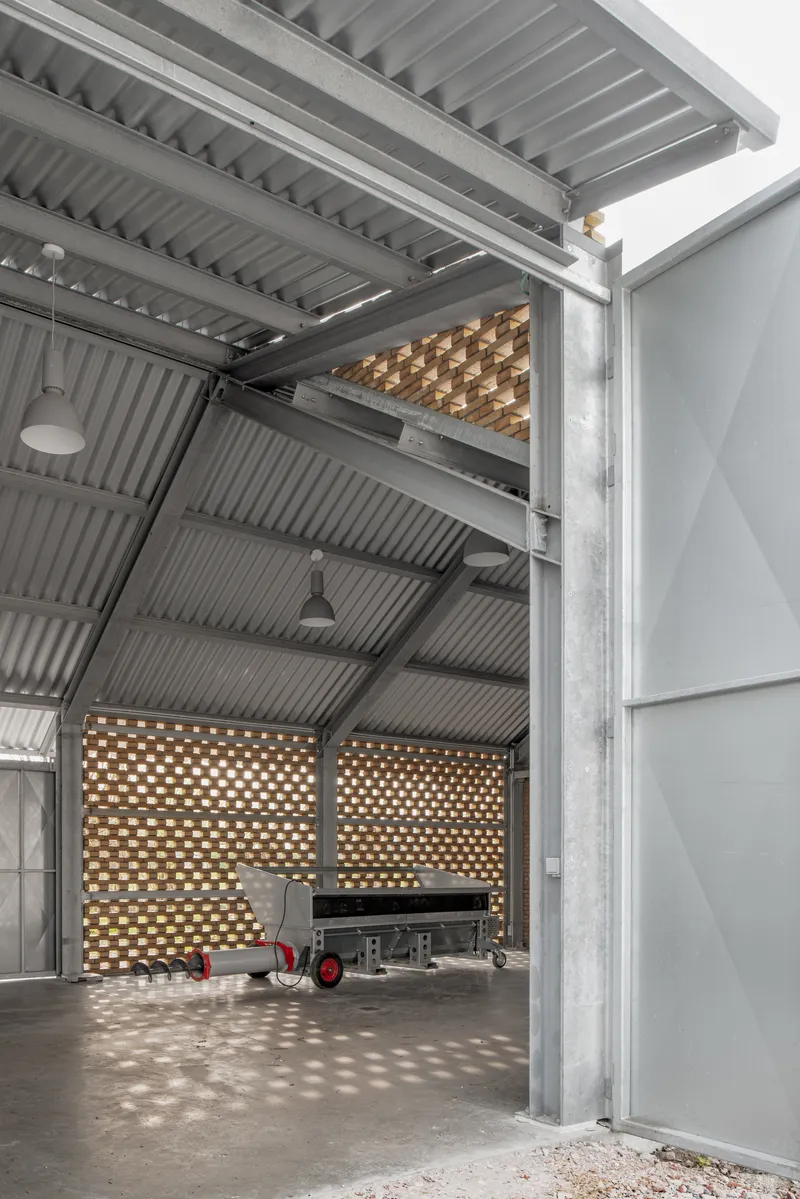
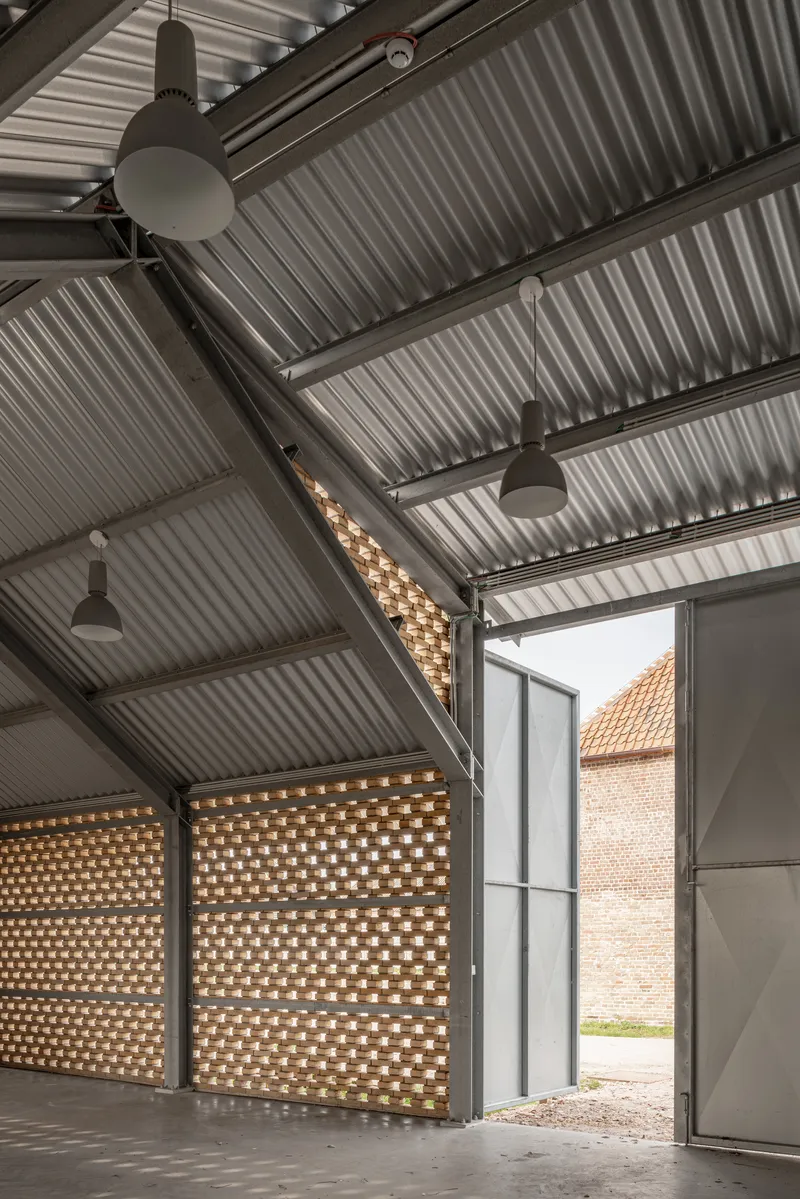
The new shed takes its cue from the existing transverse barn in color, typology, and proportions, but its open steel structure makes no attempt to mimic the timber trusses of the original. Inside, perforated brick walls filter daylight into a workshop space, casting patterns across polished concrete floors that shift throughout the day. The corrugated metal ceiling reflects light back down, amplifying the effect. Two conditioned spaces sit within the open steel frame like boxes within a box, a strategy that allows the remainder of the shed to function as covered outdoor space.
The shack, which accommodates the wood-chip stove, shares the shed's structural logic but is finished entirely in brickwork. Its chimney tower rises as the most visible new element on the skyline, housing both the flue and the wood-chip storage in a single vertical element. The tower's perforated brickwork, visible in several exterior views, gives it a textile quality that softens what could have been a blunt industrial form.
Perforated Brick and Filtered Light
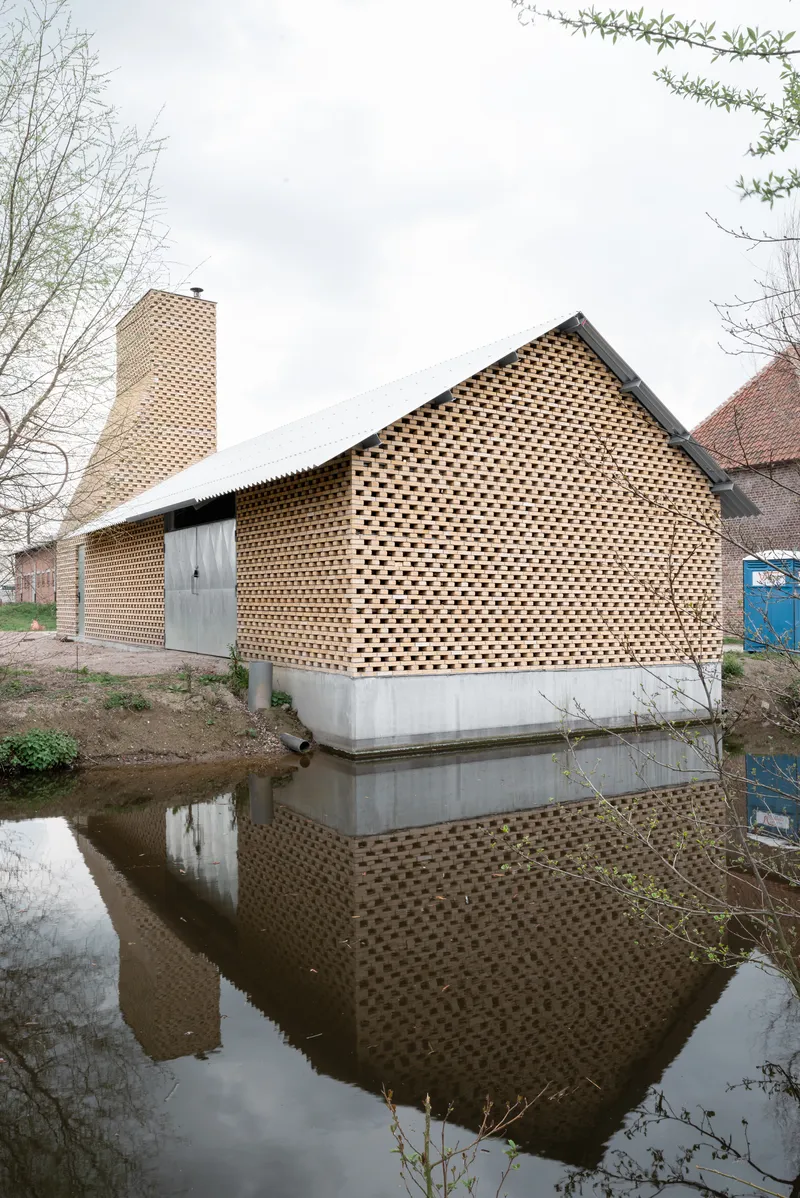
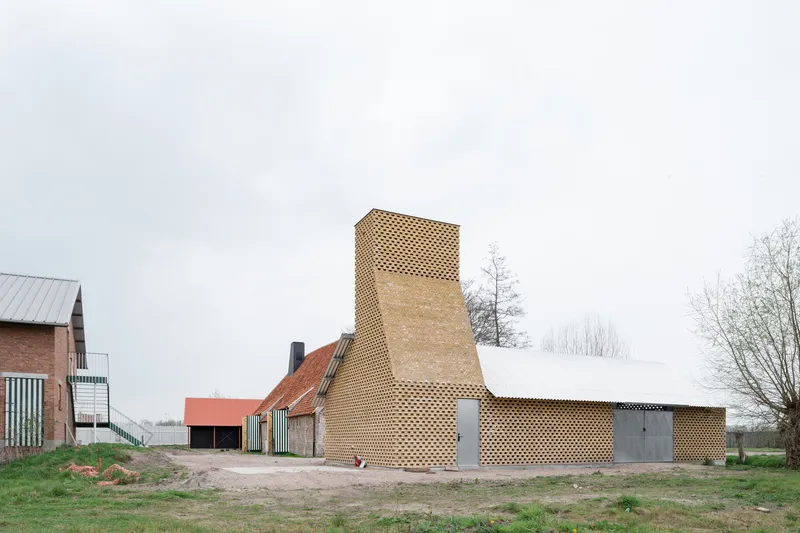
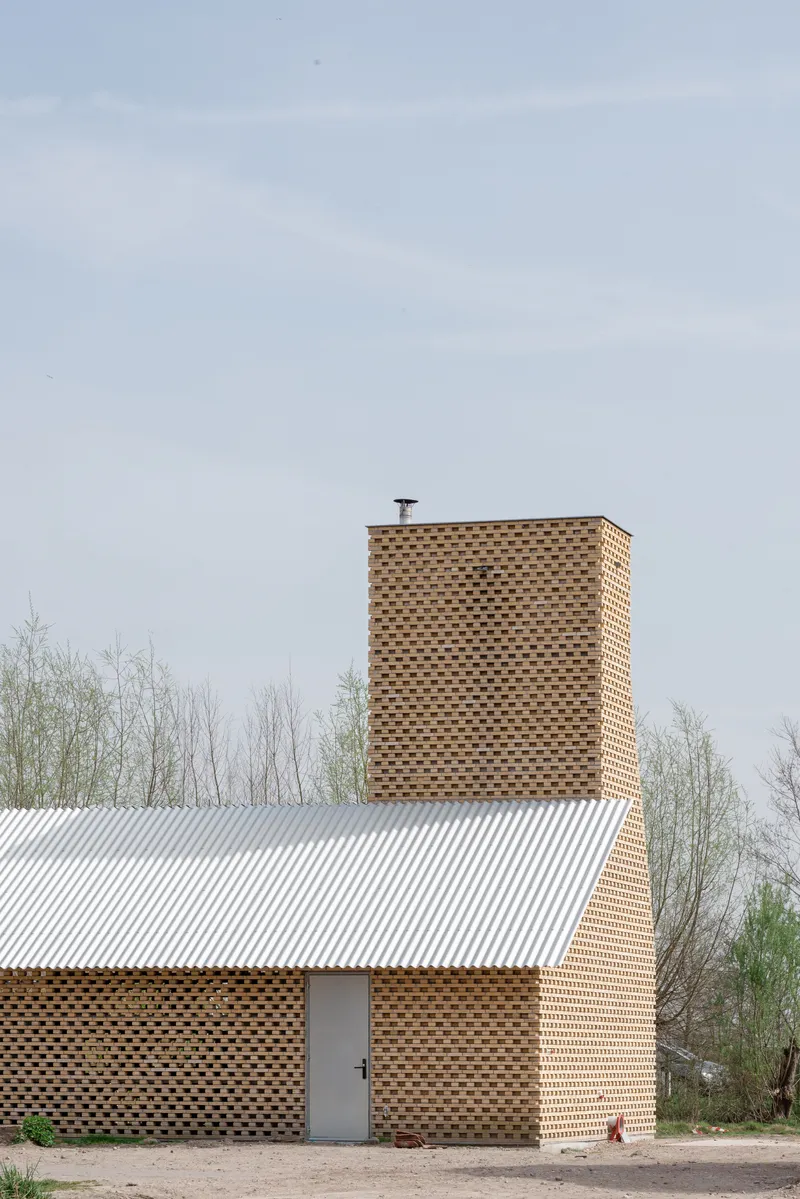
The perforated brickwork deserves its own discussion because it does so much work across the project. On the chimney tower, it ventilates the wood-chip store. On the shed walls, it provides security while admitting daylight. On the gable end reflected in the canal, it gives the new building a porous, almost woven quality that connects it visually to the water and landscape. The checkerboard pattern visible at the base of the gable end is a variation on a traditional Flemish decorative bricklaying technique, updated here with a more open weave.
This is not brickwork as mass but brickwork as screen, and it represents a thoughtful reinterpretation of the material palette already present on site. The existing barns are solid brick; the new structures use the same material in a dematerialized way, marking the boundary between old and new without resorting to the cliché of glass-against-stone.
Courtyard and Threshold
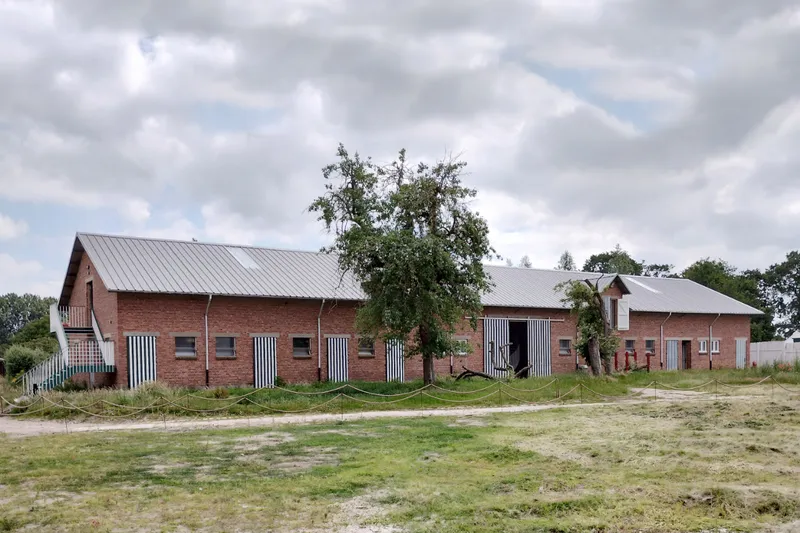
The courtyard is the heart of the project. Brick barns with corrugated metal roofs and vertical-striped shutters surround a central space anchored by a mature tree. The courtyard is not a leftover between buildings; it is the primary organizing device, the space through which all circulation flows. Large doors in the barn walls swing open to blur the boundary between inside and out, reinforcing the idea that in this building, outdoor space is program, not residual.
The view from the courtyard toward the perforated brick tower with the wind turbine beyond captures the project's ambition in a single frame: a working agricultural landscape that has been updated rather than replaced, where heritage and sustainability are not competing agendas but the same one.
The Coral-Roofed Volume
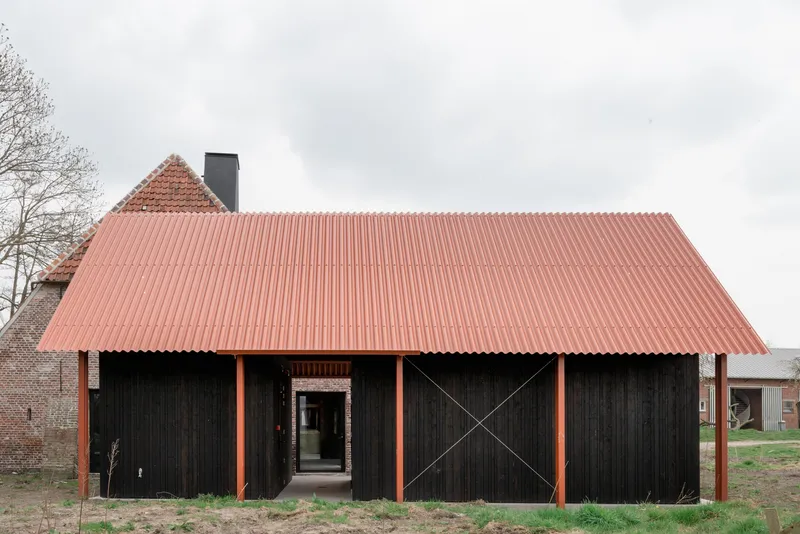
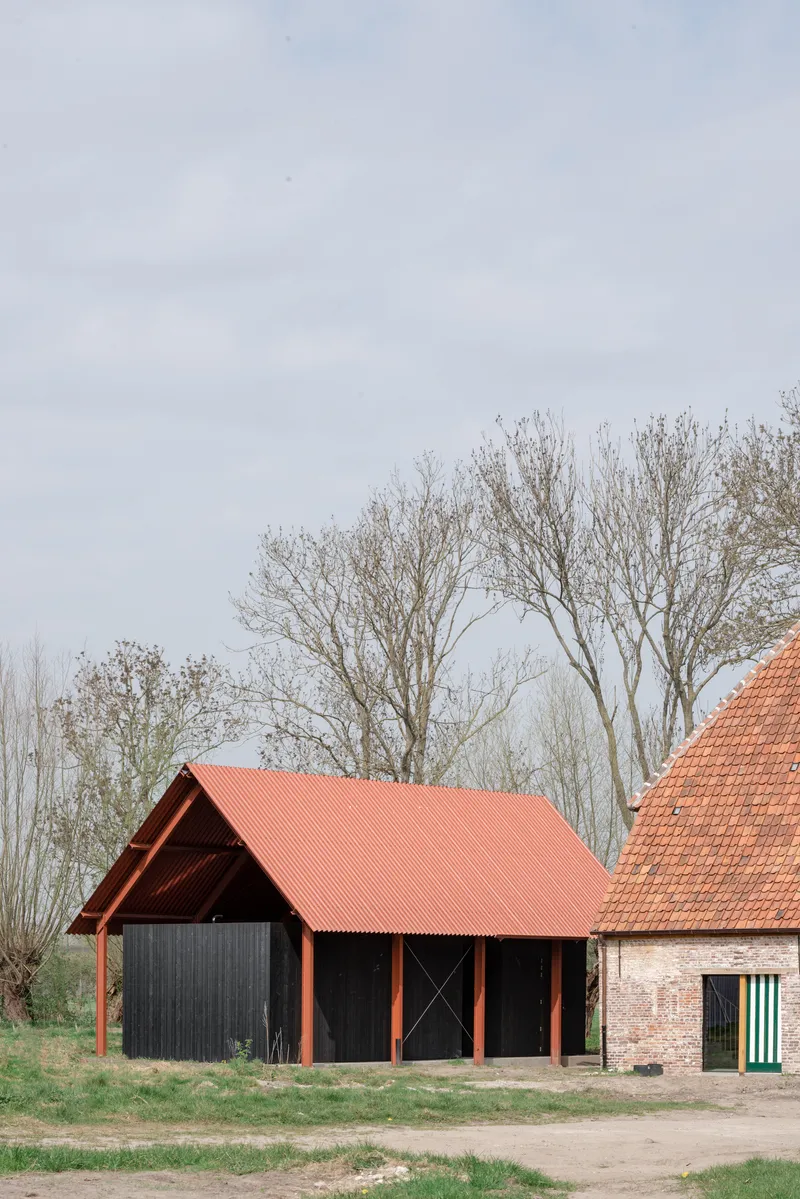
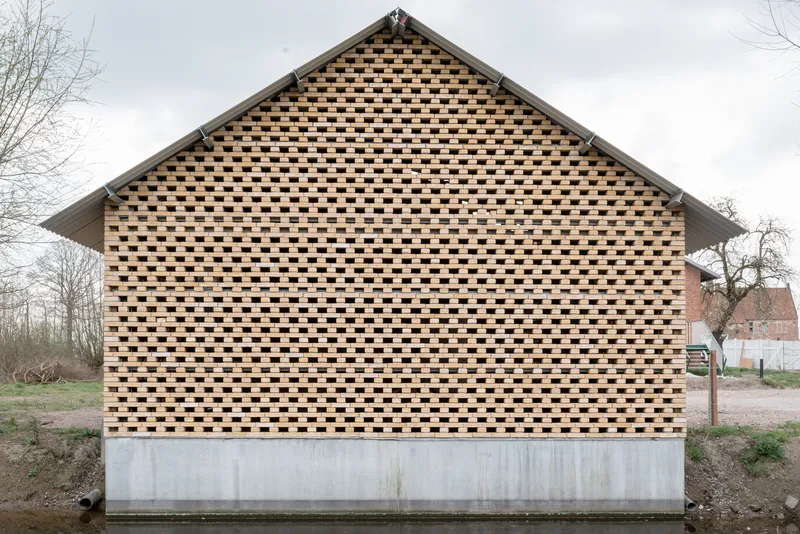
One of the more striking additions is a black timber-clad barn volume capped with a coral-colored corrugated metal roof and orange steel columns. Its saturated palette stands apart from the muted brick and tile of the historic buildings, marking it unmistakably as new construction. The gable end features a chequered brick pattern atop a concrete plinth, combining two material registers in a single elevation. The color choice is bold but not arbitrary: it creates a visual anchor at the edge of the complex, readable from a distance across the flat landscape.
Plans and Drawings
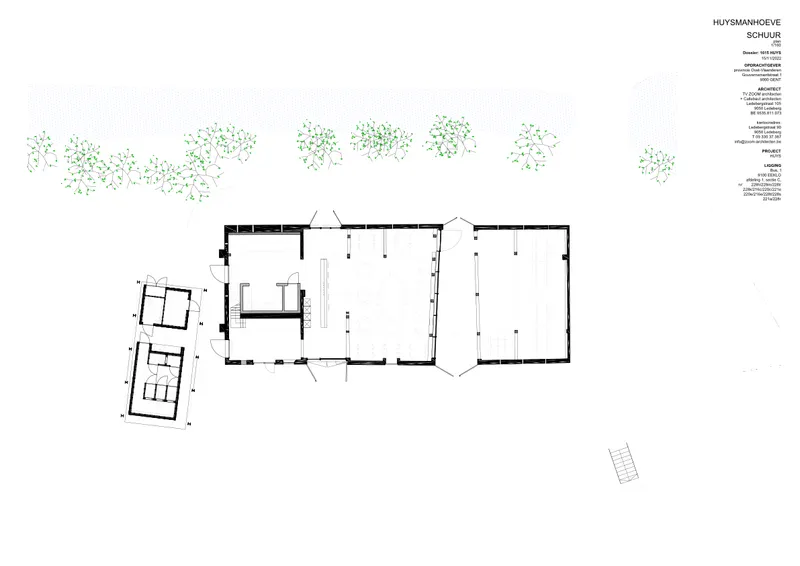
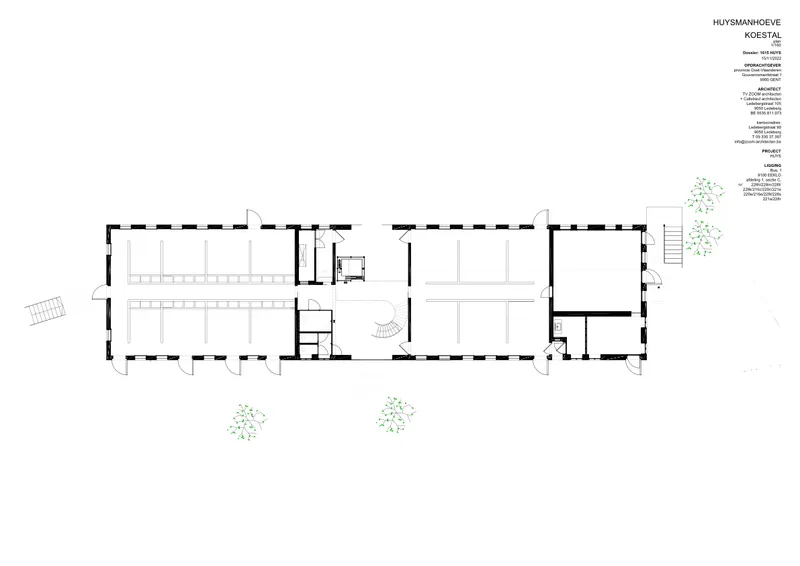
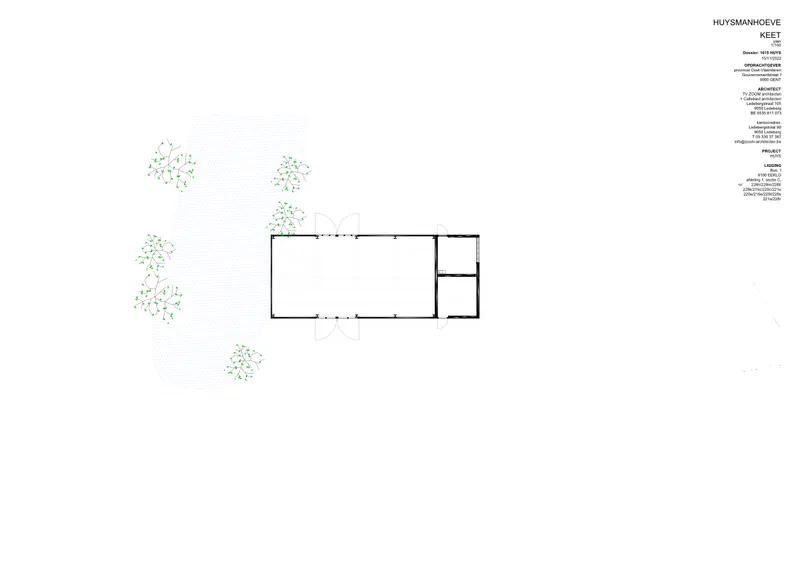

The floor plans confirm what the photographs suggest: the complex is not a single building but a constellation of volumes organized around outdoor circulation. The long rectangular plan of the cowshed, with its central courtyard and flanking interior spaces, illustrates the glass-wall strategy that allows classrooms to merge into a single hall. The site plan shows the four structures arranged along paths within a sandy clearing, the surrounding tree clusters functioning as a green perimeter that recalls the planted borders of the original moat farm. The section model is a rare piece of architectural communication, showing the relationship between timber trusses, brick walls, and the interior mezzanine with a clarity that photographs cannot achieve.
Why This Project Matters
The HUYS Center is a quiet argument against the false choice between preservation and innovation. ZOOM Architecten did not freeze the Huysmanhoeve site in amber, nor did they bulldoze it for a contemporary pavilion. They read the existing buildings closely enough to understand what each one could absorb: the transverse barn could take a cafeteria, the cowshed could take classrooms, and the gaps between them could take two new structures that extend the farmstead's logic without mimicking its forms. The sustainability strategy follows the same principle. Before deploying any building technology, they first asked what could be left unbuilt.
For architects working in rural and peri-urban contexts across Europe, where historic agricultural sites are being repurposed at an accelerating rate, this project offers a model that is replicable without being formulaic. The moat farm typology is specific to Flanders, but the approach, reading a site's spatial DNA and building only what the existing framework cannot provide, is universal. The perforated brickwork, the glass classroom walls, the wood-chip chimney tower: these are not signature moves but site-specific responses that happen to be beautifully resolved.
HUYS Center, designed by ZOOM Architecten, Eeklo, Belgium. 1,064 m². Completed 2022. Photography by Dieter Van Caneghem.
About the Studio
Share Your Own Work on uni.xyz
If projects like this are the kind of work you want to make, uni.xyz is a place to publish your own, find collaborators, and enter design competitions.


Popular Articles
Popular articles from the community


Cube Design Draws an Ecological Corridor Between Two Shenzhen Hills with the Nankai Building
Beside Shenzhen's container docks, the Nankai Building pairs stacked balconies with a climbing green screen to connect two hillsides across its height.


Singing Woman: An Opera House That Performs Before the Curtain Rises
Ovidiu Cristian Pavel's conceptual opera house translates Estonia's choral identity into a sculpted waterfront landmark facing the Baltic Sea.

David Ortega Stacks a Two-Story Mexico City Penthouse Around a Steel Stair and a Pergola-Shaded Roof Terrace
In Colonia Roma, a 300 m² penthouse uses oak joinery, a planted steel stair and a slatted roof pergola to make a new-build apartment feel like a house.

The Amber Palace Opera: A Geological Fiction Surfaces on Tallinn's Baltic Waterfront
Pierre Brillard reimagines a Baltic legend as a public landscape, opera house, and waterfront promenade rooted in Tallinn's coastal identity.

Similar Reads
You might also enjoy these articles

LAVA Architecten Gives Vocational Education a Sawtooth-Roofed Face on a Mechelen School Campus
In Mechelen, Belgium, a 2,053 m² STEM school on a 6×6 m grid turns workshops and classrooms into rooms that can be rearranged as teaching changes.

KEMA Studio Turns a Derelict Marvila Attic into a 60 m² Lighthouse Apartment Above Lisbon
In Lisbon's Marvila district, a rebuilt roof, four skylights and two plywood volumes turn an unlivable attic into a bright home facing the Tagus.

Pixel Gardens: One Repeated Module Stacked Into a Terraced Social Housing Tower for Famagusta
Salem Bader's shortlisted housing tower builds a vertical neighbourhood from one repeated module, offsetting units to carve terraces, light and air.

Bao Huynh Watercolor Atelier: A Serene Art Retreat in Hội An
Bao Huynh Watercolor Atelier in Hội An blends multifunctional art spaces, sustainable design, local materials, and family-friendly living in a serene environment.

Explore Student Center Competitions
Discover active competitions in this discipline

Challenge to reimagine the Iron Throne

Photograph architecture without architects

Illustrate the lost glory of Angkor Wat - Render Challenge

Design challenge to reuse E-waste
Comments (0)
Please login or sign up to add comments
No comments yet. Be the first to comment!