
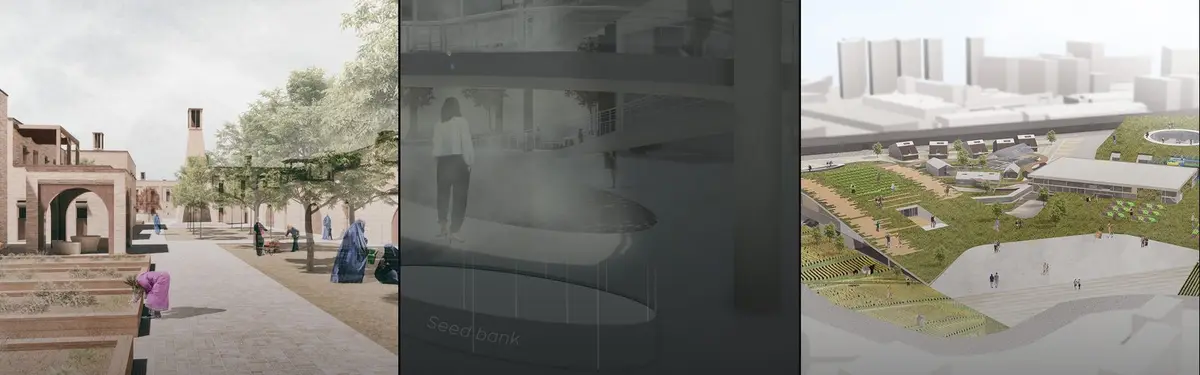


Community Garden
Shared green spaces designed to cultivate food, community connection, and environmental stewardship.
A community garden is a piece of land gardened by a group of people, either in individual plots or together as one shared garden, and managed by the gardeners themselves rather than by park staff. Its design questions are mostly social: who holds the land, who gets a plot, how decisions are made, and how a fenced patch of vegetables becomes a place that a whole neighbourhood uses.
What is a community garden?
The Wikipedia article on community gardening draws the basic distinction. In most community gardens the land is divided into individual plots, each tended by one gardener or family who keeps the harvest. In collective gardens the land is not divided, and the group works it together and shares the yield. Many gardens mix the two, with private beds around common paths, compost bays, tool sheds and seating.
Two things separate a community garden from a public park. It is run by the people who garden it, and its planting is usually productive rather than ornamental. Whether the gate is open to passers-by depends on the lease and the members' rules, so openness is a design and governance decision rather than a given.
The allotment is a close relative. In Britain and much of northern Europe, allotments are rented plots on land held by a council or an association, grouped into sites with shared rules. Community gardens in North America grew from different roots, often on vacant lots claimed by neighbours. The two traditions now borrow from each other.
The topic is also distinct from food production as a business, which the uni.xyz article on urban agriculture covers in depth. A community garden may grow a lot of food, but its measure of success is participation. For the wider design of shared outdoor rooms, see community spaces.
A short history of community gardening
The allotment came first. According to the Wikipedia article on allotments, the enclosure acts and the Commons Act 1876 sharply reduced the land that poor households could cultivate in England. Parliament answered with allotment legislation, first codified in the Small Holdings and Allotments Act 1908, which requires local authorities to provide an "adequate provision" of land. The Allotments Act 1922 limited a plot to forty square rods and tied it to fruit and vegetables for the plot-holder's household.
In Germany the movement took its name from Moritz Schreber, a Leipzig doctor. From 1864 a public initiative in Leipzig leased land so that children could play in a healthy, green setting, and these areas soon became gardens. Germany's first allotment law after the First World War gave gardeners security of tenure and fixed rents, and the Federal Allotment Gardens Act of 1983 replaced it. The same article counts about 1.4 million allotment gardens in Germany today.
North America saw what Wikipedia describes as three waves: workers' gardens during industrialisation, Liberty and Victory Gardens during the two world wars, and a grassroots movement in the 1970s. In New York, the Green Guerillas' own history records how Liz Christy, Amos Taylor and Martin Gallent threw "seed green-aids" over the fences of vacant lots and then took over a debris-filled lot at Bowery and Houston Streets, creating the Bowery Houston Farm and Garden.

"We were basically saying to the government, if you won’t do it, we will."
Amos Taylor, co-founder of the Green Guerillas, recalling the early 1970s
The gardens that followed were often on city-owned land, which made them vulnerable. Wikipedia notes that New York State reached a settlement in 2002 that protected hundreds of gardens in the city's GreenThumb program from development. The history of the community garden is, in large part, a history of land tenure.
Key principles of community garden design
Secure the land before drawing the beds
Wikipedia puts it bluntly: access to land and security of tenure remain a major challenge worldwide, because in most cases the gardeners do not own or control the land. A lease length, a land trust, a park designation or a planning protection shapes the design more than any planting plan. Short tenure argues for raised beds, movable sheds and soil that can travel.
Balance private plots and the commons
Individual plots give people ownership and a reason to return. Shared areas, such as paths, orchards, compost, seating and play space, give the garden a public life. The same Wikipedia article warns that purely communal models can suffer a tragedy of the commons, with uneven workloads and eventual neglect. Most successful gardens combine both, and the layout should make the boundary between them legible.

Write the rules as carefully as the plan
Governance is part of the design. The District of Columbia's Department of Parks and Recreation publishes community garden bylaws guidance that requires each garden to set out its governance structure, a maintenance plan and a way to replace its leaders. A garden manager keeps the waiting list, assigns open plots and reassigns those left derelict, and a public meeting is held each year before the growing season. Architects can support this with a notice board, a lockable store, a meeting table and a clear route from the waiting list to the gate.
Open the gate
Seattle's P-Patch Community Gardening Program describes its gardens as community managed open spaces that are open to the public and used for gatherings, learning and rest. A garden that only plot-holders can enter serves dozens; one with a public path, benches and a shaded table serves a street.
Program for people, not only plants
Gardens host workshops, school visits, shared meals and care. Member projects use the garden as a social program in its own right. The Gardeners' Shelter by Kamila Zboina and Marcin Kryska, a winning entry in the Reinstate competition, serves both local residents and homeless people, called gardeners, with community gardens at the entrance and workshops for guests and neighbours.

Habitation - Vegetation by Ava Emamifard, Taraneh Mireskandari and Alireza Bagheri, an Honorable Mention in the Co-Life competition, builds a senior housing scheme around food and skills so that older residents keep their independence and a social life.
"Food is a great unifier across every culture and is unique to every country."
Ava Emamifard, Taraneh Mireskandari and Alireza Bagheri, project statement for Habitation - Vegetation
Build the shared infrastructure well
Water points, compost, a greenhouse, tool storage, accessible raised beds and shade are the garden's real architecture. They are small, cheap and used every day, which makes them ideal projects for students and self-build.
Community gardens on uni.xyz
The member work in this topic ranges from built structures in real gardens to competition schemes that put a shared garden at the centre of housing, care and public space.
The journal on the Plant Nursery in Belo Horizonte documents a wooden structure built in 2024 by PFLEX at the UFMG School of Architecture, under Professor Hugo Alkmim de Matos, with students, technicians and residents of the Fazendinha settlement. The community garden there had become a hub for cooperation during the pandemic in 2020, and the nursery gives it a place to raise, care for and store seedlings.

In Brooklyn, the Ellipse Greenhouse by SAW.EARTH sits in the Scholes Street Community Garden. Students from the New York Institute of Technology built the 144 square foot, tiered cedar structure with copper flashing in four weeks in 2025, its shape following the sun path of the garden. It is the sixth permanent installation by the SAW.EARTH program.

Urban Oasis by Evgenii Varlygin and Anastasiya Soshnikova, covered in a uni.xyz journal, takes Berlin's culture of urban gardening and makes it the organising idea for densifying a former barracks site in Spandau, with greenhouses and garden communities built into the blocks rather than left between them.
Several competition entries treat the garden as social glue. Green Grow Garden by Hani Mansurnejad, Leils Senobari and mahin azadpeyma, entered in the Huddle competition, designs cubes as community gardens where people grow produce, get to know each other and sell what they grow, which in turn motivates them to maintain and organise the gardens.
The Qala Community by Karl Huby and Sundas Rohilla, a winning entry in the Resile competition, draws on Afghan traditions of living and crafting to give the widows of Zanabad a place to live, work, learn and raise children within a system of mutual support.

Other entries work at the scale of the street or the house. Urban exchange food by ahmed, Sarra BELCAID and fatma kobbi, entered in the Urban Meal Mine competition, rethinks the fence between houses as a mechanism for neighbours to exchange fresh produce. Organic Shelves by Lochana Bolisetty, Mantri Sai Laasya, Shivani Riddhi and Bala Reshmant, which received the Sprout from Sprawl competition's People's Choice Award, is presented simply as farming for the community.
Challenges and future directions
Land remains the central problem. Wikipedia notes that community gardens compete with the interests of developers, and that zoning can lag behind practice: in Detroit, hundreds of gardens grew on abandoned land, and the city created agricultural zones in 2013 to legitimise more than 355 of them. Gardens on vacant land often do the work of proving a site's value and then lose it.
"The more dense our urban environments become, the more valuable open and natural settings become."
Rogerio Carvalheiro, Neil Maass and Matthew Cavender, project statement for Bend It, a winning entry in the Salut Paris competition
Governance is the second challenge. Plots with long waiting lists can harden into private holdings, communal areas can be neglected, and a closed gate can make a public asset feel exclusive. Clear bylaws, regular public meetings and an open path through the site are the usual answers.

The future points toward gardens written into planning from the start: in new housing, on school and hospital grounds, on rooftops, and in parks where a share of the land is set aside for growing. Representative bodies such as Britain's National Allotment Society work with government, landlords and developers to provide and preserve sites, and that advocacy is as much a part of the field as horticulture.
Community gardens for students and designers
The best student projects in this field are small and real. A seed nursery, a greenhouse, a tool shed or a shaded meeting table can be designed and built in a semester, as the Belo Horizonte and Brooklyn journals show. Larger thesis questions include how to secure tenure through design, how to plan a garden that a care home, school or shelter can share with its neighbours, and how to make a garden reversible. The journal on gaSSz arquitectos' circulating garden in Vicálvaro, Madrid shows a garden of bolted steel, rubble gabions, composting stations and a picnic circle called the Assembly Ring, designed to be taken apart.

Find open briefs on uni.xyz competitions, and explore the related topics community-driven architecture and landscape design.
Frequently asked questions
What is the difference between a community garden and an allotment?
An allotment is a rented plot on a site provided by a council or association, a system codified in Britain by the Allotments Acts and in Germany by the Federal Allotment Gardens Act. A community garden is a broader term for any garden run by a group, which may be divided into plots or worked collectively, and often includes shared public space.
Who owns a community garden?
Usually not the gardeners. Most gardens sit on land owned by a city, a parks department, a school, a church or a private owner, and the group holds it through a lease or agreement. That is why tenure is the first design question.
How is a community garden run?
Typically by a volunteer group with written bylaws, a garden manager or committee, a waiting list for plots, rules on maintenance and an annual meeting. Washington DC's parks department, for example, requires each garden group to submit bylaws covering governance, maintenance and leadership succession.
What makes a good community garden design?
A clear mix of individual plots and shared areas, reliable water, compost and tool storage, accessible beds, shade and seating, and a route that lets the public pass through. The social program and the rules matter as much as the planting plan.
References and further reading
- Community gardening, Wikipedia
- Allotment (gardening), Wikipedia
- Our History, Green Guerillas
- DPR Community Garden Bylaws Guidance, District of Columbia Department of Parks and Recreation
- P-Patch Community Gardening, Seattle Department of Neighborhoods
- The National Allotment Society, National Society of Allotment and Leisure Gardeners


Popular projects
View all 57 projects


Latest journals
View all 55 journals

gaSSz arquitectos Builds a Demountable Circular-Economy Garden from Rubble and Tires in Madrid's Vicálvaro
In Vicálvaro, Madrid, a 2,400 m² garden of bolted yellow steel, rubble gabions and tire-rubber paving treats public space as a reversible material bank.
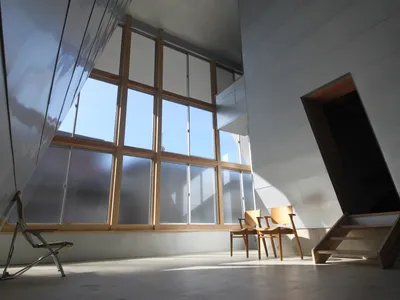
D Environmental Design System Laboratory Sinks an Ancient Pit Dwelling into a Passive House in Japan
In a quiet residential district of Iwata, a sunken garden replaces fire as the thermal heart of a cedar-framed home.
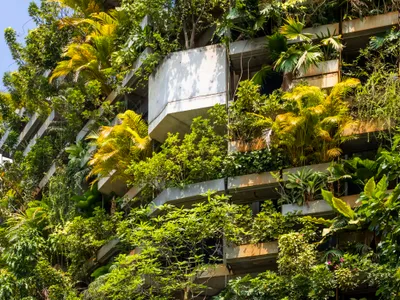
VTN Architects Wraps Their Own Ho Chi Minh City Studio in a Vertical Tropical Forest
A six-story office in Vietnam's Thu Duc district uses modular planters and passive cooling to achieve a 190 percent green ratio.

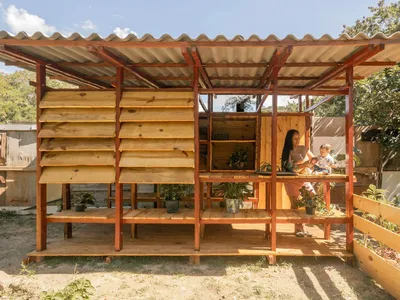
Plant Nursery in Belo Horizonte: A Collaborative Community Architecture Project
The Plant Nursery in Belo Horizonte fosters community collaboration, sustainable urban gardening, and educational architecture using functional wooden structures and participatory design.


