
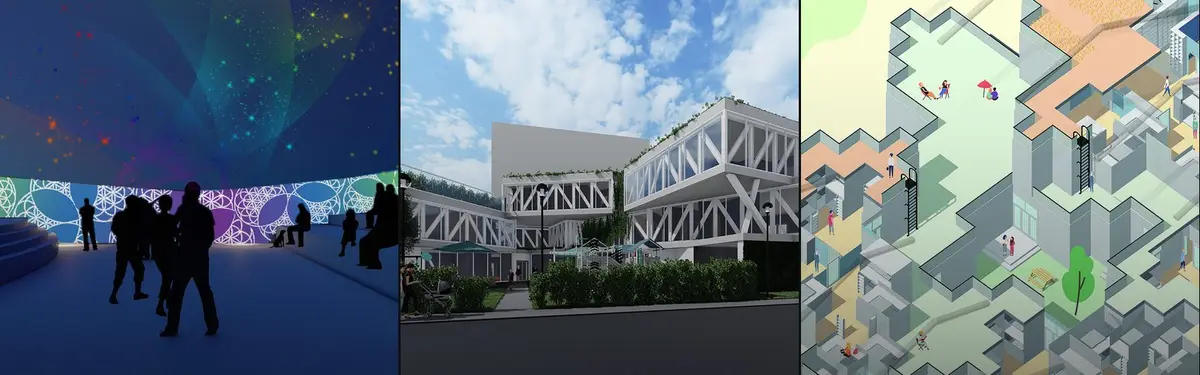


Pattern Design
Systematic arrangement of repeated elements in design and architecture, from textiles to spatial organization.
A pattern is a motif or element repeated in a regular or predictable arrangement across a surface, an object or a space. Pattern design is the discipline of choosing that motif, setting the rules by which it repeats and judging how the result reads from near and far. It runs from wallpaper and textiles to brick bonds, screens and the facades of whole buildings.
What is pattern in design?
In design the word pattern is more exact than in everyday speech. A pattern has a unit (the motif), a rule of repetition (the repeat) and a field it covers. Change any of the three and the pattern changes, even if the motif stays the same.
The question people most often ask is whether pattern is an element of art. Strictly, it usually is not. The elements are the raw ingredients of a picture, and pattern is one of the ways those ingredients are organised. The education materials of the J. Paul Getty Museum, for example, list the elements of art as line, shape, form, space, colour and texture, with value described as one of colour's characteristics; many other courses count value separately, which gives the familiar list of seven. The same museum places pattern among the principles of design, next to balance, emphasis, movement, repetition, proportion, rhythm, variety and unity, and defines it as the repeating of an object or symbol all over a work. Some school curricula do list pattern as an element, but the principle reading is the more common one.
Pattern design overlaps with textile design, where printed and woven repeats are the core of the craft, and with geometric abstraction, where repeated shapes become the subject of a painting rather than its decoration.
Elements of a pattern
Whatever the medium, the same handful of decisions makes up every pattern:
- Motif. The repeated unit: a flower, a star, a hexagon, a letter, a brick. A motif can carry meaning as well as shape. The MAYA project by Eda Buse Usta, Sumeyye Gungor and Tuğçe Sevinç builds on the lotus flower and uses spiralling lines to stand for a wavering path towards balance.
- Repeat. The rule that copies the motif: shifting it, rotating it, mirroring it or a mix of these.
- Interval and spacing. The gap between motifs, which sets the density and the rhythm of the whole.
- Grid or structure. The underlying framework of squares, diamonds, triangles or hexagons on which the motifs sit, visible or hidden.
- Colour and value. Contrast decides which parts read as figure and which as ground, and whether the pattern looks busy or calm.
- Scale. The size of the motif relative to the surface and to the viewer. A pattern that reads as texture across a street can read as individual objects at arm's length.
Types of pattern
Regular patterns repeat the same unit at the same interval; irregular or random patterns vary the unit, the spacing or both, as bark, pebbles and terrazzo do. A second split is between geometric patterns built from straight lines, polygons and circles, and organic or natural patterns built from leaves, flowers and flowing curves.
Flat repeating patterns can also be classified by their symmetry. Mathematicians have shown that every pattern repeating in two directions on a plane belongs to one of exactly 17 wallpaper groups, a result first proved by Evgraf Fedorov in 1891. A related idea is tessellation, the covering of a surface with tiles that leave no gaps and no overlaps.

Surface designers use a more practical vocabulary for how a printed tile joins its neighbours. A block or straight repeat stacks the tile in a plain grid. A half-drop repeat shifts each column down by half a tile, which hides the grid and suits trailing florals. A brick repeat makes the same half shift sideways, row by row, like courses of masonry. A mirror repeat flips the tile so that edges meet their own reflection, which is the easiest way to make a join invisible.
A short history of pattern design
Repeated ornament is as old as weaving and pottery, but pattern design as a discipline with written rules took shape in nineteenth-century Britain, as industry multiplied patterned goods and reformers argued over how they should be designed. The architect Owen Jones answered with The Grammar of Ornament, first published in 1856: colour plates reproducing hundreds of historic ornaments, prefaced by thirty-seven numbered propositions on form and colour. According to a study of the book by Nicholas Frankel, Moorish decoration seen at the Alhambra in Granada was Jones's lifelong passion and grounded much of his theory.
"In surface decoration, all lines should flow out of a parent stem. Every ornament, however distant, should be traced to its branch and root."
William Morris turned principle into product. His first wallpaper design, Trellis, was drawn in 1862 from the rose trellises in the garden of Red House, with birds added by the architect Philip Webb. The Victoria and Albert Museum records it as block printed in distemper colours by Jeffrey and Co., registered and produced in 1864. In his 1881 lecture Some Hints on Pattern-Designing, Morris described the two main constructions behind continuous patterns, the branch on a diagonal line and the net framed on diamonds, and advised designers to hide the construction just enough that people stop counting the repeats.

In the twentieth century M. C. Escher made tessellations of irregular interlocking tiles, inspired by the Moorish use of symmetry he saw at the Alhambra in 1936, as the history of tessellation records. In 1977 Christopher Alexander, Sara Ishikawa and Murray Silverstein published A Pattern Language, which uses the word in a different sense. Its 253 patterns are not ornaments but recurring design problems paired with proven solutions, at every scale from entire regions down to doorknobs.
Pattern in architecture
Buildings carry pattern at every scale. Brick bonds such as English and Flemish bond are patterns that come straight out of construction: the alternation of long stretchers and short headers ties a wall together and draws a texture across it at the same time. The jali, the perforated stone screen of Indian and Indo-Islamic architecture, uses a geometric or floral pattern to filter light and air while keeping privacy, and the idea survives in the brick jaali walls built today.

The glazed tile dados of the Alhambra show the geometric tradition at its most intricate, and the Arts and Crafts interiors that hung Morris papers show the floral one. Today scripting tools let designers vary a motif cell by cell across a whole envelope, so that openings widen where more daylight is needed or panels rotate to follow the sun. This is where pattern design meets parametric design and contemporary facade design.
Key principles of pattern design
Structure before ornament
Every successful repeat sits on a grid, even when the eye cannot find it. Decide the grid first (square, diamond, triangular or hexagonal), then draw the motif to fit it. The journal on Kalo-Escape describes a pavilion built from a parametric hexagonal grid, where the cell is the structure, the cladding and the pattern at once.

Rhythm and interval
Spacing sets the tempo. Tight intervals read as texture; wide ones let each motif register on its own. Alternating two intervals, as a Flemish bond alternates headers and stretchers, adds a beat without adding a new shape.
Variation within rules
A pattern that never varies tires the eye, and one that varies without rules stops being a pattern. TETRIS CITY by Tanya Prevezentseva and team shows the balance: five module variants made of fifteen containers in the shapes of Tetris figures, which can be placed on the land in different ways, so a strict kit produces a varied plan.
Hide the seam
Morris's advice still holds: mask the construction enough that the viewer stops counting repeats. Half-drop and mirror repeats, motifs that cross the tile edge and an even spread of weight across the ground all help.
"Ornamental pattern-work, to be raised above the contempt of reasonable men, must possess three qualities: beauty, imagination, and order."
Design for every viewing distance
Test a pattern at the scale of the whole surface and at the scale of a hand. Contrast and value decide the far view; motif detail decides the near one.
Pattern design on uni.xyz
Members of uni.xyz use pattern in murals, pavilions, towers and sculpture. These are among the clearest examples on the topic.
PIXEL WALL by Saranya Harikumar was a winning entry in the Canva competition. The designer sums the work up in three ideas, sacred geometry, dynamism and social interaction. The project is also filed under mosaic, algorithmic art and interactive art, which places it between geometric pattern and public participation: a wall people are meant to gather around, not only look at.

Samanvitaha by Priyank Ajudiya, another entry to the Canva competition, is a geometric wall mural made for the community space of a housing project in Vijayawada. It shows pattern doing social work: a geometric mural gives a shared space in a housing project a recognisable identity.

The journal on the Lagos Wooden Tower looks at Hermann Kamte's proposal for a residential high-rise in Ikoyi built from laminated veneer lumber and wrapped in patterned screens instead of a sealed curtain wall. A timber lattice cut in a star pattern runs along the terrace edges with planting behind each opening, so the pattern filters breeze and light much as a jali does. The journal notes that the project won the inaugural WAFX Prize in the Cultural Identity category.

Kalo-Escape, by Rania Mohamed, Alina Sebastian and Saagarika Dias, was a shortlisted entry in the Elevate 2019 competition. Its name joins the Greek root kalos, beauty, with the idea of escape, and its journal explains how dichroic and reflective film panels on the hexagonal frame shift colour as visitors move and as clouds pass, while semi-private seats and charging points invite people to stay.
The MoonRatio journal covers a dome by Mariacristina Sipala and Giorgia Maria Frassetto, shortlisted in the Moontrip 2019 competition. Its spiralling form is derived from the golden ratio and from growth patterns that galaxies and living cells share, and the spiral footprint follows the bend of the river beside it: natural pattern used as a planning rule.
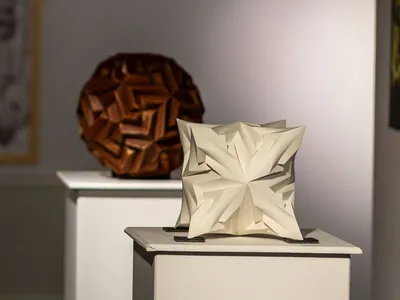
At the scale of an object, the Polyhedra Sculpture journal follows Lars Renklint, who subdivided the faces of a cube and later a dodecahedron in Beegraphy's cloud-based parametric editor, then turned the results into plaster casts, 3D prints and a faceted wooden sphere. The work won Best in Category at the Beegraphy Design Awards, and Renklint published his plugin so others could generate their own forms.
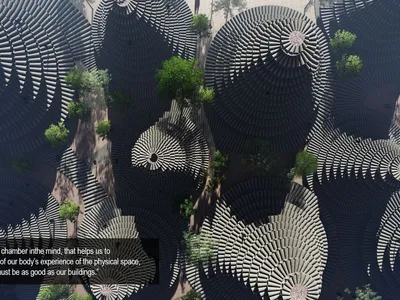
Other entries carry pattern into the city. 2030 Buzz Haus by Felix Leung and Hoi Ching Cheng, an Editor's Choice entry in the NomadHouse 2020 competition, develops its tower through a sequence of hexagonal diagram panels and a beehive metaphor. The Reconstruction Memory Hive by Abdo Shahadeh and Ghaith Tish, beside the Aleppo Citadel, groups conical cells built from war debris into one hive-like landscape. Visitors climb each cell along a spiral walkway, so a single repeated unit, multiplied, becomes a public monument.
Challenges and future directions
The oldest risk is clutter. Pattern applied to every surface stops guiding the eye and starts competing with the building, which is why Jones argued that ornament should grow from construction rather than be stuck onto it. A second challenge is fabrication: a pattern that is cheap on screen can be costly in stone, timber or glazed tile, and every unique panel in a parametric facade is a separate part to make, number and install. Perforated screens must also balance shade, glare, views and airflow, and a pattern tuned for one orientation may fail on another.
Computational tools now make it possible to vary density and opening size where daylight or ventilation demands it, so pattern can carry environmental work as well as identity. Digital fabrication brings custom tiles, cast panels and cut screens within reach of small studios, while craft traditions such as jali carving and brick bonding offer tested motifs to reinterpret rather than copy.
Pattern design for students and designers
Pattern makes a strong thesis subject because it links drawing, making and performance. Promising angles include a contemporary screen drawn from a local craft, a facade whose openings respond to sun angles, a public mural that gives a housing block an identity, or a study of how one motif behaves at the scale of a tile, a wall and a street.

Start with hand drawings of repeats before scripting them, test the motif at full size, and build a physical sample early. To test ideas against a brief, browse open design competitions on uni.xyz, and read further in computational design for scripted patterns.
Frequently asked questions
Is pattern an element of art?
Usually it is taught as a principle of design rather than an element. The elements are commonly listed as line, shape, form, space, colour, value and texture, and pattern describes how those elements are repeated and organised. Some curricula list pattern among the elements, so you will see both answers.
What is pattern design in art?
Pattern design in art is the planned repetition of a motif across a surface or a series of works. The artist chooses the motif, the grid it sits on, the spacing and the colours, and decides how strictly it repeats. The result can be decorative, structural or the subject of the work itself.
What are the elements of a pattern?
The main elements are the motif, the repeat that copies it, the interval or spacing between copies, the underlying grid, colour and value contrast, and scale. Changing any one of them produces a different pattern from the same motif.
How is pattern used in architecture?
Architects use pattern in brick bonds, tiled surfaces, perforated screens such as the jali and in parametric facades. A good architectural pattern often does a job as well, filtering light, shading a wall or expressing how the building is made.
References and further reading
- Elements of Art and Principles of Design, J. Paul Getty Museum Education
- The Ecstasy of Decoration: The Grammar of Ornament as Embodied Experience, Nicholas Frankel, Nineteenth-Century Art Worldwide
- Trellis wallpaper, William Morris, Victoria and Albert Museum
- Some Hints on Pattern-Designing, William Morris Internet Archive
- Wallpaper group and Tessellation, Wikipedia
- A Pattern Language, Wikipedia


Open competitions in Pattern Design
See all Pattern Design competitions

Popular projects
View all 97 projects





Latest journals
View all 10 journals

2030 Buzz Haus: A Triangular Tower Grown from Three Axes for Singapore's Digital Nomads
Living, working and future axes meet on a Singapore site, rising into a modular tower and landscape where nomads move between studios, cabins and pools.

Lagos Wooden Tower: A Porous LVL Skyscraper That Rethinks How Africa Builds Tall
Hermann Kamte's WAFX-winning timber tower for Ikoyi stacks LVL grids, lattice screens and planted terraces into a breathable vertical neighbourhood.

Reconstruction Memory Hive: Turning Aleppo's Rubble into a Landscape of Collective Healing
A cluster of conical concrete structures built from war debris rises beside the Aleppo Citadel, weaving memory and renewal into urban space.
Polyhedra Sculpture: Algorithmic Geometry Cast in Plaster and Wood
Lars Renklint turns parametric subdivision logic into tactile sculptures, bridging cloud-based computation with physical casting and 3D printing.


