

Lagos Wooden Tower: A Porous LVL Skyscraper That Rethinks How Africa Builds Tall
Hermann Kamte's WAFX-winning timber tower for Ikoyi stacks LVL grids, lattice screens and planted terraces into a breathable vertical neighbourhood.


Most towers rising across Africa's fast-growing cities follow a familiar formula of a concrete frame, a sealed glass skin and air conditioning to make the interior bearable. The Lagos Wooden Tower rejects all three. It proposes a residential high-rise built from a skeleton of Laminated Veneer Lumber, wrapped in patterned screens rather than curtain wall, and opened up with deep terraces so the tropical breeze can pass through. The central idea is simple and difficult at once: a skyscraper in a megacity can be made of wood and can breathe.
Designed by Hermann Kamte, the project is described as the first wooden skyscraper proposed in Africa. It won the inaugural WAFX Prize in the Cultural Identity category and was presented among the forward-looking concepts at the World Architecture Festival 2017. The site is Ikoyi, one of the most prominent and affluent districts of Lagos. Lagos is Africa's most populous city, with more than 20 million inhabitants, and it is growing upward as buildable land runs out. Kamte frames tall timber as a local answer to that pressure rather than an imported sustainability trend.
A Facade That Filters Instead of Seals
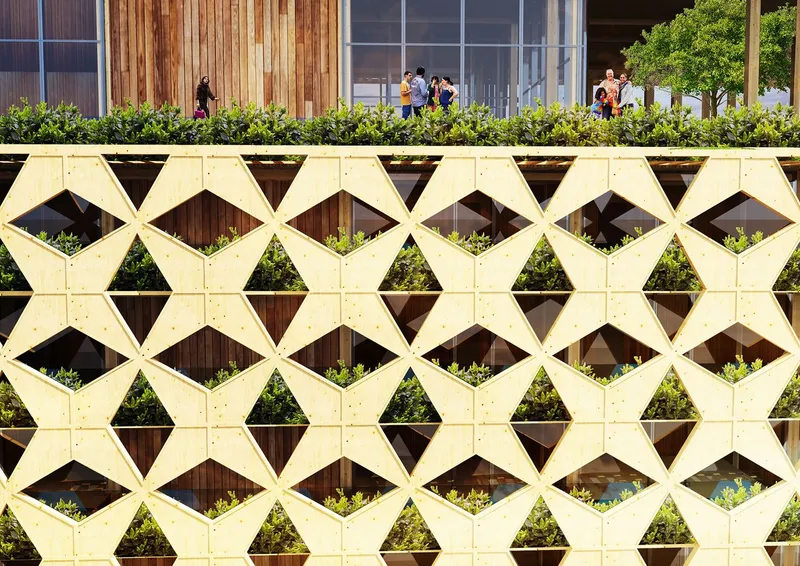
The first image shows the tower's main gesture at the scale of a person. A timber lattice cut in a star pattern runs along the terrace edge, and planted shrubs sit behind each opening, so the screen is layered with greenery rather than backed by glass. Visitors stand on the level above, which reads the facade as a set of occupied depths and not a flat surface. Here the brief's commitment to porosity becomes physical. The screen shades the interior and limits solar gain, it lets air move freely, and the planting acts as a climatic buffer between the apartments and the city.
This matters because the screen does environmental work that a sealed tower would hand to machinery. The designer lists cross-ventilation, shaded facades and deep recesses as the main passive strategies. The star lattice turns those strategies into ornament, and that ornament is where the project's claim to cultural identity is most visible.
Shared Rooms Stitched Into the Vertical Grid
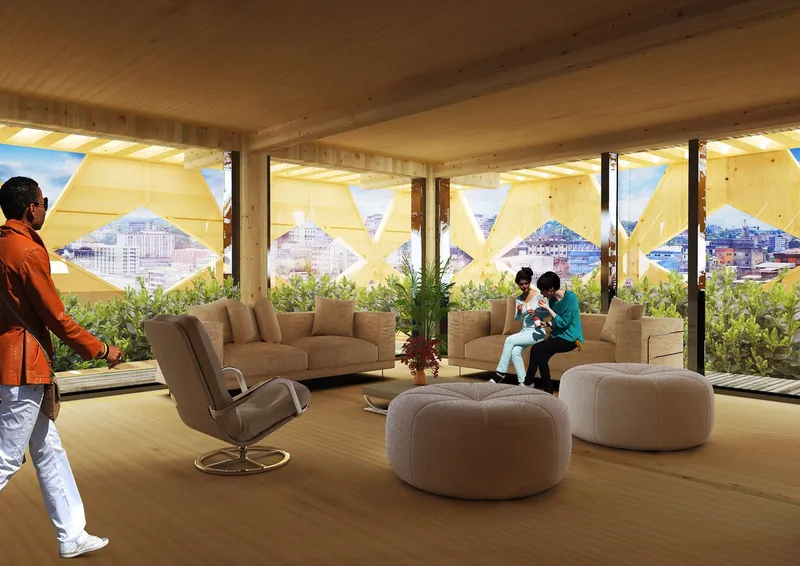
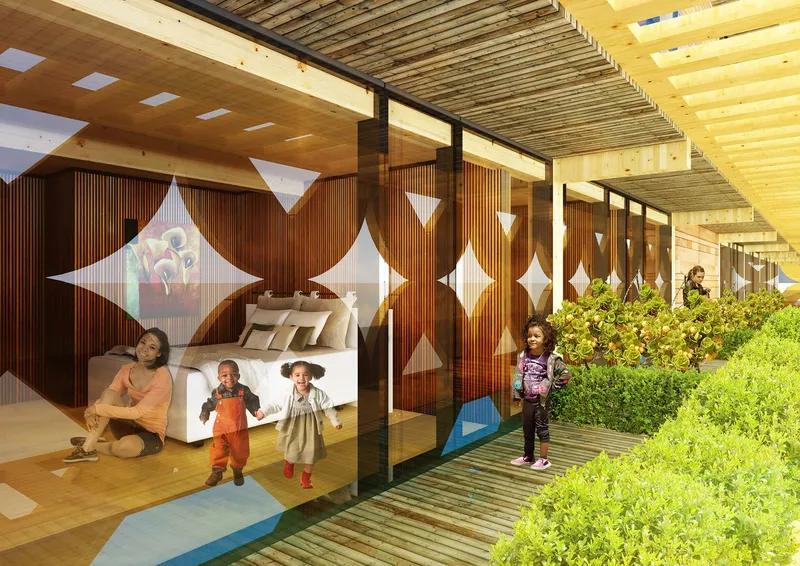
The structure is a repetitive grid of LVL beams and columns joined with steel connectors. The material was chosen for its high strength-to-weight ratio, its dimensional stability and its lower carbon footprint compared with concrete and steel. The interior views show what that grid allows. In the lounge, sofas and round ottomans sit inside a frame of lattice screens and clipped hedges, a semi-open communal room that sits somewhere between corridor and garden. The walkway image shows timber slats lining a path beside a glazed bedroom, with children playing alongside the hedges in full daylight.
These scenes support the project's most persuasive argument, that the tower should work as a vertical neighbourhood rather than a stack of private boxes. One, two, three and four-bedroom apartments share the grid with amenities spread through the building's height, and the modular structure keeps the layouts flexible. The steel connections also make precise assembly and future disassembly possible, which suggests a building that can be adapted instead of demolished. The walkway is the clearest test: putting a private bedroom beside a busy shared path is a deliberate social bet, and the hedges and slats are what make that closeness workable.
Stacked Volumes, Shifting Patterns
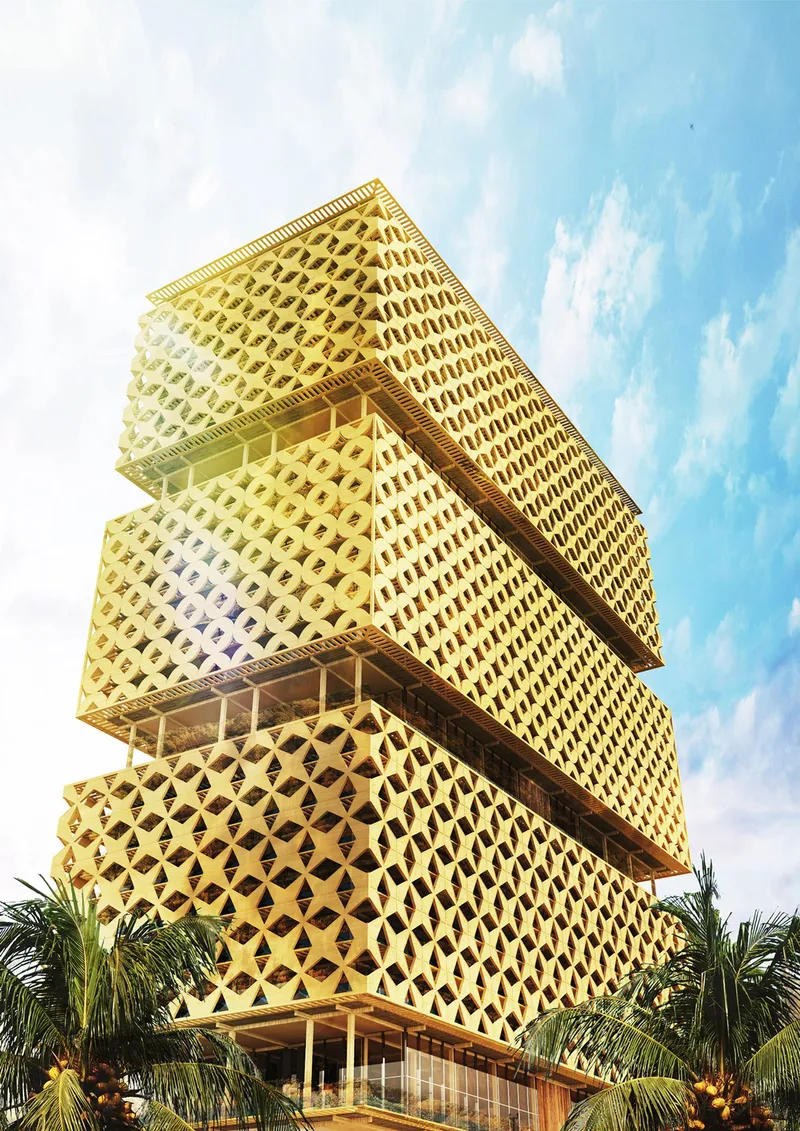
Viewed from below, the tower breaks into three stacked volumes, each clad in its own lattice pattern and framed by palm fronds against the sky. Changing the pattern from volume to volume gives the building a legible rhythm over its height and avoids the monotony of a repeated floor plate, even though the LVL grid behind it stays consistent. The upper levels hold gardens, restaurants and soft landscaped terraces looking out over Lagos Island, the lagoon, Victoria Island, Lekki and the Atlantic Ocean.
The lightness of the timber frame also cuts the load on the foundations, an advantage in a coastal city. Because wood stores carbon, the tower aims to be more than a low-carbon building and to act as a potential carbon store. Seen from the street, all of this comes across as something the eye can read: a tall building made of distinct, patterned, planted parts.
Why This Project Matters
Mass timber debates have mostly been held in Europe, North America and Japan, in temperate climates with established supply chains. The Lagos Wooden Tower moves that debate to a tropical African megacity and asks a sharper question: what if the material that cuts carbon also allows a building to give up mechanical cooling? Combining an LVL frame with a porous, planted envelope ties the structural argument and the climatic argument together, and that link is the project's real contribution.
The proposal also refuses the idea that sustainable architecture in Africa has to look like a copied green tower. Its patterned screens, shared lounges and garden walkways stake a claim for identity and community at high-rise scale, which explains why the WAFX jury recognised it for Cultural Identity. Questions remain about timber sourcing, fire strategy and maintenance in a humid climate, and any built version would have to answer them. As a provocation, though, it sets a clear benchmark for how Lagos and cities like it might build tall.
View the Full Project
About the Designers
Designer: Hermann Kamte
Enter a Design Competition on uni.xyz
uni.xyz runs architecture and design competitions year-round that reward proposals with spatial conviction and real site intelligence.
Project credits: Lagos Wooden Tower by Hermann Kamte.


Popular Articles
Popular articles from the community


David Ortega Stacks a Two-Story Mexico City Penthouse Around a Steel Stair and a Pergola-Shaded Roof Terrace
In Colonia Roma, a 300 m² penthouse uses oak joinery, a planted steel stair and a slatted roof pergola to make a new-build apartment feel like a house.

Cube Design Draws an Ecological Corridor Between Two Shenzhen Hills with the Nankai Building
Beside Shenzhen's container docks, the Nankai Building pairs stacked balconies with a climbing green screen to connect two hillsides across its height.


Opera on the Sea: Driftwood Logic Shapes a Timber Opera House on Estonia's Coast
Trevor Orgill's opera house translates the entangled drift of floating timber into a civic building where wood, water, and music converge.

Singing Woman: An Opera House That Performs Before the Curtain Rises
Ovidiu Cristian Pavel's conceptual opera house translates Estonia's choral identity into a sculpted waterfront landmark facing the Baltic Sea.

Similar Reads
You might also enjoy these articles

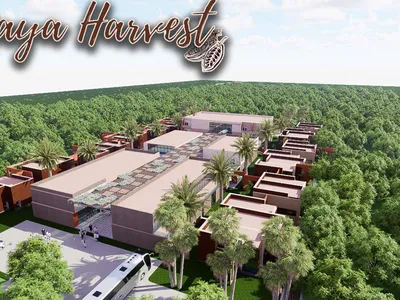
Maya Harvest: A Cacao Resort Village Rooted in Mayan Tradition and Local Craft
Situated within a Tabasco cacao plantation, this shortlisted resort proposal merges vernacular materials with hands-on cultural immersion.
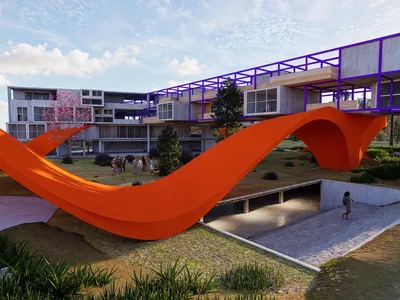
Harmonia: A River-Shaped Community That Grows Over Decades in Boa Vista
Curved pathways and modular grid structures along the Branco River create a phased settlement designed to evolve from 2030 to 2050.

The Architecture of Bathing: A Mughal Hammam Reimagined Across the Yamuna
Charlotte May's honorable mention entry for The Black Taj reinterprets Agra's bathing rituals through red sandstone, water, and framed views of the Taj Mah
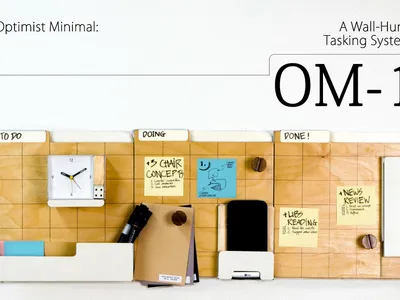
Om-1: A Wall-Hung System That Moves Your Workspace Off the Desk
Modular plywood boards, magnetic pegs, and utility elements migrate clutter from the horizontal surface to the vertical plane.

Explore African Architecture Competitions
Discover active competitions in this discipline

Deconstructivism - Illustration Design Challenge

Design challenge to reuse E-waste
Comments (0)
Please login or sign up to add comments
No comments yet. Be the first to comment!