

Kalo-Escape: A Dichroic Hexagonal Pavilion That Fights Digital Fatigue
A parametric modular installation uses kaleidoscopic light play and semi-private seating to reclaim public space from screen addiction.


What if a public pavilion could compete with the glow of a smartphone? Kalo-Escape takes the kaleidoscope, that simple tube of fractured color, and scales it into an inhabitable urban structure. Built from a parametric hexagonal grid clad in dichroic and reflective film panels, the installation shifts hue with every step and every passing cloud, producing the kind of sensory reward that no screen can replicate. The name itself fuses the Greek root kalos (beauty) with the promise of escape, and the design delivers on both counts: it is a place to sit, charge a phone, watch light scatter across a metal framework, and, perhaps most critically, look up from a device long enough to notice another person.
Kalo-Escape is a shortlisted entry in Elevate 2019, designed by Rania Mohamed, Alina Sebastian, and Saagarika Dias. The project addresses a familiar paradox of contemporary urbanism: cities are denser than ever, yet social isolation persists because public infrastructure rarely encourages lingering or genuine interaction. By combining semi-private seating zones, integrated charging stations, and a dazzling envelope of color-shifting panels, the designers propose a pavilion type that adapts to city corners, parks, and plazas alike.
Touching the Kaleidoscope: Dichroic Surfaces at Body Scale
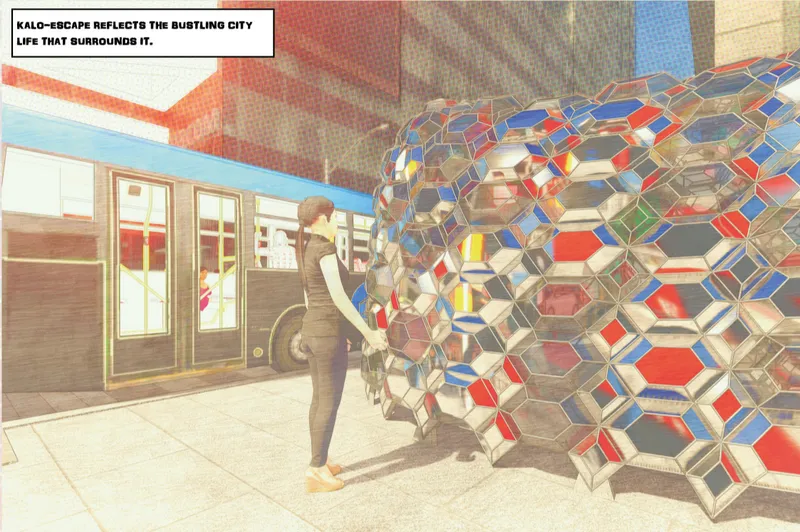
The opening render captures the pavilion's essential proposition: a person reaching out to touch an iridescent surface that shifts from gold to violet in full sunlight. The hexagonal panels are dual-sided, with reflective film on the exterior and dichroic material on the interior. This layering means the pavilion reads differently from every angle and at every hour. In daylight, passersby see their surroundings fractured and multiplied across the reflective exterior. Step inside, and the dichroic interior bathes the space in spectral color. The effect is not merely decorative; it produces a clear threshold between the pace of the street and the slower, more contemplative atmosphere within.
Staying, Not Just Passing: Charging Stations and Social Seating

Four views of the pavilion in use reveal how the designers thought beyond spectacle. People gather beneath the canopy, occupy modular seating, and plug into an integrated charging station. That last detail is strategic: offering a charge gives visitors a reason to stay, and staying is the precondition for the kind of casual social interaction that most urban furniture fails to generate. The enveloping form creates semi-private zones without closing off sightlines, so users feel sheltered but not isolated. Children, adults, and commuters occupy the space simultaneously, which suggests the form is legible and inviting across age groups.
A Kit of Parts: Metal Frame, Hex Grid, and Layered Skins

The exploded axonometric strips the pavilion down to its construction logic. A metal framework provides the primary structure, shaped into a fluid, organic silhouette. Onto this armature, the hexagonal panel modules are mounted in a parametric array. Each module is a sandwich: reflective film outboard, dichroic film inboard, both fixed to a lightweight panel substrate. The diagram makes a quiet but important argument about feasibility. Because the system is modular, it can be flat-packed, transported, and assembled on site without specialized labor. It can also be reconfigured: a linear arrangement for a narrow city sidewalk, a circular formation wrapping a park play zone, or a freestanding cluster in a plaza.
This adaptability is not cosmetic. The designers explicitly propose three deployment scenarios. In city corners, the pavilion acts as a porous landmark that bounces light off adjacent buildings while allowing pedestrian flow to pass through. In parks, the circular configuration prioritizes child safety and integrates with greenery. In plazas, the structure provides visual relief and social pause in high-traffic environments. The hexagonal grid is the constant; the overall form responds to context.
Porous Enough for a Cyclist, Vivid Enough to Stop a Commuter

The final set of street-level views places the installation in a dense urban plaza where pedestrians and cyclists share the ground plane. What stands out is the pavilion's porosity. It does not block movement or create a dead zone; people weave through and around it as naturally as they navigate street furniture. Yet the color-shifting panels are arresting enough to slow the pace, drawing the eye and, potentially, the body into the seating zones. The interplay of natural and artificial light across the dichroic surfaces also contributes to wayfinding and safety after dark, turning the pavilion into a glowing landmark rather than an obstacle.
Why This Project Matters
Kalo-Escape confronts a problem that most urban pavilion proposals acknowledge but few solve: how to make people want to occupy a public structure long enough for it to function as social infrastructure. The answer here is not programmatic complexity or high-tech interaction but material seduction paired with practical amenity. Dichroic panels create a sensory environment that rewards presence, while charging stations and modular seating provide the functional excuse to stay. The hexagonal kit-of-parts system keeps the proposal grounded in buildability, avoiding the trap of parametric spectacle that cannot survive contact with a budget or a construction schedule.
For Mohamed, Sebastian, and Dias, the project demonstrates a sharp instinct for calibrating ambition against feasibility. The strongest move is the decision to tie visual spectacle directly to construction logic: the same hexagonal module that creates the kaleidoscopic effect is also the unit that makes the system modular, transportable, and adaptable. That alignment of aesthetic and structural thinking is what separates a compelling competition entry from a rendering exercise, and it positions Kalo-Escape as a credible model for interactive public space design in cities hungry for reasons to look up.
View the Full Project
About the Designers
Designers: Rania Mohamed, Alina Sebastian, Saagarika Dias
Enter a Design Competition on uni.xyz
uni.xyz runs architecture and design competitions year-round that reward proposals with spatial conviction and real site intelligence.
Project credits: Kalo-Escape by Rania Mohamed, Alina Sebastian, Saagarika Dias Elevate 2019 (uni.xyz).


Popular Articles
Popular articles from the community


David Macias Steps a Doorless Stone and Plaster House Down a Tropical Colombian Hillside
In the humid hills of Colombia, Threshold House replaces the front door with an open void and terraces its 850 m² down the slope instead of fighting it.

Cube Design Draws an Ecological Corridor Between Two Shenzhen Hills with the Nankai Building
Beside Shenzhen's container docks, the Nankai Building pairs stacked balconies with a climbing green screen to connect two hillsides across its height.

LT2A and OPEN Architectes Thread a Brick and Glass High School Through a Wooded Belgian Campus
In Braine-l'Alleud, a 3,000 m² wing for Collège Cardinal Mercier pairs pale brick with a glazed colonnade, deferring to a small chapel and a dense wood.

U.GA Architects Wraps an Oval Rooftop Pool in Curved Board-Formed Concrete on Busan's Jeollidan-gil
In Busan's Jeonpo-dong, a 454 m² mixed-use block stacks a neighborhood facility, guest rooms and an oval rooftop pool inside spiraling concrete walls.

Similar Reads
You might also enjoy these articles


Aquadapt: An Underwater Habitat That Rewrites Its Rooms by the Hour
Curved modules ring the seabed while one shell shifts from breakfast room to cinema, farm and football pitch as residents' needs change.

Play: Fragments of Their World: Remembered Architecture Rebuilt as a Modular Playground for Refugee Camps
Tom Gardner abstracts domes, arches and towers from the homelands of displaced families into a kit of child-scaled play parts for camp settlements.
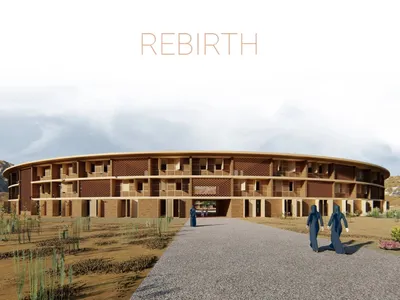
REBIRTH: A Circular Settlement Where Afghan Widows and Their Children Rebuild Life Together
A shortlisted Resile entry turns the circle into a protective ring of timber and brick, gathering homes, classrooms and gardens around a shared landscape.
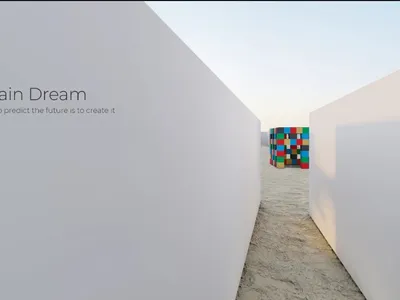
The Main Dream: A Recycled Plastic Kit That Lets Refugee Children Build Their Own Playground
Thirty-centimetre interlocking cubes that connect on three axes turn play into construction, letting children author the spaces they occupy.

Explore Urban Design Competitions
Discover active competitions in this discipline

Deconstructivism - Illustration Design Challenge

Design challenge to equip cities with modern furniture
Comments (0)
Please login or sign up to add comments
No comments yet. Be the first to comment!