

MoonRatio: A Spiraling Dome Where Children Learn to Reach for the Moon
A shortlisted Moontrip 2019 entry plants a golden-ratio dome on a riverbank, turning lunar exploration into tactile education for kids.


What if you could compress the geometry of a galaxy and the curiosity of a child into a single building? MoonRatio answers that question with a spiraling dome sited on a riverbank, its form derived from the golden ratio and the growth patterns shared by galaxies and living cells alike. The structure operates simultaneously as a science museum, an interactive playground, and a speculative laboratory for young minds. Every surface, ramp, and suspended volume inside is calibrated to provoke wonder and physical engagement, turning lunar exploration from distant abstraction into something a child can climb, touch, and inhabit.
Designed by Mariacristina Sipala and Giorgia Maria Frassetto, MoonRatio was shortlisted in the Moontrip 2019 competition. The brief called for architecture that bridges space exploration and earthbound experience, and this entry responds by embedding cosmic geometry into a civic site nestled within the urban fabric of a city, right at the bend of a river. The result is a building that belongs to its landscape while pointing unmistakably skyward.
A Spiral Footprint Locked into the River Bend
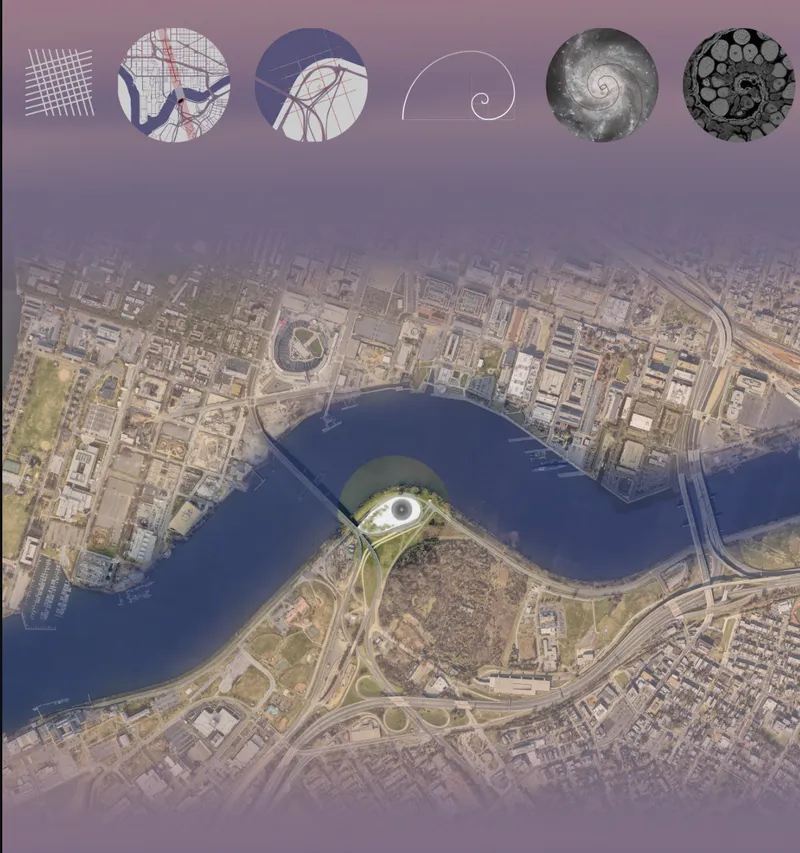

The aerial site plan reveals how MoonRatio's spiral footprint mirrors the curvature of the river it sits beside. Rather than imposing a rigid geometry on the landscape, the building wraps itself into the terrain, its form reading as an organic extension of the waterway's bend. On the adjacent island peninsula, a circular solar panel array fans outward, supplying energy to the complex while reinforcing the project's language of radial, nature-derived geometries. The siting is deliberate: by positioning the dome where urban fabric meets natural waterscape, the designers create a threshold between the known city and the speculative world inside.
A Helical Tower That Teaches Through Ascent
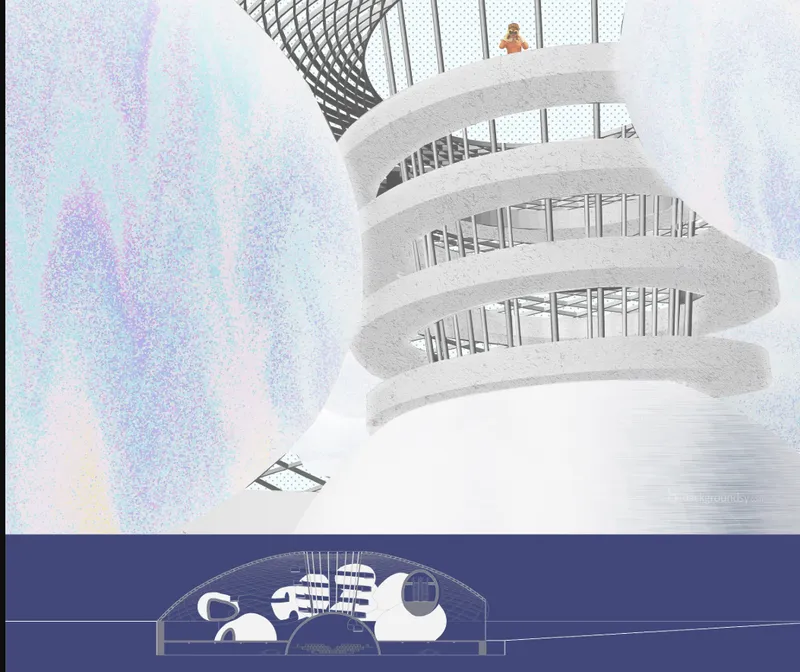
The section drawing and perspective rendering expose the project's vertical logic: a helical ramp tower rises through multiple levels, threading visitors upward in a continuous spiral. The golden ratio, referenced in the building's conceptual framework, governs the proportional relationships between platforms, voids, and the enclosing skin. Each level along the ramp introduces a different educational environment, so the act of ascending becomes an act of learning. Children move from ground-level exhibits through increasingly elevated micro-worlds, their view of the interior expanding with every revolution.
Structurally, the ramp does double duty. It circulates visitors and organizes the programme vertically, eliminating the corridor-and-room typology that makes conventional museums static. Here, movement is the architecture. The transparent, domed skin allows natural light to filter in, softening the interior and reinforcing the dreamlike quality the designers were after.
Suspended Spheres and Crater Amphitheaters Inside the Dome

The interior collage rendering captures the sensory density of MoonRatio's gallery spaces. Suspended spheres hang at varying heights, evoking planetary forms, while iridescent surface elements shimmer across walls and floors. In one section, a model spacecraft floats above a crater-like amphitheater where stories of the first moon landing unfold. Playful ramps and soft, organic volumes invite tactile engagement. The space is not designed to be observed passively; it demands climbing, reaching, and inhabiting. Figures in the rendering are dwarfed by the volumes around them, a proportional strategy that amplifies the sense of entering something vast and unfamiliar.
Looking Up Through the Spiral Toward the Sky
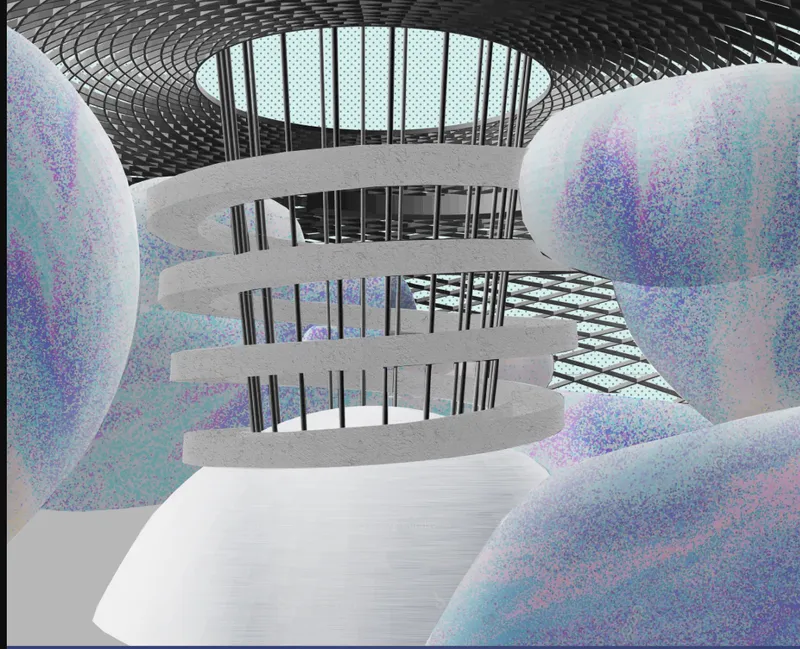
The most revealing image in the set is the interior view looking straight up through the spiraling ramps toward a latticed skylight at the tower's apex. The geometry tightens as it rises, pulling the eye toward a bright oculus of diffused light. It is the building's thesis compressed into a single vantage point: ascent as aspiration, structure as pedagogy, light as destination. The lattice filters daylight into a soft, even glow that eliminates harsh shadows, reinforcing the otherworldly atmosphere the designers cultivated throughout. For a child standing at the base of this void, the effect must be something close to looking up from inside a telescope.
Why This Project Matters
MoonRatio proposes that architecture for children does not need to be miniaturized or condescending. By grounding its form in the same mathematical principles that govern spiral galaxies and cellular growth, the project treats its youngest users as capable of encountering complexity. The building does not explain the cosmos through signage; it lets children experience cosmic geometry through their own bodies as they climb, spiral, and look up.
Sipala and Frassetto have produced a prototype for a different kind of educational space: one where the architecture itself is the primary exhibit. In a moment when experiential learning is often reduced to screen-based interactivity, MoonRatio argues for spatial immersion as the more potent pedagogical tool. It is a building that asks children to reach for the moon, then gives them the ramps to do it.
View the Full Project
About the Designers
Designers: Mariacristina Sipala, Giorgia Maria Frassetto
Enter a Design Competition on uni.xyz
uni.xyz runs architecture and design competitions year-round that reward proposals with spatial conviction and real site intelligence.
Project credits: MoonRatio by Mariacristina Sipala, Giorgia Maria Frassetto Moontrip 2019 (uni.xyz).


Popular Articles
Popular articles from the community


Extended Shell: Retrofitting Kolkata's Balconies as Living Urban Thresholds
A modular retrofit system recovers the social and environmental intelligence of Kolkata's historic verandas for contemporary Park Street residents.

The Amber Palace Opera: A Geological Fiction Surfaces on Tallinn's Baltic Waterfront
Pierre Brillard reimagines a Baltic legend as a public landscape, opera house, and waterfront promenade rooted in Tallinn's coastal identity.

Opera on the Sea: Driftwood Logic Shapes a Timber Opera House on Estonia's Coast
Trevor Orgill's opera house translates the entangled drift of floating timber into a civic building where wood, water, and music converge.
Opera by the Sea Estonia: Three Shells Dissolving Architecture into Tallinn's Coastline
A winning opera house proposal replaces monumental form with interconnected shells that blur the boundary between building, park and Baltic Sea.

Similar Reads
You might also enjoy these articles
The Amber Palace Opera: A Geological Fiction Surfaces on Tallinn's Baltic Waterfront
Pierre Brillard reimagines a Baltic legend as a public landscape, opera house, and waterfront promenade rooted in Tallinn's coastal identity.
Dynamic Modules Shelter: A Telescopic Ring for Mountain Pilgrimage
A circular modular framework of steel, bamboo, and fabric grows vertically with demand, wrapping communal ground in adaptable shelter.

Singing Woman: Contemporary Architecture Inspired by Estonia’s Voice and the Sea
Singing Woman turns Estonia’s song culture into flowing opera house architecture, blending public life, landscape, sea, and national memory.
HYPERBLOCK: Flexible Urban Design for Barcelona’s Future City
HYPERBLOCK reimagines Barcelona as flexible urban design, layering density, daylight, public space and adaptable housing above Cerdà’s grid.

Explore Moondial Competitions
Discover active competitions in this discipline

Deconstructivism - Illustration Design Challenge

Challenge to reimagine the Iron Throne

Photograph architecture without architects

Illustrate the lost glory of Angkor Wat - Render Challenge
Comments (0)
Please login or sign up to add comments
No comments yet. Be the first to comment!