

K-Thengono Design Studio Weaves Sundanese Craft into a Wedding Compound in the Bogor Hills
Kencana Valley Compound pairs glulam arches, bamboo bridges, and seven species of Indonesian wood with views of Mount Pangrango.


Wedding venues tend to flatten culture into decoration: a carved panel here, a batik runner there. Kencana Valley Compound, an 880 square meter complex in the hills of Megamendung near Bogor, Indonesia, takes the opposite approach. K-Thengono Design Studio designed a chapel, a family villa, a bridal villa, a service building, and a connecting bamboo bridge that treat Sundanese building traditions not as ornament but as the structural and spatial logic of the entire project. The curved rooflines that define West Javanese architecture here become glulam arches; the woven basket patterns of local craft become a pedestrian bridge; handcrafted timber joints on a 3.5 by 3.5 meter grid become the primary expression of interior space.
What makes the compound genuinely interesting is the material literacy at work. At least seven distinct Indonesian wood species appear across the project: aliwowos for structural beams, jabon for glulam arches, meranti for cladding and ceilings, ulin shingles for roofing, nyatoh for wall and floor panels, teak for carved cabinetry, and bamboo for the bridge arches. Each material is chosen for its performance characteristics and sourced locally, so the architecture reads as a catalogue of regional timber knowledge rather than a single aesthetic gesture. Positioned to frame Mount Pangrango and overlook surrounding rice paddies, the compound makes a strong case that vernacular intelligence and contemporary ambition are not competing agendas.
The Chapel: Glulam Arches Framing a Volcano

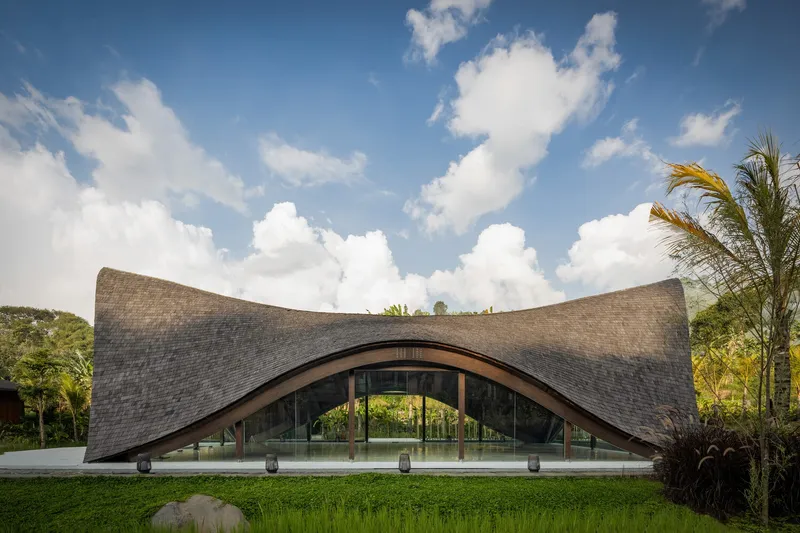

The chapel is the compound's most public gesture, and its most structurally ambitious. A sweeping shingle roof clad in ulin sirap rises in a dramatic curve that echoes the traditional Sundanese roofline but achieves its span through laminated jabon wood arches. The glazed base beneath the roof dissolves the boundary between ceremony and landscape. From the interior, the peaked window frames Mount Pangrango with an almost cinematic precision, turning the volcanic peak into a living altar backdrop.
The roof is designed to admit natural light from all sides, so the chapel avoids the cave-like quality that heavy timber structures sometimes produce. Instead, the arched ceiling glows with the warm tones of meranti cladding while daylight washes down the curved surfaces. It is a building that performs its function, sheltering a moment of ceremony, without ever losing sight of the landscape that gives that moment its emotional weight.
Interior Light and Laminated Timber
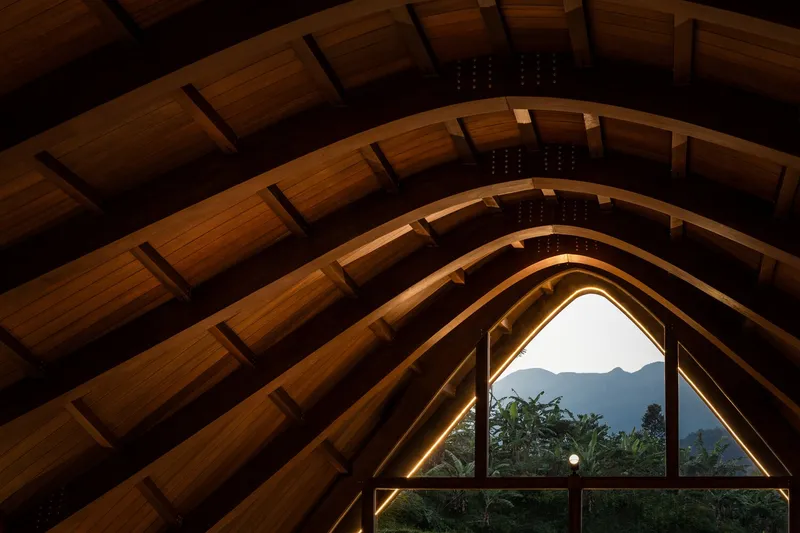

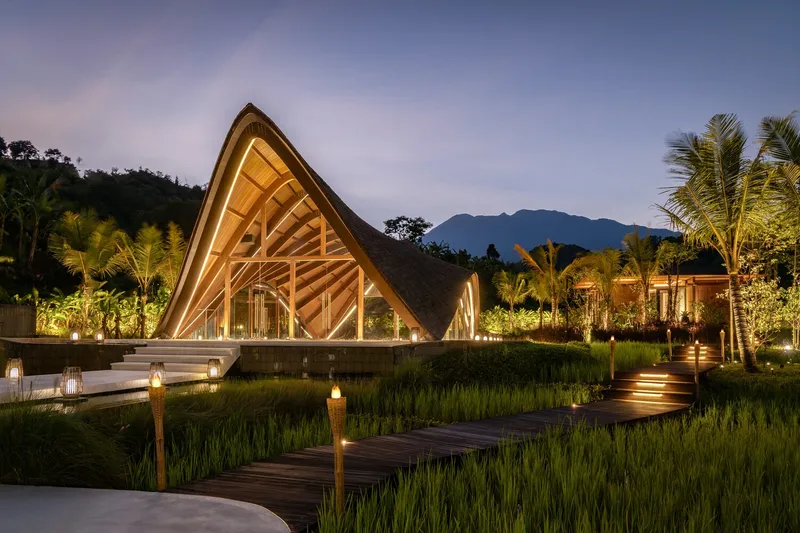
Seen from inside, the chapel's arches reveal their construction logic clearly. The laminated timber members converge at the peak, where they frame a triangular opening oriented toward the mountain. The warmth of the wood ceiling overhead contrasts with the cool transparency of the glass walls below, creating a spatial experience that oscillates between enclosure and openness. At twilight, the peaked pavilion reflects across water features that flank the approach walkway, doubling the structure's silhouette and extending its presence into the landscape.
The reflecting pool is not merely decorative. It anchors the arrival sequence, forcing visitors to walk alongside water before entering the chapel, a threshold moment that slows the pace and shifts attention from the practical to the ceremonial. The concrete walkway flanked by palms and water channels borrows from both Islamic garden traditions and the Sundanese attention to processional landscape.
The Family Villa: Craft as Structure
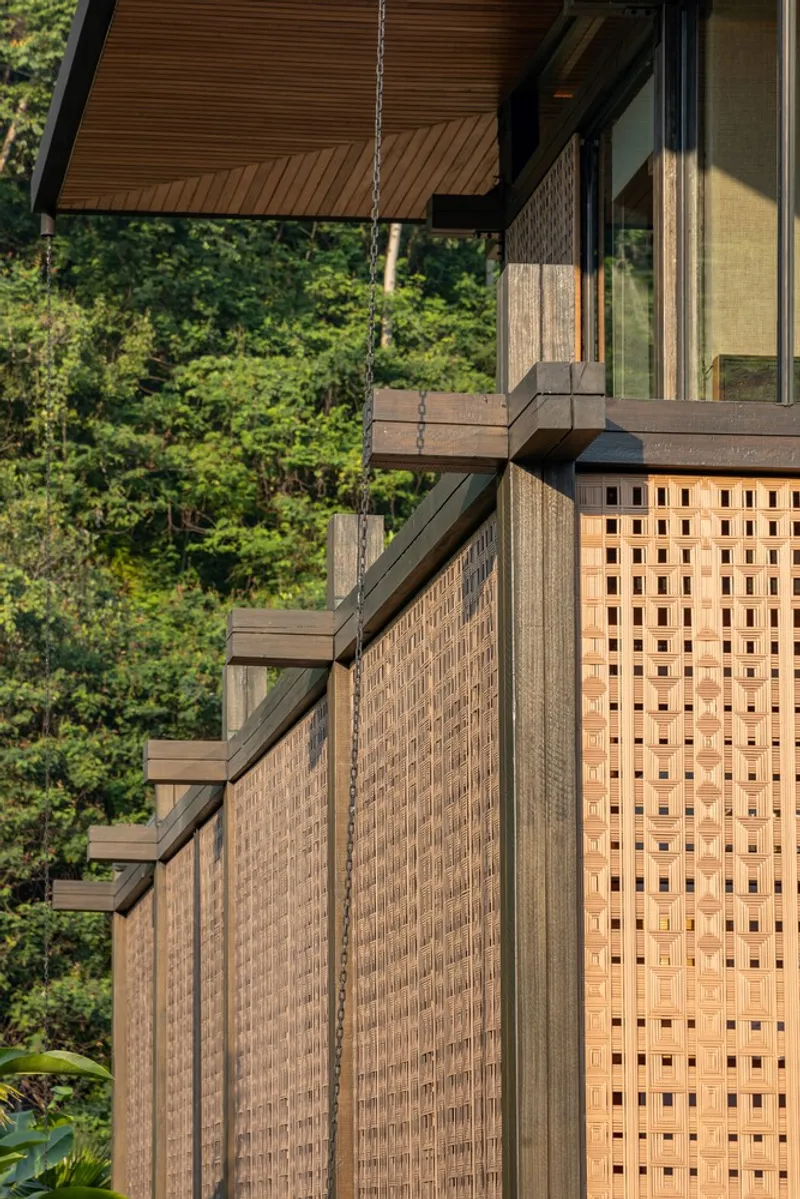


The three-bedroom family villa sits elevated above the hilly terrain, a move that preserves the topography and improves natural ventilation. Its structural system is the most legible expression of craft in the compound: aliwowos wood beams connect through handcrafted joints on a strict 3.5 by 3.5 meter grid. These joints are not hidden behind finishes. They are the architecture. Every connection point is a small demonstration of woodworking knowledge that predates the project by centuries.
Woven rattan panels serve as privacy screens for the bedrooms, filtering light and air while referencing traditional Indonesian weaving techniques. At dusk, the entrance pavilion glows behind its latticework screens, the low roof hovering among grasses and young trees like a piece of furniture set into the hillside rather than a building imposed upon it. The effect is domestic in the best sense: scaled to the body, warm in material, and open to the weather.
Living Spaces Between Glass and Wood

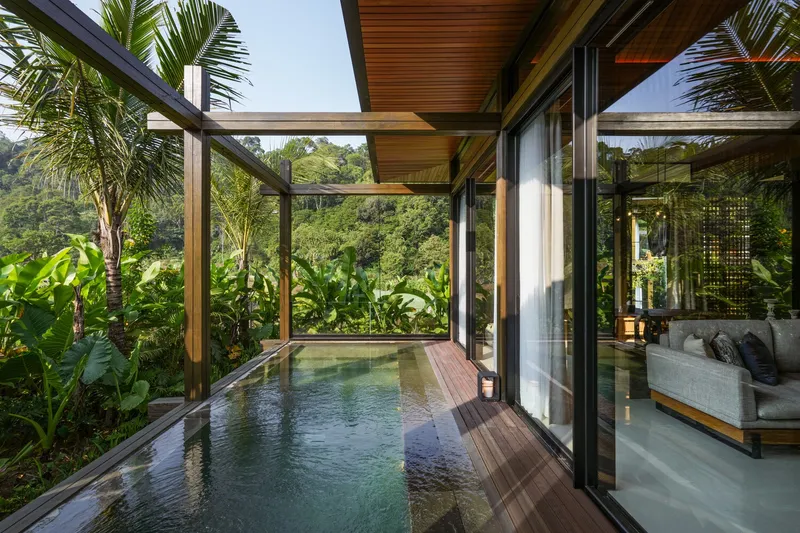

Entering the family villa, a glass-walled living area opens directly onto terraced gardens and the valley beyond. The slatted wood ceiling overhead carries the rhythm of the structural grid into the domestic interior, while floor-to-ceiling glazing makes the tropical landscape an active participant in the room. The covered terrace extends the living space toward an infinity-edge pool lined with natural Sukabumi stone, its green-tinted water echoing the surrounding vegetation.
An interior lap pool, framed by exposed structural beams and a timber deck, occupies a double-height volume that captures the compound's essential character: the pleasure of being inside a wooden frame while remaining visually immersed in the outdoors. At dusk, the warm glow of the wood ceilings and the cool blue of the water create a chromatic tension that feels calibrated rather than accidental.
Rooms That Reward Close Looking

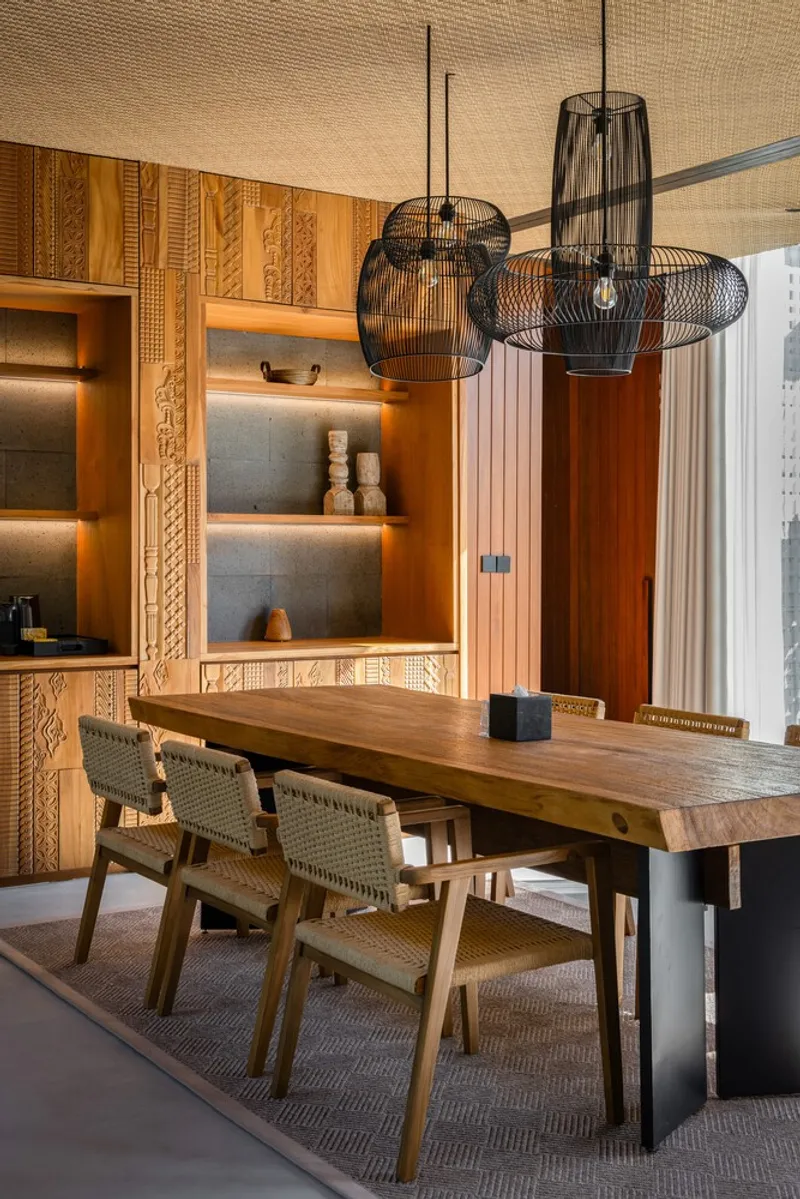
The interior detailing repays sustained attention. In the bedrooms, perforated timber screen walls cast dappled sunlight across the bed, producing a light pattern that shifts throughout the day. A woven ceiling overhead adds a second layer of texture. In the dining area, carved wood millwork panels line the walls behind a timber table, their geometric patterns drawn from Sundanese motifs but executed with a precision that reads as contemporary.
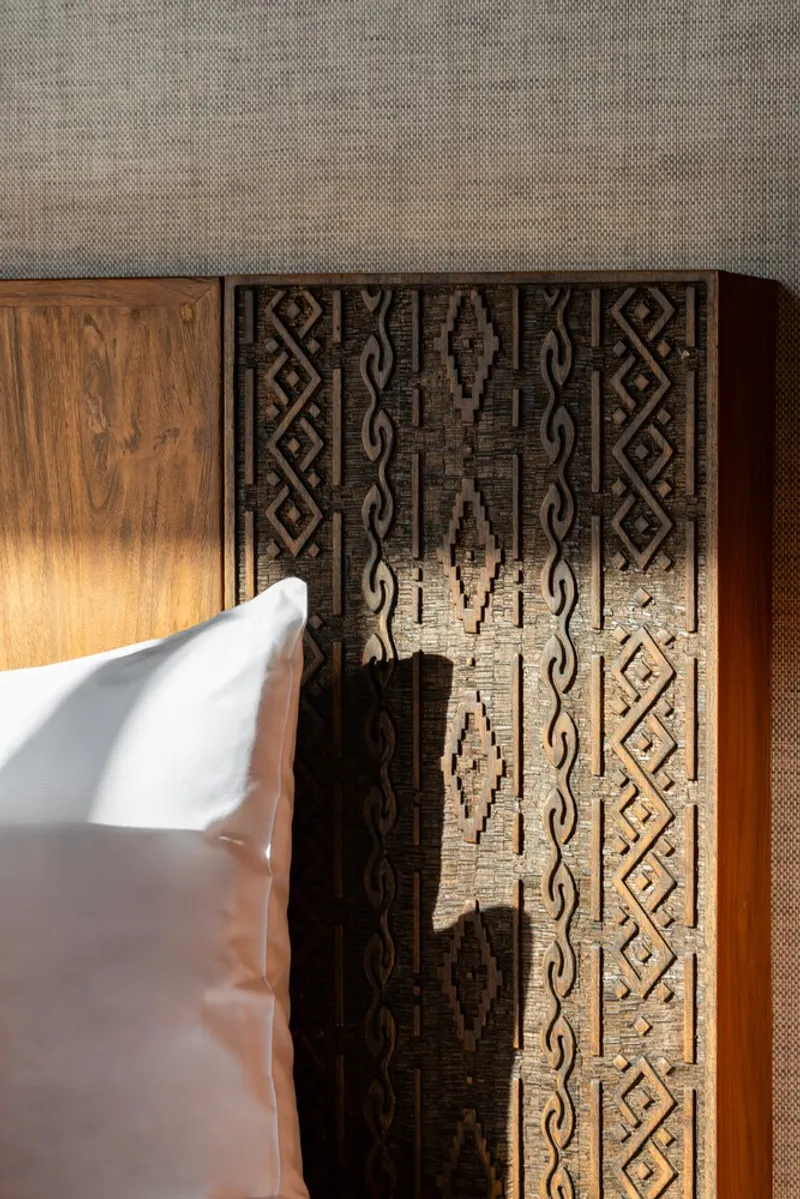
A close-up of a timber headboard reveals the carved geometric patterning that appears on the custom teak cabinets throughout the villa. These are not stock elements. Each piece is designed for its specific location, which gives the interiors a coherence that prefabricated fit-outs rarely achieve. The material palette of nyatoh panels, andesite stone accents, and brass bathroom fixtures creates a tonal range that stays warm without becoming monotonous.
Private Retreats and Bathing Rituals


The bathrooms are conceived as rooms of their own rather than service appendages. A stone soaking tub sits beside a full-height window that frames nothing but forest canopy, turning a daily ritual into a moment of contemplation. Elsewhere, a copper bathtub occupies a position beside floor-to-ceiling glass overlooking banana plants and distant mountains. These are spaces where the boundary between interior and exterior is thinnest, and where the compound's siting on the hillside pays its richest dividends.
A double-height reading nook with vertical timber paneling and a patterned textile hanging above a daybed suggests that the bridal villa, the compound's more intimate structure, operates at a quieter register than the family villa. Positioned to overlook rice fields, it prioritizes seclusion without sacrificing the visual connection to the landscape that defines every building in the complex.
Plans and Drawings

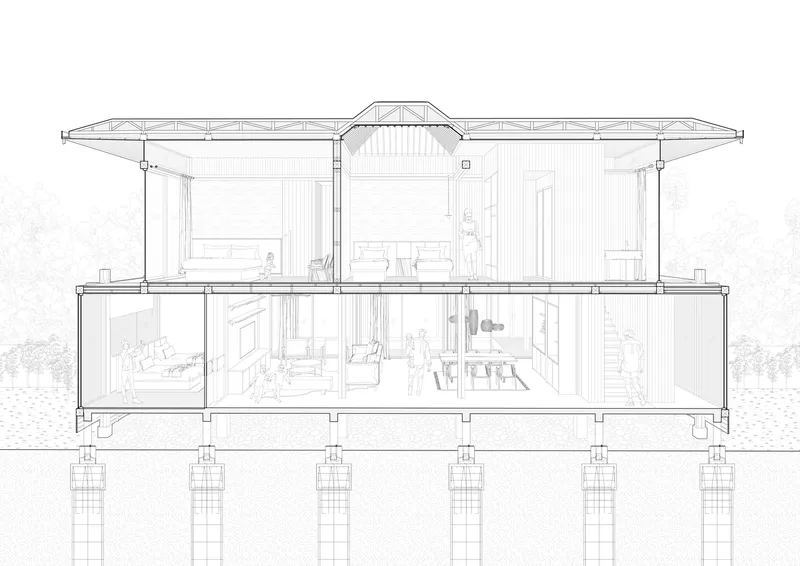
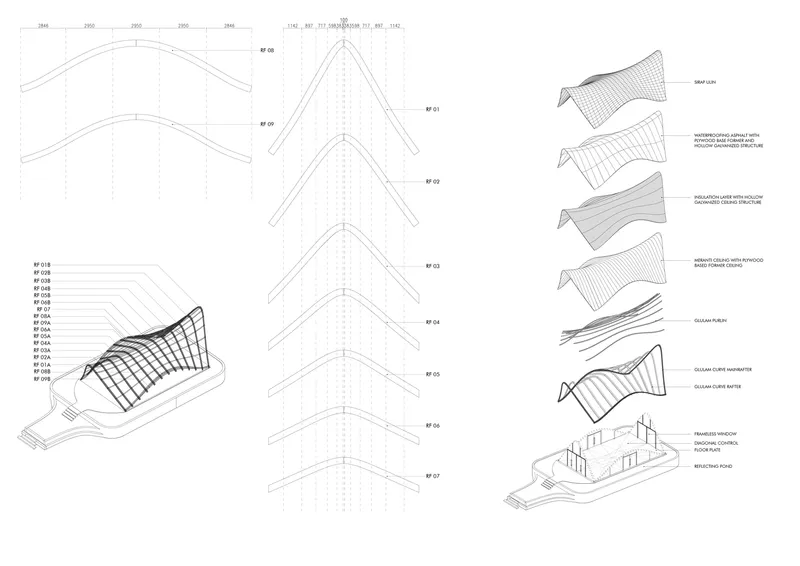
The conceptual diagram traces the design's genealogy from traditional Sundanese building forms to the compound's curved roof structures, making the cultural logic explicit rather than leaving it to interpretation. The section drawing reveals the two-level organization of the family villa, with the elevated floor suspended above the terrain on structural piers and the exposed roof truss framework visible as a continuous spatial volume. Human figures in the drawing confirm the intimate scale: these are not monumental spaces but carefully proportioned rooms within a timber skeleton.

The exploded axonometric is the most revealing drawing in the set. It breaks the family villa into its assembly sequence, from curved roof to foundation piers, and annotates each layer with dimensional notation. The 3.5 meter grid is clearly legible, as is the logic of the handcrafted joints. A detail photograph of an actual beam-to-column junction, shown alongside exploded joinery diagrams, closes the gap between drawing and built reality. This is a project that was clearly designed through its construction details, not despite them.
Why This Project Matters
The easy narrative for a project like Kencana Valley Compound would be one of nostalgia: architects return to tradition, use local wood, save the culture. The reality is more complicated and more interesting. K-Thengono Design Studio is not preserving Sundanese architecture in amber. They are testing whether its spatial principles, curved rooflines, elevated floors, woven screens, processional landscapes, can generate new buildings that perform in a contemporary program like a wedding venue. The answer, based on the evidence here, is convincingly yes.
The compound also offers a quiet rebuke to the assumption that material diversity equals visual chaos. Seven species of wood, bamboo, rattan, andesite, Sukabumi stone, brass, copper, and glass all coexist within a tightly controlled tonal range. The discipline is not minimalist restraint but material intelligence: knowing what each substance does, where it comes from, and how it ages. In a region where both generic resort architecture and heavy-handed traditionalism are common, Kencana Valley Compound charts a third path that deserves attention well beyond Bogor.
Kencana Valley Compound by K-Thengono Design Studio. Kecamatan Megamendung, Bogor, Indonesia. 880 m². Photography by Indra Wiras.
About the Studio
Share Your Own Work on uni.xyz
If projects like this are the kind of work you want to make, uni.xyz is a place to publish your own, find collaborators, and enter design competitions.


Popular Articles
Popular articles from the community

Manzana Morphosis: Stretching Barcelona's Grid into a Living Landscape for 2050
A radical reworking of the Eixample manzana turns density into a tool for generous public space, vertical ecology, and environmental performance.

The Amber Palace Opera: A Geological Fiction Surfaces on Tallinn's Baltic Waterfront
Pierre Brillard reimagines a Baltic legend as a public landscape, opera house, and waterfront promenade rooted in Tallinn's coastal identity.


FCC Arquitectura Expands a Portuguese Granite House with a Board-Marked Concrete Wing
In Portugal, JV House pairs a cleaned-up whitewashed and granite dwelling with a timber-shuttered concrete extension, courtyards and a garden pool.

David Ortega Stacks a Two-Story Mexico City Penthouse Around a Steel Stair and a Pergola-Shaded Roof Terrace
In Colonia Roma, a 300 m² penthouse uses oak joinery, a planted steel stair and a slatted roof pergola to make a new-build apartment feel like a house.

Similar Reads
You might also enjoy these articles


Hodi-Mandai Geram
Project Function: Preservation and revitalization of the Intangible heritage and socio-spatial identity of the Hodi by Housing, Cultural Memory Center, Sacred Grove, landscape, local tourism economy


Olio Towers: A Mid-Rise for Performers That Fuses Housing, Rehearsal, and Stage
Located blocks from Houston's Theater District, this modular tower stacks living units around a central performance atrium.

Oasis: Modular Green Housing Carved into Dhaka's Urban Fabric
A shortlisted Plugin Housing entry reclaims unauthorized settlements in Dhaka with stepped concrete volumes, green roofs, and ventilation-driven design.

Black Hole: A Floating Megastructure for the Post-Physical Era
Emiliano Mazzarotto envisions a spherical, self-scaling arena where e-sports, digital hotels, and holographic stadiums replace traditional public space.

Explore Architecture Competitions
Discover active competitions in this discipline

Challenge to reimagine the Iron Throne

Photograph architecture without architects

Illustrate the lost glory of Angkor Wat - Render Challenge

Design challenge to reuse E-waste
Comments (0)
Please login or sign up to add comments
No comments yet. Be the first to comment!