

Atelier Ronan Prineau Turns Two Vendée Longhouses into a Reed-Clad Cultural Center
Le Sémaphore in Le Perrier restores marshland building traditions with hemp, lime, and thatch to create a new civic landmark.


In the flat, luminous landscape of the Vendée marshes, only two vertical elements have historically punctuated the skyline of Le Perrier: a church bell tower and a concrete mill. Atelier Ronan Prineau has now added a third. Le Sémaphore is a cultural center and tourist information office inserted into two restored longhouses at the village center, joined by a contemporary tower element clad in thatched reed. The result is a building that reads simultaneously as ancient and new, grounded in regional construction logic yet unmistakably of this century.
What makes Le Sémaphore worth studying is not simply the renovation itself but the precision with which Prineau calibrates the relationship between preservation and intervention. The longhouses are treated with care bordering on reverence: stone walls replastered in lime, interiors insulated with hemp-lime, roofs relaid with traditional tiles. The new element, by contrast, is unapologetically vertical and contemporary, a signal tower that announces the building's public function without competing with the church spire nearby. At roughly 150 square meters, the program is modest. The ambition is not.
A Third Beacon on the Horizon
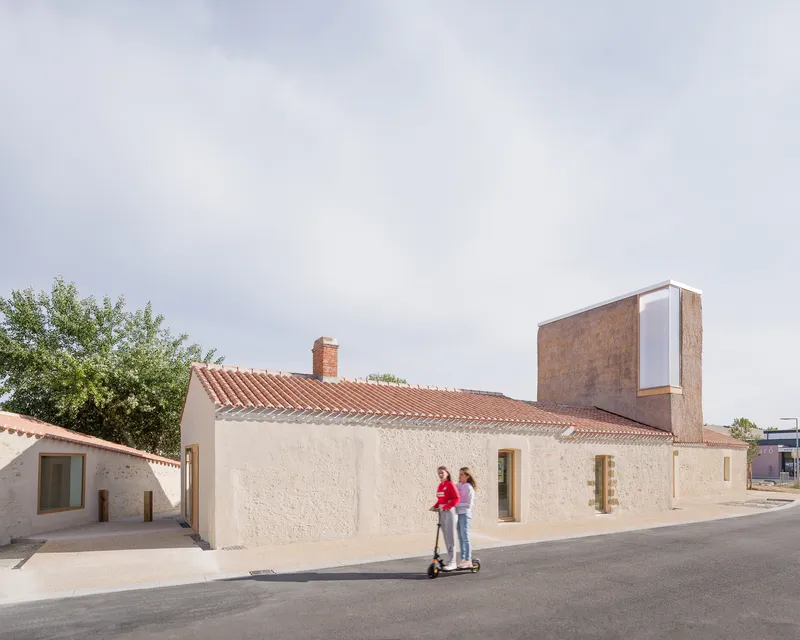
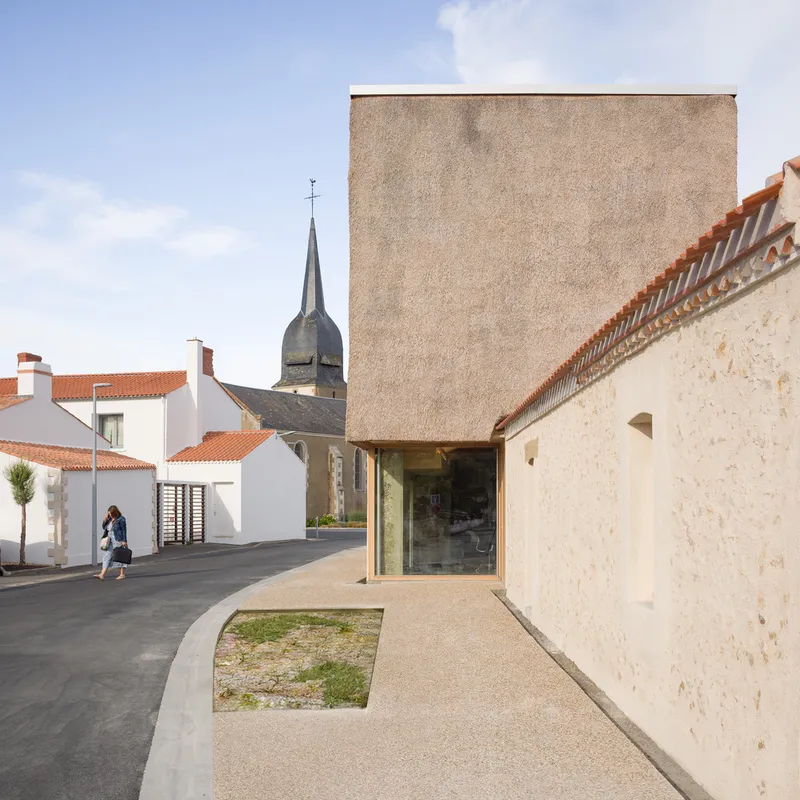
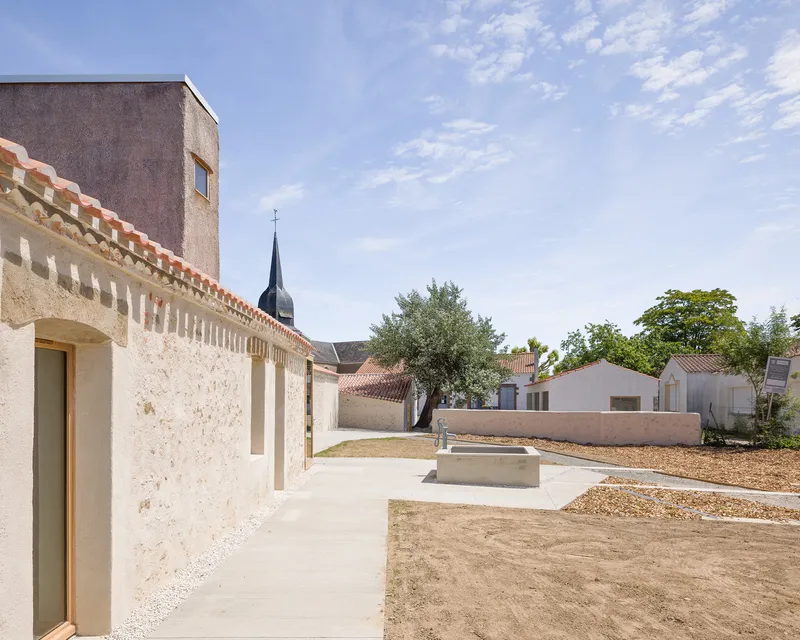
Le Perrier sits halfway between Challans and Saint-Jean-de-Monts in the Marais de Soullans, a territory so flat that any vertical gesture carries disproportionate weight. The original longhouses are low, horizontal volumes that defer to the landscape. Prineau's intervention plays on this by positioning the concrete tower at the junction of the two buildings, creating a hinge that is visible from the surrounding streets while framing views back to the church spire. The tower does not overpower; it orients.
From the courtyard, the relationship between old and new is legible in a single glance. Stone walls, terracotta tiles, and the pale render of the longhouses establish a warm, textured ground plane. The tower rises from this context with a deliberate shift in material language, its thatched reed cladding softening the geometry and extending the local vocabulary upward rather than away from it.
Stone, Lime, and the Logic of the Marsh
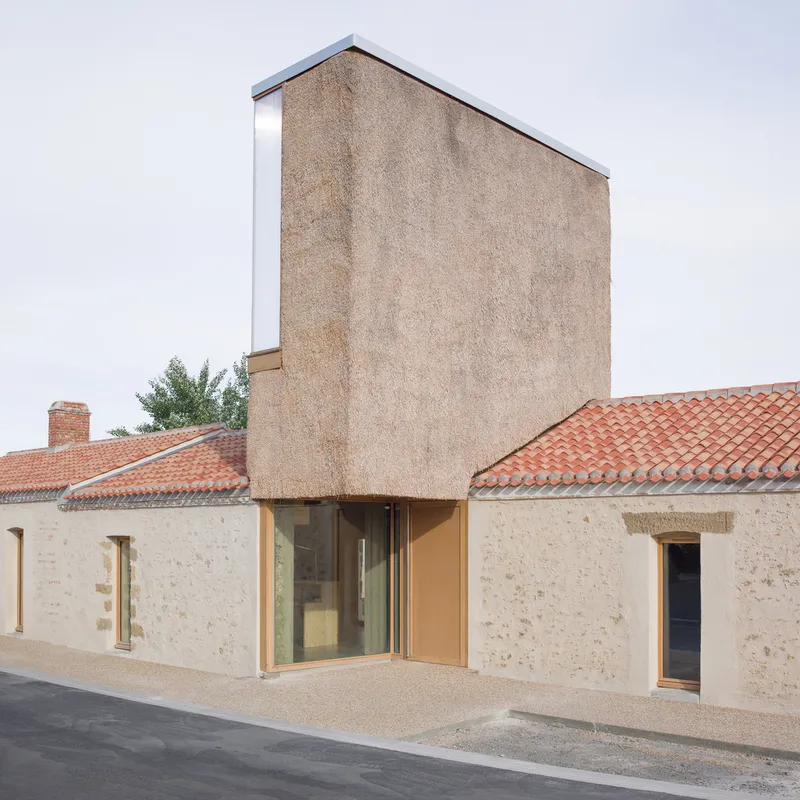
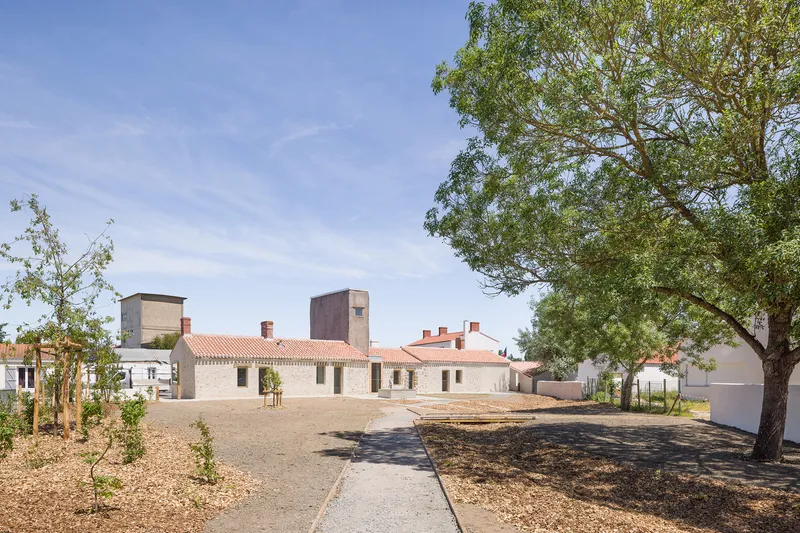
The decision to renovate rather than demolish is the project's foundational ethical stance. The two longhouses are characteristic of the region, built by marshland farmers who worked with whatever the territory provided: stone, reed, lime. Prineau's restoration honors this economy of means. Exposed stone walls were carefully repaired and replastered with lime, a material that breathes in the humid marsh climate. Hemp-lime plaster lines the interior, providing insulation while maintaining the buildings' capacity to regulate moisture naturally.
The roofing follows regional precedent as well. Traditional tiles with the characteristic overhang of the area catch the bright, diffuse light of the marshland, casting soft shadows along the facades. These are not aesthetic choices performed for nostalgia. They are functional decisions rooted in centuries of local building intelligence, redeployed within a contemporary renovation framework.
Threshold and Transition
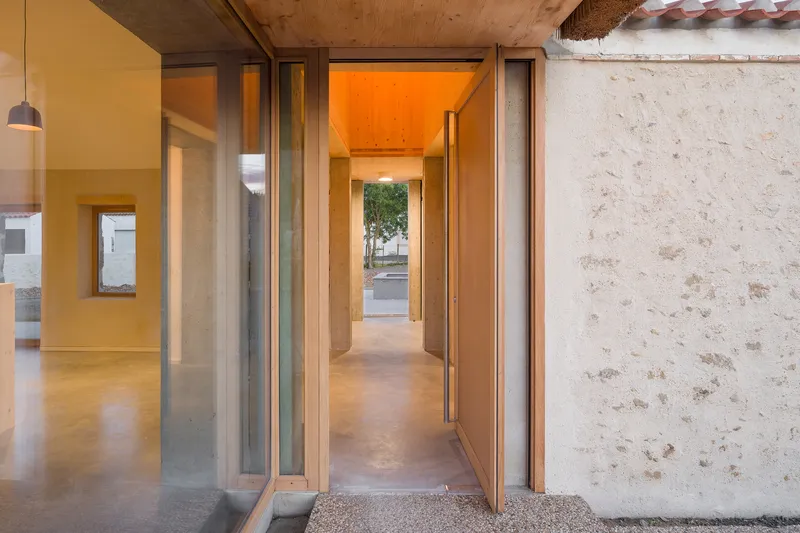

The entry sequence is one of the project's most considered moments. At dusk, the glazed threshold glows from within, the exposed plywood ceiling and timber-framed glass door creating a warm, lantern-like effect that draws visitors inward. The transition from exterior to interior is compressed and intimate, a deliberate counterpoint to the open, horizontal landscape outside. You move from the expansiveness of the marsh into a tight, carefully lit passage before the interior opens up.
The twilight view of the stone and stucco facade reinforces this reading. Windows become apertures of light in an otherwise solid wall, transforming the building from a daytime civic structure into an evening landmark. The effect is achieved without theatrical lighting design: it is simply the consequence of placing glazing thoughtfully in thick, traditional walls.
Interior: Timber, Concrete, and Honest Assembly
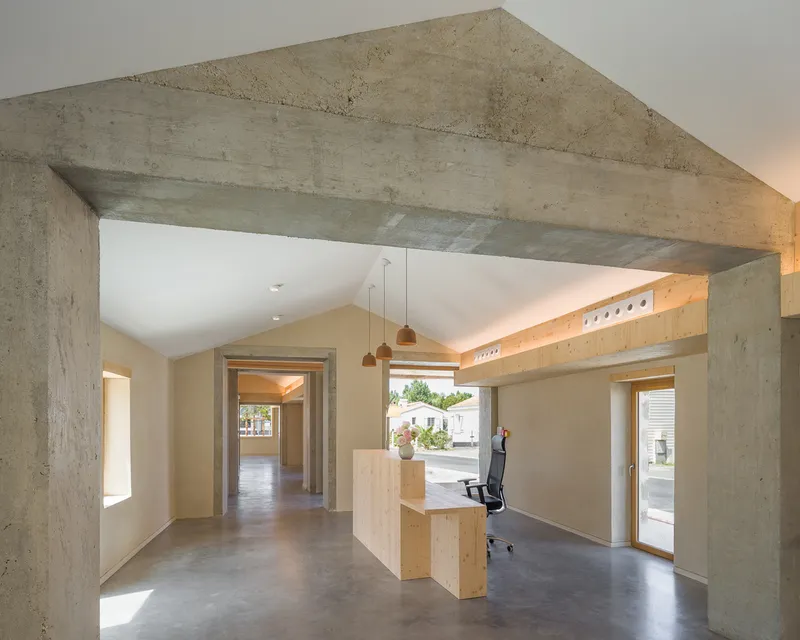

Inside, the material palette narrows to a clear dialogue between timber and concrete. Exposed concrete beams define the structural rhythm, while timber reception desks and pendant lights introduce warmth and a human scale. The polished concrete floor anchors the space without competing with the vaulted ceiling above. It is a restrained interior, one that trusts its materials to do the work of creating atmosphere.
The multifunction room, reception area, and exhibition space flow into one another with minimal partition, allowing the 150 square meters to feel considerably more generous than the numbers suggest. Concrete columns mark spatial zones without enclosing them. The effect is civic without being institutional, open enough for exhibitions and gatherings but still intimate enough for a visitor asking directions to the nearest beach.
Outdoor Rooms and Covered Ground
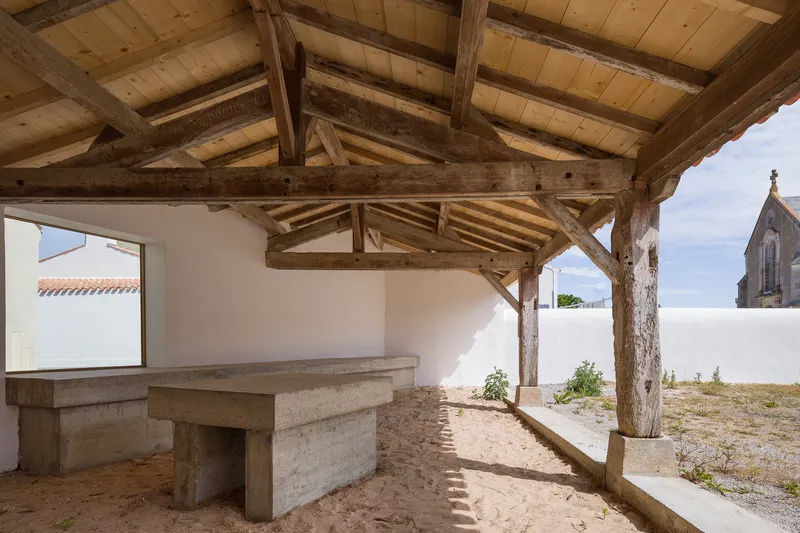
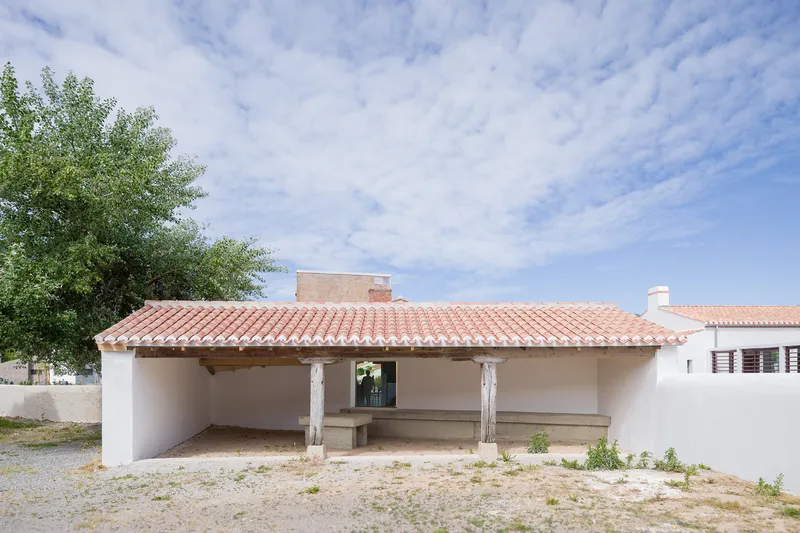
Prineau extends the program outdoors with covered terraces and porches that function as transitional rooms between the building and the village. Exposed timber trusses shelter stone benches set on sandy ground, creating spaces that belong to the public even when the center is closed. A covered porch with white columns and a barrel tile roof offers shade and a place to sit, its concrete bench a durable, low-maintenance piece of public furniture.
These outdoor spaces are not afterthoughts. In a region where the light is abundant and the climate mild, they are arguably as important as the interior rooms. They allow the cultural center to function as a village square in miniature, a gathering place that exists somewhere between architecture and landscape.
Why This Project Matters
Le Sémaphore is a small project with an outsized argument. It demonstrates that renovation, when pursued with genuine material intelligence, can produce architecture that is simultaneously more sustainable, more culturally specific, and more spatially inventive than new construction on an equivalent budget. Prineau does not treat the existing longhouses as constraints to be overcome. He treats them as resources, the same way the marshland farmers who built them treated stone and reed.
The tower is the project's boldest move, but the real lesson is in the quieter decisions: lime over cement, hemp over foam, traditional tiles over standing seam. In an era when sustainable architecture is too often reduced to energy modeling and photovoltaic arrays, Le Sémaphore reminds us that the most durable form of sustainability is cultural continuity. Building with the materials and methods of a place is not conservatism. It is the most radical form of site-specificity available.
Le Sémaphore Cultural Center, Le Perrier, Vendée, France. Designed by Atelier Ronan Prineau. Approximately 150 m². Completed 2021. Photography by François Dantart.
About the Studio
Share Your Own Work on uni.xyz
If projects like this are the kind of work you want to make, uni.xyz is a place to publish your own, find collaborators, and enter design competitions.


Popular Articles
Popular articles from the community


Riyadh For All: Intergenerational Urban Design for Active Aging in Rabat
Riyadh For All reimagines urban design in Rabat with intergenerational co-living, adaptive courtyards, and Moroccan cultural exchange today.

Conexión: Biophilic Design Reimagines High-Rise Living in Hong Kong
Conexión reimagines high-rise living in Hong Kong through biophilic design, green facades, shared spaces, daylight, water and nature within.

The Earth Pod: 3D Printed Homes for Resilient Refugee Communities
The Earth Pod reimagines refugee housing through 3D printed homes made from clay, combining resilience, self-sufficiency, and rapid shelter.
EW PARK: Sustainable Architecture Reimagines the Future of Urban Parking
EW PARK reimagines city parking as a modular wooden tower combining automation, solar energy, electric mobility, and adaptable urban design.

Similar Reads
You might also enjoy these articles


Hodi-Mandai Geram
Project Function: Preservation and revitalization of the Intangible heritage and socio-spatial identity of the Hodi by Housing, Cultural Memory Center, Sacred Grove, landscape, local tourism economy


Olio Towers: A Mid-Rise for Performers That Fuses Housing, Rehearsal, and Stage
Located blocks from Houston's Theater District, this modular tower stacks living units around a central performance atrium.

Oasis: Modular Green Housing Carved into Dhaka's Urban Fabric
A shortlisted Plugin Housing entry reclaims unauthorized settlements in Dhaka with stepped concrete volumes, green roofs, and ventilation-driven design.

Black Hole: A Floating Megastructure for the Post-Physical Era
Emiliano Mazzarotto envisions a spherical, self-scaling arena where e-sports, digital hotels, and holographic stadiums replace traditional public space.

Explore Cultural Architecture Competitions
Discover active competitions in this discipline



Challenge to reimagine the Iron Throne


Photograph architecture without architects


Illustrate the lost glory of Angkor Wat - Render Challenge

Bring back Drive In's
Comments (0)
Please login or sign up to add comments
No comments yet. Be the first to comment!