
100 Architects Turns a Ningbo Staircase into a Volcanic Playground for All Ages
A 1,350 square meter eruption of red, orange, and yellow activates a pedestrian junction in one of Ningbo's newest commercial districts.

What happens when you take a utilitarian set of stairs in a new Chinese development and treat it like the mouth of a volcano? You get Magma Flow, a 1,350 square meter public space by 100 Architects that replaces forgettable commercial infrastructure with something genuinely disruptive. Located at a pedestrian junction in a recently built residential and commercial district in Ningbo, the project colonizes both a grand staircase and the ground plane beneath it, wrapping both in a continuous narrative of molten color and programmed activity.
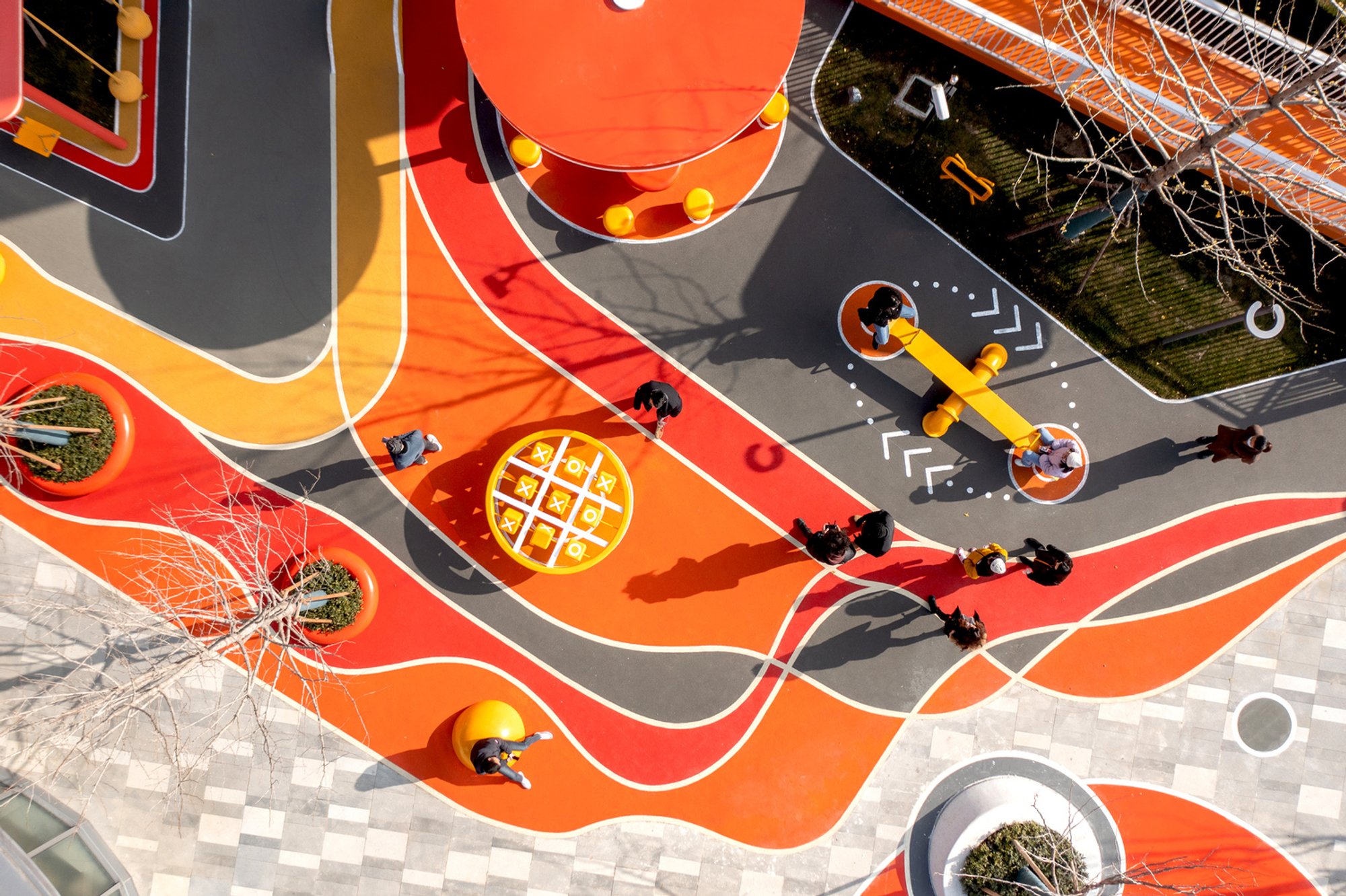
The interesting move here is not the volcanic metaphor itself, which could easily devolve into themed kitsch, but how literally the studio commits to it as an organizational strategy. The fiery palette of reds, oranges, and yellows does not merely decorate: it structures circulation, separates zones for children and adults, signals elevation changes, and even dictates where shade canopies land. Every programmatic decision, from mahjong tables to tunnel tubes, is embedded in the lava flow rather than dropped onto it. The result is a landscape where spectacle and utility are, for once, the same thing.
The Staircase as Social Infrastructure
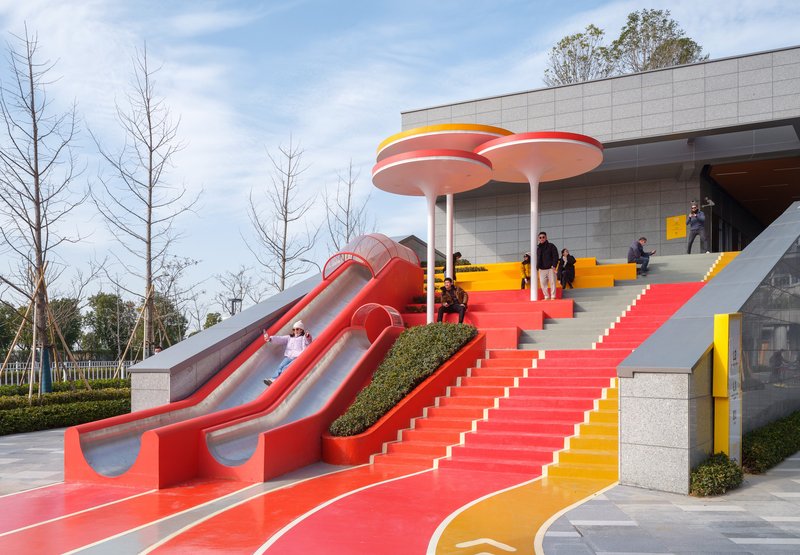
The grand staircase connecting the ground level to the second floor of the commercial street was, before this intervention, exactly what you would expect from a developer in Ningbo: functional, minimal, forgettable. 100 Architects saw it as real estate. By inserting multiple amphitheaters at different levels, they turned vertical circulation into a reason to pause. Slides flanking the central stair simulate lava cascading downhill, giving children an alternative route down that doubles as the project's most photogenic gesture.
Circular canopies sit at the top like the crater of the metaphorical volcano, their geometry a counterpoint to the fluid, organic lines of the ground surfaces below. These are not decorative: they shade seating zones and mark gathering points for adults who might otherwise have no reason to linger on a staircase. The shift from transit space to social space is real, not aspirational.
Color as Wayfinding
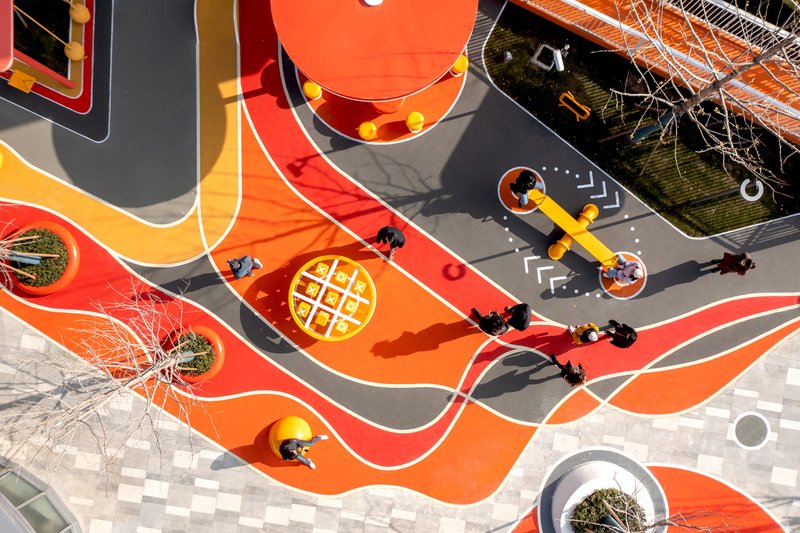
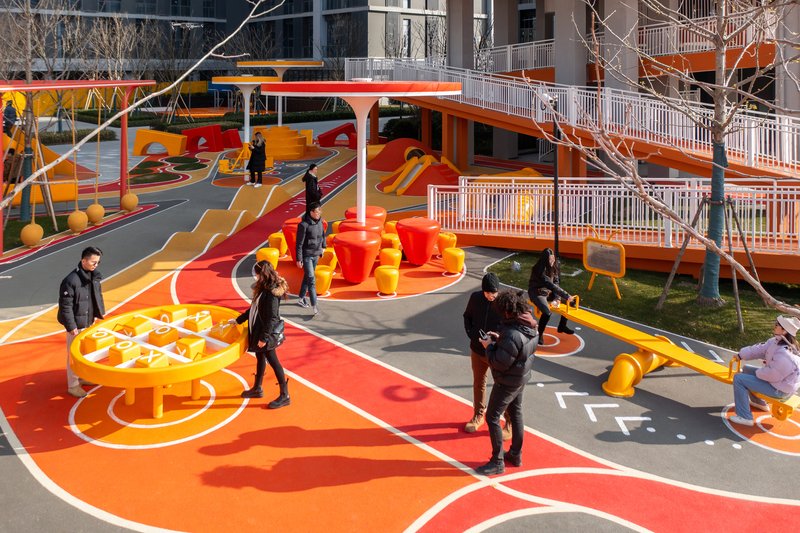
The gradation from deep red at the top of the stairs to orange and yellow at the ground level does more work than any signage system could. It tells you where you are in the sequence. It tells you where the energy is concentrated. And it creates a legible figure against the grey and beige residential towers that surround the site, giving the project the visibility that its developer, Vanke China, clearly wanted.
Seen from above, the wavy pathways read like a topographic map of some alien terrain, channels of warm color cutting through patches of neutral ground. Children instinctively follow the colored surfaces, which means the palette also functions as soft crowd management, guiding movement without barriers or fences. It is a clever trick: the thing that makes the space look dramatic is also the thing that makes it work.
Programming for Adults and Children Simultaneously
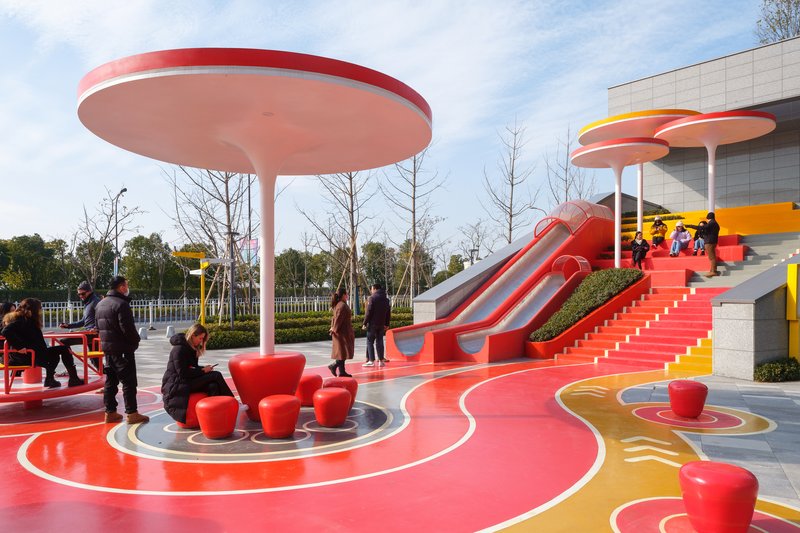
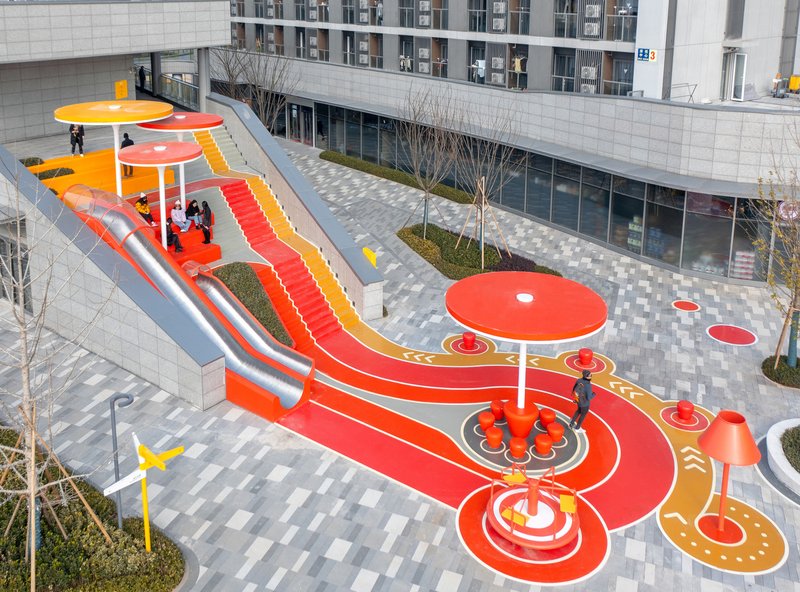
Too many playgrounds treat adults as spectators, exiling parents to benches at the perimeter. Magma Flow embeds adult programming directly into the play zones. Mahjong tables, tic-tac-toe boards, and lounge seating with shaded canopies sit within arm's reach of swings, seesaws, and climbing structures. The molded red seating elements under the pink circular canopy are a good example: they look sculptural, but they are scaled and shaped for adults to actually relax in, positioned so a parent can watch a child on the slides without craning their neck.
Swing pergolas, punching bags, tunnel tubes, and obstacle paths fill the ground-level plaza with enough variety to hold attention across age groups. The space is not zoned by age so much as layered by intensity. Quieter lounge areas occupy the margins, while the most physically demanding elements cluster near the staircase where the color is hottest. The volcanic metaphor, in this sense, becomes a genuine design tool: intensity radiates outward from the crater.
Between the Towers
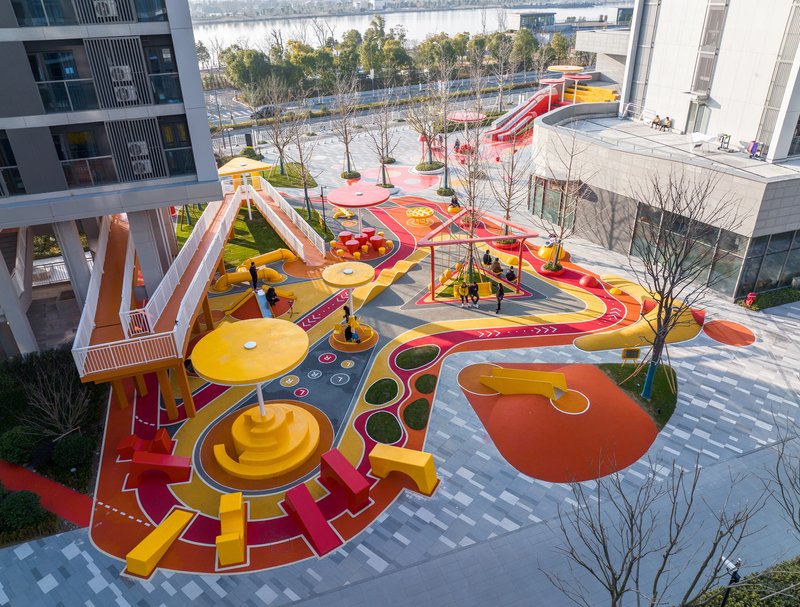
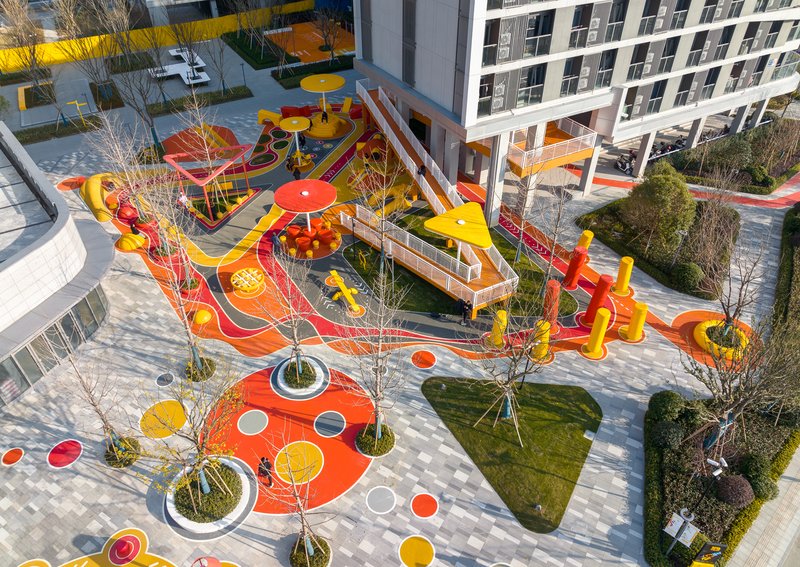
The aerial views reveal the context that the ground-level shots obscure. Magma Flow sits in a tight gap between residential slabs, a compressed site that could easily feel like leftover space. The red and yellow surfaces push back against this reading with almost aggressive confidence. Young trees planted along the edges will eventually soften the composition, but for now the contrast between the vivid intervention and the repetitive housing blocks is stark and, frankly, necessary.
LED rope lights tracing the shade structures and spotlights on the planted trees extend the space's life into evening hours. In a district this new, where street life has not yet had time to develop organically, that kind of temporal layering matters. A space that only works in daylight is only half a space.
Why This Project Matters
Chinese commercial developments at this scale produce enormous quantities of public space that almost nobody uses. The courtyards, plazas, and pedestrian streets between residential towers are vast, uniform, and dead. Magma Flow is a pointed argument that the problem is not density or program but commitment. 100 Architects committed to a single spatial idea, the volcanic eruption, and then had the discipline to let that idea drive material choices, color strategy, program distribution, and shading design simultaneously. The metaphor is not decorative; it is structural.
The broader lesson is about who public space is for. By refusing to separate adult leisure from children's play, and by treating a staircase as a destination rather than a connector, the project challenges the default hierarchies that make so many new developments feel sterile. Whether the volcanic palette ages gracefully under Ningbo's humid climate remains to be seen, but the ambition here is hard to argue with. A space designed to be noticed has a much better chance of being used.
Magma Flow Public Space by 100 Architects. Located in Ningbo, Zhejiang Province, China. Total area: 1,350 m². Completed in 2022. Client: Vanke China Co., Ltd. (Ningbo Division). Photography by Rex Zou.
About the Studio
Share Your Own Work on uni.xyz
If projects like this are the kind of work you want to make, uni.xyz is a place to publish your own, find collaborators, and enter design competitions.




Popular Articles
Popular articles from the community

Stanton Architects Sculpts a Curving Family Home into Sydney's Inner West Fabric
Five Dock House uses cantilevers, curved concrete, and layered courtyards to carve out privacy on a tight suburban lot in Sydney.

The Faith: Modular Architecture for Play, Learning, and Hope in Kutupalong Refugee Camp
A modular playground architecture project in Bangladesh where play, learning, safety, and hope rebuild childhood inside a refugee camp anew.
Inside a Timeless Mumbai Residence by Aether Studio
Aether Studio's 2,250 sq ft apartment in Malad, Mumbai uses marble, brass, boucle, and disciplined restraint to build a quiet retreat from the city.
IKC de Geluksvogel: Sustainable School Architecture Designed for Free Movement and Digital Learning
IKC de Geluksvogel turns sustainable school architecture into a flexible Maastricht campus for digital learning, nature, and free movement.

Similar Reads
You might also enjoy these articles

Olio Towers: A Mid-Rise for Performers That Fuses Housing, Rehearsal, and Stage
Located blocks from Houston's Theater District, this modular tower stacks living units around a central performance atrium.
Oasis: Modular Green Housing Carved into Dhaka's Urban Fabric
A shortlisted Plugin Housing entry reclaims unauthorized settlements in Dhaka with stepped concrete volumes, green roofs, and ventilation-driven design.

Black Hole: A Floating Megastructure for the Post-Physical Era
Emiliano Mazzarotto envisions a spherical, self-scaling arena where e-sports, digital hotels, and holographic stadiums replace traditional public space.
Compact & Sustainable Living in Piraeus: A Four-Level Family Home Built Around Light and Air
A narrow townhouse in one of Greece's densest port cities uses a central atrium and passive strategies to house three generations under one roof.

Explore Urban Design Competitions
Discover active competitions in this discipline




The International Standard for Design Portfolios


The Global Benchmark for Architecture Dissertation Awards


The Global Benchmark for Graduation Excellence


Challenge to reimagine the Iron Throne
Comments (0)
Please login or sign up to add comments
No comments yet. Be the first to comment!