
Slowbridge: A Helical Micro-City That Turns Crossing a Canal into Urban Life
Xavier Delanoue's Copenhagen bridge rejects speed in favor of stacked programs, spiraling brick towers, and a six percent slope for all.


What if a bridge made you want to stay instead of cross? Slowbridge, designed by Xavier Delanoue, takes that provocation seriously. Sited across a Copenhagen harbor channel between Gammelholm and Christiania, the project replaces the conventional shortest-path logic of bridge engineering with something far more unusual: a deliberately extended journey through stacked public programs, spiraling brick towers, and layered circulation that separates pedestrians, cyclists, and boats into their own spatial registers. The bridge is not a line between two points. It is, functionally and spatially, a vertical micro-city suspended over water.
Borrowing its thesis from Emerson's "It's not the destination, it's the journey," the project measures success not through minimized travel time but through maximized experience. Every additional meter walked opens up a café, a workshop, a viewing terrace, a kayak launch, or simply a bench from which to observe city life. That inversion of efficiency into richness is what gives Slowbridge its conceptual teeth.
Arches Over the Harbor: A Bridge That Glows
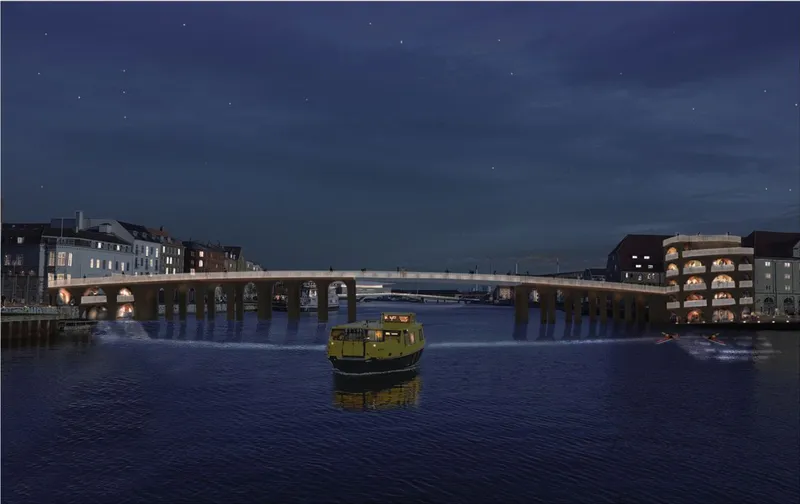
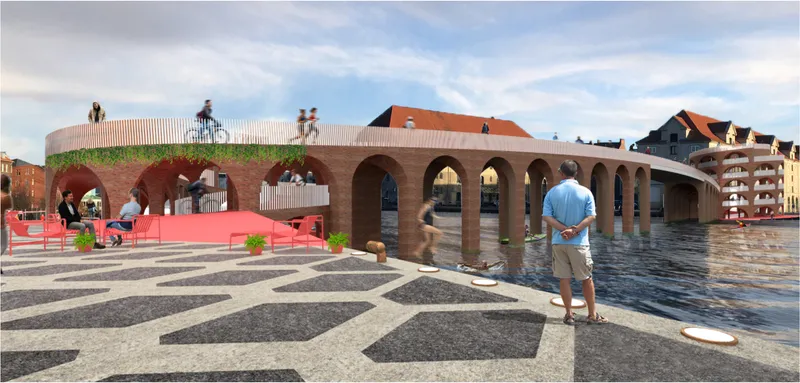
The night view reveals Slowbridge as a series of lit brick arches spanning the channel, with a small ferry passing beneath. The structural language is immediately legible: these are arches doing real work, carrying stacked programs while allowing water traffic to flow uninterrupted below. By day, the planted rooftop and patterned brick paving at the bridge's base create a generous public plaza where pedestrians gather along the waterfront. The material palette is deliberate. Brick is Copenhagen's native building material, and Delanoue deploys it not as nostalgic pastiche but as a contemporary structural skin for the helical volumes.
Copenhagen's skyline already holds helix-based landmarks like the Round Tower and Børsen. Slowbridge consciously echoes that spiraling typology while reinterpreting it as infrastructure. The arches give the bridge a civic scale that distinguishes it from the city's more minimal pedestrian crossings, positioning it as a future landmark that reads at the scale of the harbor.
The Spiraling Tower: Vertical Program Stacked Over Water
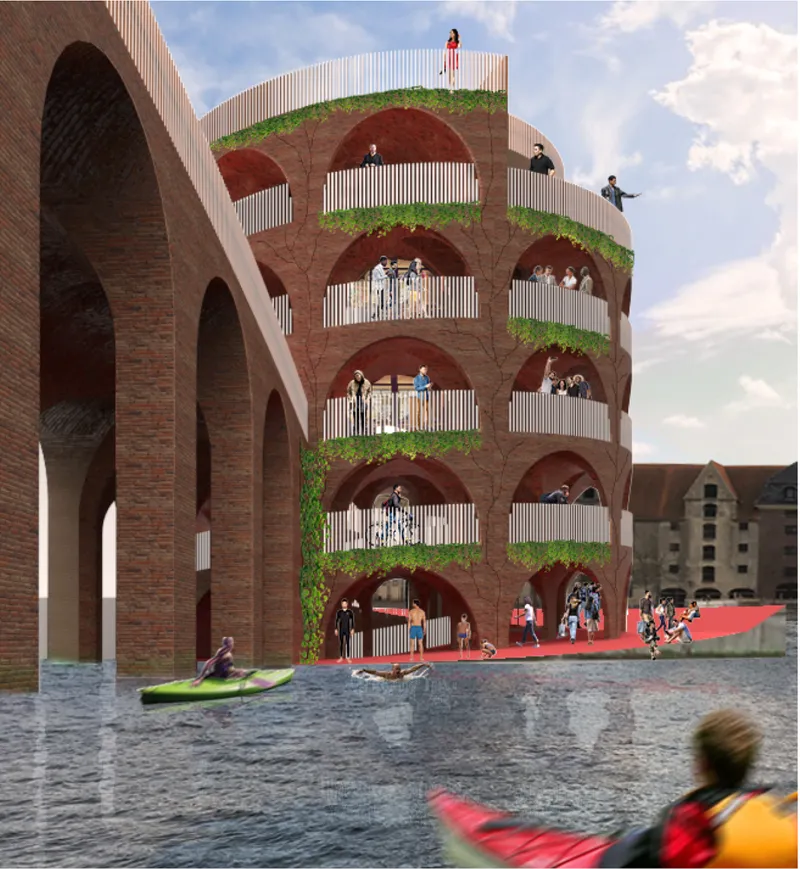
The circular brick tower is perhaps Slowbridge's most striking element. Rising with arched openings at each level and planted terraces cascading down its face, the tower functions as a vertical node where the bridge's horizontal journey becomes a spiraling ascent. At its base, kayakers occupy the canal, activating the water level as a distinct programmatic layer. The modular system that governs the tower allows it to host cafés, retail shops, bike repair hubs, and viewing terraces, all stacked within a compact footprint. This is a genuine piece of vertical urbanism, not merely a sculptural gesture.
The superposition of functions within this tower demonstrates Delanoue's core strategy: treat the bridge as a three-dimensional volume, not a two-dimensional surface. The result is a compact urban ecosystem where commerce, leisure, and transit coexist in tight vertical proximity, each level offering a different relationship to the water, the skyline, and the adjacent neighborhoods.
The Red Path: Separating Flows on the Bridge Deck
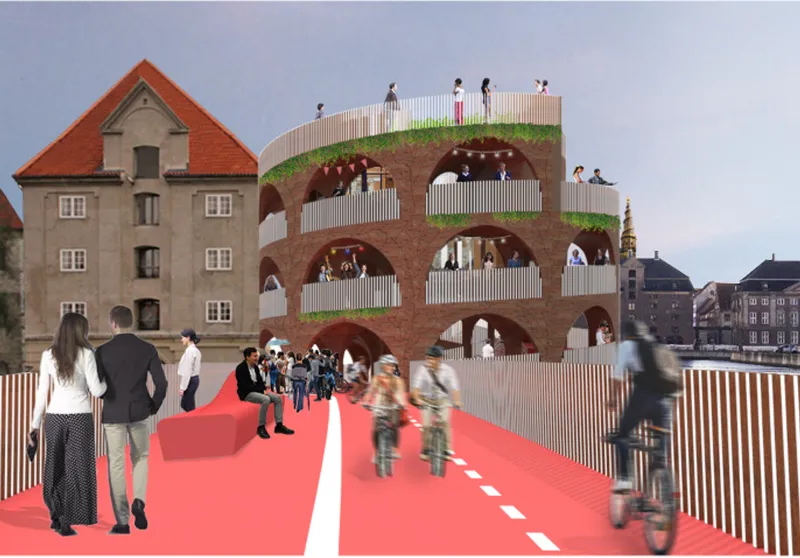
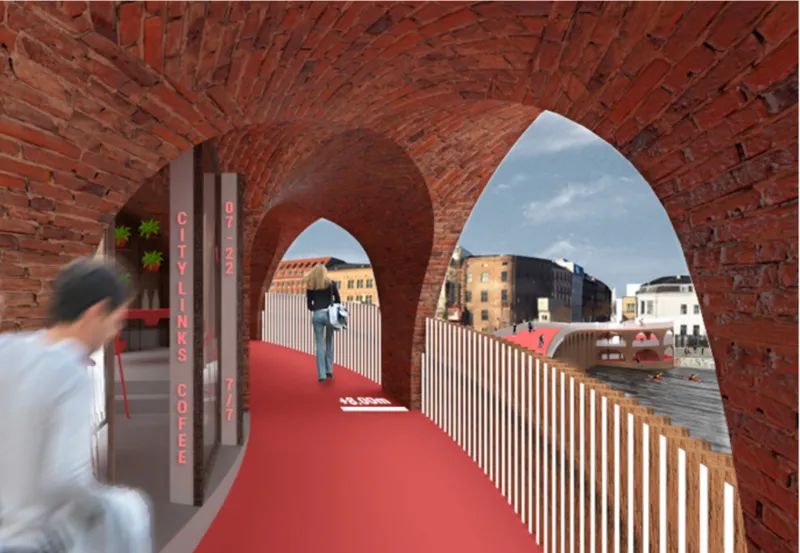
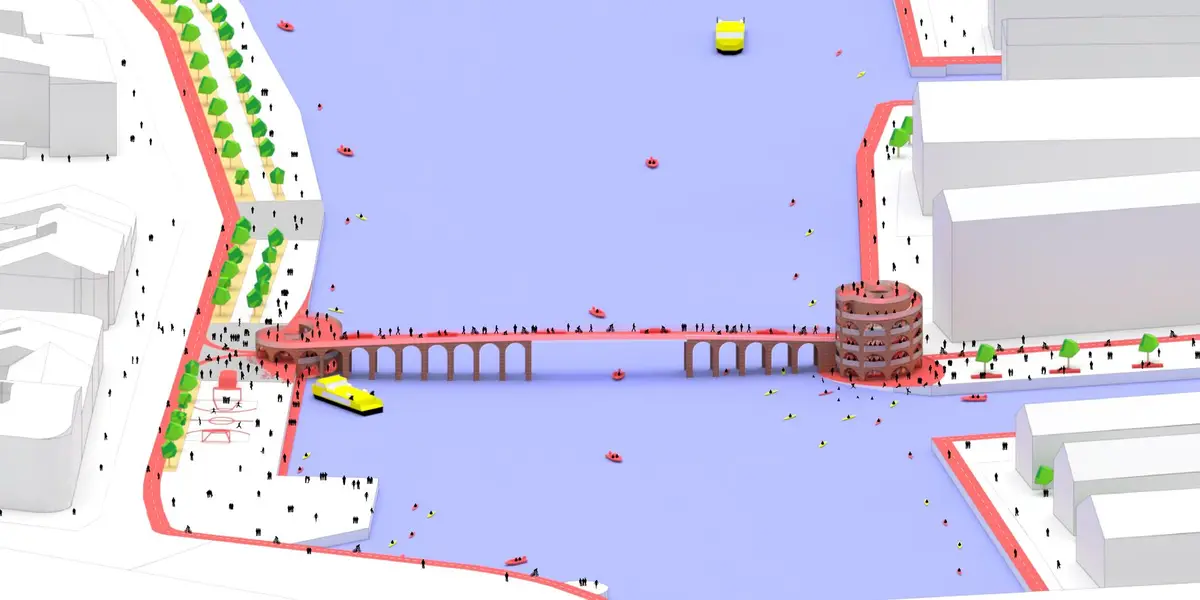
From above, the bridge deck reveals a clearly defined red pedestrian pathway running through its length, with cyclists and visitors moving in parallel but distinct lanes. A gentle 6% slope accommodates all users, including those with reduced mobility, making the extended journey genuinely accessible rather than merely aspirational. The separation of flows is not just functional; it is spatial. Pedestrians occupy a slower register, framed by vertical timber balustrades and punctuated by moments where the brick vaulted arches open to frame views of the canal below.
The elevated view also shows how the bridge connects into the urban fabric at both ends, with public plazas and micro-destinations creating soft transitions between bridge and city. This is critical to the project's ambition as an urban link between Gammelholm and Christiania: the bridge does not simply land on the shore but negotiates its arrival through graduated public spaces that belong equally to both districts.
Inside the Vault: Brick, Timber, and the Compression of Passage
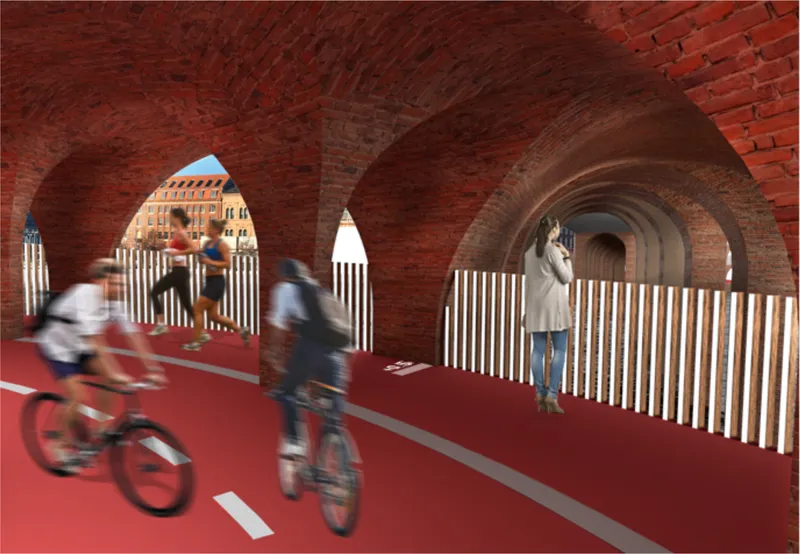
The interior perspective reveals what it actually feels like to move through Slowbridge. Vaulted brick ceilings compress the space overhead while arched openings to the canal pull light and air through the passage. Cyclists ride along timber-railed lanes, and the material interplay between warm brick and vertical timber members creates a tactile richness that is rare in bridge architecture. There is a directness here: brick laid in repeating arches, timber used structurally and as a guardrail, and the canal always visible through the side openings. No unnecessary complexity, just honest material assembly working at human scale.
The passage also reveals how the nonlinear circulation works at the experiential level. Detours and loops create a relationship between time and distance that is deliberately unpredictable: you may glance through an arch and decide to descend to the water level, or spiral up one more floor to a terrace. The bridge's programmatic diversity means that the same crossing can be different each time, which is the real payoff of Delanoue's journey-centric approach.
Why This Project Matters
Slowbridge matters because it takes a building type that has been almost entirely surrendered to engineering optimization and reclaims it for public life. The idea that a bridge should slow you down rather than speed you up is counterintuitive, but Delanoue builds a convincing case through concrete design decisions: the helical towers, the 6% accessible slope, the modular program, the material rootedness in Copenhagen's brick tradition. These are not abstract gestures. They are specific, buildable propositions that respond to a real site and a real urban condition.
More broadly, the project asks a question that urban designers increasingly need to confront: when infrastructure already exists in abundance, what is the value of adding more of it unless it also adds richness to civic life? Slowbridge suggests that the next generation of urban connectors should be judged not by how fast they move people through, but by how many reasons they give people to linger. That is a genuinely productive reframing, and it positions Xavier Delanoue as a designer worth watching.
View the Full Project
About the Designers
Designer: Xavier Delanoue
Enter a Design Competition on uni.xyz
uni.xyz runs architecture and design competitions year-round that reward proposals with spatial conviction and real site intelligence.
Project credits: Slowbridge by Xavier Delanoue.


Popular Articles
Popular articles from the community


David Macias Steps a Doorless Stone and Plaster House Down a Tropical Colombian Hillside
In the humid hills of Colombia, Threshold House replaces the front door with an open void and terraces its 850 m² down the slope instead of fighting it.

GROUP A Strips a 1969 Rotterdam Harbor Headquarters to Its Frame and Wraps It in Timber Louvers
In Rotterdam's M4H harbor district, Ferro Offices reuses a 1969 frame, adds one timber storey and reaches BREEAM-NL Outstanding.

LT2A and OPEN Architectes Thread a Brick and Glass High School Through a Wooded Belgian Campus
In Braine-l'Alleud, a 3,000 m² wing for Collège Cardinal Mercier pairs pale brick with a glazed colonnade, deferring to a small chapel and a dense wood.

Cube Design Draws an Ecological Corridor Between Two Shenzhen Hills with the Nankai Building
Beside Shenzhen's container docks, the Nankai Building pairs stacked balconies with a climbing green screen to connect two hillsides across its height.

Similar Reads
You might also enjoy these articles


Aquadapt: An Underwater Habitat That Rewrites Its Rooms by the Hour
Curved modules ring the seabed while one shell shifts from breakfast room to cinema, farm and football pitch as residents' needs change.

Play: Fragments of Their World: Remembered Architecture Rebuilt as a Modular Playground for Refugee Camps
Tom Gardner abstracts domes, arches and towers from the homelands of displaced families into a kit of child-scaled play parts for camp settlements.
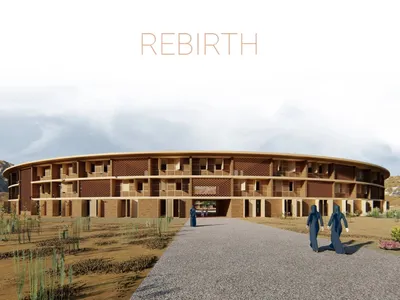
REBIRTH: A Circular Settlement Where Afghan Widows and Their Children Rebuild Life Together
A shortlisted Resile entry turns the circle into a protective ring of timber and brick, gathering homes, classrooms and gardens around a shared landscape.
The Main Dream: A Recycled Plastic Kit That Lets Refugee Children Build Their Own Playground
Thirty-centimetre interlocking cubes that connect on three axes turn play into construction, letting children author the spaces they occupy.


Comments (0)
Please login or sign up to add comments
No comments yet. Be the first to comment!