
Through the Eyes of Nature
Experiencing the various perspectives of the forest
when observing the forest from a pathway, the perspective we experience is always from a human eye point of view, but what would the forest look like from the perspective of its residents [animals]! this project aims to make the user experience the perspective of other creatures in the forest and highlight the fact that different animals in different layers view the same spot differently based on their perspective level height, this will orient people to wonder about them more which will increase people’s awareness of the forest’s residents.

Forests can be divided into four main layers vertically, and each one of them has special characteristics and various types of animals since not all of them can reach higher levels, and some prefer to live in one layer more than the others. These layers are as the following: the forest floor layer, the understory layer, the canopy layer, and the emergent layer. different heights represent different experiences. however, since a forest can go higher than 100 meters, this project will focus on the first three layers reaching a maximum of 20 meters high.
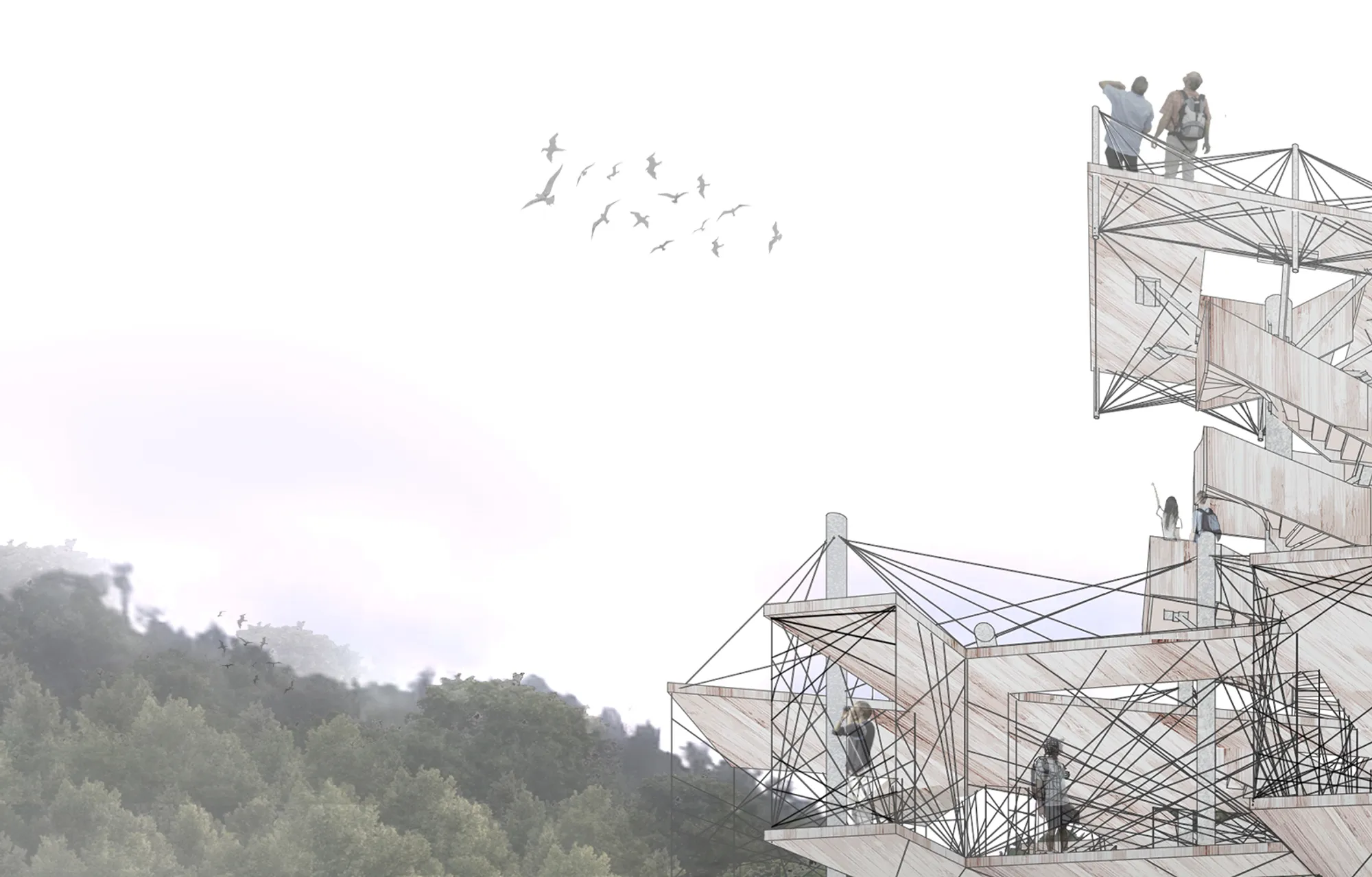
Simply said it’s like a simulation of minimized forest layers with their various experience characteristics; the forest floor layer is a familiar experience as the user will approach the project already experiencing it on their way there, the structure work as a representative figure of tree trunks where the user will start the experience by walking through them. Other animals view the forest from this perspective as we do such as squirrels, some birds, pine marten, and others. then they will go up the stairs to reach the next experience.

The understory layer is a layer covered with a thick layer of leaves and large trees that block the sky view, which can also represent the lower part of the canopy layer, the user in this layer of the project will experience both the density and the narrow pathways formed by the branches, using multi-layered cables designed in a way that represents the busyness and unclear view in the horizontal direction, they are also part of the Structure that holds this level which contains setting areas and a pantry. The second part of the experience is the pathways that represent the branches that will take the user to a new view frame at the end of each pathway showing a different scene of the forest. The animals who share this point of view are usually climbing animals, such as chameleons, squirrel monkeys, and some birds like coati.

The emergent layer is the last layer of the forest as well as this level in the project; that is why it will represent that layer in design characteristics while standing in the minimum canopy layer, this will make the design an open viewing deck, where the sky view is not blocked as well as the horizontal view.
Throughout the whole experience, the design highlighted the same view frame in each layer, which is the same view that the user sees when he approaches the project from the pathway, which will make the user aware of how different can the same view look to everyone living there. Moreover, while going up the stairs, the user can also view the landscape while moving. The openness in the project helps the user to feel and sense the forest more than in a closed environment.
The design took into consideration the context of the project and moved towards making the project engage with the surroundings to be part of it. The structure chosen for this project is tensegrity structure; as it is suitable for enhancing the concept in both the busyness representation and working as an ecological attraction for both birds to land on the project, and climbing plants by guiding them into the project, this will make the project change through time to be fully contained by the forest. Furthermore, the first level roof cover is a green cover (Ecological skin) that helps organisms to grow and be part of the whole ecosystem. The materials were chosen to match the context; wood and neutral-colored materials like galvanized steel.

In the future, the project can either go higher or wider; it can represent more perspectives from a wider range of heights, or get more pathways that represent branches, and better if these paths can be entangled with real trees to make the experience more realistic.

Popular Articles
Popular articles from the community


Hill & Cross Opera: Sculptural Opera House Architecture Shaped by Tallinn’s Landscape and Identity
Hill & Cross Opera reimagines opera house architecture in Tallinn through its sculptural hill, civic plaza, glass wave and a luminous cross.

Riyadh For All: Intergenerational Urban Design for Active Aging in Rabat
Riyadh For All reimagines urban design in Rabat with intergenerational co-living, adaptive courtyards, and Moroccan cultural exchange today.

The Earth Pod: 3D Printed Homes for Resilient Refugee Communities
The Earth Pod reimagines refugee housing through 3D printed homes made from clay, combining resilience, self-sufficiency, and rapid shelter.

Co-life: Sustainable Architecture for Age-Friendly Community Living
Co-life reimagines sustainable architecture for seniors through courtyards, rammed earth, shared gardens, and spaces designed for belonging.
Similar Reads
You might also enjoy these articles
The Rhythm of Seasons
A Farmers' Market Connecting Nature and the City

More Than a Building-Designing a Living System
More Than a Building-Designing a Living System
Base Beyond
DESERT COMPOUND ARID: TOURISM OF ABSENCE AND ABUNDANCE
Explore Natural Architecture Competitions
Discover active competitions in this discipline




Challenge to reimagine the Iron Throne


Photograph architecture without architects


Illustrate the lost glory of Angkor Wat - Render Challenge


Design challenge to reuse E-waste
Comments (0)
Please login or sign up to add comments
No comments yet. Be the first to comment!