
23o5Studio Weaves a Vertical Garden Through a 132 m² Saigon Townhouse
The 140THL House turns a cramped urban plot in Ho Chi Minh City into a climate-responsive dwelling layered with greenery and light.


Saigon's green canopy, measured at roughly 2 to 3 square meters of tree cover per resident, is vanishing under the pressure of a city that adds people faster than it can add parks. 23o5Studio has spent the last several years assembling a body of work around one proposition: if the city will not provide green space, the house itself must become one. The 140THL House, completed in 2022 on a tight urban parcel in Ho Chi Minh City, is the firmest expression of that argument yet. At just 132 square meters, it manages to stack planted beds, tree pockets, and screened terraces from ground level to rooftop, turning a conventional tube-house footprint into a vertical fragment of landscape.
What makes the project genuinely interesting is not merely the presence of plants, which any balcony could achieve, but the degree to which vegetation drives the architecture rather than decorating it. Perforated screens, skylights, voids, and split levels are all calibrated around the needs of the trees first and the rooms second. The result, recognized with an Architecture MasterPrize in 2023, is a house where thermal comfort, acoustic calm, and spatial generosity emerge as byproducts of keeping things alive.
A Facade That Breathes
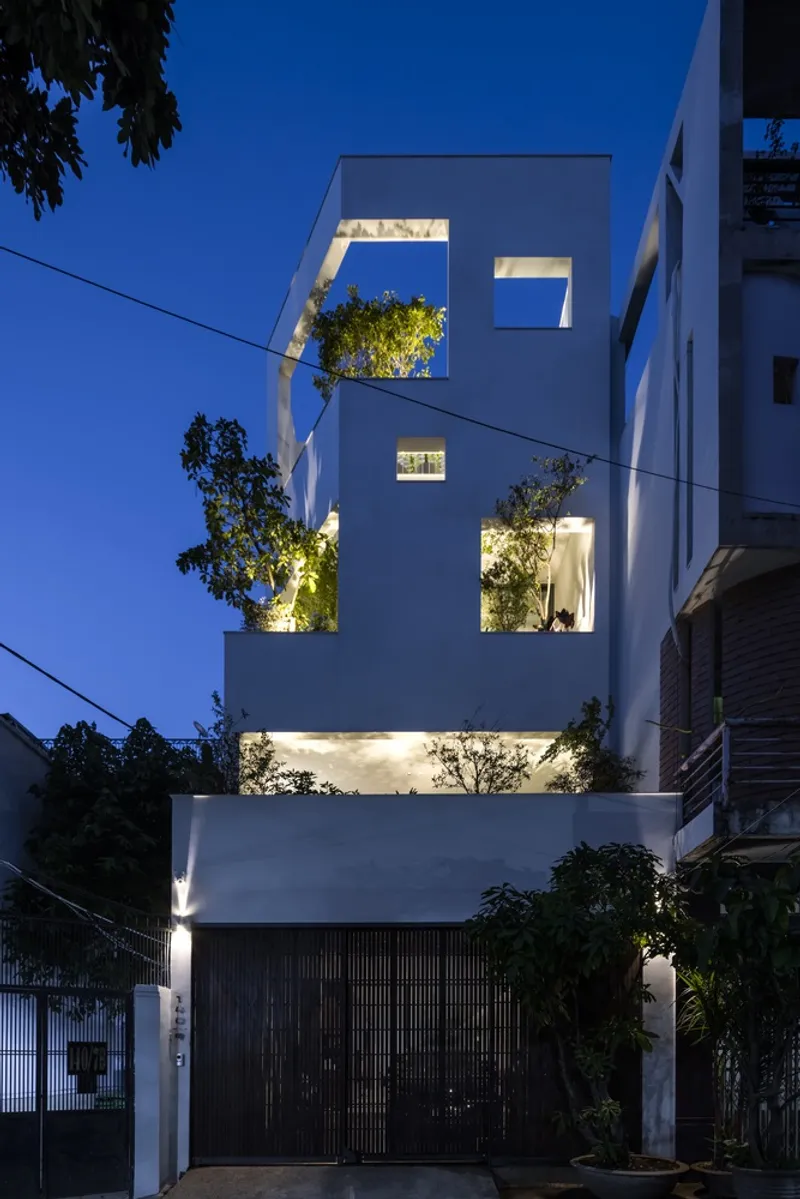
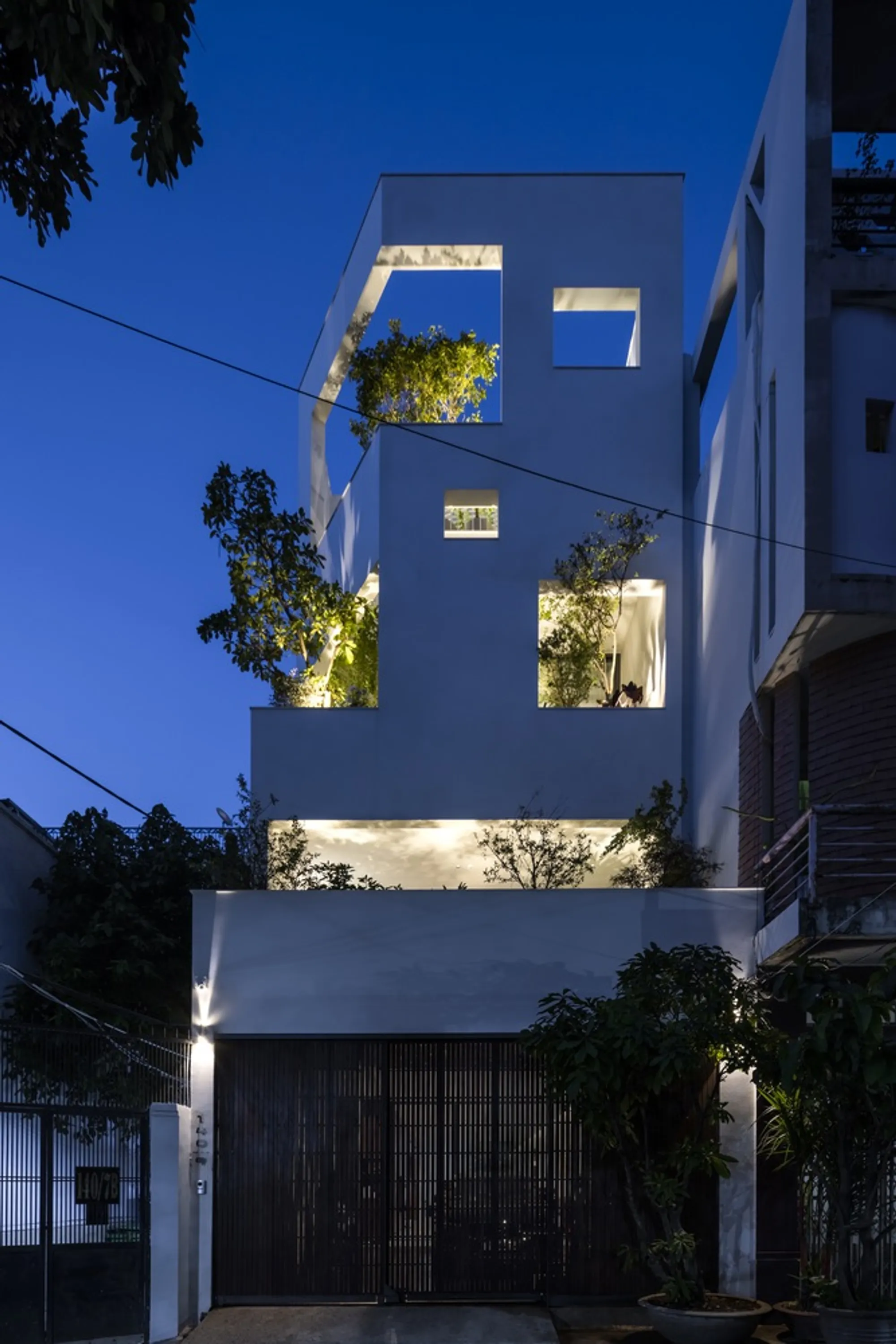
From the street at dusk, the 140THL House reads less as a wall than as a lantern: rectangular cutouts carved across four levels reveal uplighting that catches the silhouettes of trees within. The facade doubles as a shading device, its thick shell reducing heat gain while also acting as a buffer against Saigon's dust and traffic noise. It is a deliberately porous boundary, designed to invite light and air while filtering the city's less welcome gifts.
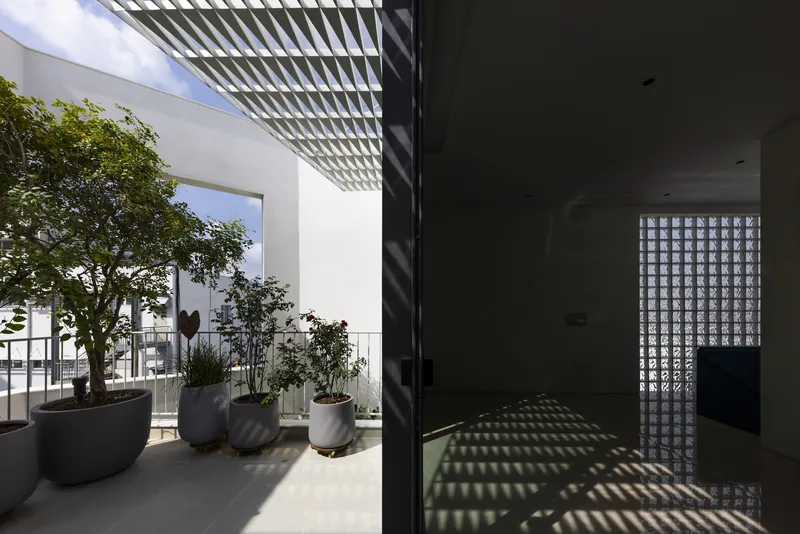
Up on the roof, slatted timber pergolas cast a rhythmic pattern of shadows across potted plantings and a perforated screen wall, extending the green strategy to the very top of the section. The rooftop terrace is not an afterthought; it is the logical terminus of a continuous green circuit that pulls warm air upward and out.
The Interior Courtyard as Climate Engine
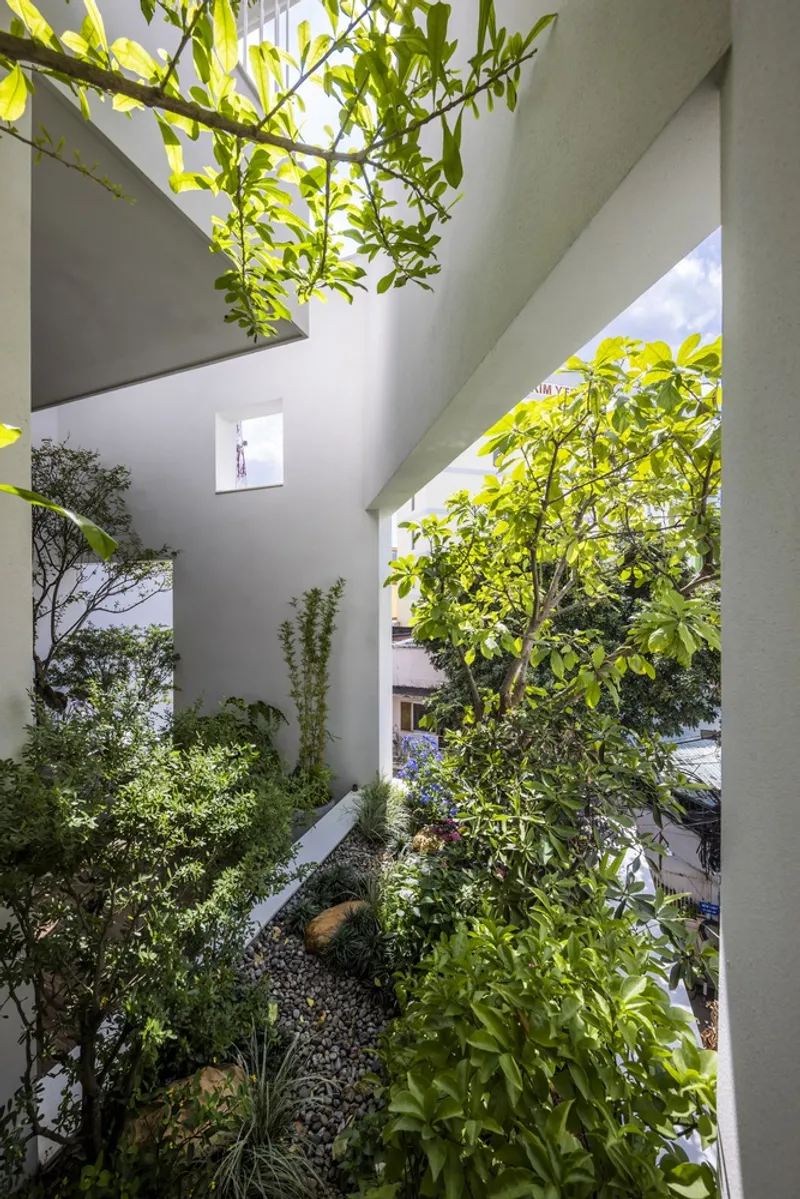
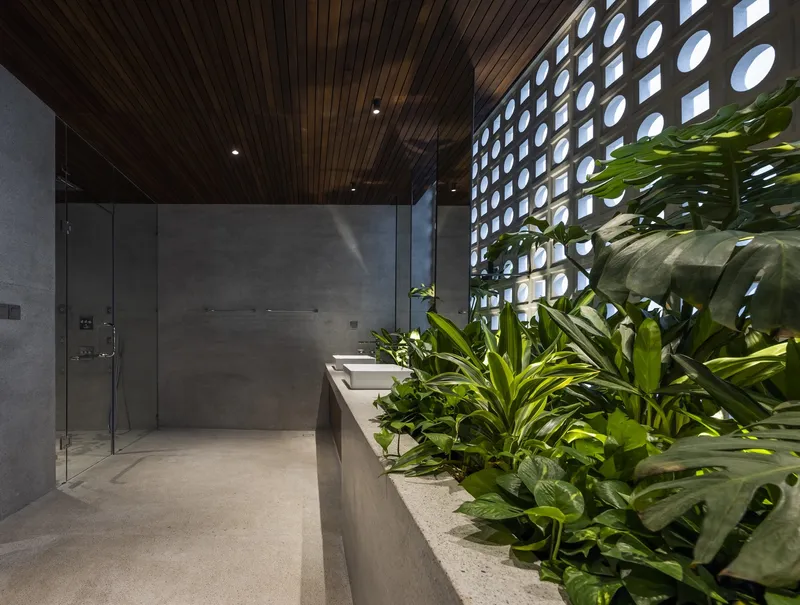
The central courtyard is the heart of the scheme. Planted beds sit beneath a skylit gabled ceiling, creating a column of cooled, humidified air that drives cross-ventilation through adjacent rooms. The gabled profile is not merely aesthetic: it channels hot air upward and toward the roof opening, establishing a stack effect that reduces reliance on mechanical cooling in a city where annual temperatures have been creeping upward by one to two degrees Celsius.
Tropical foliage occupies the lower planted beds alongside perforated screen walls and timber slatted ceilings, layering natural textures in a way that feels lush without feeling cluttered. These are working landscapes, positioned to intercept direct sunlight before it reaches habitable rooms.
Rooms Defined by Greenery
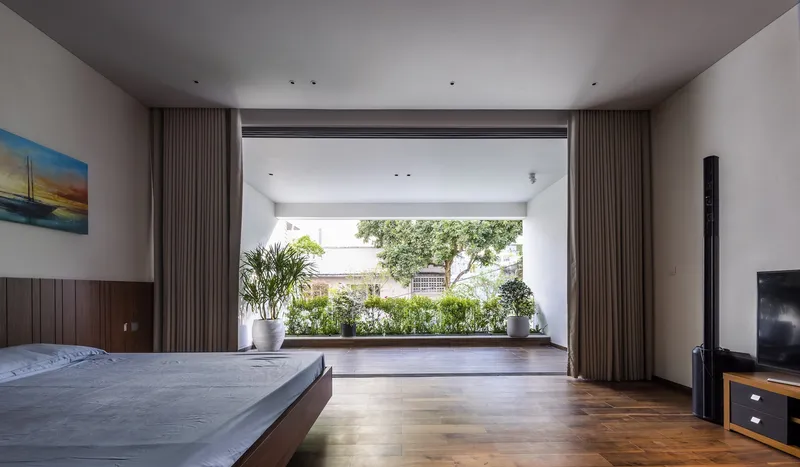
The bedroom opens through floor-to-ceiling glass onto a terrace lined with potted trees, collapsing the threshold between sleeping space and garden. Rather than treating the planted zone as a view to be framed, the architects made it the room's primary boundary: the trees regulate light, moderate temperature, and provide privacy in place of curtains.
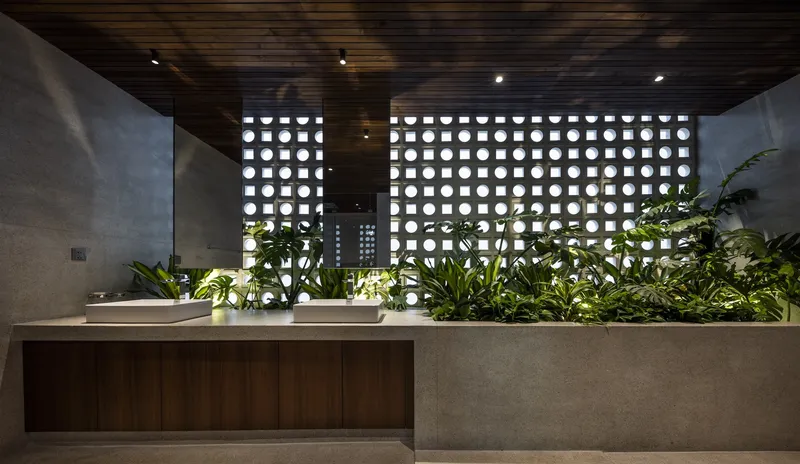
The bathroom takes the same logic further. Twin basins sit behind a perforated screen wall that filters daylight through an intermediate planted bed. The effect is both practical and sensory: diffused, leaf-dappled light replaces the harsh glare typical of a Vietnamese townhouse bathroom, while the vegetation scrubs the air moving between exterior and interior. Every private room in the house is, by design, within arm's reach of a living plant.
Material Warmth and Controlled Light
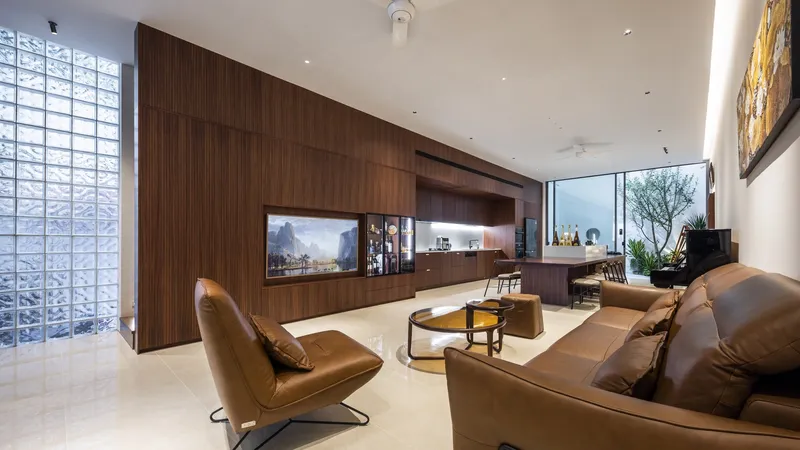
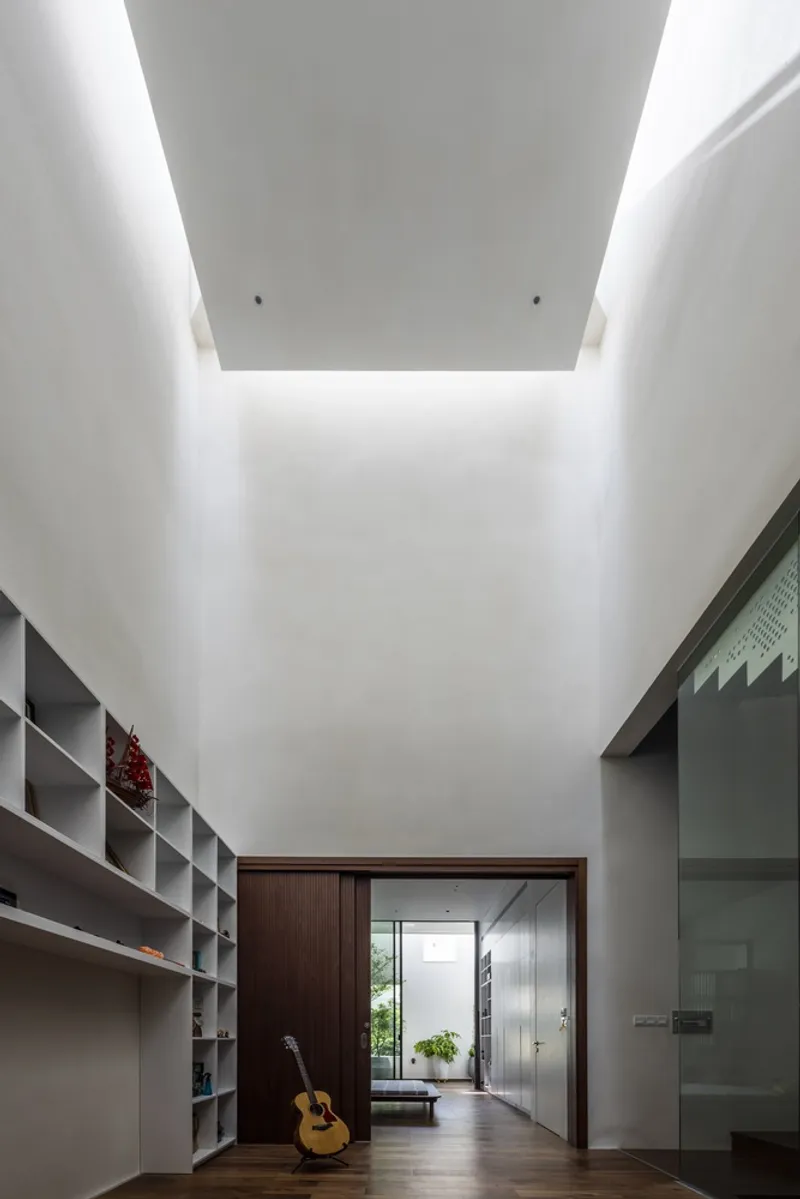
Inside, the palette stays restrained: timber-paneled walls, glass block partitions, and recessed ceiling coves do the heavy lifting. The living room pairs a warm timber accent wall with a glass block screen that scatters daylight into a soft, even glow. It is a quiet room, deliberately underdecorated, allowing the shifting quality of filtered light to provide visual interest throughout the day.
A corridor with built-in shelving and a cove-lit ceiling connects the more public zones to private rooms behind glazed doors. The proportions are tight, as they must be on a 132 square meter footprint, but the consistent deployment of light wells and transparent partitions prevents the compression from feeling oppressive. 23o5Studio's use of products from Technal, Grohe, and Schneider Electric points to an awareness that sustainability claims need to be backed by hardware, not just intentions.
Why This Project Matters
The 140THL House matters because it treats vegetation not as ornament but as infrastructure. Every aperture, screen, and void in the building exists to support plant life, and the resulting thermal and acoustic benefits flow directly from that commitment. In a city where air conditioning is almost a survival necessity, demonstrating a passive alternative at this modest scale is a more useful contribution than any number of speculative masterplans.
It also matters as a replicable idea. Saigon is built overwhelmingly of narrow, deep townhouses on tight lots. 23o5Studio's strategy of splitting the section with planted voids and capping it with a working rooftop garden could be adopted by thousands of similar parcels without heroic structural feats or inflated budgets. That scalability, more than any single photogenic moment, is the real achievement here.
140THL House by 23o5Studio. Ho Chi Minh City, Vietnam. 132 m². Completed 2022. Photography by Hiroyuki Oki.
About the Studio
Share Your Own Work on uni.xyz
If projects like this are the kind of work you want to make, uni.xyz is a place to publish your own, find collaborators, and enter design competitions.




Popular Articles
Popular articles from the community


Riyadh For All: Intergenerational Urban Design for Active Aging in Rabat
Riyadh For All reimagines urban design in Rabat with intergenerational co-living, adaptive courtyards, and Moroccan cultural exchange today.

The Ocean Hive: Sustainable Architecture for a Self-Sufficient Civilization at Sea
The Ocean Hive imagines sustainable architecture at sea, where modular habitats, algae, wave power and ocean waste sustain a growing colony.

The Musturak Paradise: Senior Living Architecture for a Connected Future in Temara, Morocco
The Musturak Paradise reimagines senior living architecture in Temara via private homes, social spaces, culture, community, and shared care.

Co-Life: Senior Housing Design That Reconnects Older Adults With the City
Co-Life reimagines senior housing design through healing gardens, shared streets, workshops, and a sustainable community across generations.


Similar Reads
You might also enjoy these articles


Hodi-Mandai Geram
Project Function: Preservation and revitalization of the Intangible heritage and socio-spatial identity of the Hodi by Housing, Cultural Memory Center, Sacred Grove, landscape, local tourism economy


Olio Towers: A Mid-Rise for Performers That Fuses Housing, Rehearsal, and Stage
Located blocks from Houston's Theater District, this modular tower stacks living units around a central performance atrium.

Oasis: Modular Green Housing Carved into Dhaka's Urban Fabric
A shortlisted Plugin Housing entry reclaims unauthorized settlements in Dhaka with stepped concrete volumes, green roofs, and ventilation-driven design.

Black Hole: A Floating Megastructure for the Post-Physical Era
Emiliano Mazzarotto envisions a spherical, self-scaling arena where e-sports, digital hotels, and holographic stadiums replace traditional public space.


Explore Housing Competitions
Discover active competitions in this discipline



Challenge to reimagine the Iron Throne


Photograph architecture without architects


Illustrate the lost glory of Angkor Wat - Render Challenge


Design challenge to reuse E-waste
Comments (0)
Please login or sign up to add comments
No comments yet. Be the first to comment!