

Matharoo Associates Channels the Ancient Stepwell to Build a Five-Story Sea House Near Surat
In the coastal town of Dumas, a 150-step staircase threads through stacked concrete tubes connecting a freshwater well to the Arabian Sea.


When workers began excavating a residential site in Dumas, a quiet coastal town 20 kilometers from Surat, they unearthed something unexpected: a baori, an ancient freshwater stepwell, buried beneath the remains of a demolished colonial haveli. For most developers this would have been an inconvenience. For Matharoo Associates, it became the organizing principle for an entire house. The 150 Steps Up to the Sea House, completed in 2021 for a jeweler couple and their son's family, takes that well as its lowest point and spirals upward through five floors and 150 steps until it clears the palm canopy and opens to the Arabian Sea on the southwest.
What makes this project genuinely interesting is not its scale or its material palette, though both are striking. It is the decision to treat vertical circulation as the protagonist of the house. The central staircase is not hidden in a service core or tucked beside an elevator shaft. It is the spatial event around which every room, every view, and every encounter with daylight is organized. The void it carves through the building constricts and dilates, pulling natural light from a skylight down to the basement and stitching four generations of one family into a single, continuous spatial sequence.
Stacked Volumes Against the Sky
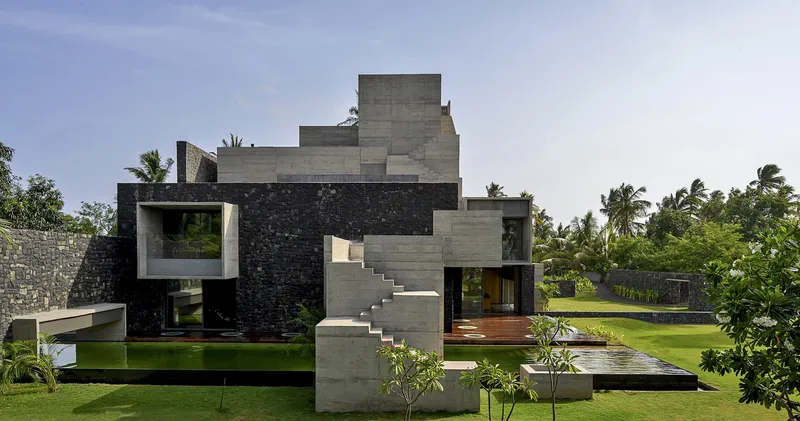
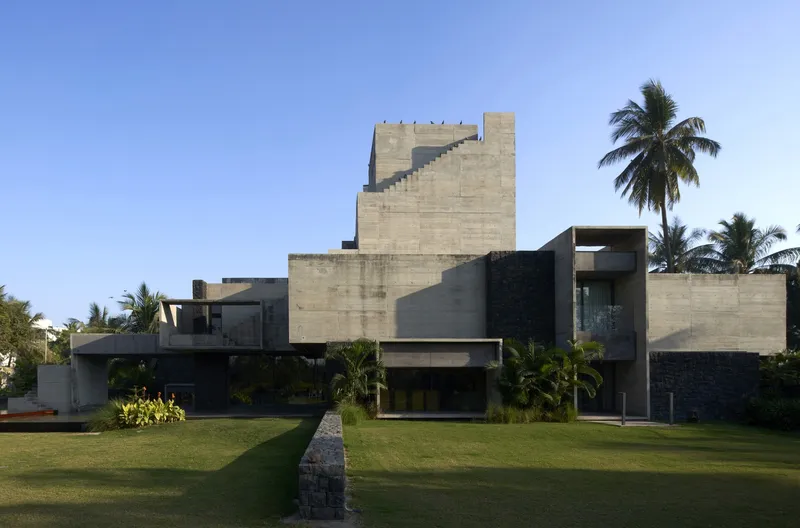

From the garden, the house reads as a cluster of concrete tubes pushed and pulled into a loose stack. The tubes are slender enough to feel distinct from one another yet locked together by their structural logic: a massive stone masonry base on the road side absorbs noise and provides privacy, while the concrete volumes above open toward the calmer, greener interior of the site. Each tube shifts slightly in plan and section, framing a different slice of landscape, whether a palm crown, a strip of ocean, or a wedge of open sky.
The board-formed concrete finish is left raw, registering the grain of the timber formwork and aging in dialogue with the tropical salt air. There is no applied cladding, no color. The material honesty gives the massing its weight and keeps the composition from tipping into sculptural excess. It looks heavy because it is heavy, and that honesty is refreshing.
The 150-Step Stairwell

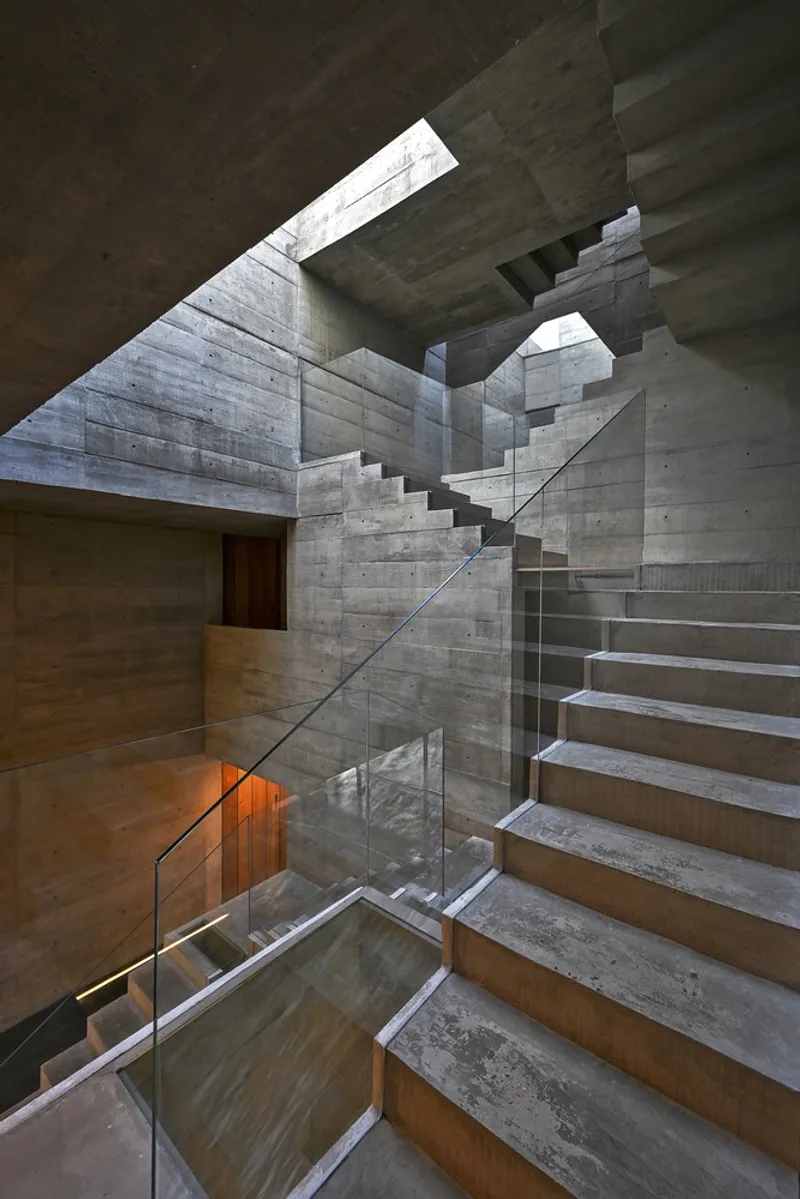
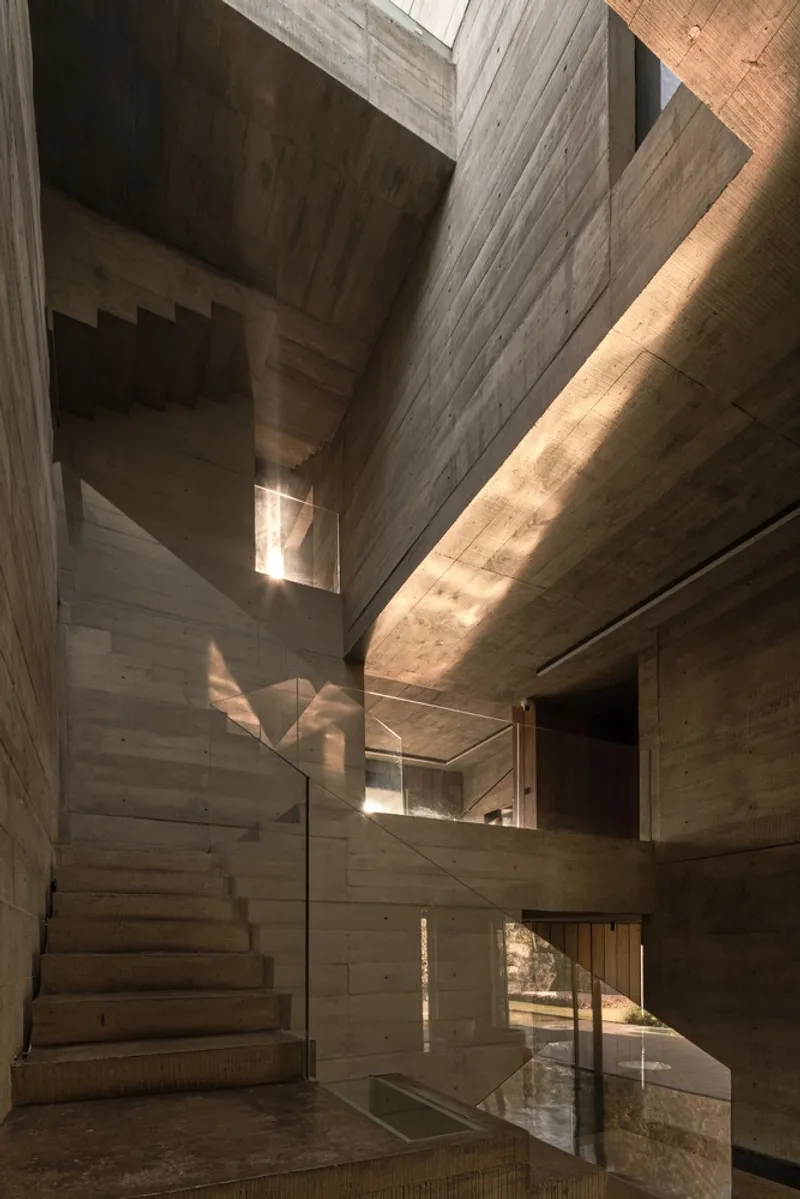
The stairwell is the house's engine. Wrapping around a central void, 150 timber-clad steps ascend from the lowest point of the site, where the rediscovered well sits, to the highest terrace on the southwest. Glass balustrades border the linear flights, catching and reflecting slivers of light that filter down from angular skylights above. The effect changes by the hour: at noon, shafts of direct sunlight slice through the void; in the late afternoon, the light softens to a warm glow against the board-formed walls.
Matharoo Associates drew explicitly on the typology of the baori, the traditional Indian stepwell in which descent into the earth is experienced as a compression of space and temperature. Here the logic is inverted. You ascend, and the space dilates. The stairwell widens and contracts at different landings, creating resting points and intimate thresholds between the public lower floors and the private suites above. It is architecture as choreography: each flight reorients the body and reframes the view.
The Sunken Court and Stone Base
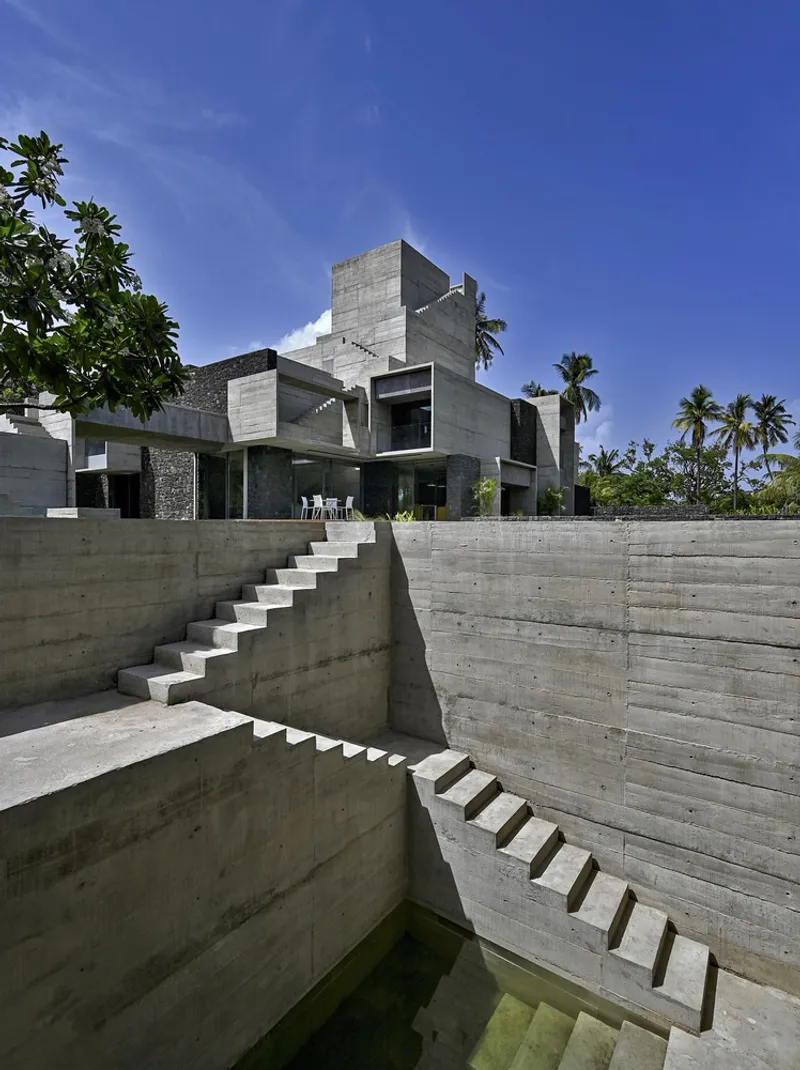
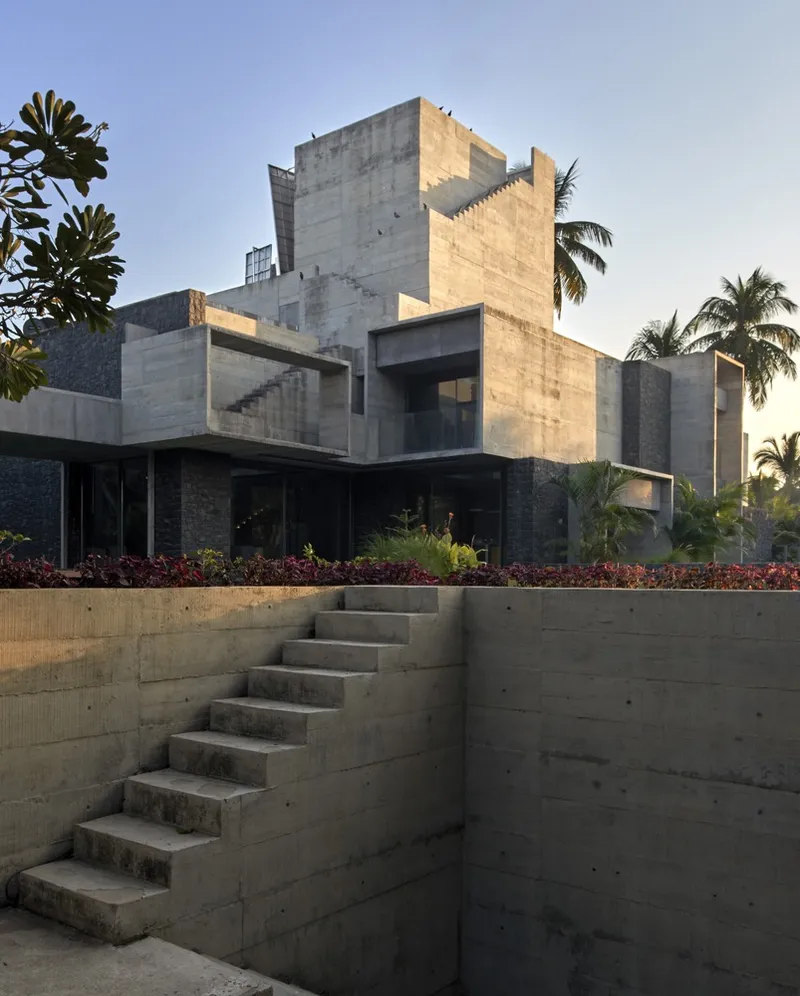

At ground level, high stone masonry walls create a defensive edge along the road, blocking traffic noise and the visual clutter of a rapidly urbanizing coastline. On the interior side, those same walls drop away to reveal a sunken courtyard framed by cantilevered concrete staircases and planted beds. The contrast is deliberate: fortress toward the street, garden toward the family. Dumas was once dotted with havelis built for Nawabs, and the thick-walled, inward-looking plan nods to that precedent without replicating its ornament.
The cobblestone driveway and planted beds at the entrance sequence slow your arrival, establishing a transition from public road to private realm before you ever step inside. It is a simple move, but it sets up the entire experiential arc of the house: compression at the threshold, then gradual release as you move deeper in and higher up.
Living Spaces and the Vaastu Grid
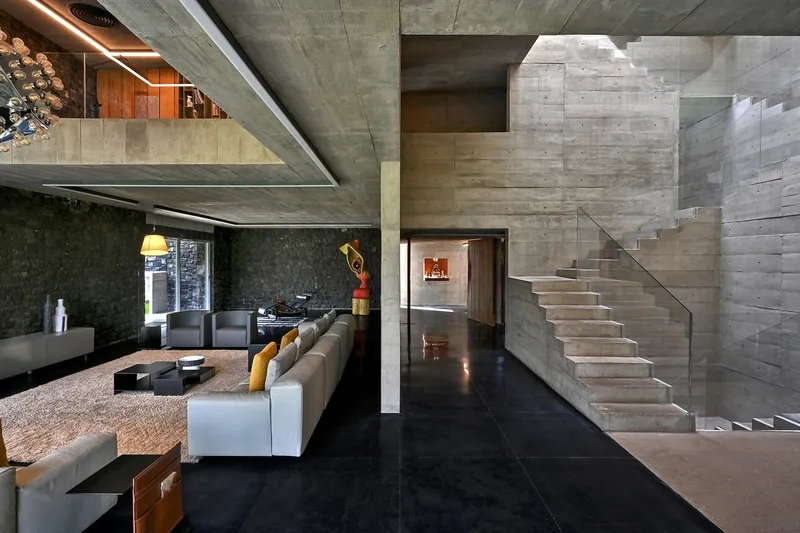

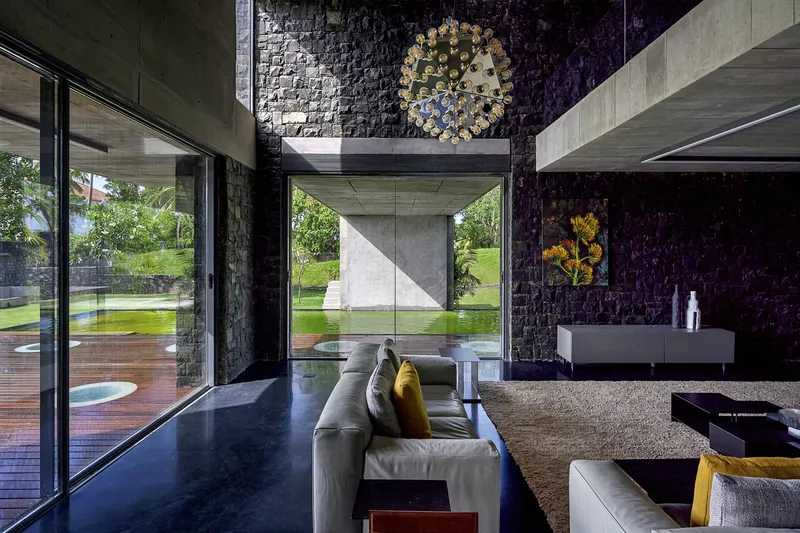
The ground floor organizes communal life around a dark stone-clad living room that opens through floor-to-ceiling glazing onto a reflecting pool and palm-fringed courtyard. A semi-open verandah wraps the corner between the dining area and the swimming pool, collapsing the boundary between inside and out in a way that the tropical climate rewards. The spatial layout follows Vaastu Shastra, the traditional Indian system of aligning rooms to cardinal directions. The temple sits to the compulsory east; the kitchen and utilities occupy their prescribed zones.
Rather than treating Vaastu as a constraint, Matharoo Associates used it as a generative framework, much as a poet uses a sonnet's fourteen lines. The result is a plan that feels disciplined without feeling rigid. Double-height volumes at the living areas amplify the sense of openness, while recessed ceiling lighting washes the dark stone walls in a warm ambient glow that contrasts with the bright tropical daylight outside.
Private Rooms and Intimate Details

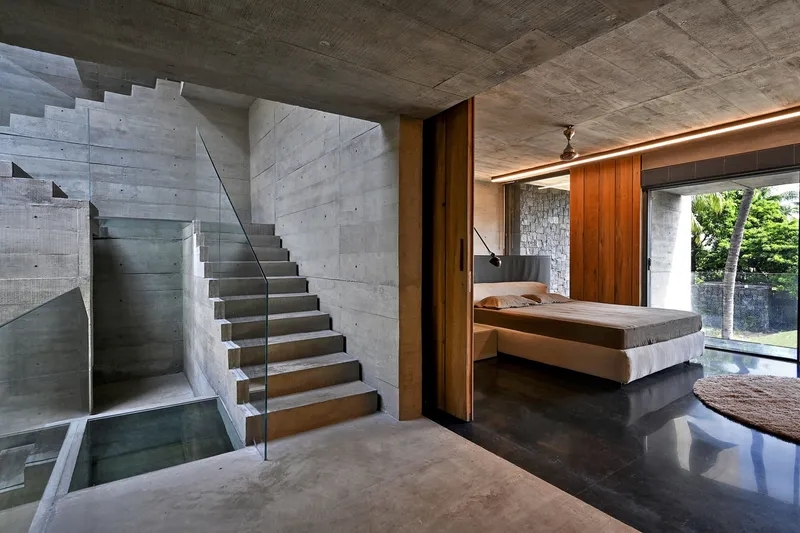
The upper floors house private suites for the extended family, each calibrated to balance privacy with connection. Bedrooms feature vertical timber paneling set against exposed concrete, creating warm interior surfaces that soften the brutalist shell. A cantilevered staircase with timber treads overlooks a bedroom and reflecting pool below, turning even a moment on the stairs into a framed view of domestic life.
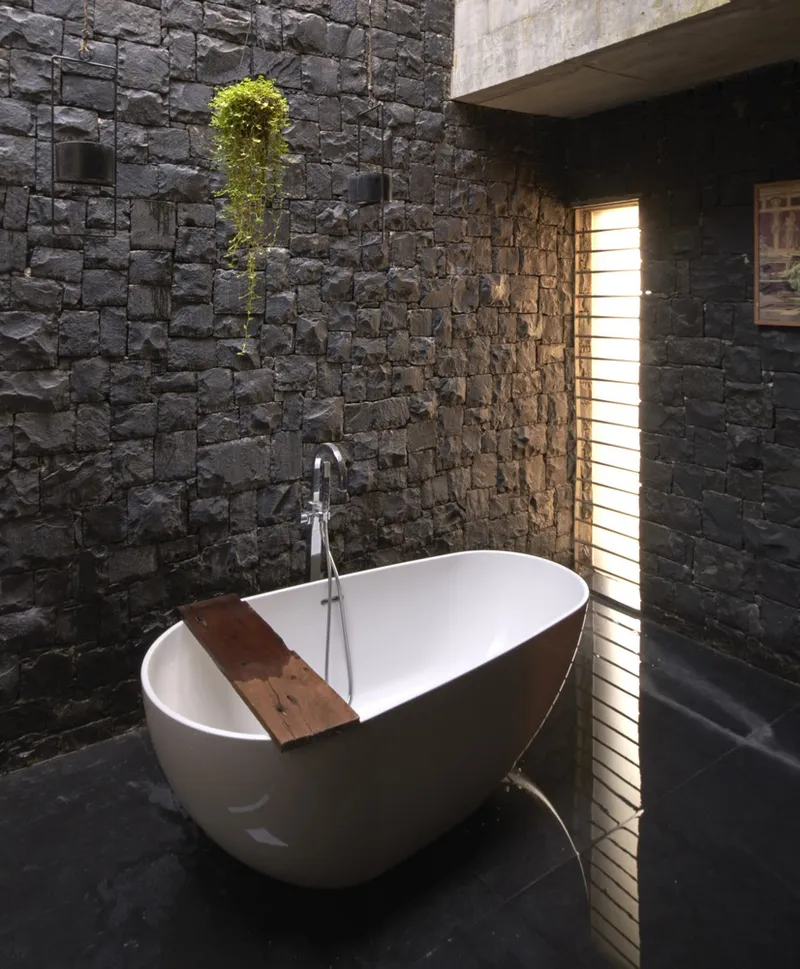
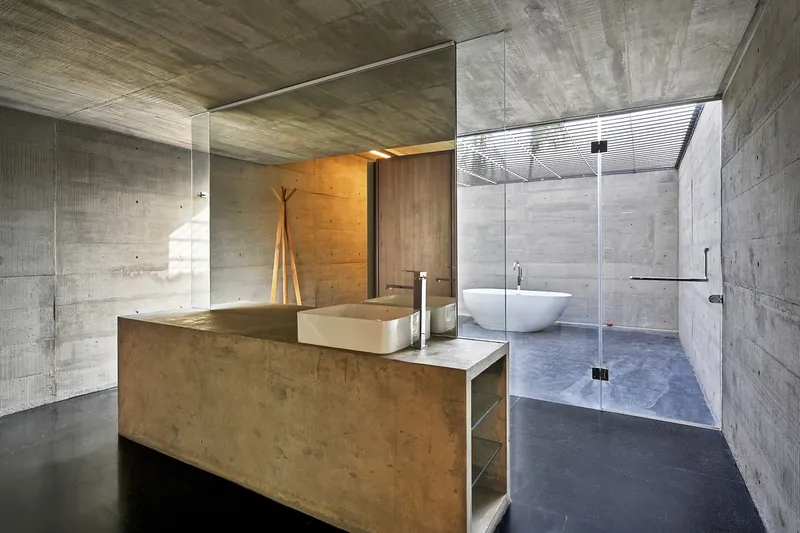
Bathrooms are treated with the same spatial generosity as the public rooms. A freestanding white bathtub sits beside a dark stone wall with a narrow vertical slot window admitting a controlled blade of light and a single plant. Another bathroom uses a glass enclosure to separate the vanity from a tub positioned beneath a skylight. These are not afterthought spaces; they are rooms designed with the same rigor as the stairwell itself.
Dining, Devotion, and Shared Rituals

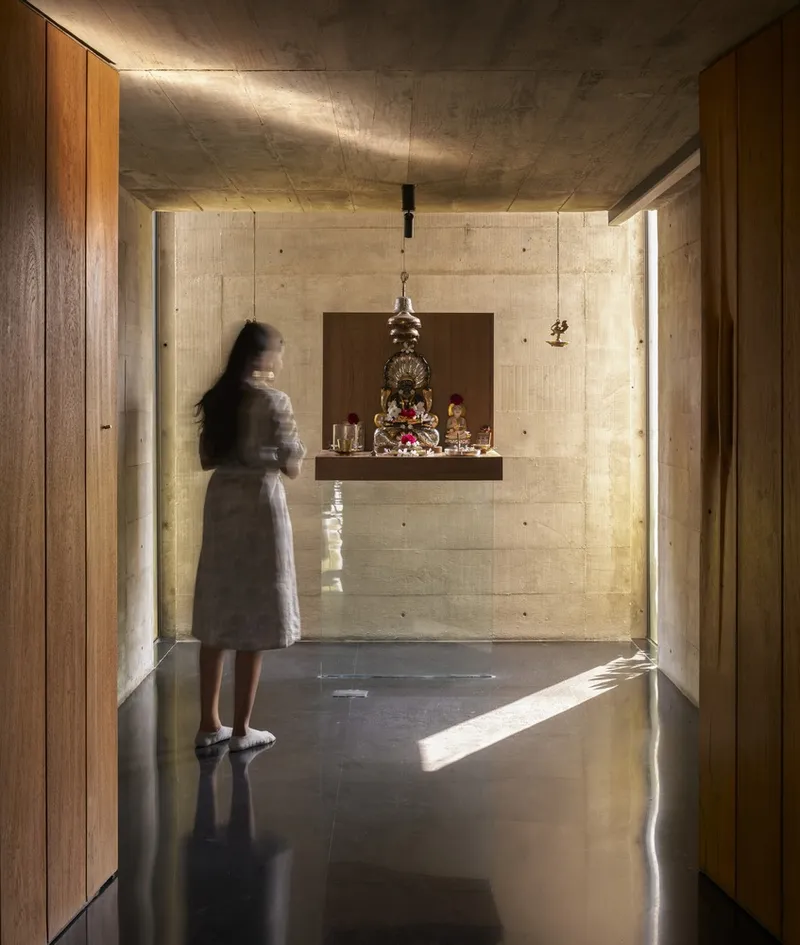
The dining room anchors one end of the communal zone with a dark table, yellow upholstered chairs, and three dome pendant lights hung beneath an exposed concrete ceiling. It is a room designed for gathering, and its proportions feel right for a household spanning four generations. Nearby, a prayer niche carved from board-formed concrete houses a floating timber shelf illuminated by a wash of natural light from above. The material restraint here is notable: no gilding, no colored glass, just concrete, wood, and light.
Together these spaces reveal how the house accommodates both secular and sacred rituals without privileging one over the other. The temple and the dining table exist on the same spatial continuum, linked by the central staircase and the void that ties all floors together.
Night Presence
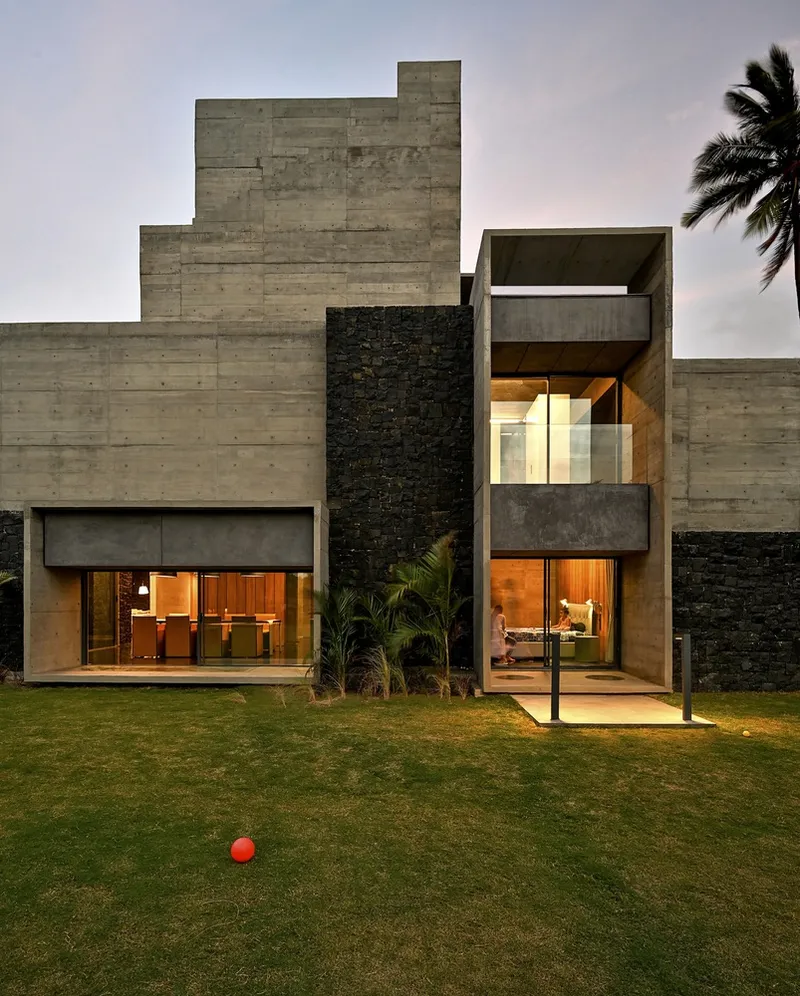
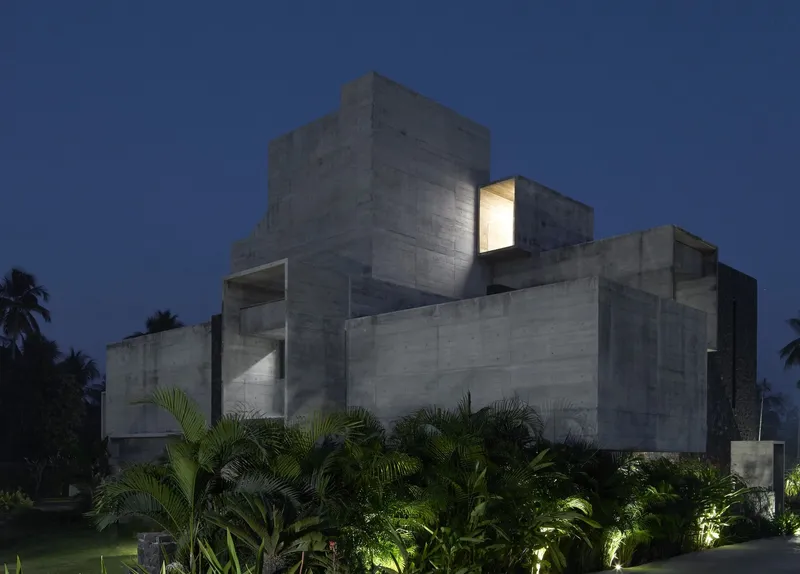

At dusk, the house transforms. Interior lighting turns the concrete tubes into lanterns, their openings glowing against the darkening palm canopy. The stacked volumes, which read as a monolithic composition in daylight, separate into distinct luminous elements at night. The garden elevation reveals the full height of the stepped tower and its relationship to the horizontal landscape beds, stone boundary wall, and lawn. It is a building that rewards observation at different times of day, and the photographers have captured both states with clarity.
Plans and Drawings
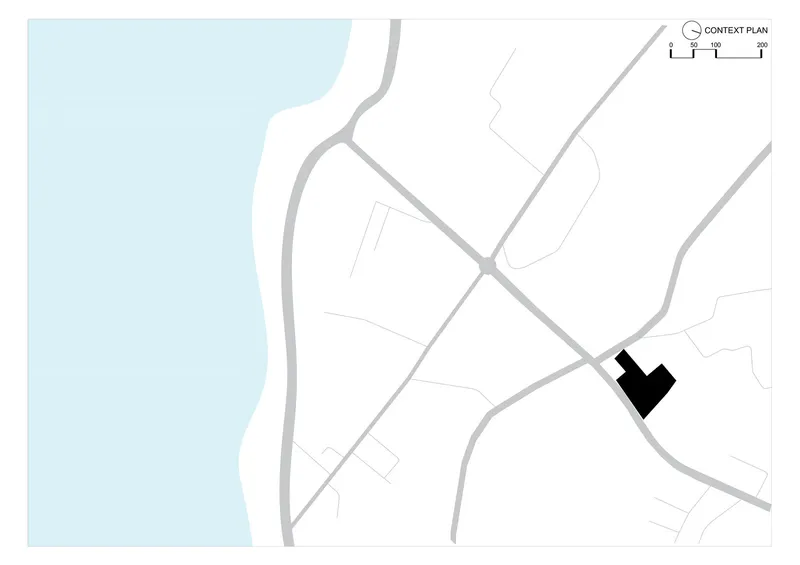
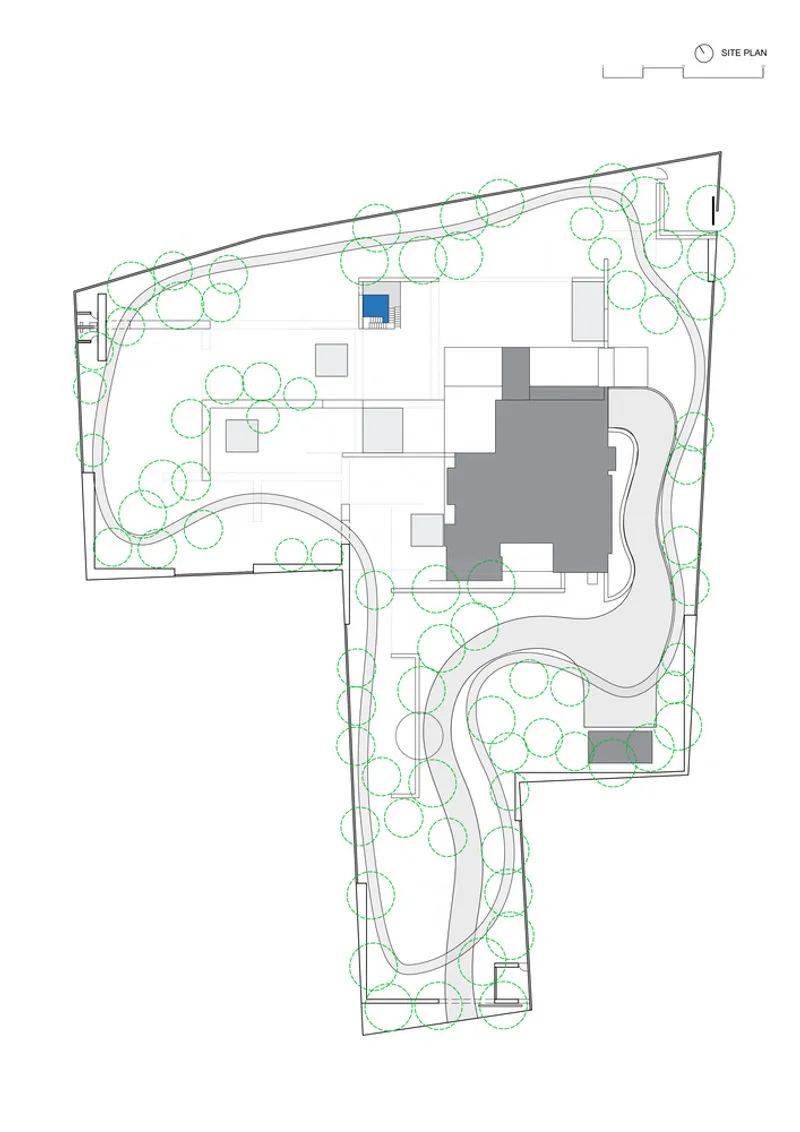
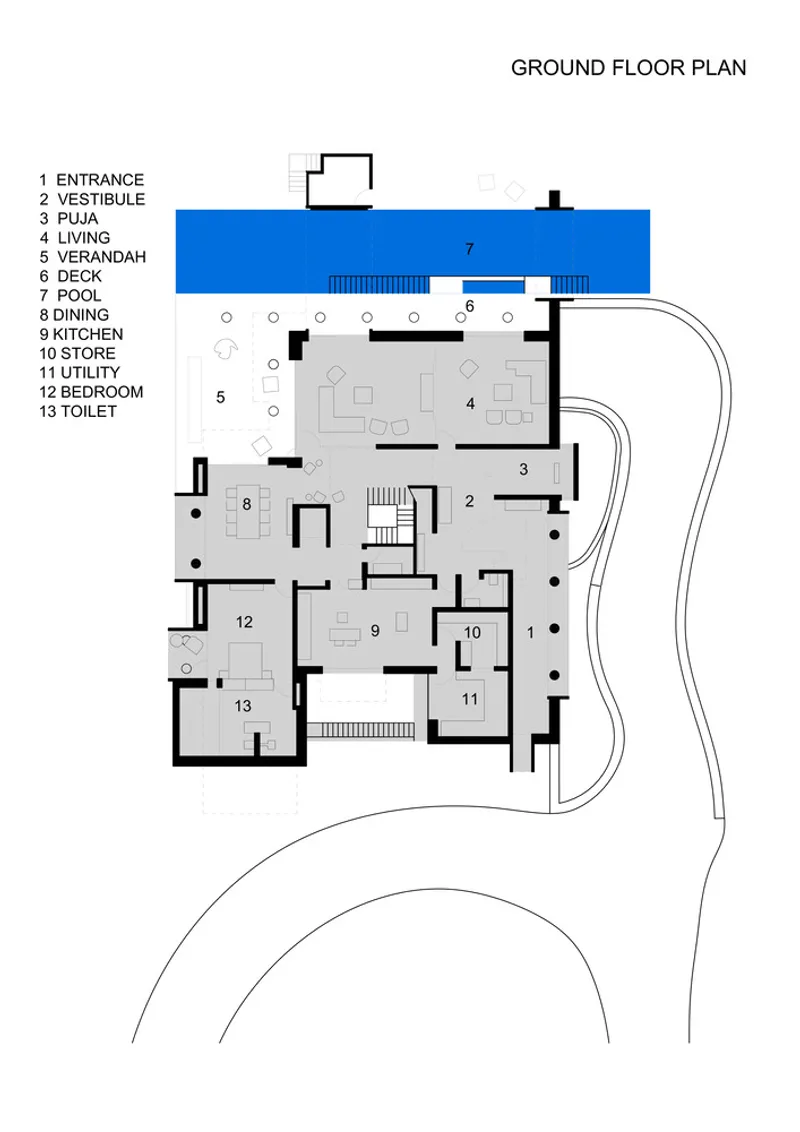


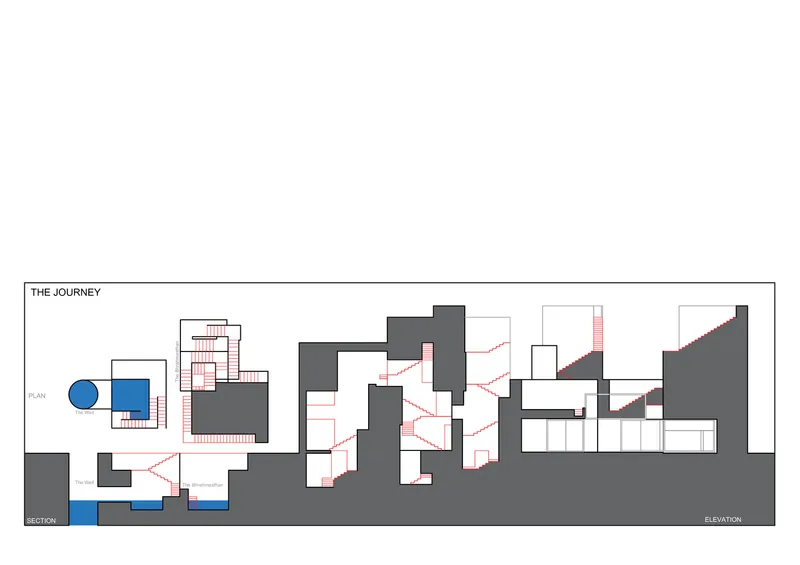
The context plan locates the house relative to the street network and the waterfront, confirming how close the Arabian Sea actually is. The site plan shows the building footprint surrounded by circular tree canopies and curving garden paths. At the ground floor, the pool deck, entrance sequence, and communal rooms cluster around the central void, while the first floor redistributes the plan into bedrooms, a library, and dressing rooms arranged around the staircase core.
The section and elevation drawings are where the project's ambition becomes fully legible. The cross section reveals how the staggered volumes step down the site's natural slope, embedding the house into the terrain rather than sitting on top of it. A blue-highlighted pool element punctuates the composition. The composite diagram traces the circulation path in red through the terraced volumes, making explicit what the photographs only imply: every room in this house is organized by the act of moving through it.
Why This Project Matters
In a region where new residential construction often defaults to imported styles or gated-community templates, the 150 Steps Up to the Sea House demonstrates that tradition can be a source of invention rather than nostalgia. The stepwell is not reproduced as ornament or metaphor; it is reinterpreted as a spatial strategy that gives the house its structure, its light, and its experiential logic. Vaastu Shastra is not resisted or dismissed but absorbed into a plan that feels genuinely contemporary. The project proves that working within inherited systems does not mean surrendering design agency.
Matharoo Associates have built a house that asks its inhabitants to participate in its architecture every time they climb a flight of stairs. That is a rare ambition in residential work, where convenience usually trumps experience. Here, the 150 steps are not an inconvenience but a proposition: that the journey between a well in the earth and a view of the sea is worth taking slowly, one step at a time.
150 Steps Up to the Sea House by Matharoo Associates. Dumas, Surat, India. 1,280 square meters. Completed 2021. Photography by Dinesh Mehta and Edmund Sumner.
About the Studio
Share Your Own Work on uni.xyz
If projects like this are the kind of work you want to make, uni.xyz is a place to publish your own, find collaborators, and enter design competitions.


Popular Articles
Popular articles from the community


LT2A and OPEN Architectes Thread a Brick and Glass High School Through a Wooded Belgian Campus
In Braine-l'Alleud, a 3,000 m² wing for Collège Cardinal Mercier pairs pale brick with a glazed colonnade, deferring to a small chapel and a dense wood.

U.GA Architects Wraps an Oval Rooftop Pool in Curved Board-Formed Concrete on Busan's Jeollidan-gil
In Busan's Jeonpo-dong, a 454 m² mixed-use block stacks a neighborhood facility, guest rooms and an oval rooftop pool inside spiraling concrete walls.

longwave studio Reorganizes a 112 m² Tainan Apartment Around the Daily Routines of a Family and Two Cats
In Tainan, Taiwan, birch plywood, rust-red furniture and a freestanding plaster wall link arrival, storage, work and family life in one apartment.

Cube Design Draws an Ecological Corridor Between Two Shenzhen Hills with the Nankai Building
Beside Shenzhen's container docks, the Nankai Building pairs stacked balconies with a climbing green screen to connect two hillsides across its height.

Similar Reads
You might also enjoy these articles


Hodi-Mandai Geram
Project Function: Preservation and revitalization of the Intangible heritage and socio-spatial identity of the Hodi by Housing, Cultural Memory Center, Sacred Grove, landscape, local tourism economy


Olio Towers: A Mid-Rise for Performers That Fuses Housing, Rehearsal, and Stage
Located blocks from Houston's Theater District, this modular tower stacks living units around a central performance atrium.

Oasis: Modular Green Housing Carved into Dhaka's Urban Fabric
A shortlisted Plugin Housing entry reclaims unauthorized settlements in Dhaka with stepped concrete volumes, green roofs, and ventilation-driven design.

Black Hole: A Floating Megastructure for the Post-Physical Era
Emiliano Mazzarotto envisions a spherical, self-scaling arena where e-sports, digital hotels, and holographic stadiums replace traditional public space.

Explore Architecture Competitions
Discover active competitions in this discipline

Challenge to reimagine the Iron Throne

Photograph architecture without architects

Illustrate the lost glory of Angkor Wat - Render Challenge

Design challenge to reuse E-waste
Comments (0)
Please login or sign up to add comments
No comments yet. Be the first to comment!