
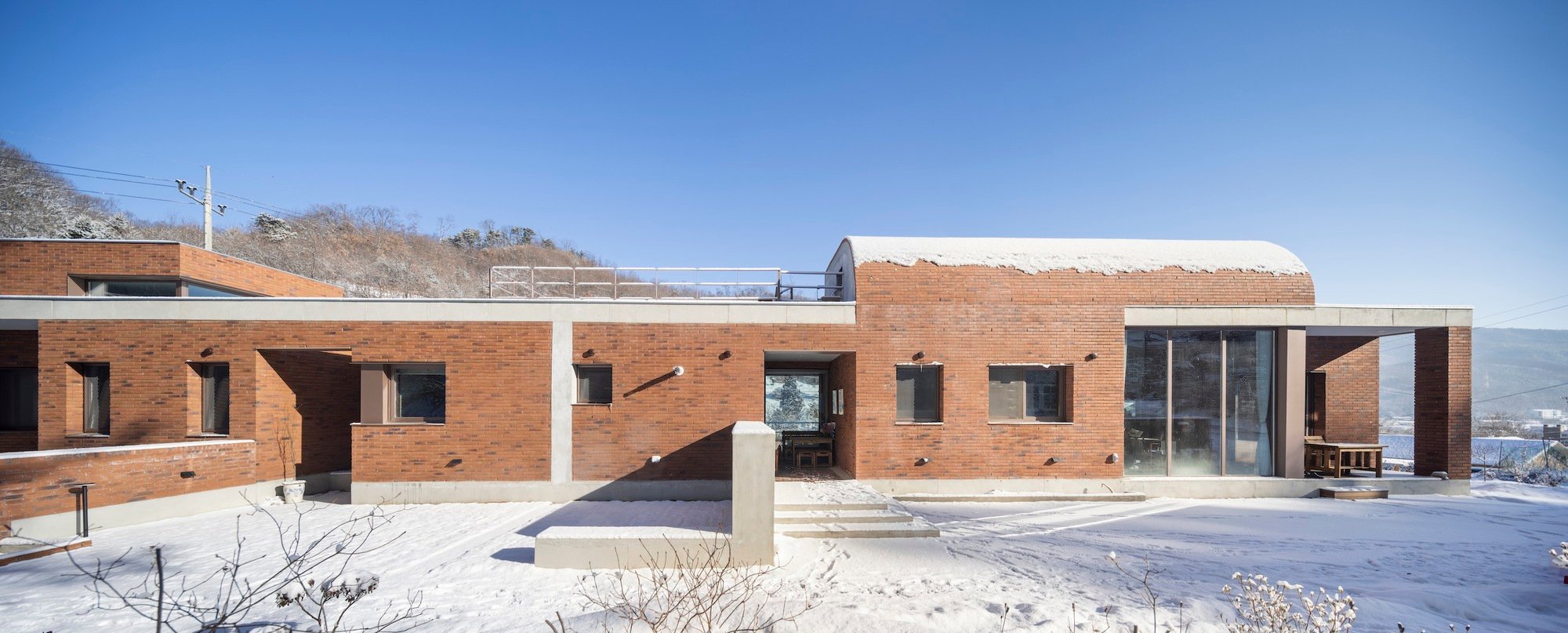
1990uao Stretches a Brick House Across a Korean Hillside Like a Village Wall
In rural Pocheon, a 150 m² corridor-house threads between two cultivated terraces, trading domestic hierarchy for a democratic sequence of rooms.

Walk up a quiet village lane in Pocheon's Gachae-ri district, past small houses that grow sparser as the road climbs, and eventually you reach two large rocks standing like gateposts at the entrance of a hill. Beyond them sits a long brick building that does not look like a conventional Korean house. Designed by Seoul-based 1990uao and led by Yoon GeunJu, Pocheon House stretches laterally across a sloped site, dividing the land into an inner courtyard and an outer landscape of creek views, forest, and layered mountain ridgelines. At 150 m², it is modest in area but expansive in ambition: the house reimagines domestic layout by eliminating any central room and arranging every space along a single common corridor.
What makes the project genuinely interesting is its refusal to privilege one room over another. Living room, kitchen, bedrooms: each is an independent volume plugged into the corridor with equal standing. The result is closer to a small village street than a traditional floor plan. The site itself was already organized in two levels, one formerly holding a farm machinery warehouse and the other a plastic greenhouse. Rather than re-grading the terrain, 1990uao accepted these two cultivated plateaus as given topography and placed the new house on the larger ground where the warehouse once stood, connecting the levels with stairs and a bridge. It is a house that belongs to its slope rather than imposing on it.
A Horizontal Presence in the Valley
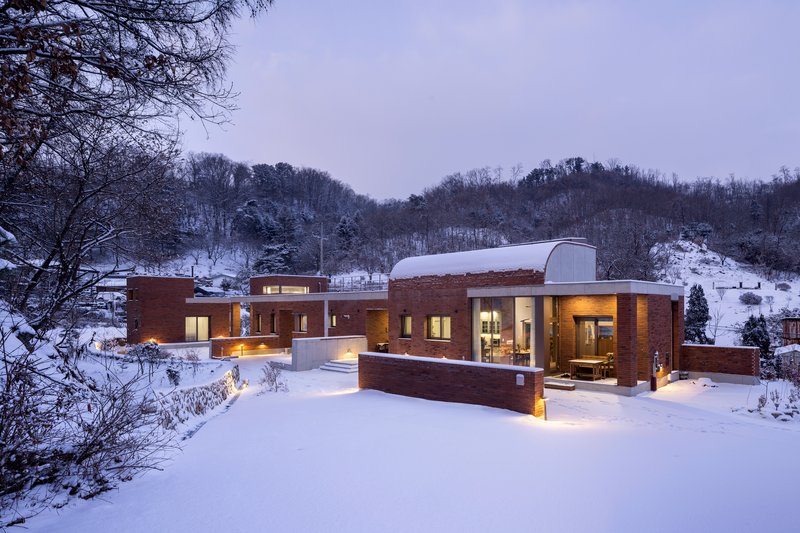
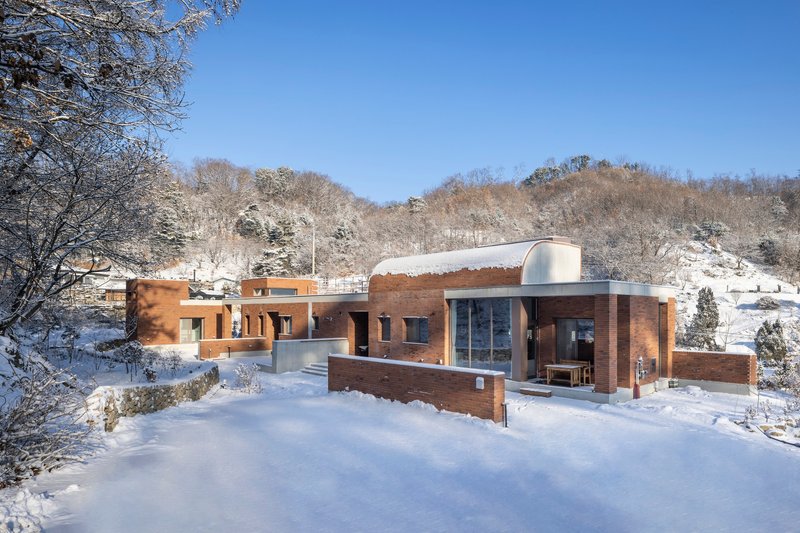
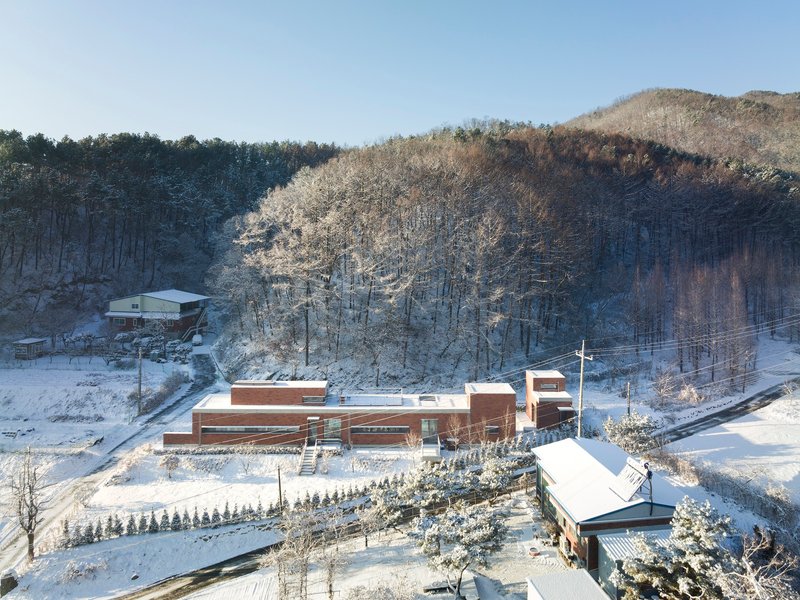
Pocheon House reads as a low, insistent line drawn across the hillside. The barrel-vaulted roof segments give vertical relief without puncturing the tree canopy, while the brick cladding ties the building to the earth tones of the surrounding terrain. Seen from a distance in winter, with snow blanketing the site, the warm red of the masonry becomes a quiet landmark in the valley. The elongation is not arbitrary: the house's footprint follows the long axis of a triangular lot, maximizing frontage to the views while minimizing the building's depth and its visual impact on the lane.
From above, the strategy becomes even clearer. The curved green roof wraps the stepped volumes, softening what could be a rigid composition and letting the building merge with the foliage in summer. The rooftop terraces register as open-air rooms within the landscape, extending the inhabitable surface beyond the 150 m² interior.
Brick and the Boundary Between Lane and Garden
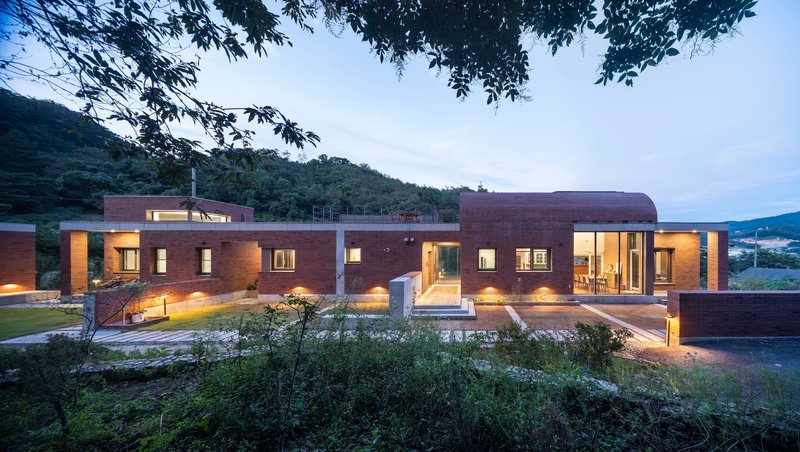


On the village lane side, the house presents itself through low, elongated window bands rather than a conventional fence. It is a deliberate openness: the landscape of small gardens, forests, and fields on the lower ground remains visible to passersby, while the building itself acts as the boundary between public lane and private inner yard. The ribbon windows glow at dusk, turning the facade into a lantern that signals habitation without exhibitionism.
The brick detailing rewards close attention. Mortar joints are precise, and the material's scale relates naturally to the modest houses nearby. In morning light the horizontal bands of window openings cast crisp shadows across the masonry, reinforcing the building's linearity. Planted beds at the base of the wall anchor the composition to the ground and blur the transition from architecture to garden.
Courtyard as Connector
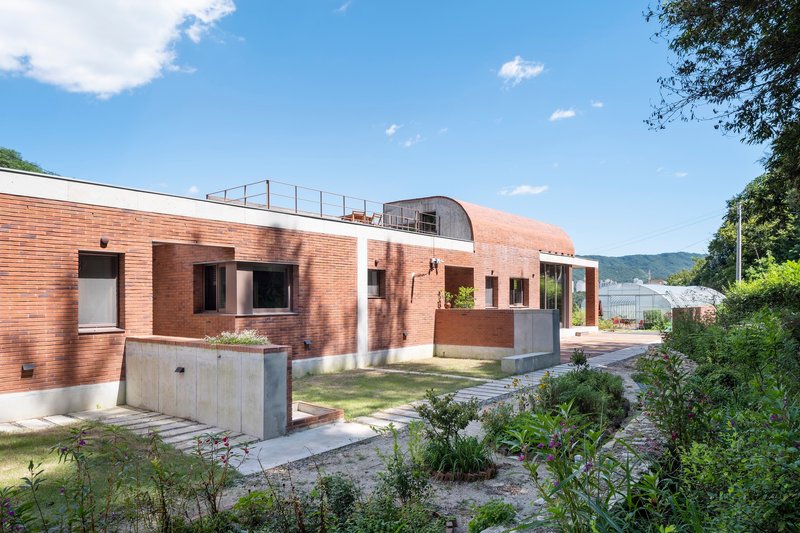

The inner yard is where the house's social logic plays out. Because the long building separates this courtyard from the exterior landscape, the yard becomes a sheltered zone that looks toward the client's mother's house at the end of the road while embracing the surrounding hilly terrain. It is simultaneously inward-looking and panoramic. The barrel-vaulted roof segments create interstices in the building's mass, allowing views to penetrate between inside and outside.
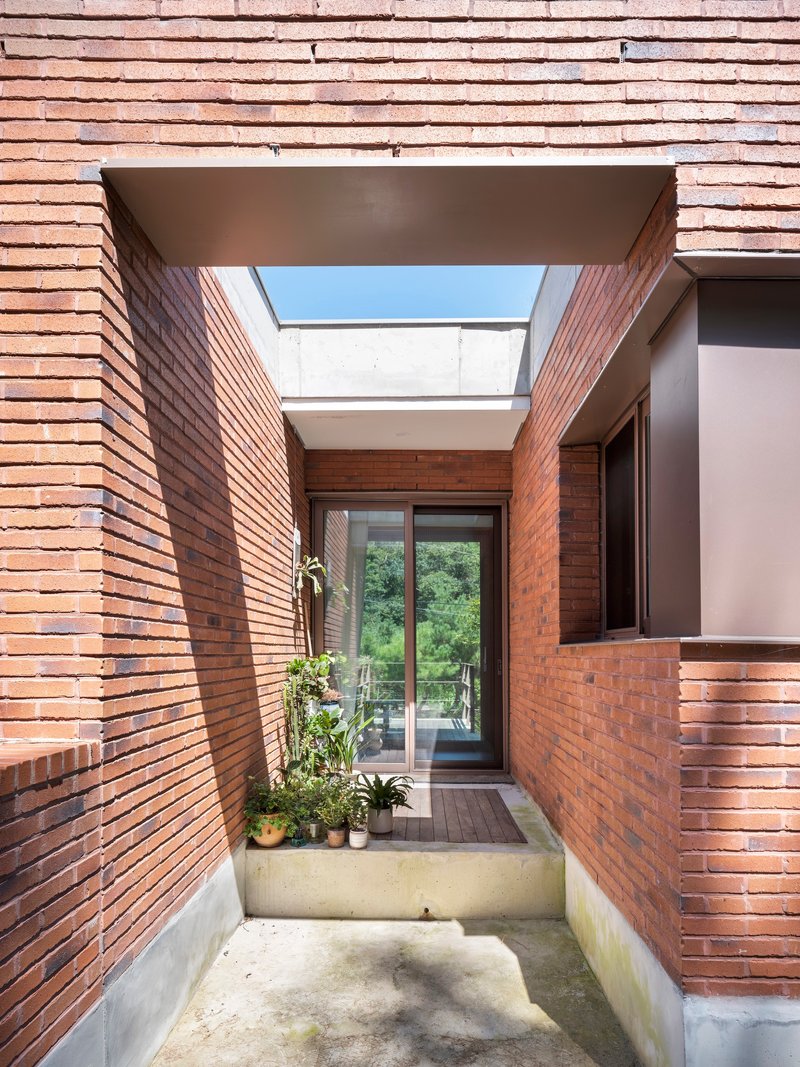
A brick-lined entry court with a skylight overhead and potted plants along a concrete base sets the tone on arrival. Concrete planters line the base of the exterior walls, and the rooftop terrace visible from the aerial view doubles as an extension of the courtyard when approached from above. The effect is of a compound rather than a single dwelling, a series of thresholds rather than a single front door.
The Corridor as Organizing Principle

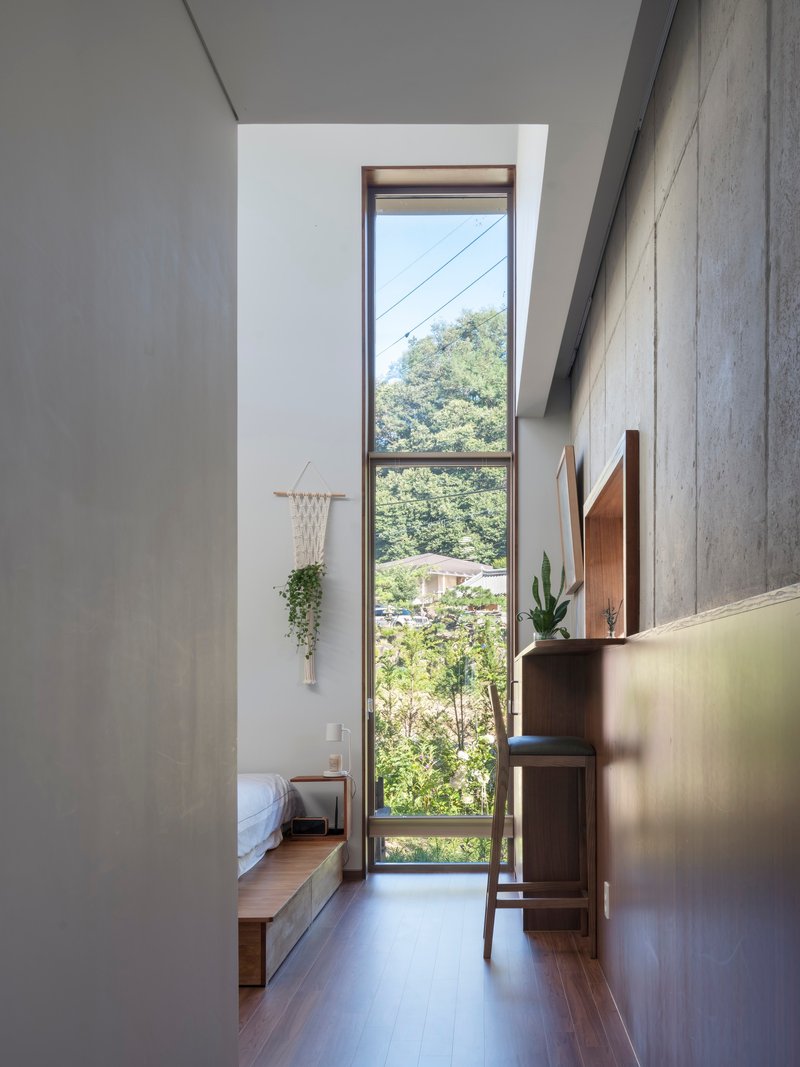

Inside, a board-formed concrete wall runs the length of the corridor, giving the spine of the house a material weight distinct from the brick exterior. Timber cabinetry lines one side, and clerestory windows above pull daylight deep into the plan without sacrificing privacy. The corridor is not a leftover hallway: it is the primary social space, the datum from which every room departs.
Tall vertical windows at the corridor's narrowest points frame precise views of hillside foliage, turning what could feel like a compressed passage into a sequence of landscape vignettes. The rooms themselves connect back to the corridor through sliding partitions and open thresholds, so that the degree of enclosure is always a choice of the inhabitant rather than a fixed condition of the plan. This is what 1990uao means by an "open social structure": no room dominates, and various lifestyles can be organized according to each resident's preference.
Rooms That Hold Their Own
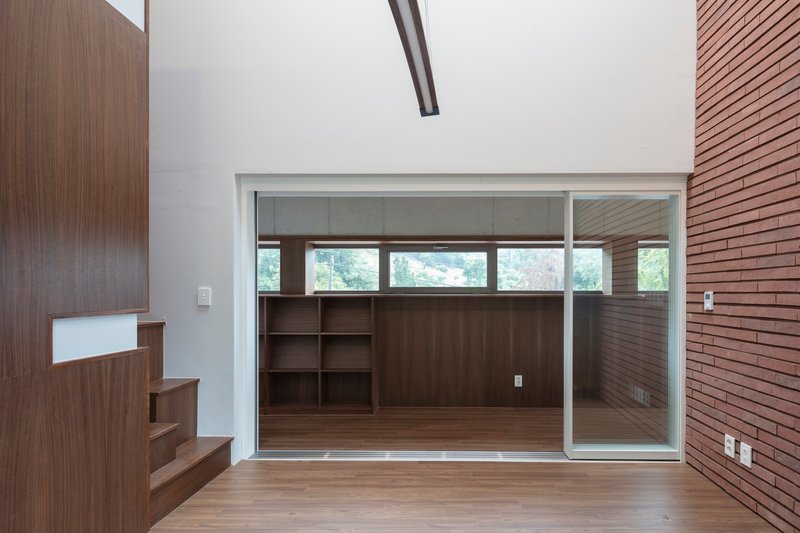
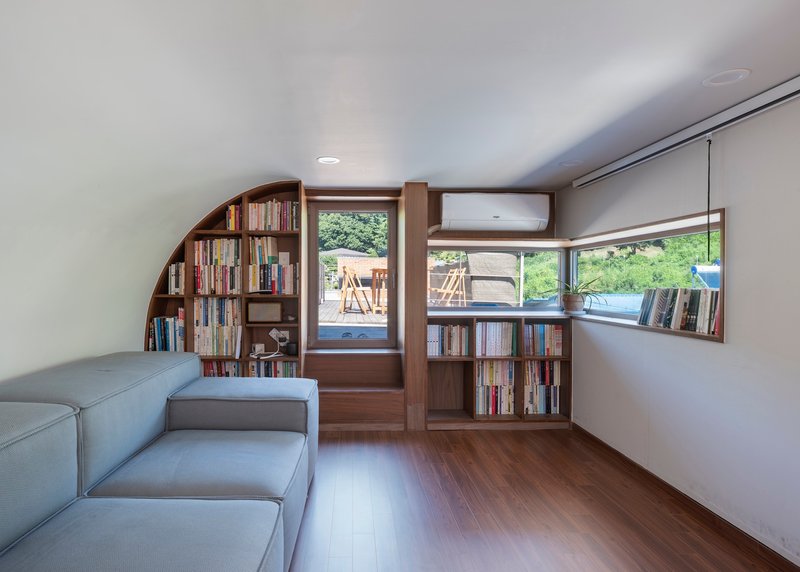
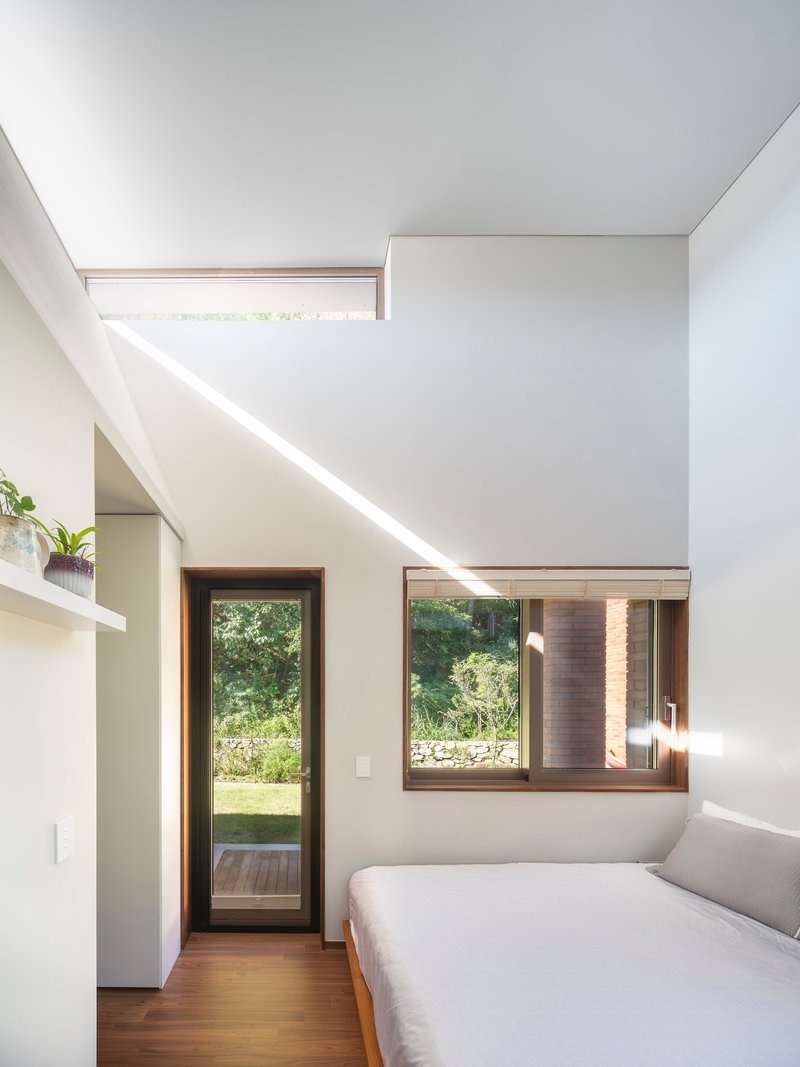
Each room along the corridor possesses a distinct character. A double-height space with a timber stair and glazed sliding partition opens to an adjacent room filled with built-in shelving, creating a library-like atmosphere that can be joined or separated at will. Elsewhere, a reading room with curved timber bookshelves and corner windows overlooks the surrounding greenery with the intimacy of a treehouse. Bedrooms receive high clerestory slots that wash walls in afternoon light while keeping sightlines above the grade of the courtyard.
The material palette inside is restrained: white walls, exposed concrete, and warm timber for shelving, stairs, and ceiling linings. Nothing competes with the landscape visible through every window. The curved brick interior wall in the dining area, lit from above by a skylight, is the one moment where the architecture announces itself loudly, and even that gesture serves a practical purpose: the vault directs light downward onto the table, reducing the need for artificial lighting during the day.
Living Between Inside and Outside
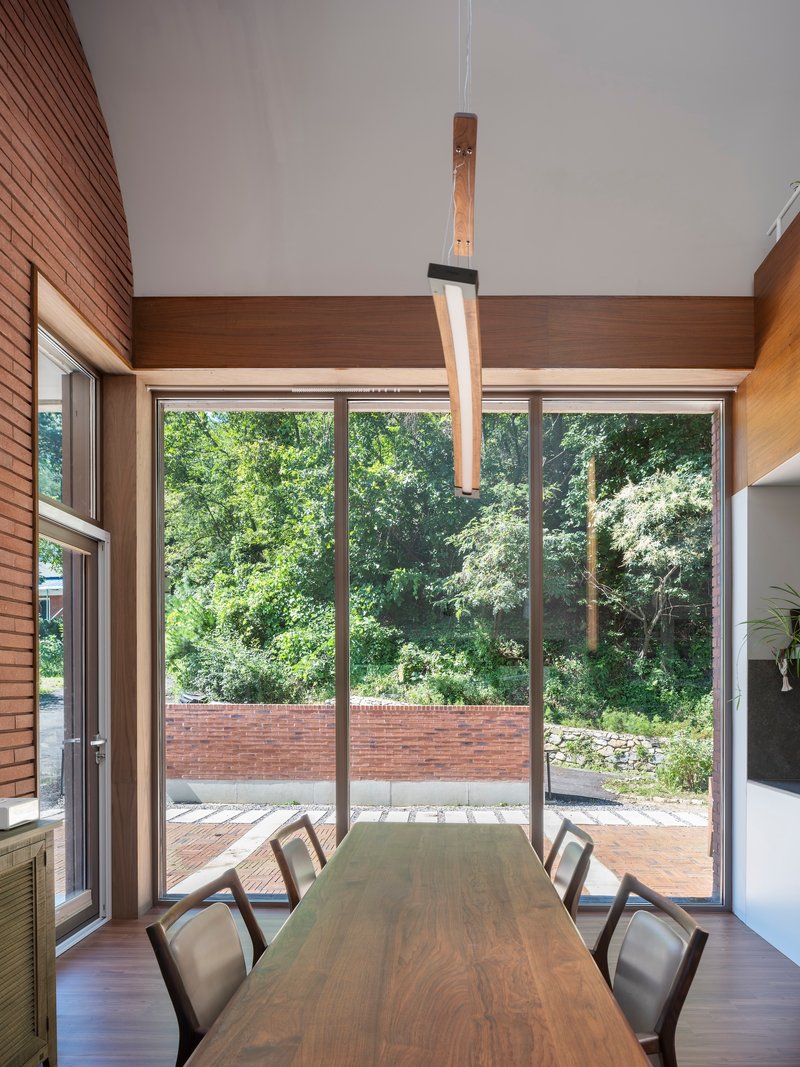
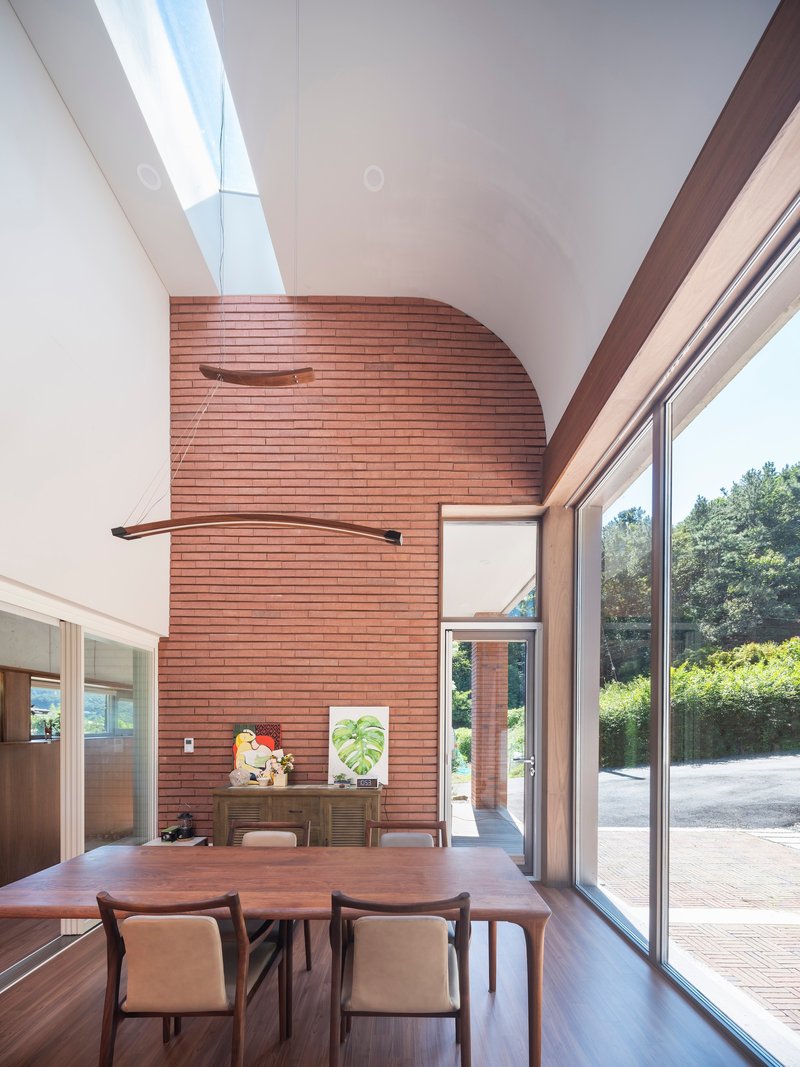
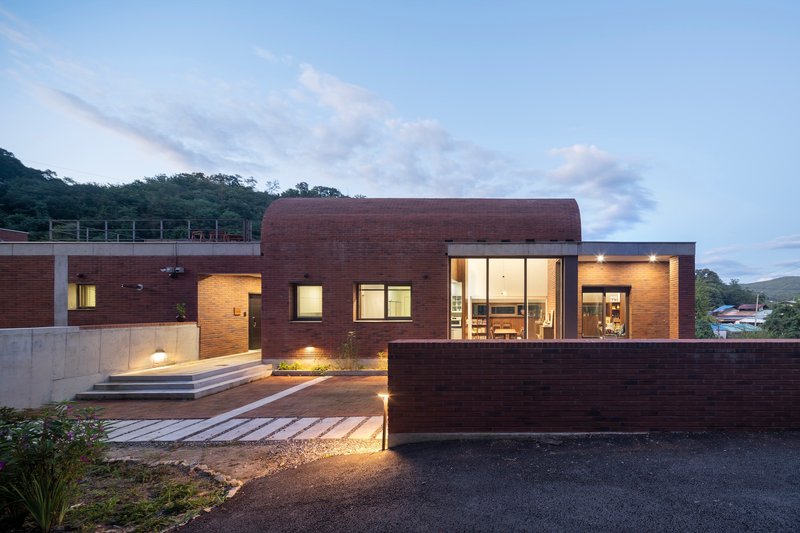
The dining room and kitchen have the strongest connection to the exterior. Glazed walls slide open to a brick-walled garden terrace, collapsing the boundary between cooking and courtyard. A timber pendant light marks the center of the dining table, and the view through the glass encompasses the planted beds, the brick enclosure, and the hills beyond. At dusk, the timber walkway connecting the stepped volumes becomes an outdoor living room in its own right, lit from within by the warm glow of adjacent interiors.
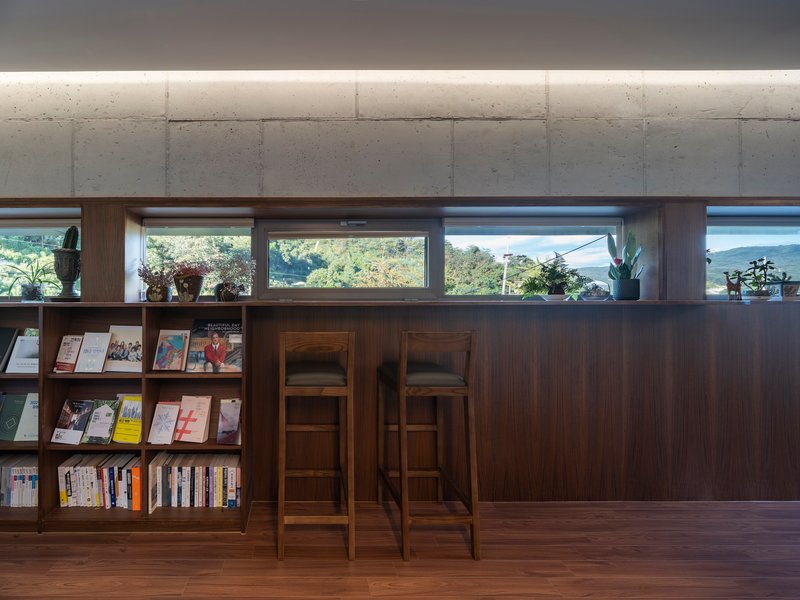
The counter space with timber bookshelves and stools below a band of clerestory windows suggests a way of living where reading, eating, and watching the weather are not compartmentalized activities but part of a single flow. Pocheon House does not romanticize rural life; it simply removes the barriers that suburban conventions erect between a person and the landscape they chose to live in.
The Roof as Landscape
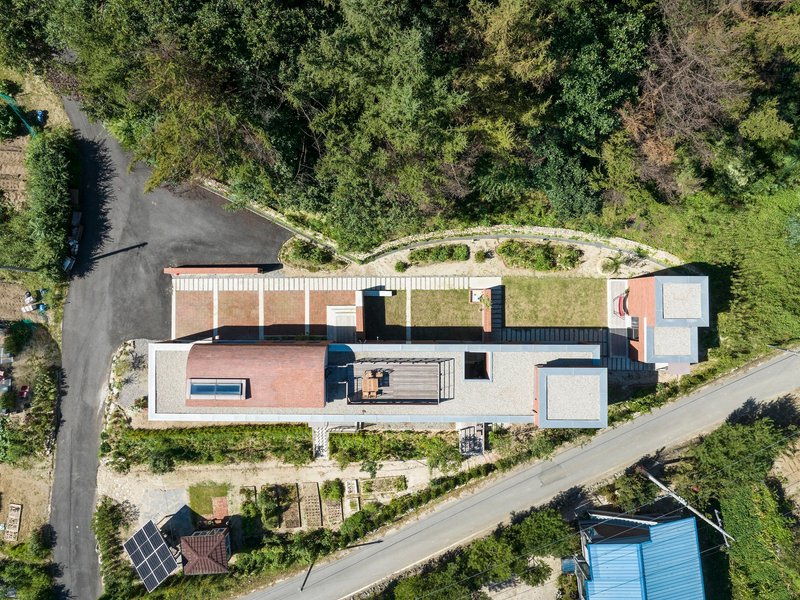
From above, the green roof reads as a continuation of the hillside itself. The curved surfaces wrap around the stepped volumes, concealing the mechanical realities of the rooftop while creating a fifth facade visible from the higher terrain and from the mother's house at the end of the road. It is a generous gesture: the house gives back to its context the green surface it consumed.
Plans and Drawings
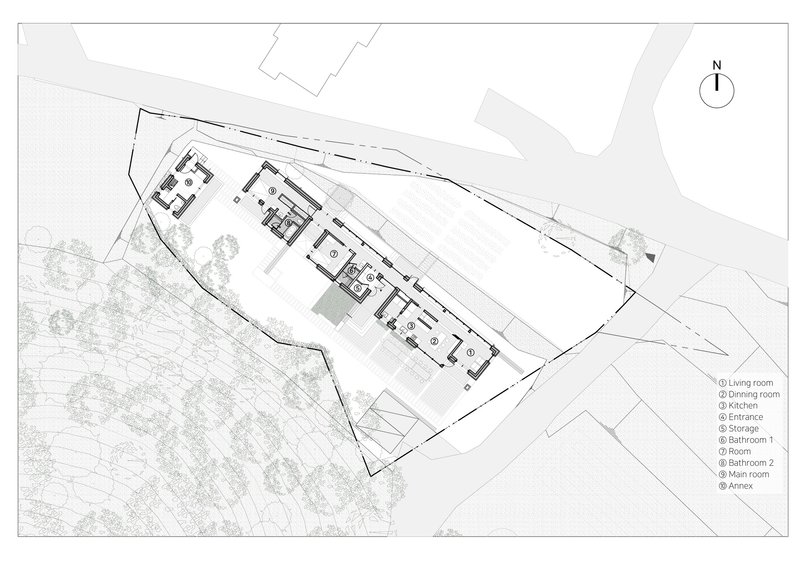
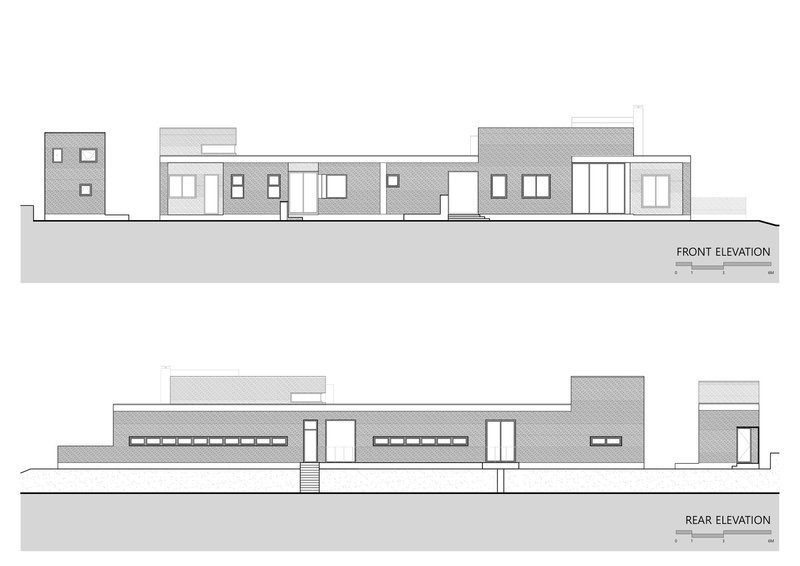

The site plan confirms the elongated footprint stretched across a triangular sloped lot, with existing trees preserved around the perimeter. Elevation drawings reveal the massing strategy: varied heights across the volumes prevent the long facade from feeling monotonous, while window openings are clustered and sized to respond to the orientation and program of each room. The section through the hillside is the most revealing drawing, showing how the interior levels step with the terrain and how the corridor serves as a spine linking the upper yard to the lower landscape via stairs and a bridge.
Why This Project Matters
Pocheon House challenges two ingrained assumptions about rural Korean residential design. The first is that a house needs a hierarchy of rooms with a living room at its center. By distributing every room along a corridor in a horizontal, egalitarian arrangement, 1990uao proposes that a house can function more like a small settlement, with residents choosing their room according to mood, season, or social situation rather than convention. The second assumption is that a rural house should be a discrete object sitting in its garden. Here the house is the garden wall, the lane boundary, and the topographic connector all at once.
At a time when many rural houses in South Korea default to standardized developer templates or overwrought sculptural gestures, Pocheon House offers a third path: specific, site-literate, and spatially generous within a compact footprint. The corridor is not a new invention, but using it to flatten domestic hierarchy while simultaneously stitching together two levels of cultivated terrain is a move that earns its complexity. This is a house that asks you to walk its full length before you understand it, and rewards you for doing so.
Pocheon House, designed by 1990uao (design team: Yoon GeunJu, Park JinYoung, Min KyungHyun). Located in Gachae-ri, Pocheon-si, South Korea. 150 m². Completed in 2021. Photography by Namgoong Sun.
About the Studio
Share Your Own Work on uni.xyz
If projects like this are the kind of work you want to make, uni.xyz is a place to publish your own, find collaborators, and enter design competitions.




Popular Articles
Popular articles from the community

Shinkō Komyuniti: Public Space Architecture Reimagining Sport, Culture and Community in Tokyo
Shinkō Komyuniti transforms sports spectatorship into public space architecture that reconnects play, culture, community and Tokyo life now.
POP ART: Adaptive Reuse Architecture as a Cultural Intervention in Sydney
POP ART reimagines an unused Sydney warehouse through adaptive reuse architecture, creating a bold cultural landmark above the city streets.

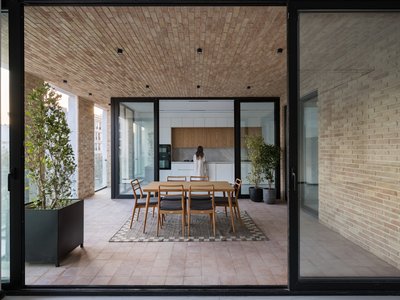
DIM Architecture Studio Revives the Iranian Courtyard Inside a Mashhad Apartment Building
A 2,500-square-meter mid-rise infill project reinterprets the traditional hashti and central courtyard within the dense urban fabric of Mashhad, Iran.
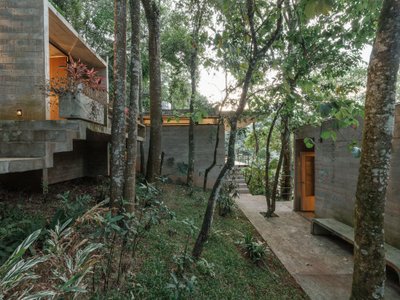
Terra e Tuma Scatters Four Concrete Pavilions Through the Atlantic Forest in Mairiporã
A fragmented compound of music studio, art studio, chapel, and living quarters preserves every tree on a steep forested hillside near São Paulo.


Similar Reads
You might also enjoy these articles
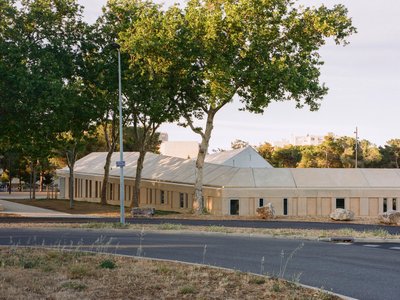
School Group Samuel Paty in Béziers: A Contemporary Educational Campus by Ateliers O-S Architectes and NAS Architecture
Samuel Paty School in Béziers features concrete massing, porous courtyards, metal structures, and landscaped playgrounds, creating a child-scaled, light-filled learning environment.
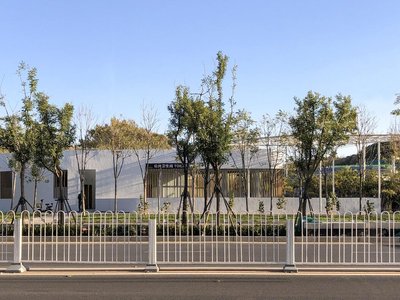
Four Public Pavilions in Beijing by Aurélien Chen and CSCEC
Four park pavilions in Beijing combine public services with floating roofs, acting as subtle urban signals integrated into landscape contextually.
LÁ-SÁCH House by Atelier tho.A
Compact tropical tube house-library with polycarbonate louvers, flexible interiors, concrete core, crafted materials, and community-focused alley setback.
Luxelakes Tianfu Food Island Phase II: A Contemporary Lakeside Commercial Hub in Chengdu
Lakeside commercial complex in Chengdu featuring cascading terraces, sloped roofs, and public waterfront spaces, blending restaurants, retail, and community interaction.

Explore Landscape Design Competitions
Discover active competitions in this discipline




The Global Benchmark for Architecture Dissertation Awards


Challenge to design mud housing for contemporary communities
Comments (0)
Please login or sign up to add comments
No comments yet. Be the first to comment!