
Adam Bresnick Restores a Baron's Granite House in the Mountains of Madrid for Contemporary Life
A 19th-century residence in Los Molinos, once one of six built for a Baron's daughters, finds new clarity through material honesty and spatial reinvention.


At the end of the 19th century, a Baron commissioned six small residences in Los Molinos, a mountain municipality outside Madrid, as homes for his daughters. Built in granite masonry with Tuscan pilasters and obelisk-topped columns flanking the entrance, the house read as a compact exercise in Herrerian austerity: disciplined geometry, a four-sided tile roof, and a 26-by-11.5-meter rectangular plan that sits with quiet authority on a south-sloping plot. After decades of abandonment and careless modifications, Boston and Madrid-based architect Adam Bresnick took on the task of returning the building to legibility while equipping it for 21st-century life.
What makes this 2023 restoration worth studying is its refusal to flatten the house's biography. Rather than stripping every surface back to a uniform finish, Bresnick treats each material layer as evidence. An exposed central brick wall, polished concrete ground floors, Campaspero limestone thresholds, and saw-cut oak in the bedrooms each occupy a distinct temporal register. The most dramatic spatial move, relocating the staircase to open a triple-height void with zenithal light, reorganizes circulation without erasing the original load-bearing logic. The result is a house that looks like it has lived through something, because it has.
The Triple-Height Void as Organizational Core
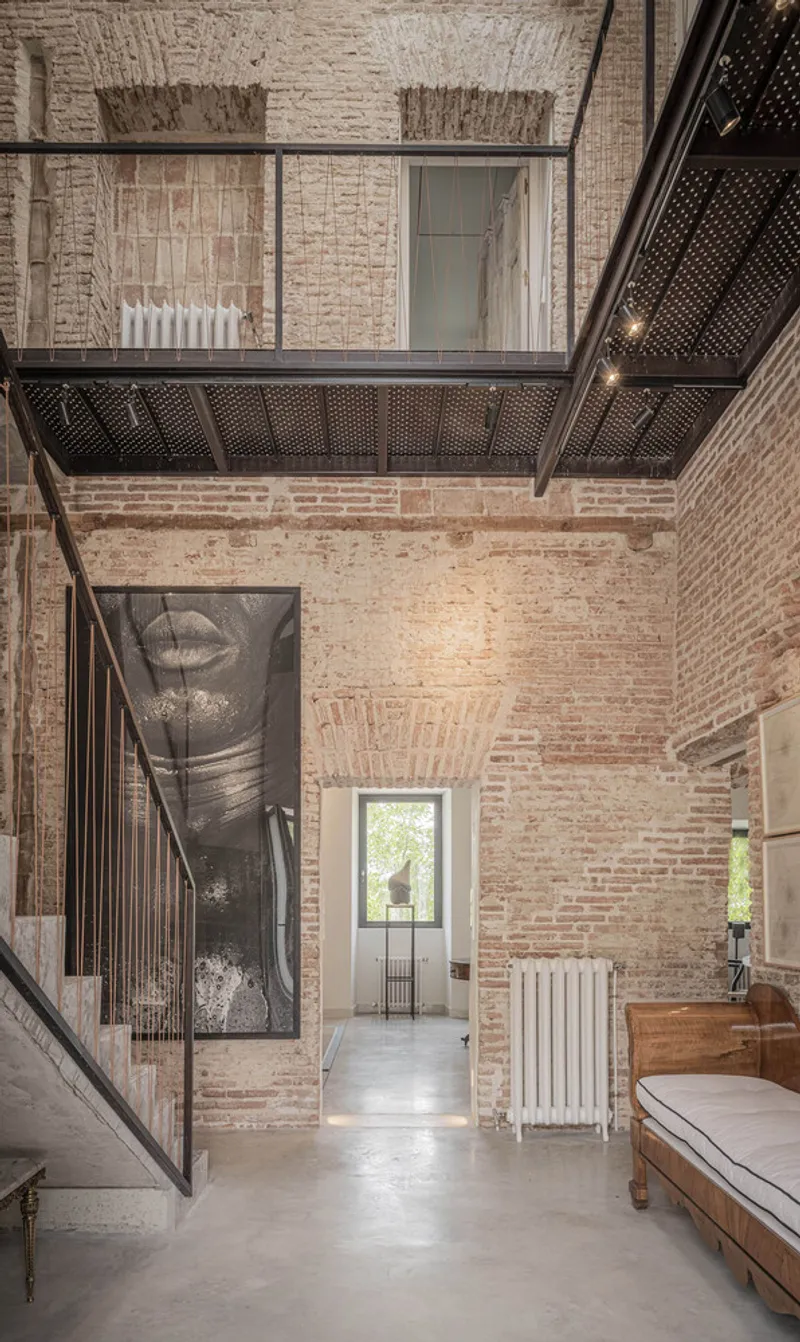
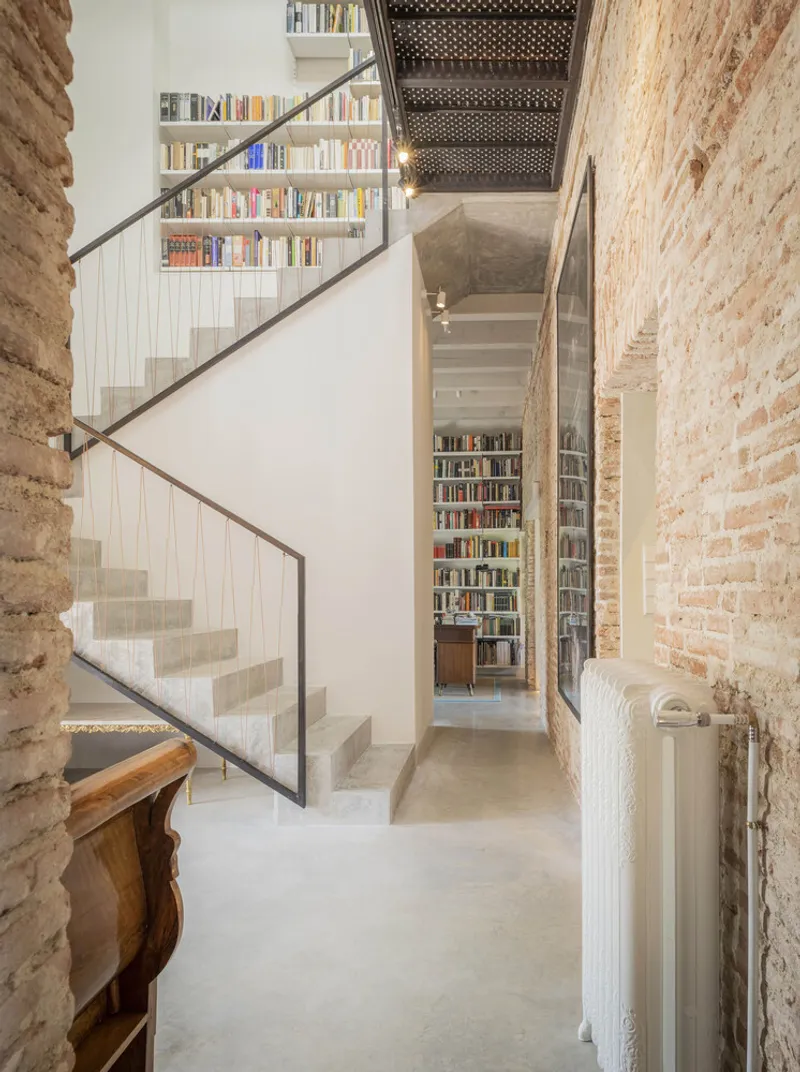
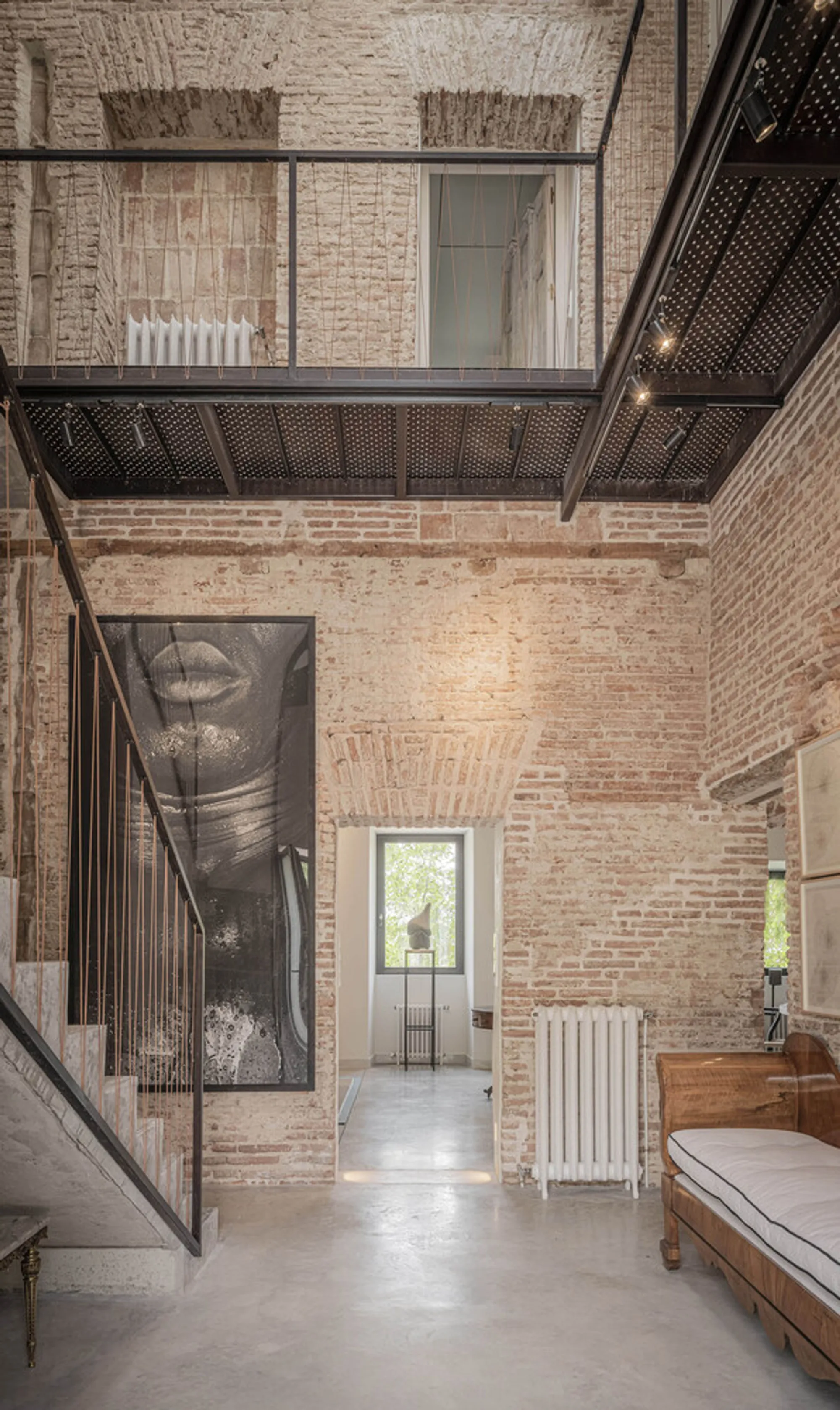
Relocating a staircase sounds like a contractor's decision, not an architectural thesis. In this house it becomes one. By shifting the vertical circulation, Bresnick opened a triple-height entrance void that funnels overhead daylight deep into the plan. The space doubles as a passive ventilation chimney, drawing warm air upward and reducing the need for mechanical intervention in a building whose thick granite walls already buffer temperature swings. A perforated metal walkway bridges the void at the upper level, connecting three en-suite bedrooms without subdividing the volume.
The monolithic concrete staircase rises directly from the polished concrete floor below, an intentionally foreign element that reads as a sculptural insertion against the aged brick. Steel railings and the tramex balcony overhead reinforce the distinction: new interventions are metallic, precise, and visually transparent, while the original fabric is massive, textured, and opaque. The hierarchy is clear without being didactic.
Brick, Concrete, and Limestone: A Material Timeline
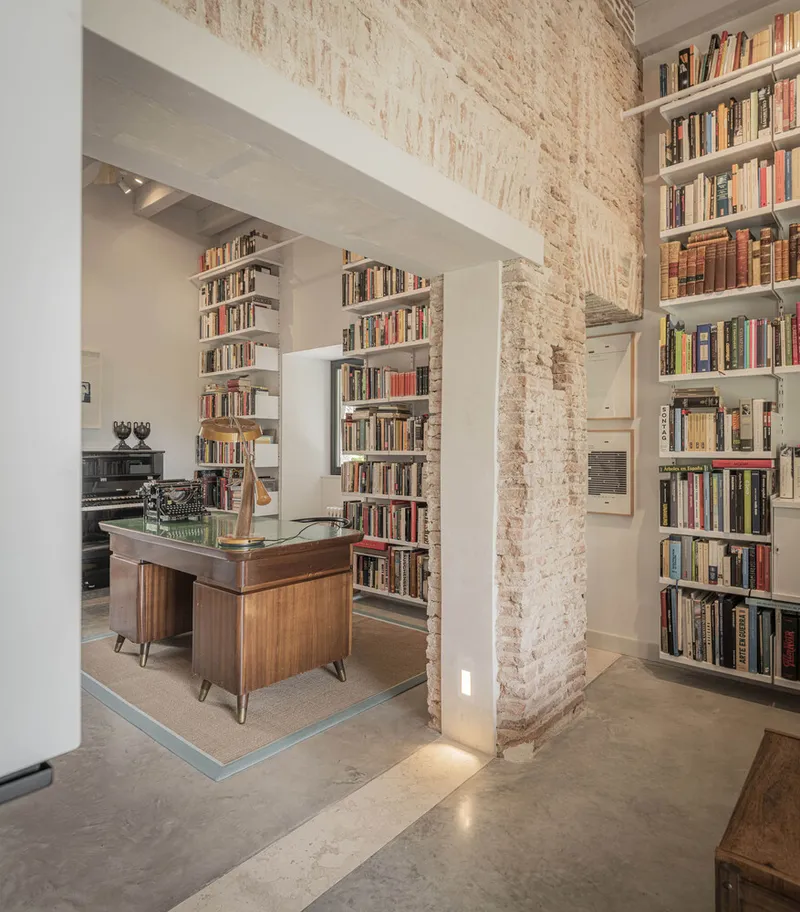
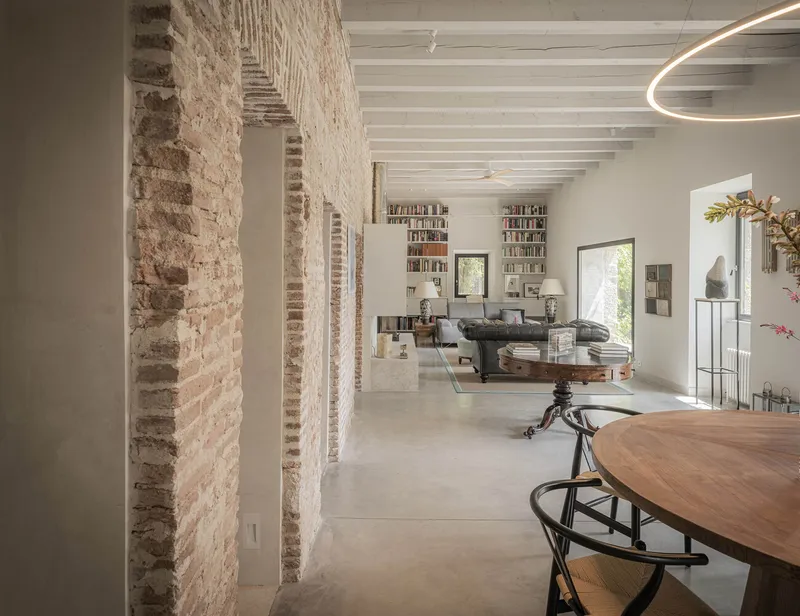
The central brick wall was originally a structural necessity, a load-bearing spine running the length of the plan. Bresnick leaves it fully exposed, and its patchwork of different mortars, infilled openings, and repair campaigns becomes a stratigraphic record of the house's life. Rather than romanticizing the ruin, the approach is forensic: you can read the wall like a timeline.
On the ground floor, polished concrete unifies what is now a single open living space. Where passages cut through the brick spine, Campaspero limestone slabs mark the thresholds, a regional stone from Valladolid province that introduces a cooler, finer grain at the points of transition. Black plaster panels conceal mechanical systems on the back walls, disappearing into shadow so that the brick and concrete can hold the viewer's attention. The material palette is restrained, but each element is doing real work: structural, thermal, or narrative.
Living Along the Garden Facade
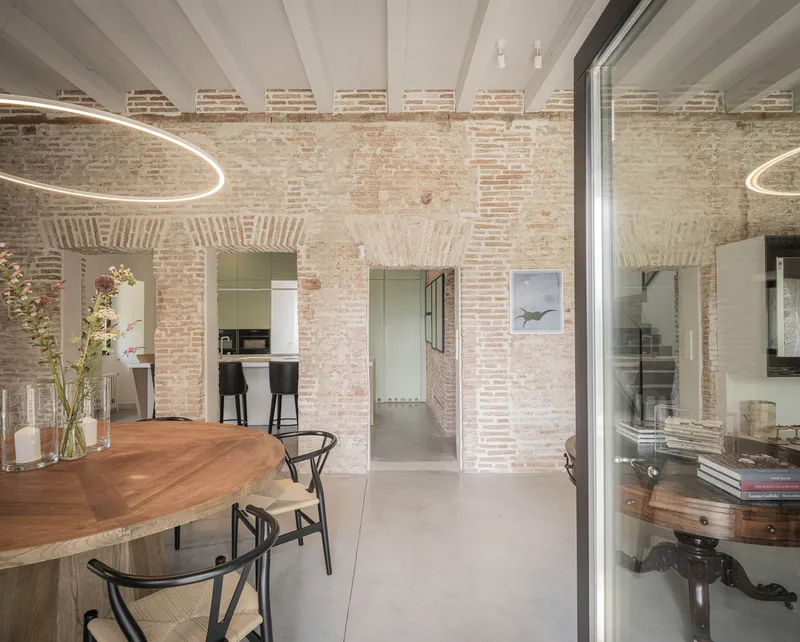
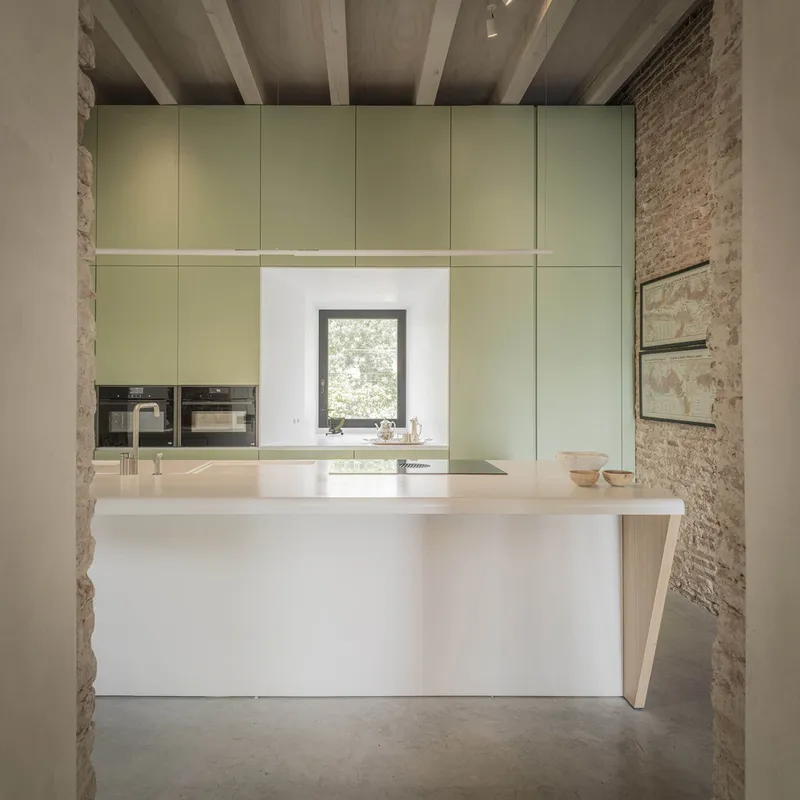
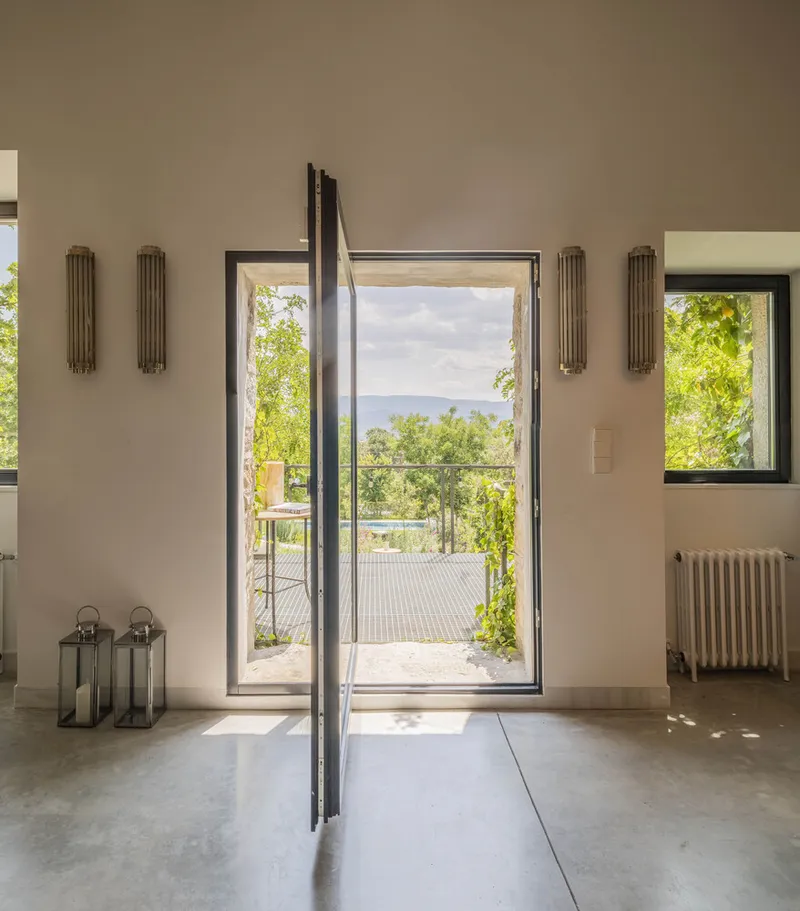
Bresnick treats the ground floor as a single continuous environment. The living room occupies the entire garden bay, stretching the full length of the south-facing facade to capture light and views of the sloping terrain below. A large pivoting window opens onto a metal-framed terrace, collapsing the boundary between interior and landscape in a way the 19th-century plan never intended. The kitchen sits on one side of the entrance hall, a music room on the other, each framed by the exposed brick columns and white-stained pine ceiling structure overhead.
The dining area and kitchen adopt a warmer, more domestic register. Pale green cabinetry set against the brick and timber ceiling is one of the few moments where color appears in the palette, and it works precisely because the surrounding surfaces are so restrained. A circular pendant light over the dining table introduces a softer geometry that offsets the rectilinear rigor of the plan. These are small decisions, but they keep the house from tipping into austerity for its own sake.
The Upper Rooms and a Skylit Bathroom
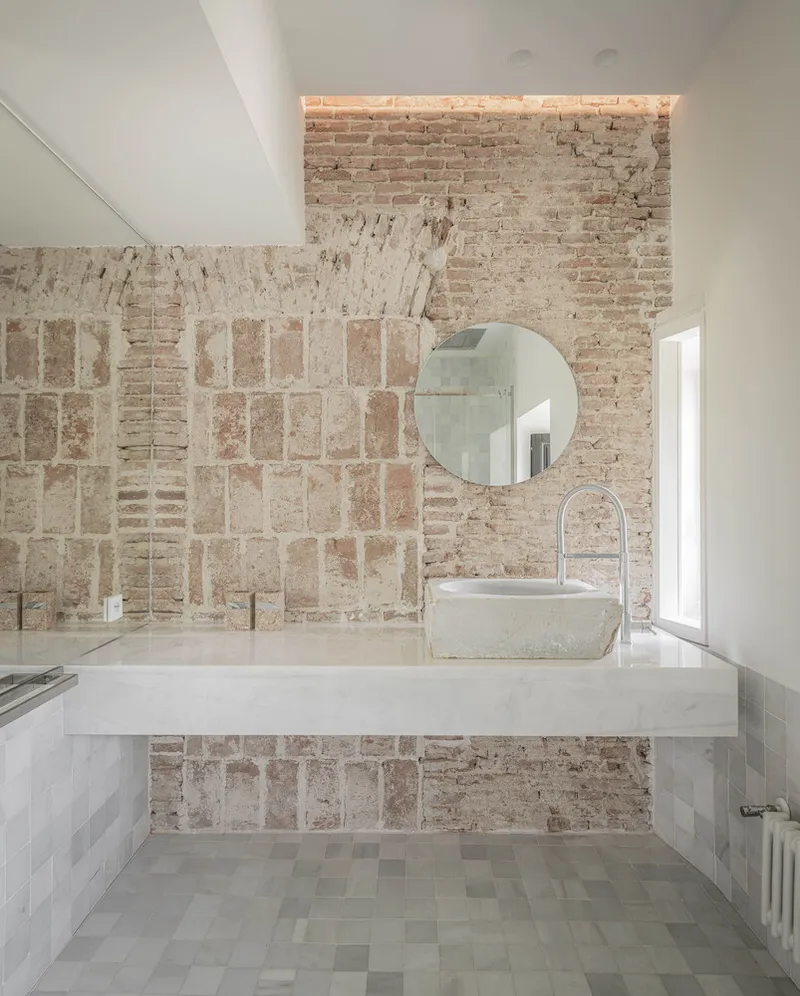
Upstairs, saw-cut oak flooring replaces the concrete of the ground level, signaling a shift from public to private. Three en-suite bedrooms open off the steel walkway that bridges the central void, each one enclosed enough to feel intimate without being cut off from the house's larger spatial ambitions. The bathrooms are where Bresnick allows himself the most expressive detailing: a floating marble vanity, a vessel sink, and a patchwork wall of brick and plaster that reads almost as collage.
A skylight washes one bathroom in diffused overhead light, echoing the zenithal strategy of the entrance void at a much smaller scale. It is a generous gesture in a room that could easily have been treated as leftover space, and it demonstrates the consistency of the lighting concept throughout the house: wherever possible, light comes from above, bouncing off the thick masonry walls to produce an even, warm glow that changes through the day.
Granite Terraces and the Reconstructed Garden
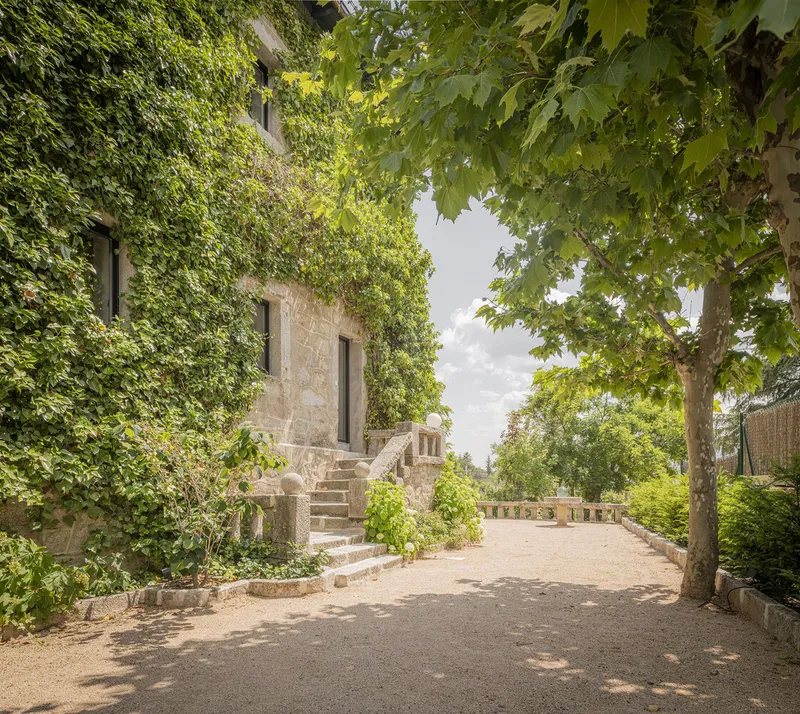
The landscape work, designed with Citherea and landscape architect Ana Luengo, reconstructs the historic garden terraces as near-replicas of the original configuration. Granite walls, stairs, and balusters link the house to its plot, stepping down the south-facing slope in a sequence that moves from formal to naturalistic. The upper terraces are structured and mineral; the lower garden follows a meandering path that incorporates existing trees, a well, and long views toward the surrounding mountains, eventually arriving at a pool and pavilion.
The material palette outside mirrors the one inside: soapstone, granite, and native plantings replace the decorative impulse with something more durable. Gravel surfaces under mature plane trees and climbing ivy on stone walls give the terraces an established, unhurried character that feels appropriate for a house with more than a century of history. The garden does not compete with the architecture; it extends its logic into the terrain.
Why This Project Matters
Heritage restoration in Spain often defaults to one of two modes: total conservation that freezes a building in an idealized past, or dramatic insertion that treats the old fabric as a backdrop for contemporary spectacle. Bresnick avoids both by insisting that the original and the new remain legible as separate systems. The granite envelope belongs to the 19th century; the concrete staircase, steel walkway, and pivoting windows belong to this one. Neither pretends to be the other, and the house is stronger for it.
The project also demonstrates that spatial generosity and material honesty are not mutually exclusive with comfort. A triple-height void, polished concrete floors, and exposed brick could easily produce a cold, gallery-like atmosphere. Here, the warmth of oak, the scale of the furniture, and the continuous connection to the garden keep the house feeling like a home. That balance, between rigor and livability, is what makes this restoration worth returning to.
Restoration of a 19th-Century Granite House by Adam Bresnick, with landscape design by Citherea and Ana Luengo. Located in Los Molinos, Madrid, Spain. Approximately 26 x 11.5 meters in plan. Completed in 2023.
About the Studio
Share Your Own Work on uni.xyz
If projects like this are the kind of work you want to make, uni.xyz is a place to publish your own, find collaborators, and enter design competitions.




Popular Articles
Popular articles from the community


Riyadh For All: Intergenerational Urban Design for Active Aging in Rabat
Riyadh For All reimagines urban design in Rabat with intergenerational co-living, adaptive courtyards, and Moroccan cultural exchange today.

Hill & Cross Opera: Sculptural Opera House Architecture Shaped by Tallinn’s Landscape and Identity
Hill & Cross Opera reimagines opera house architecture in Tallinn through its sculptural hill, civic plaza, glass wave and a luminous cross.

Lunar Spiral: Space Architecture Shaped by the Mathematics of the Universe
Lunar Spiral reimagines space architecture through Fibonacci geometry, lunar regolith, levitating habitats, and self-sustaining Moon living.

The Ocean Hive: Sustainable Architecture for a Self-Sufficient Civilization at Sea
The Ocean Hive imagines sustainable architecture at sea, where modular habitats, algae, wave power and ocean waste sustain a growing colony.


Similar Reads
You might also enjoy these articles

FAMM Arquitectura Organizes Ten Villas Around Courtyards and Jungle in Nosara, Costa Rica
El Molino pairs two elongated volumes with deep overhangs and timber louvers to build a compact coastal community five minutes from the beach.
Oscar Niemeyer's Ibirapuera Park Pavilions Define São Paulo's Cultural Identity in Concrete and Curve
A constellation of modernist volumes set within São Paulo's most important urban park, conceived for the city's 400th anniversary in 1954.
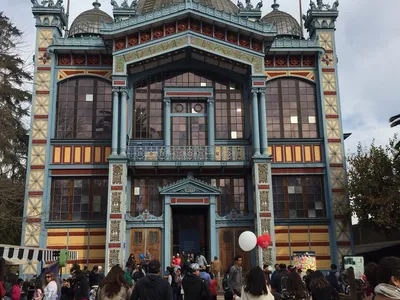
How Henri Picq's 1889 Paris Pavilion Traveled 11,000 Kilometers to Become Santiago's Artequín Museum
A prefabricated iron and glass pavilion built for the Paris Universal Exposition found a second life as a children's art museum in Chile.
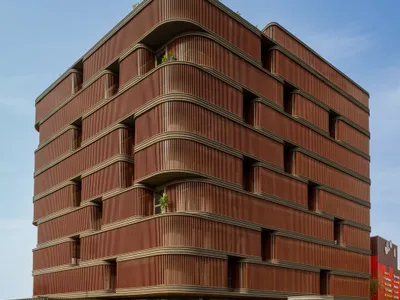
Sanjay Puri Architects Wraps a Jaipur Office Tower in Capsule-Shaped Green Buffers
A nine-level climate-responsive workplace near Jaipur Airport uses stacked planter terraces and aluminium screens to fight 40°C heat.


Explore Residential Building Competitions
Discover active competitions in this discipline


Challenge to design mud housing for contemporary communities


Challenge to reimagine the Iron Throne


Photograph architecture without architects


Illustrate the lost glory of Angkor Wat - Render Challenge
Comments (0)
Please login or sign up to add comments
No comments yet. Be the first to comment!