

30+8 Social Housing Units on Josep Togores Street by Vivas Arquitectos: Sustainable Architecture Rooted in Place
Sustainable social housing in Palma using local earth and timber, blending tradition, climate responsiveness, and community-centered spatial design.


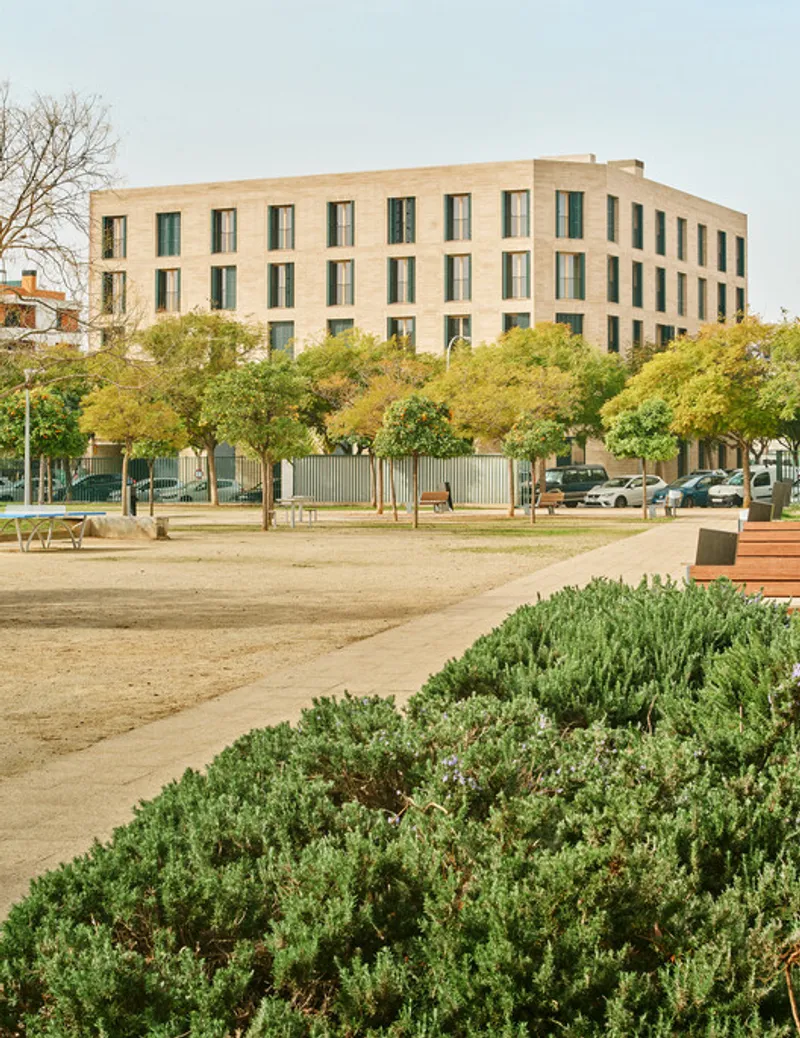
On the northern edge of Palma, Spain, Vivas Arquitectos have designed the 30+8 Social Housing Units on Josep Togores Street, a project that redefines how sustainability, culture, and community converge in contemporary social housing. Completed in 2025, this 2,840-square-meter development demonstrates a climate-sensitive, low-impact architecture grounded in traditional Mallorcan construction techniques while addressing today’s urgent environmental and social needs.
Urban Context and Site Integration
The project occupies a hybrid urban fringe of Palma, where low-density plots meet agricultural remnants, creating a textured landscape of gradual urbanization. This transition zone called for an architectural solution sensitive to its environment—neither purely urban nor rural.
Vivas Arquitectos responded with two complementary buildings:
- A main L-shaped corner block, five stories above a basement parking garage, hosting 30 dwellings.
- A secondary two-level structure containing 8 additional homes on a rectangular plot nearby.

By respecting the irregularity of the urban fabric and balancing built density with open space, the complex creates a micro-neighborhood that fosters both collective identity and domestic intimacy.
Spatial Design: From Community to Privacy
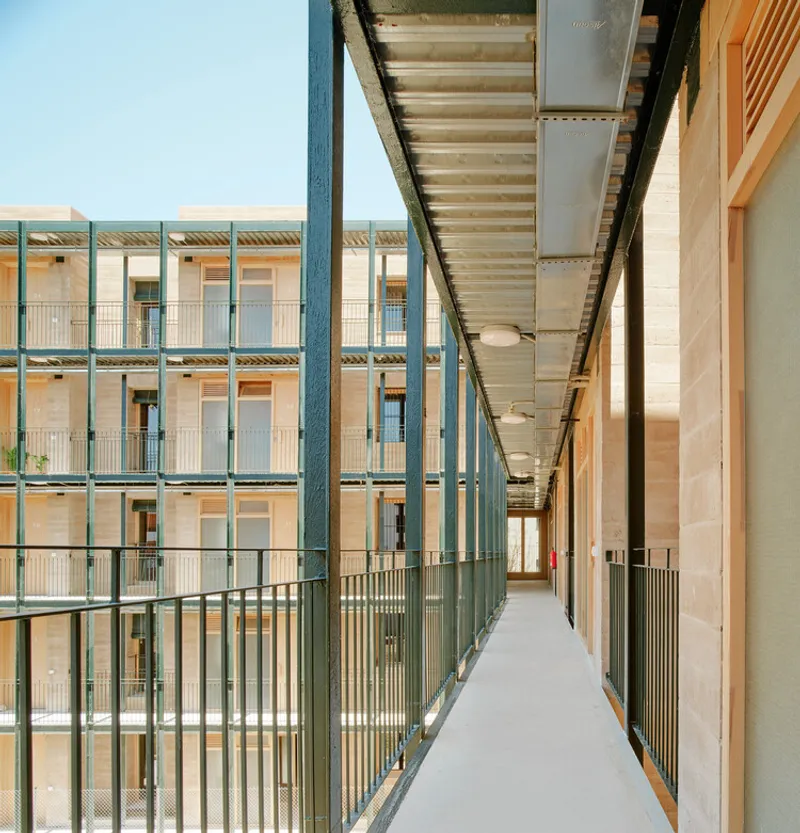
Access is organized through a shared courtyard reached from a simple ground-floor lobby. Covered corridors extend toward each dwelling, establishing a spatial gradient from public to private. These transitional spaces—cool, shaded, and semi-open—become opportunities for casual encounter and social interaction.
Each apartment, configured with one or two bedrooms, benefits from dual orientation and cross ventilation. Compact layouts avoid internal corridors; instead, the kitchen and living space form a continuous core, optimizing light, air, and spatial efficiency.

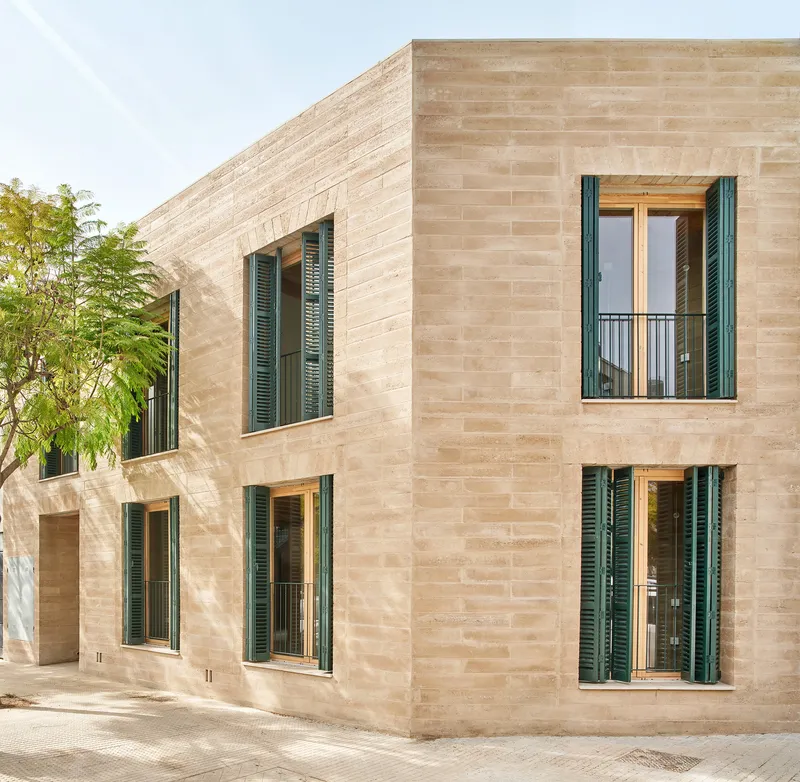
The façade’s southwest-facing gallery acts as a multifunctional buffer—filtering sunlight, providing privacy, and capturing warmth in winter while enabling natural cooling in summer. In doing so, it offers residents both climatic comfort and a tactile connection to the outdoors.
Constructive Logic: Earth and Timber
The project’s structural and environmental innovation lies in its hybrid construction system combining BTC (compressed earth blocks) and prefabricated wooden slabs.
BTC, produced locally in Mallorca, substitutes for concrete or fired brick, effectively reducing embodied energy and transport emissions. Formed without high-temperature kilns, these earthen units offer superior thermal inertia and permeability, allowing the walls to “breathe.” This enhances indoor air quality, acoustic performance, and passive thermal regulation.

Prefabricated wood slabs complement the BTC walls, enabling rapid modular assembly and lighter structural weight. Together, these materials create a sustainable, low-maintenance framework characterized by robustness, adaptability, and timeless simplicity.
This approach transforms construction into a closed ecological cycle, where performance and tradition intersect. The inherent stability of earth—fireproof, pest-resistant, and naturally insulating—lends longevity and comfort across all seasons.

Sustainability: Local Identity and Environmental Coherence
Beyond material efficiency, the project reaffirms Mallorca’s architectural heritage, where building and territory were historically intertwined. Drawing from vernacular coastal housing typologies, the design reconnects ecological intelligence and craftsmanship, ensuring that place, material, and climate form an integrated narrative.

In the context of climate change, this project asserts the earth itself as a regenerative material—a renewable local resource with cultural and ecological resonance. Through its use of indigenous construction methods, Vivas Arquitectos reaffirm the continuity between architectural heritage and sustainable innovation.
The design’s environmental logic extends beyond construction to passive operation:
- Orientation and shading reduce cooling loads.
- Natural light and cross-ventilation minimize energy consumption.
- Thermal mass stabilizes indoor temperatures year-round.
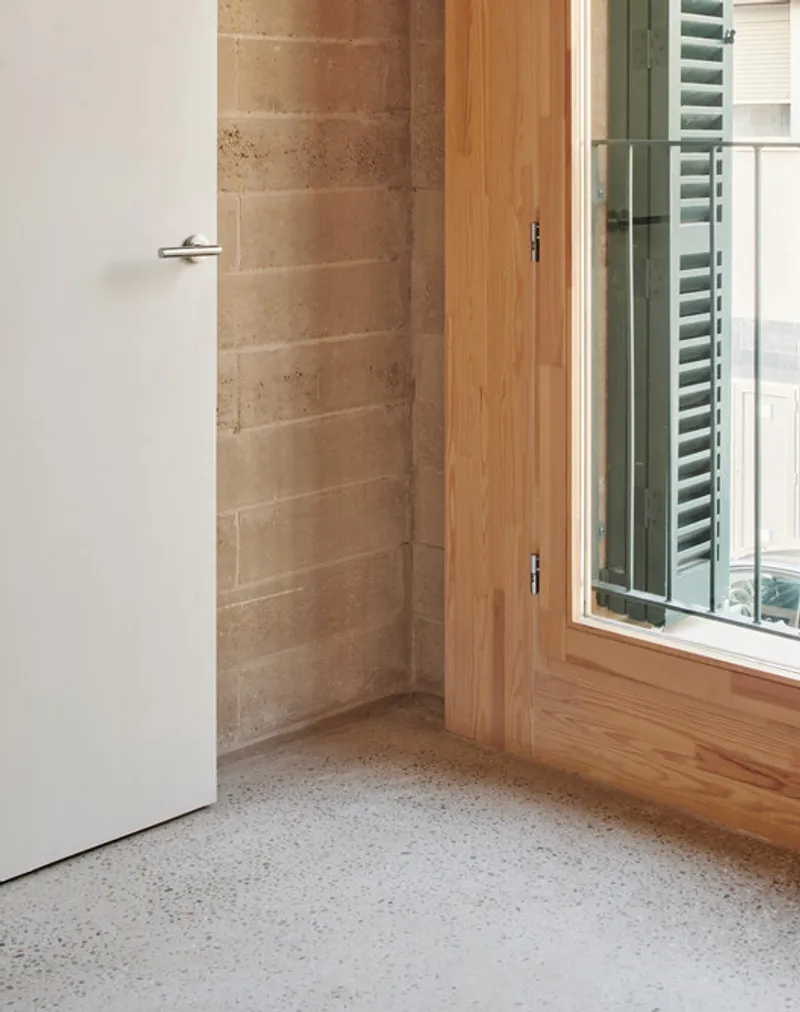
By prioritizing resource efficiency and minimizing technological dependence, the project embodies passive sustainability—a form of resilience rooted in local knowledge rather than imported solutions.
Architectural Character and Aesthetic Restraint
The visual language of the buildings derives from their material honesty. The rhythmic interplay of earth-toned walls, timber structures, and shaded galleries creates a quiet architecture of texture and light. Every element responds to the Mediterranean context: thick walls, restrained openings, and layered patios turn necessity into beauty.

This aesthetic restraint evokes the timelessness of traditional Mallorcan settlements while providing dignity and serenity for its inhabitants—qualities often denied in conventional social housing.
Architecture as Social Infrastructure
Beyond shelter, the development acts as an instrument for community cohesion. By mixing scales of collectivity, from the shared courtyard to individual balconies and walkways, Vivas Arquitectos create a space that enhances social proximity without compromising privacy.
It demonstrates how public housing can embody excellence and humanity, fostering a sense of belonging as much as environmental intelligence.
All the Photographs are works of José Hevia



Popular Articles
Popular articles from the community


Co-life: Sustainable Architecture for Age-Friendly Community Living
Co-life reimagines sustainable architecture for seniors through courtyards, rammed earth, shared gardens, and spaces designed for belonging.

Play: Fragments of Their World
Familiar architecture becomes modular playground design, creating safe spaces where displaced children can learn, connect, imagine and play.

Conexión: Biophilic Design Reimagines High-Rise Living in Hong Kong
Conexión reimagines high-rise living in Hong Kong through biophilic design, green facades, shared spaces, daylight, water and nature within.

Hill & Cross Opera: Sculptural Opera House Architecture Shaped by Tallinn’s Landscape and Identity
Hill & Cross Opera reimagines opera house architecture in Tallinn through its sculptural hill, civic plaza, glass wave and a luminous cross.


Similar Reads
You might also enjoy these articles


Hodi-Mandai Geram
Project Function: Preservation and revitalization of the Intangible heritage and socio-spatial identity of the Hodi by Housing, Cultural Memory Center, Sacred Grove, landscape, local tourism economy


Olio Towers: A Mid-Rise for Performers That Fuses Housing, Rehearsal, and Stage
Located blocks from Houston's Theater District, this modular tower stacks living units around a central performance atrium.

Oasis: Modular Green Housing Carved into Dhaka's Urban Fabric
A shortlisted Plugin Housing entry reclaims unauthorized settlements in Dhaka with stepped concrete volumes, green roofs, and ventilation-driven design.

Black Hole: A Floating Megastructure for the Post-Physical Era
Emiliano Mazzarotto envisions a spherical, self-scaling arena where e-sports, digital hotels, and holographic stadiums replace traditional public space.


Explore Housing Competitions
Discover active competitions in this discipline



Challenge to reimagine the Iron Throne


Photograph architecture without architects


Illustrate the lost glory of Angkor Wat - Render Challenge


Design challenge to reuse E-waste
Comments (0)
Please login or sign up to add comments
No comments yet. Be the first to comment!