

A Contemporary Tropical Hillside Home in Lombok by GFAB Architects
A Contemporary Tropical Hillside Home in Lombok by GFAB Architects


House of Herring is a contemporary tropical residence by GFAB Architects, nestled within the Tampah Hills development on Lombok’s south coast, Indonesia. Designed as a shared holiday retreat for two Danish workmates and their young families, the house balances relaxed coastal living with carefully considered spatial planning, environmental responsiveness, and material authenticity. When not in use by its owners, the residence is seamlessly integrated into the estate’s rental management system, reinforcing its dual role as both a private retreat and an income-generating holiday home.
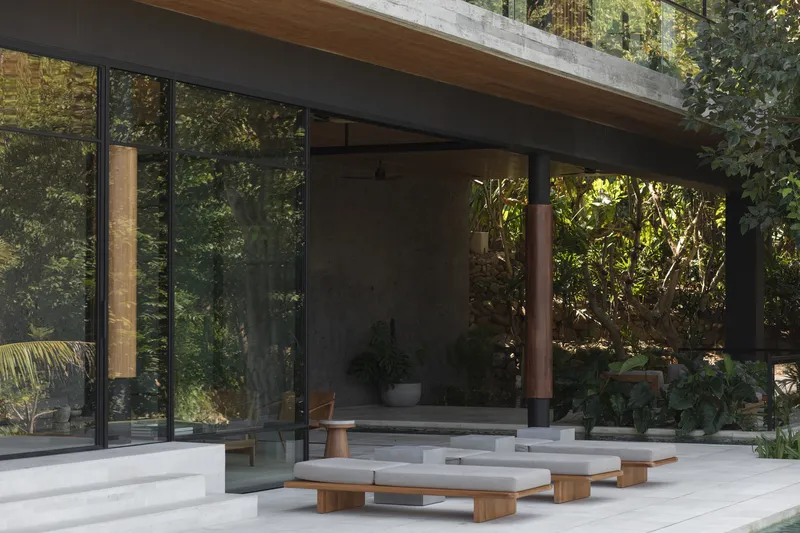
Responding to Topography and Climate
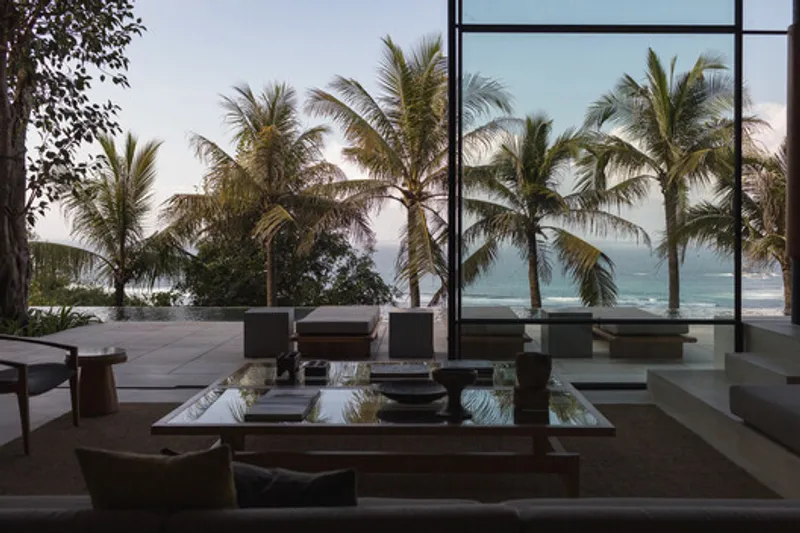
Set on a steeply sloping site overlooking the bay, the architecture takes full advantage of the natural gradient. Entry occurs from the uppermost level, where the house presents itself as a low-profile, single-storey volume, subtly embedded into the landscape. Dense planting buffers the arrival sequence, creating privacy while softening the transition from exterior to interior.
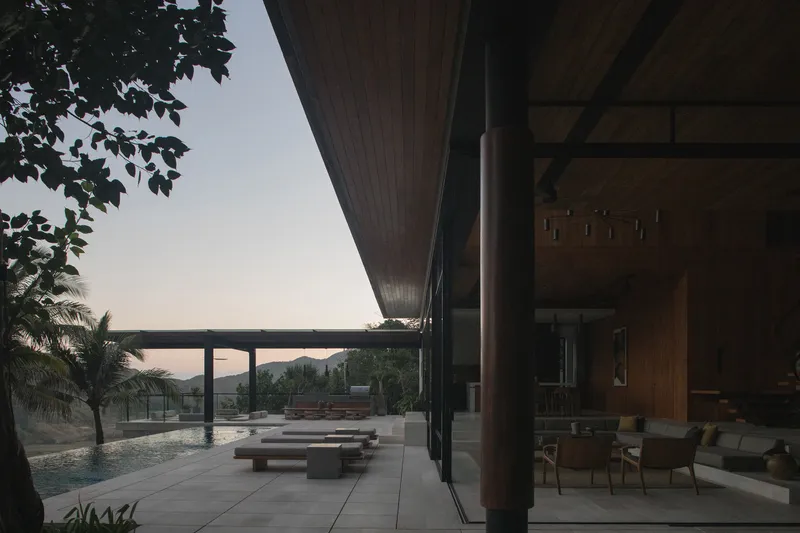
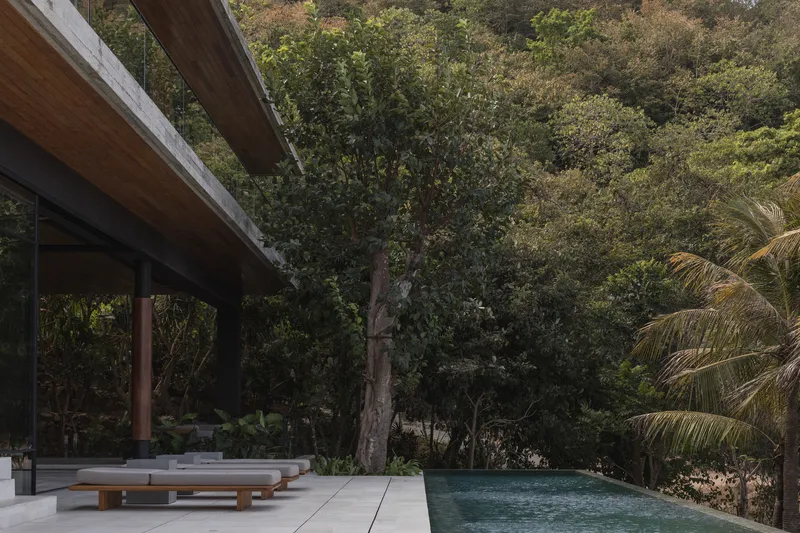
Deep roof overhangs extend outward to provide covered parking and protect the building from the intense northern sun, a crucial response to Lombok’s tropical climate. These architectural gestures contribute to passive shading strategies while reinforcing the house’s horizontal character.
Spatial Sequence and Living Experience
Upon entry, visitors are welcomed into a dramatic double-height volume, where a central stair descends into the main living spaces below. This vertical movement reveals a layered interior experience, with spaces unfolding gradually as one moves downward.
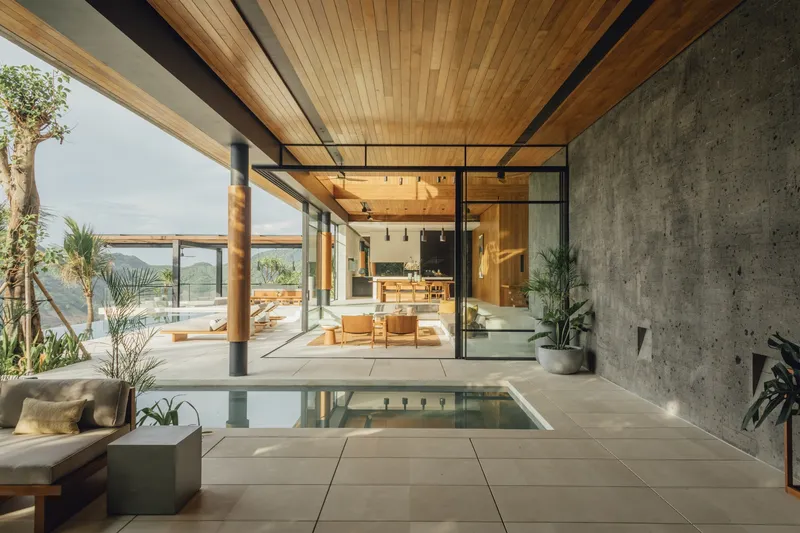
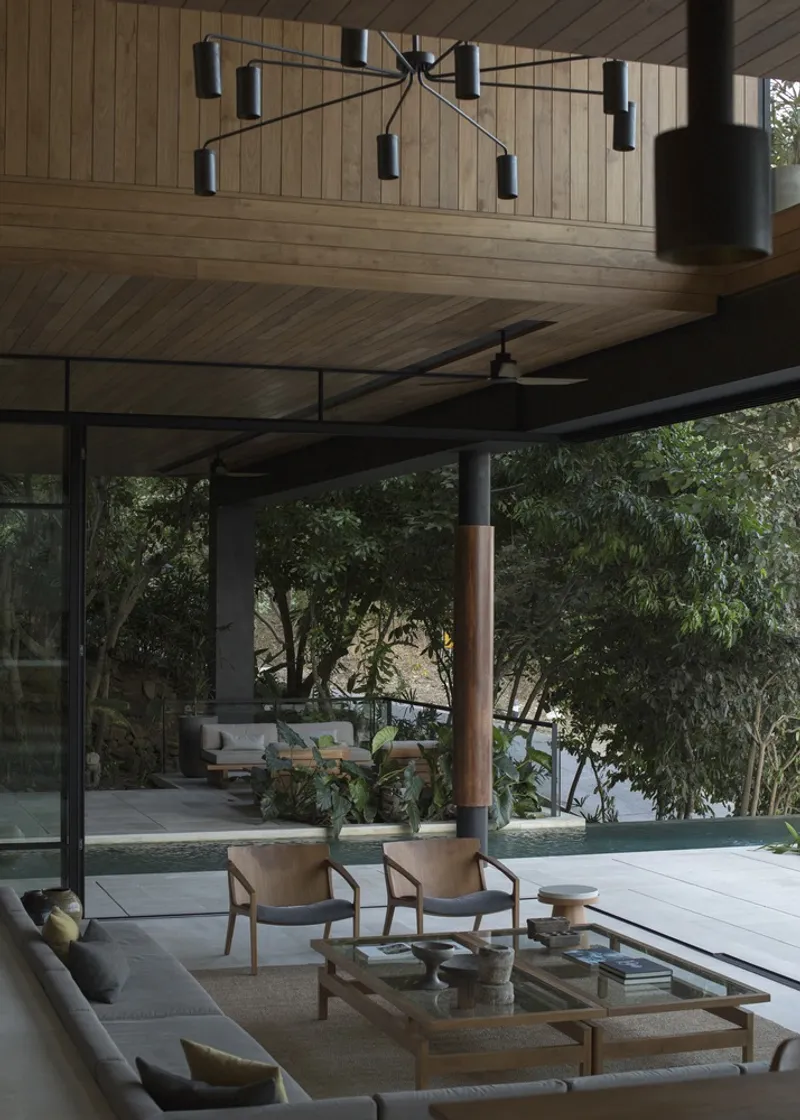
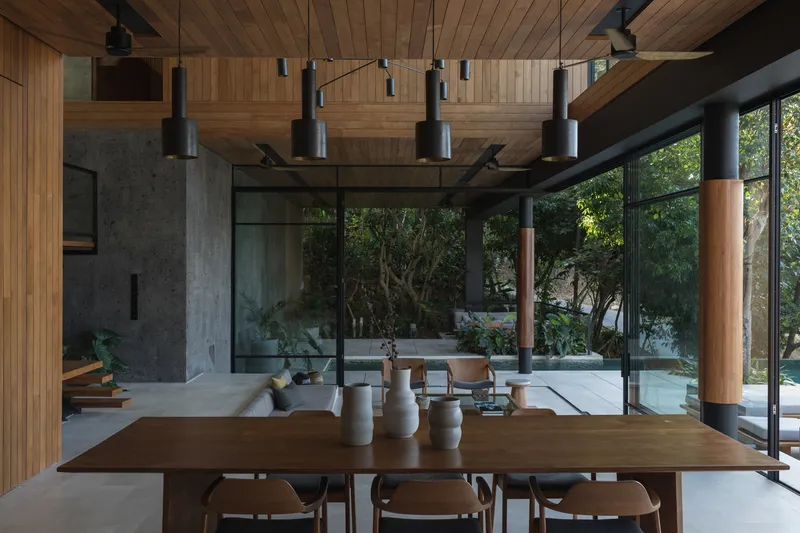
The dining area and guest kitchen are positioned slightly above the primary sitting area and pool deck, enhancing spatial volume and visual connection. Floor levels transition seamlessly toward the exterior, dissolving boundaries between indoor and outdoor living. The swimming pool wraps beneath the house, generating shaded play areas while cooling adjacent spaces naturally.
At the far end of the pool, a cantilevered entertainment terrace projects over the hillside. This shaded zone accommodates a barbecue, sunken seating, and outdoor dining, offering panoramic views and reinforcing the home’s role as a social gathering space. Supporting functions, including a service kitchen, laundry, and staff accommodation, are discreetly positioned beyond the guest kitchen to maintain spatial clarity.
Private Zones and Environmental Comfort
The upper level accommodates a master suite and a secondary bedroom, each located on either side of the stair void. Both suites feature walk-through wardrobes and generous bathrooms, illuminated naturally through feature skylights that rise through landscaped garden roofs above.
Circulation corridors are naturally ventilated using timber screening, reducing reliance on mechanical systems. Motion-sensor wall lighting ensures energy efficiency while maintaining comfort and safety during evening use.
Materiality and Landscape Integration
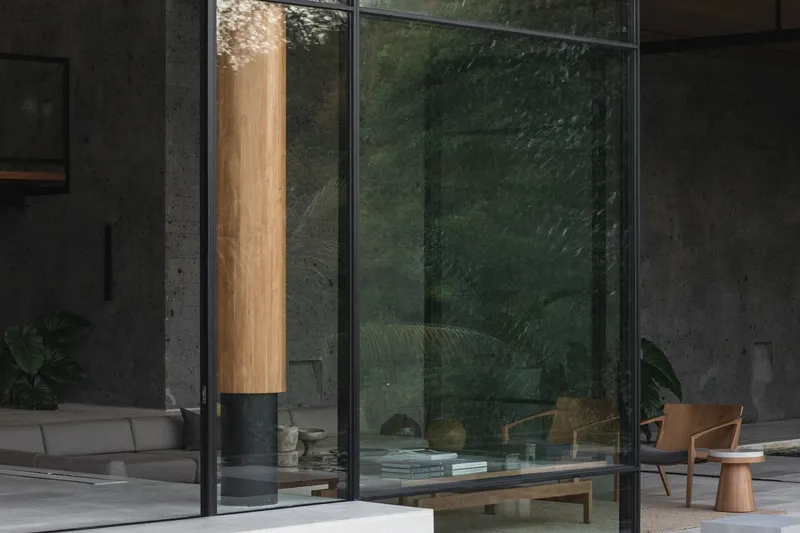
Material selection reflects a balance between durability, tactility, and local craftsmanship. Board-formed and smooth concrete form the structural backbone, complemented by local stone and teak timber used across floors, walls, and ceilings. This restrained palette creates a calm, cohesive interior atmosphere while responding to the coastal environment.
The landscape design prioritizes low-water, native plant species, reinforcing sustainable site practices and reducing long-term maintenance. Interior spaces are styled with locally sourced fabrics and custom-designed furniture, grounding the project firmly within its Indonesian context.
A Contemporary Tropical Retreat
House of Herring exemplifies GFAB Architects’ approach to tropical residential architecture, where site sensitivity, spatial generosity, and material honesty converge. The project demonstrates how contemporary design can adapt to steep terrain, climatic challenges, and shared living requirements, resulting in a refined yet relaxed coastal home deeply connected to its environment.
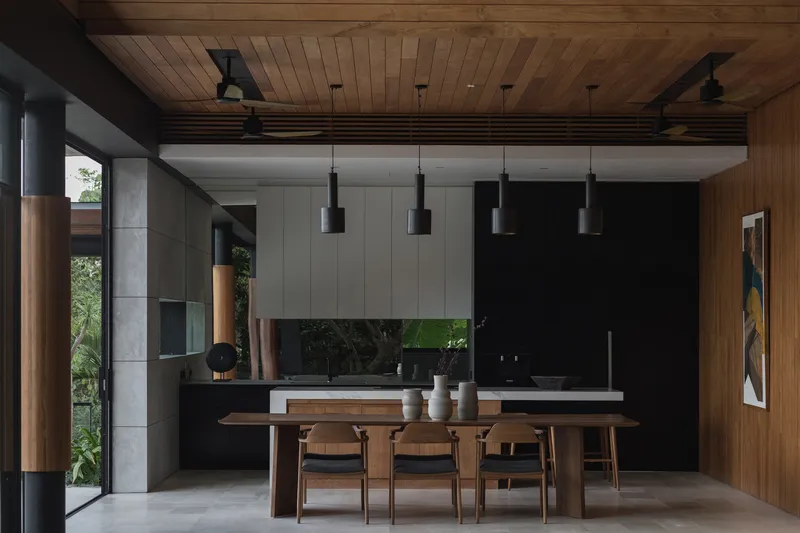
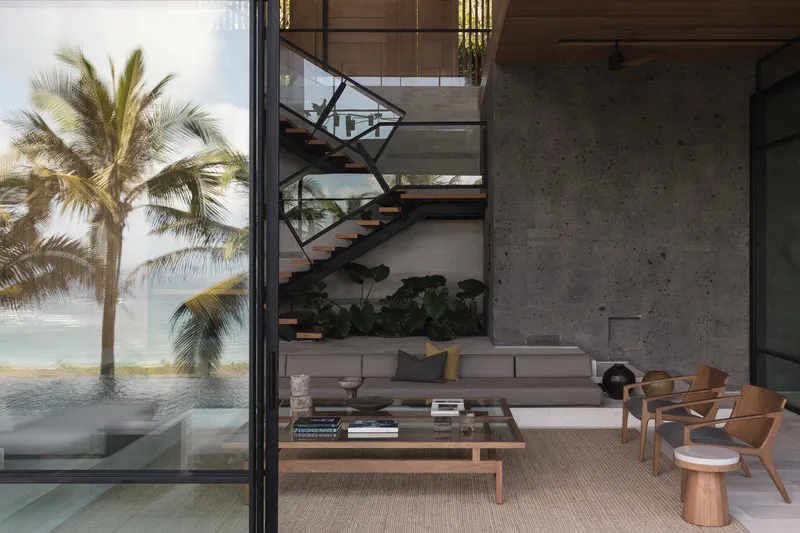
All photographs are works of Tommaso Riva


Popular Articles
Popular articles from the community


Cube Design Draws an Ecological Corridor Between Two Shenzhen Hills with the Nankai Building
Beside Shenzhen's container docks, the Nankai Building pairs stacked balconies with a climbing green screen to connect two hillsides across its height.

U.GA Architects Wraps an Oval Rooftop Pool in Curved Board-Formed Concrete on Busan's Jeollidan-gil
In Busan's Jeonpo-dong, a 454 m² mixed-use block stacks a neighborhood facility, guest rooms and an oval rooftop pool inside spiraling concrete walls.

LT2A and OPEN Architectes Thread a Brick and Glass High School Through a Wooded Belgian Campus
In Braine-l'Alleud, a 3,000 m² wing for Collège Cardinal Mercier pairs pale brick with a glazed colonnade, deferring to a small chapel and a dense wood.

Jaramillo Van Sluys Arquitectura and Urbanismo Turn a Demolished Registry Lot in Quito into an Orchard Plaza
In Quito's Centro Histórico, a 2,800 m² plaza exposes the San Agustín convent wall and redraws its lost Augustinian orchard in volcanic stone.

Similar Reads
You might also enjoy these articles


Hodi-Mandai Geram
Project Function: Preservation and revitalization of the Intangible heritage and socio-spatial identity of the Hodi by Housing, Cultural Memory Center, Sacred Grove, landscape, local tourism economy


Olio Towers: A Mid-Rise for Performers That Fuses Housing, Rehearsal, and Stage
Located blocks from Houston's Theater District, this modular tower stacks living units around a central performance atrium.

Oasis: Modular Green Housing Carved into Dhaka's Urban Fabric
A shortlisted Plugin Housing entry reclaims unauthorized settlements in Dhaka with stepped concrete volumes, green roofs, and ventilation-driven design.

Black Hole: A Floating Megastructure for the Post-Physical Era
Emiliano Mazzarotto envisions a spherical, self-scaling arena where e-sports, digital hotels, and holographic stadiums replace traditional public space.

Explore Housing Competitions
Discover active competitions in this discipline

Challenge to reimagine the Iron Throne

Photograph architecture without architects

Illustrate the lost glory of Angkor Wat - Render Challenge

Design challenge to reuse E-waste
Comments (0)
Please login or sign up to add comments
No comments yet. Be the first to comment!