
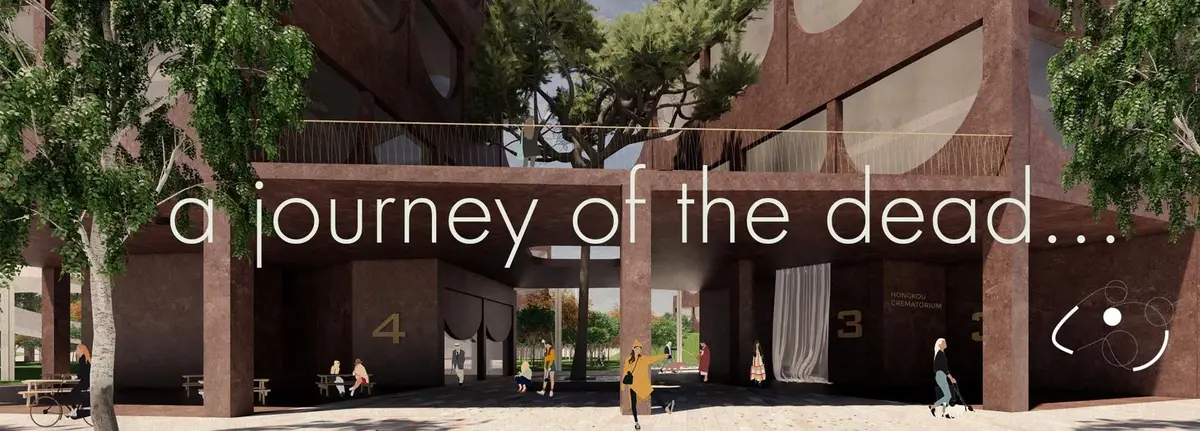
A Journey of the Dead: Vertical Cemetery Architecture Reimagined as Urban Parkland
A 26-storey modular cemetery tower system weaves burial rituals, sky gardens, and civic walkways into dense urban life.


What happens when a city decides that its dead deserve the same spatial generosity as its living? The typical answer is sprawl: acres of lawn, iron gates, perimeter walls that signal separation. This proposal flips that logic entirely, stacking burial infrastructure vertically and releasing the ground plane for parks, gardens, and daily civic life. The cemetery becomes a place you walk through on your way to work, not a place you drive to once a year.
Alice Meyer, Amarilnto GKIOSA, and Victoria Peal developed this shortlisted entry for the Circle of Life competition. Titled "A Journey of the Dead," the project proposes a cluster of towers, each up to 26 stories, arranged around a central park within a high-density cityscape. It is designed to hold up to 138,600 burial units with the capacity to scale to 300,000, using prefabricated modular systems that allow incremental vertical expansion without disrupting the surrounding urban fabric.
Towers That Frame a Park, Not a Fence


The site strategy is visible in the ground floor plan, landscape cluster view, and axonometric diagrams: tower modules are grouped to define a central green space rather than enclose a burial ground. Each cluster forms what the designers call a "civic island," a public territory that serves mourners, students, families, and pedestrians equally. The towers alternate between functional burial floors, columbaria, cremation rooms, and reflective spaces such as ritual terraces and communal sky gardens. Green terraces appear every five levels, functioning simultaneously as sky parks, rainwater absorbers, and oxygen generators.
The rendered view of planted terraces and a tall brick tower reveals how this massing reads at the urban scale. It does not look like a cemetery. It looks like a mixed-use neighbourhood with an unusual programme, and that is precisely the point. The architecture normalizes the presence of death within the everyday, refusing to relegate end-of-life infrastructure to the margins.
Corridors of Memory: Section and Interior Spaces

The presentation board lays out the interior programme with precision. Floor plans show the careful circulation logic: mourners move through columbarium corridors, arched garden passages, and stair interiors that offer moments of privacy without severing connection to the surrounding civic life. The tower section reveals how ritual and functional spaces are interleaved vertically. Cremation areas, burial zones, chapels, and libraries occupy different levels, connected by a deliberate sequence that treats mourning as a journey rather than a destination.
One of the project's most striking architectural gestures is an elevated walkway called the "Journey of Death" that spirals through the complex. This path crosses terraces, gardens, and ceremonial spaces, offering a spatial metaphor for passage and transition. The arched garden view on the board gives a sense of the atmosphere along this route: light filtered through planting, structure framing sky, and a sense of moving slowly upward.
Ground Plane as Public Room
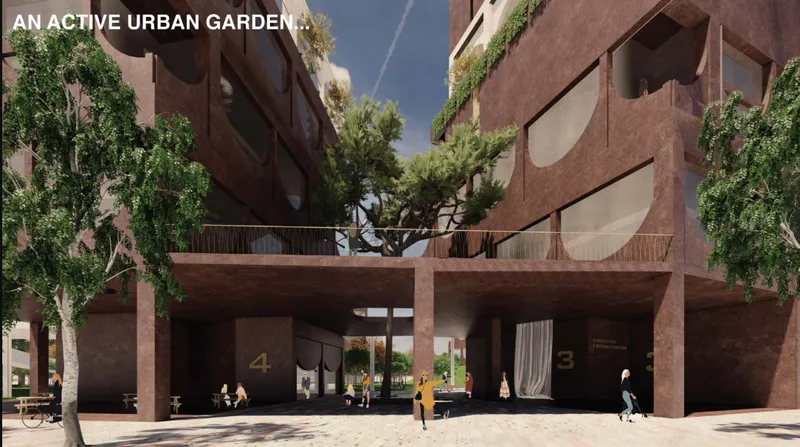
At street level, the raised plaza sits on concrete piers with planted facades softening the structural grid above. Pedestrians walk beneath and through the complex as part of their daily routine. The cemetery does not announce itself with walls or gates; it simply becomes another layer of the city. This is the core provocation of the project: that deathcare is essential public infrastructure, not residual space, and it should be treated with the same spatial ambition as a library or a transit hub.
Water, Willows, and the Threshold Between Worlds
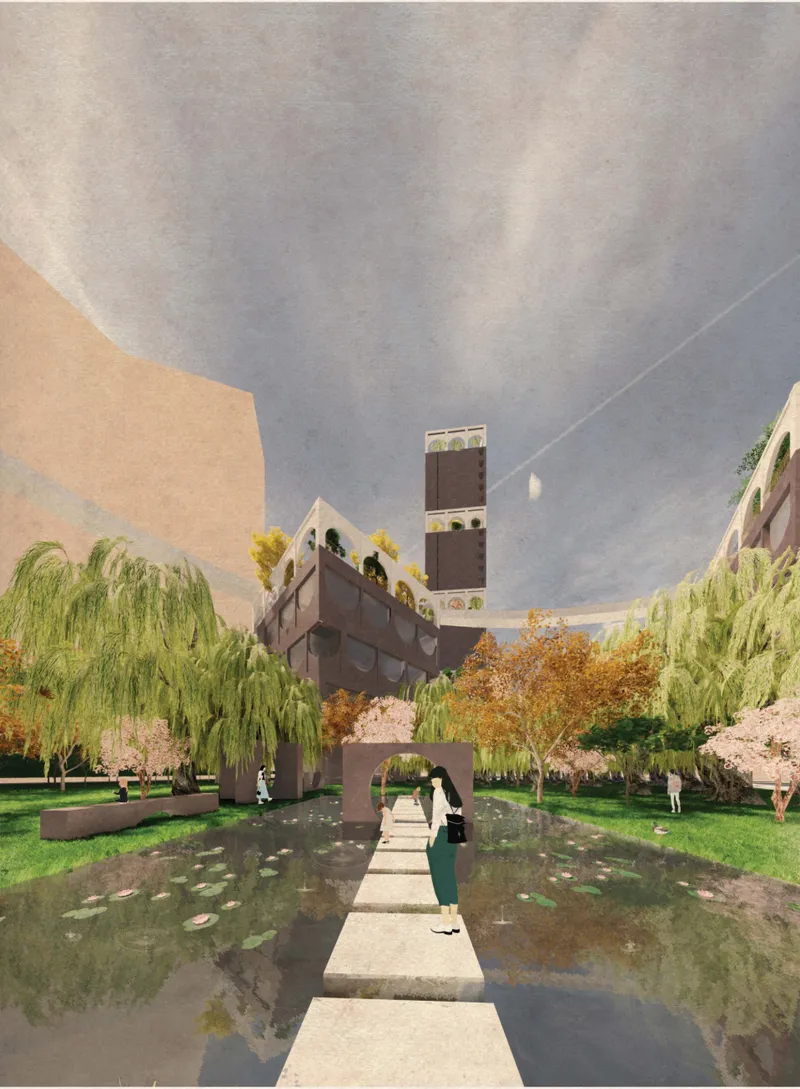
The final rendered view pulls back to reveal a linear reflecting pool with stepping stones, bordered by willow trees, with the tower rising in the distance. It is a landscape of threshold: quiet enough for contemplation, open enough for a lunchtime walk. The water surface doubles the tower's presence, grounding the vertical ambition in something horizontal and still. This image captures the project's emotional register better than any diagram. The architecture does not shout; it holds space for both grief and ordinary life, and trusts the visitor to find the boundary between them.
Why This Project Matters
Urban land is finite. Cultural attitudes toward death are shifting. The conventional cemetery, with its horizontal spread and its isolation from public life, is becoming both spatially unsustainable and socially insufficient. Meyer, GKIOSA, and Peal confront this reality directly, proposing a modular system that can scale from 138,600 to 300,000 burial units while simultaneously producing parks, gardens, and civic walkways. The design does not treat sustainability and ritual as competing priorities; it braids them together in every five-level terrace module.
What makes this project worth watching is not just its programmatic ambition but its spatial generosity. By lifting burial functions into the air and returning the ground to the public, the designers reframe the cemetery as a right rather than a remnant. The "Journey of Death" walkway is the clearest expression of this idea: a path that does not end at a grave but continues through gardens, terraces, and open sky, insisting that mourning is a form of movement, and that cities owe their dead more than silence.
View the Full Project
About the Designers
Designers: Alice Meyer, Amarilnto GKIOSA, Victoria Peal
Enter a Design Competition on uni.xyz
uni.xyz runs architecture and design competitions year-round that reward proposals with spatial conviction and real site intelligence.
Project credits: A JOURNEY OF THE DEAD by Alice Meyer, Amarilnto GKIOSA, Victoria Peal Circle of Life (uni.xyz).


Popular Articles
Popular articles from the community


Lunar Spiral: Space Architecture Shaped by the Mathematics of the Universe
Lunar Spiral reimagines space architecture through Fibonacci geometry, lunar regolith, levitating habitats, and self-sustaining Moon living.

Play: Fragments of Their World
Familiar architecture becomes modular playground design, creating safe spaces where displaced children can learn, connect, imagine and play.

Co-Life: Senior Housing Design That Reconnects Older Adults With the City
Co-Life reimagines senior housing design through healing gardens, shared streets, workshops, and a sustainable community across generations.

Little Red Riding Hood: Architectural Design as a Journey Through Fear, Light, and Storytelling
Little Red Riding Hood reimagines the fairy tale through architectural design shaped by fear, light, scale, memory, uncertainty, and choice.

Similar Reads
You might also enjoy these articles

Day and Night Park: A Time-Based Urban Newsstand in Beijing
A temporary urban newsstand in Beijing blending travel, light, and reading through poetic colors, compact form, and community-focused design.

Modernist Patio Renovation in El Masnou, Barcelona by Oliver Segura Arquitectura + Cebrià Arquitectura
Modernist patio renovation blending tradition and innovation with a movable pool, leveled floors, and Catalan materials in El Masnou.

Alto Residencial Coop: Cooperative Housing Development in Santiago de Compostela by Carbajo Barrios Arquitectos
A linear cooperative housing complex blending white volumes and perforated metal façades, enhancing community living, natural light, privacy, and urban integration.
Vil Genis School by BPA ARCHITECTURE – Massy, France
Vil Genis School in Massy, France, features sustainable design, south-facing classrooms, community integration, accessible spaces, and modern educational architecture.

Explore Vertical Cemetery Competitions
Discover active competitions in this discipline

Challenge to design locus for the upliftment of human rights

Design challenge to reuse E-waste
Comments (0)
Please login or sign up to add comments
No comments yet. Be the first to comment!