

IPARCIADOX: A Parking Tower That Unzips Into Urban Landscapes
A jury-commended concept for Manhattan reimagines the multi-story car park as a vertical ecology of forests, water bodies, and meadows.


What happens when you take the most utilitarian piece of urban infrastructure and force it to become its own opposite? IPARCIADOX asks exactly that question, proposing a parking tower for Manhattan that doesn't just store cars but actively generates the green space that car-centric planning destroyed. The concept treats the tower's vertical section as a canvas for three distinct landscape typologies: water bodies, forests, and meadows, all threaded through a modular structural grid that can shift between parking and public park depending on demand.
Designed by Karan Daisaria, this entry received a Jury Commendation in the Yo! Parking 2019 competition. The brief challenged designers to rethink parking as something more than dead space, and Daisaria responded with a provocation: a tower that literally contains alternative realities of nature within a high-density Manhattan block, treating the paradox of "park" and "parking" not as wordplay but as a genuine programmatic merger.
A Pixelated Facade Against a Monochrome Skyline
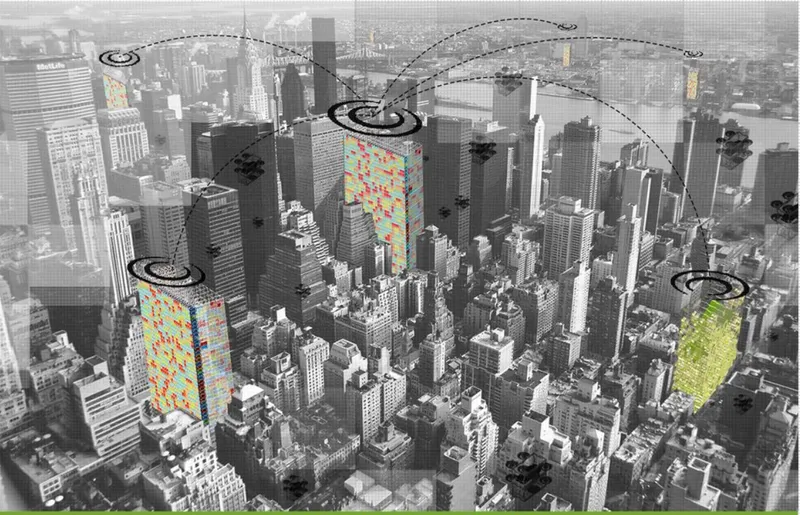
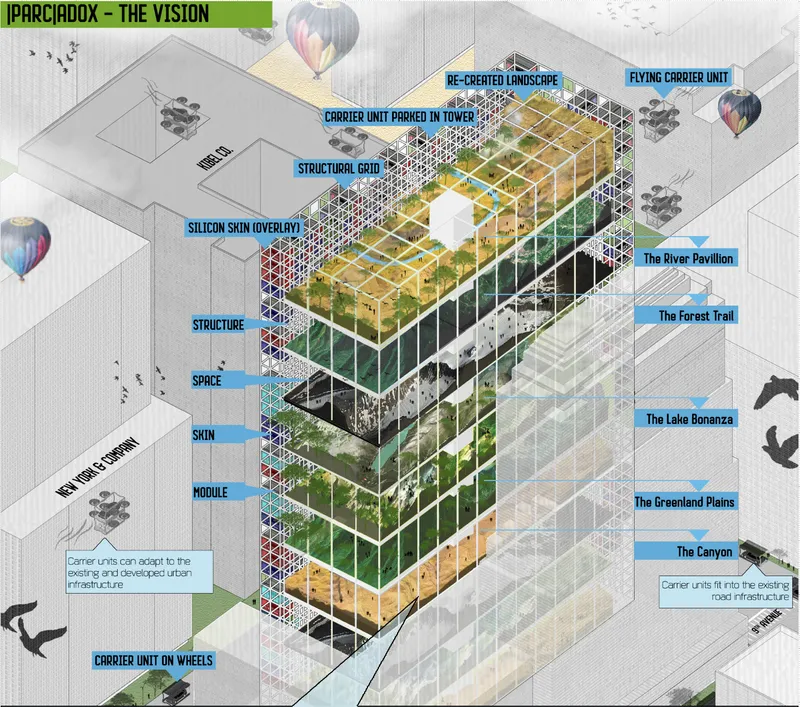
From above, the tower reads as a burst of saturated color dropped into a field of grey. The aerial view reveals a dense urban fabric of towers, with IPARCIADOX distinguishable by its pixelated, multicolored facade modules that signal something fundamentally different happening inside. Drone paths indicated above the structure hint at a future-facing integration with autonomous mobility systems. The axonometric drawing makes the logic legible: a modular structural grid, exposed on all sides, cradles pockets of integrated greenery within repeating bays. The grid is not decorative; it is the armature that allows landscape and vehicle storage to coexist within the same structural footprint.
Questioning the Elevation: Trees or Modules?

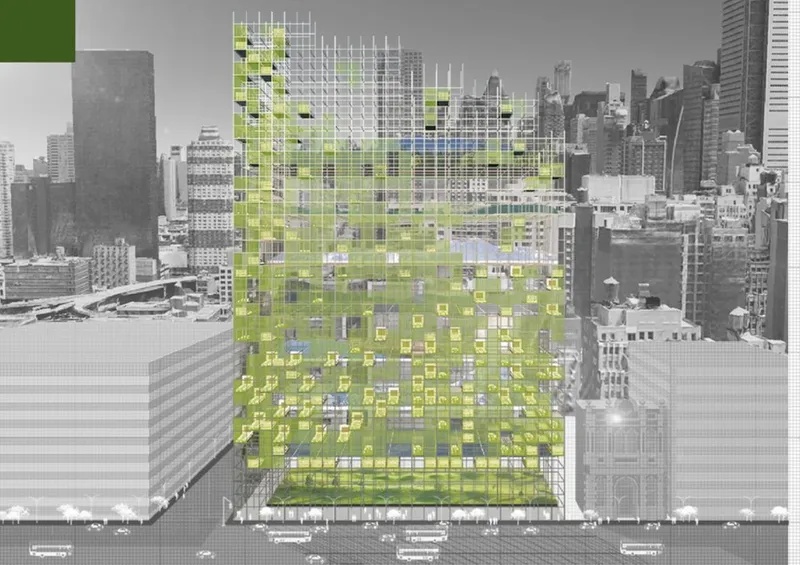
One of the most compelling drawings in the set places two facade compositions side by side, separated by a question mark. On one side, a conventional modular arrangement; on the other, tree-shaped modules populate the elevation. The ambiguity is deliberate. Daisaria is asking the viewer to consider whether a building's skin should be defined by its structural logic or by the ecological systems it supports. The answer, of course, is both. At street level, this dual identity becomes tangible: a gridded green and yellow facade rises among neighboring towers rendered in stark black and white, making IPARCIADOX visually legible as something that belongs to a different species of urban structure entirely.
Modular Assembly and the Logic of Color
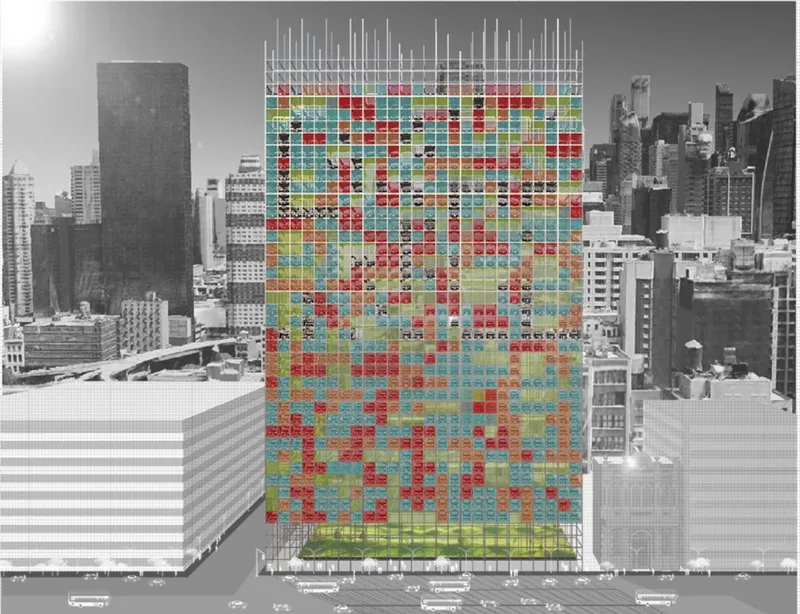
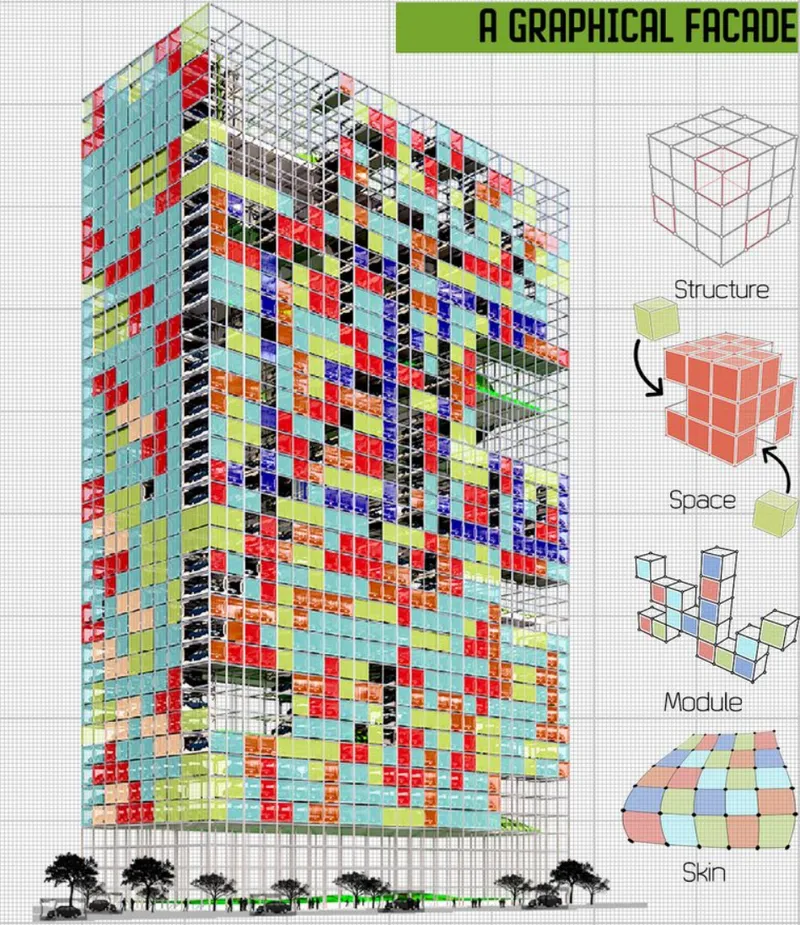
The facade elevation in full color is striking against its monochrome cityscape backdrop, with multicolored panels arranged in a pixelated pattern that encodes information about what lies behind each module. This is not random patterning for visual effect; the isometric exploded diagram reveals how each colored panel corresponds to a specific programmatic or structural element within the tower's assembly. The exploded axonometric breaks the tower into its component systems, showing how the structural frame, facade modules, and landscape insertions fit together as a single, repeatable kit of parts. Prefabrication and modularity are implicit in the design, which is critical for any structure that aspires to be replicable across multiple high-density sites.
Cars on Platforms, Nature Between the Floors
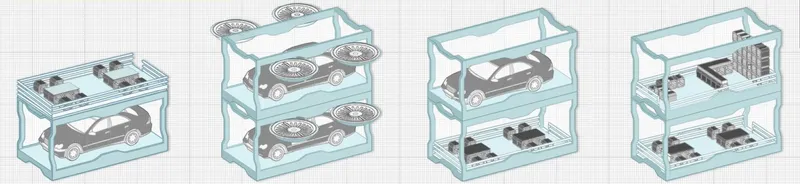
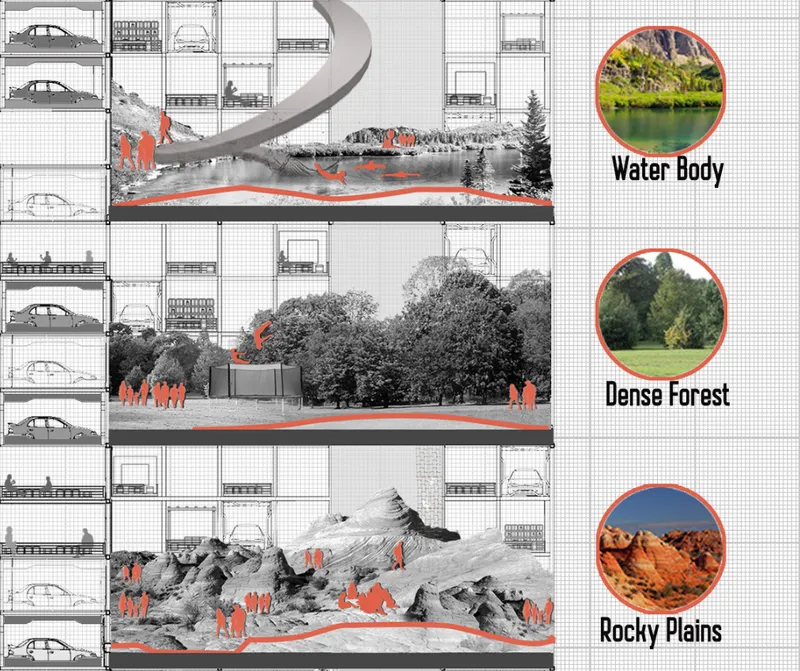
The axonometric parking diagrams clarify the mechanical reality of the proposal: cars are arranged on stacked platforms within the modular grid, a relatively conventional automated parking solution. But the section drawing immediately adjacent reframes the entire conversation. Three landscape typologies occupy full multi-story zones within the same tower: a water body where people wade and gather, a conifer forest with actual soil depth, and a rocky plain. These are not token planter boxes on a parking deck. They are inhabited landscapes with enough vertical clearance and programmatic commitment to function as genuine public spaces.
Three Ecologies in Section
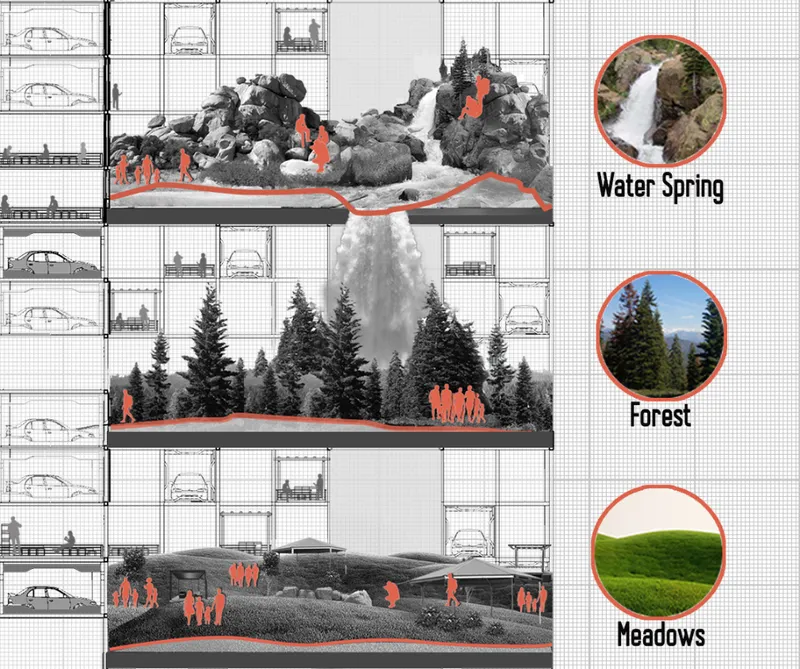
The final section drawing is the project's most powerful image. It stacks three distinct ecological zones vertically: a water spring at the base, a dense forest of conifers in the middle, and open meadows populated by grouped figures at the top. Each zone has its own spatial character, light quality, and social dynamic. The water spring suggests cooling and contemplation; the forest offers immersion and enclosure; the meadows provide openness and gathering. Together, they constitute a vertical public park that happens to contain a parking structure, rather than the other way around. The human figures scattered through each zone are essential: they prove this is not a rendering exercise but a spatial proposal about how people might actually live among these systems.
Why This Project Matters
IPARCIADOX matters because it refuses to accept the premise that parking infrastructure must be spatially inert. In a city like Manhattan, where every square meter of ground plane is contested, the idea that a parking tower could restore multiple landscape typologies to the urban section is not naive optimism; it is a necessary provocation. The modular structural system suggests scalability, and the three distinct ecologies demonstrate that vertical density and ecological richness are not mutually exclusive.
Daisaria's Jury Commendation was well earned. The project operates simultaneously as a technical proposition (modular grid, stacked platforms, prefabricated facade) and as an imaginative leap (forests and springs suspended in a parking tower). That duality is exactly what competitions like Yo! Parking exist to surface: work that treats infrastructure not as a problem to solve but as an opportunity to reimagine what cities could feel like from the inside out.
View the Full Project
About the Designers
Designer: Karan Daisaria
Enter a Design Competition on uni.xyz
uni.xyz runs architecture and design competitions year-round that reward proposals with spatial conviction and real site intelligence.
Project credits: IPARCIADOX by Karan Daisaria Yo! Parking 2019 (uni.xyz).


Popular Articles
Popular articles from the community


Singing Woman: An Opera House That Performs Before the Curtain Rises
Ovidiu Cristian Pavel's conceptual opera house translates Estonia's choral identity into a sculpted waterfront landmark facing the Baltic Sea.

Opera on the Sea: Driftwood Logic Shapes a Timber Opera House on Estonia's Coast
Trevor Orgill's opera house translates the entangled drift of floating timber into a civic building where wood, water, and music converge.

Faces of the Soviet Avant-Garde: Turning Moscow's Street Names into an Open-Air Museum
A network of sculptural installations across a Moscow residential district transforms forgotten architect names into spatial encounters with cultural memor
Extended Shell: Retrofitting Kolkata's Balconies as Living Urban Thresholds
A modular retrofit system recovers the social and environmental intelligence of Kolkata's historic verandas for contemporary Park Street residents.

Similar Reads
You might also enjoy these articles

Shakur's House: Exposed Brick as an Interior Organiser in a 168 m² Mashhad Residence
Brick moves indoors in this Mashhad residence, where masonry walls, glass partitions and teal planes sequence a compact home without closing it off.

Day and Night Park: A Time-Based Urban Newsstand in Beijing
A temporary urban newsstand in Beijing blending travel, light, and reading through poetic colors, compact form, and community-focused design.

Modernist Patio Renovation in El Masnou, Barcelona by Oliver Segura Arquitectura + Cebrià Arquitectura
Modernist patio renovation blending tradition and innovation with a movable pool, leveled floors, and Catalan materials in El Masnou.

Alto Residencial Coop: Cooperative Housing Development in Santiago de Compostela by Carbajo Barrios Arquitectos
A linear cooperative housing complex blending white volumes and perforated metal façades, enhancing community living, natural light, privacy, and urban integration.

Explore Vertical Parking Competitions
Discover active competitions in this discipline

Design a brochure to showcase the effects of the technosphere

Challenge to illustrate ‘A tale of Two Cities’

Deconstructivism - Illustration Design Challenge
Comments (0)
Please login or sign up to add comments
No comments yet. Be the first to comment!