

Epiphany Architects Lands a Timber Petal Pavilion at the Edge of a Chengdu Commercial District
Three hundred unique wooden elements and six mirrored bases give this 64 square meter installation in Chengdu its weightless, petal-like form.


A pavilion that looks like it drifted down from the sky and just barely touched the ground: that is the conceit behind the Petal Pavilion by Epiphany Architects, completed in 2023 at the entrance to Block B of the Luxelakes·Lufang development in Chengdu, China. At just 64 square meters, it is small enough to call an installation yet substantial enough to function as a genuine gathering space, a threshold between a commercial district and the greenery around it. Lead architects Zhuoxin Fang and Qianqian Xu built its undulating shell from 300 individually shaped wooden elements braced by curved steel trusses, then set the whole thing on six mirror-clad bases that all but vanish into the reflective water feature at the center of the site.
What makes the project worth paying attention to is not the petal metaphor itself but the engineering required to sustain it. Every stainless steel lightbox connects to its supporting truss at a unique angle, producing 600 distinct connector geometries fabricated through a fully parametric pipeline of node design, data output, and CNC machining. The result is a structure that reads as organic and effortless while being, at the level of production, ruthlessly precise. That tension between perceived softness and actual rigor is the real subject of the pavilion.
A Form That Invites Occupation
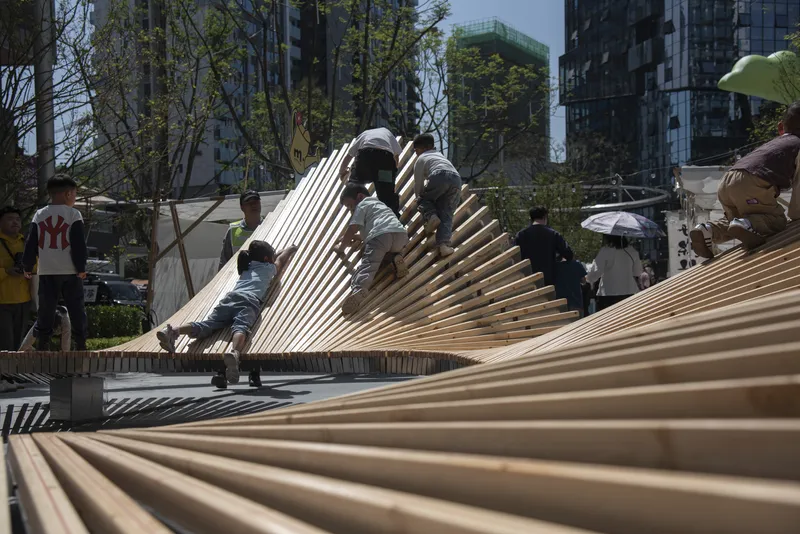

The pavilion's curves do more than look good in photographs. At its center, a circular void rises to a uniform height, carving out a sheltered social room scaled for conversation. Along the perimeter, the shell dips and rises at varying heights, creating surfaces calibrated for sitting, leaning, and, judging by its youngest users, climbing. Children treat the undulating timber form as a landscape feature rather than a building, which is arguably the highest compliment a piece of public architecture can receive.
The striped shadow patterns cast by the parallel timber slats extend the pavilion's spatial effect beyond its footprint. Light filters through the gaps in rhythmic bands that shift throughout the day, turning the surrounding paving into a sundial of sorts. The slats also modulate airflow, keeping the interior comfortable in Chengdu's humid summers without any mechanical systems.
Timber Craft at Close Range
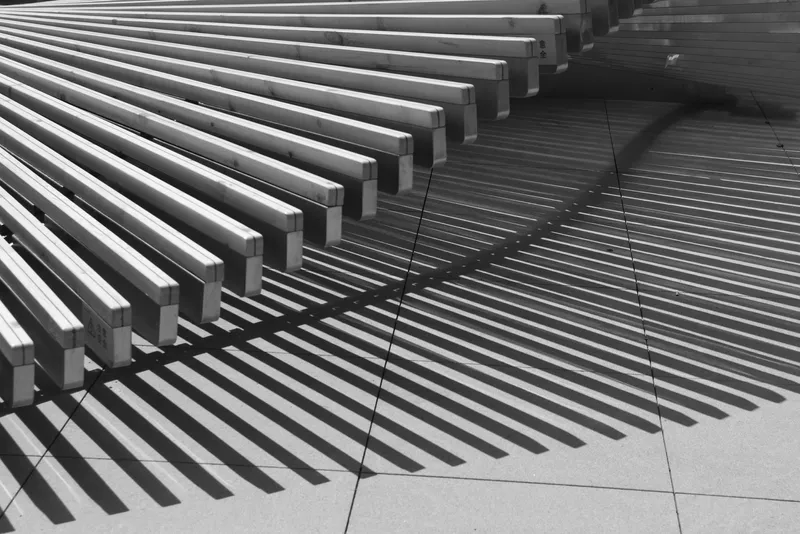

Zooming in on the material palette reveals how much work went into making the pavilion feel tactile rather than industrial. The timber battens are tightly spaced but not uniform; their varying lengths and subtle curvature produce a visual rhythm that reads differently at every angle. Where the shell meets the ground, water droplets collect along the stacked beam edges, hinting at the structure's exposure to Chengdu's frequent rain and confirming that the wood has been treated to withstand it.
The decision to leave the wood grain visible and unfinished in a high-gloss commercial setting is deliberate. Against the polished paving and reflective water, the pavilion reads as something handmade that landed in a corporate landscape. That contrast is what gives it presence. A smoother, more conventionally finished surface would have disappeared into the surrounding retail context.
Fabrication Logic Laid Bare
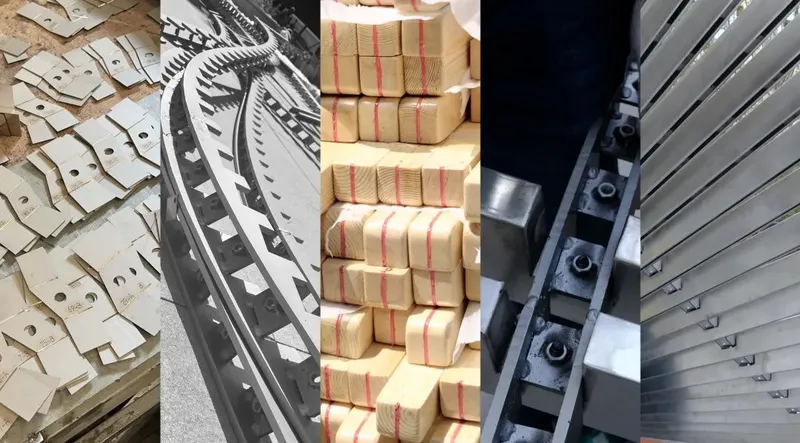
A fabrication detail shot pulls back the curtain on the pavilion's production. Layered plywood components, banded timber blocks, and metal brackets sit together in an almost archaeological cross-section of the assembly process. Each bracket mediates between the curved steel trusses hidden inside the shell and the outward-facing wood and stainless steel lightbox layers. The snap-fit connection method that links truss to lightbox is barely visible in the finished pavilion, which is exactly the point: the structure wants to look like a single continuous surface, not a kit of parts.
The production pipeline, moving from parametric node design through data organization to CNC output and on-site assembly, is standard practice for digitally fabricated pavilions. What distinguishes this project is scale management. With 600 unique connectors serving only 64 square meters of floor area, the ratio of bespoke components to built area is unusually high. Yunnan Wanwuzaozhi, the constructor, deserves credit for keeping that complexity from becoming chaos on site.
The Mirrored Base and the Illusion of Weightlessness
Six mirror-clad bases carry the pavilion's entire load, yet they are designed to be invisible. Aligned with the six points where the petal form touches down, they reflect the water feature and surrounding pavement, making the structure appear to hover. The trick is not new, but it is executed well. Where many mirrored-base installations reveal their supports from certain angles, the Petal Pavilion's low profile and the distraction of the reflective water surface keep the illusion intact from most vantage points.
The reflective water at the center of the site doubles the effect. Visitors approaching the commercial entrance see both the pavilion itself and its inverted twin on the water's surface, reinforcing the reading of something that floated down and landed. It is a simple scenographic move, but paired with the mirror bases, it coheres into a spatial experience that feels lighter and more transient than the engineering inside it would suggest.
Why This Project Matters
Small pavilions in commercial developments are often afterthoughts, decorative objects commissioned to generate social media content and forgotten within a season. The Petal Pavilion has a shot at outlasting that cycle because it does something more than pose. Its undulating surfaces create genuinely usable micro-spaces, its material palette ages in a way that will deepen rather than degrade, and its structural logic, while hidden from view, is rigorous enough to hold up under real weather and real use.
For Epiphany Architects, the project is a proof of concept for parametric fabrication at intimate scale. Managing 600 unique connectors across 300 timber elements in a 64 square meter footprint is, square meter for square meter, as demanding as many larger commissions. The lesson is that complexity does not require size, and that the most effective public installations are the ones where the difficulty is invisible and the invitation is immediate.
A Petal Pavilion, by Epiphany Architects (lead architects Zhuoxin Fang and Qianqian Xu). Chengdu, China. 64 m². Completed 2023.
About the Studio
Share Your Own Work on uni.xyz
If projects like this are the kind of work you want to make, uni.xyz is a place to publish your own, find collaborators, and enter design competitions.


Popular Articles
Popular articles from the community


Opera on the Sea: Driftwood Logic Shapes a Timber Opera House on Estonia's Coast
Trevor Orgill's opera house translates the entangled drift of floating timber into a civic building where wood, water, and music converge.

Faces of the Soviet Avant-Garde: Turning Moscow's Street Names into an Open-Air Museum
A network of sculptural installations across a Moscow residential district transforms forgotten architect names into spatial encounters with cultural memor

Cloaked Colonization: A Mobile Underwater Habitat That Moves Like a Fish
Micah Abaya's shortlisted EHC Pacific entry reimagines ocean settlement as a dispersed network of self-sustaining architectural organisms.

Extended Shell: Retrofitting Kolkata's Balconies as Living Urban Thresholds
A modular retrofit system recovers the social and environmental intelligence of Kolkata's historic verandas for contemporary Park Street residents.

Similar Reads
You might also enjoy these articles


Hodi-Mandai Geram
Project Function: Preservation and revitalization of the Intangible heritage and socio-spatial identity of the Hodi by Housing, Cultural Memory Center, Sacred Grove, landscape, local tourism economy


Olio Towers: A Mid-Rise for Performers That Fuses Housing, Rehearsal, and Stage
Located blocks from Houston's Theater District, this modular tower stacks living units around a central performance atrium.

Oasis: Modular Green Housing Carved into Dhaka's Urban Fabric
A shortlisted Plugin Housing entry reclaims unauthorized settlements in Dhaka with stepped concrete volumes, green roofs, and ventilation-driven design.

Black Hole: A Floating Megastructure for the Post-Physical Era
Emiliano Mazzarotto envisions a spherical, self-scaling arena where e-sports, digital hotels, and holographic stadiums replace traditional public space.

Explore Architecture Competitions
Discover active competitions in this discipline

Challenge to reimagine the Iron Throne

Photograph architecture without architects

Illustrate the lost glory of Angkor Wat - Render Challenge

Design challenge to reuse E-waste
Comments (0)
Please login or sign up to add comments
No comments yet. Be the first to comment!