
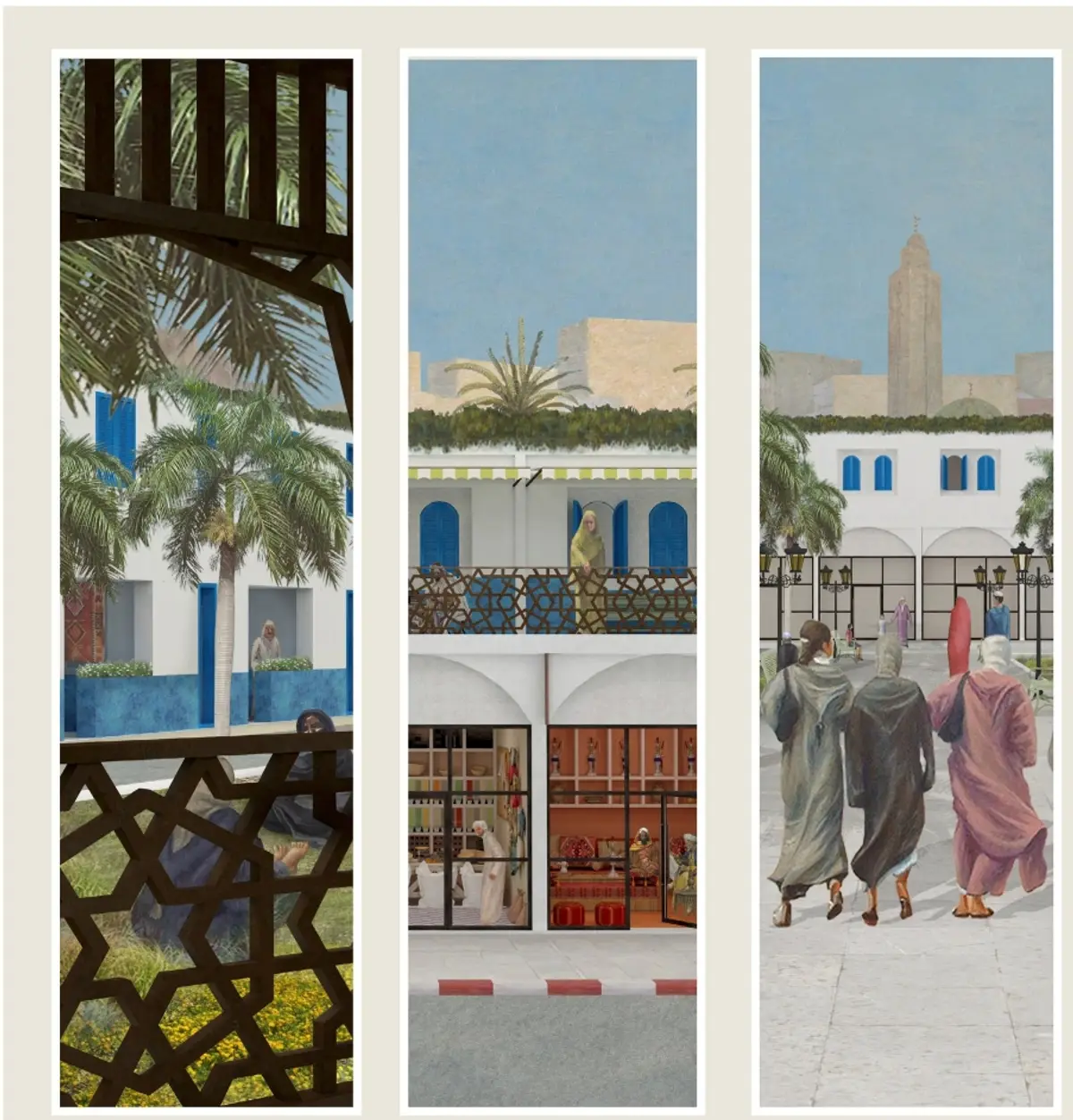
A Rabat Co-(mmunity): Housing That Keeps Aging in Public View, Not Behind Closed Doors
A Co-Life winner that threads arcades, courtyards and market frontages through Rabat so older residents remain woven into the life of the city.


Most housing for older people is designed around a quiet withdrawal: a building set back from the street, a corridor of units, a common room nobody chose. A Rabat Co-(mmunity) rejects that model at its root. It treats ageism as a spatial problem, something produced by buildings that isolate, and answers it with arcades, market stalls, courtyards and promenades that keep older residents visible, active and in daily contact with neighbours of every age.
Designed by Lesley Mcintyre and Faye Sedgewick, the proposal is the Winner of the Co-Life competition. Its site sits at the junction of Mohammed V and Avenue Moulay Rachid in Rabat, Morocco, a prominent corner of the city's urban fabric. Rather than enclosing a residential enclave, the designers use mixed housing typologies and active public edges to frame intergenerational living around four principles: empathy, community, independence, and security and wellbeing.
A Market Frontage That Puts Housing on the Street
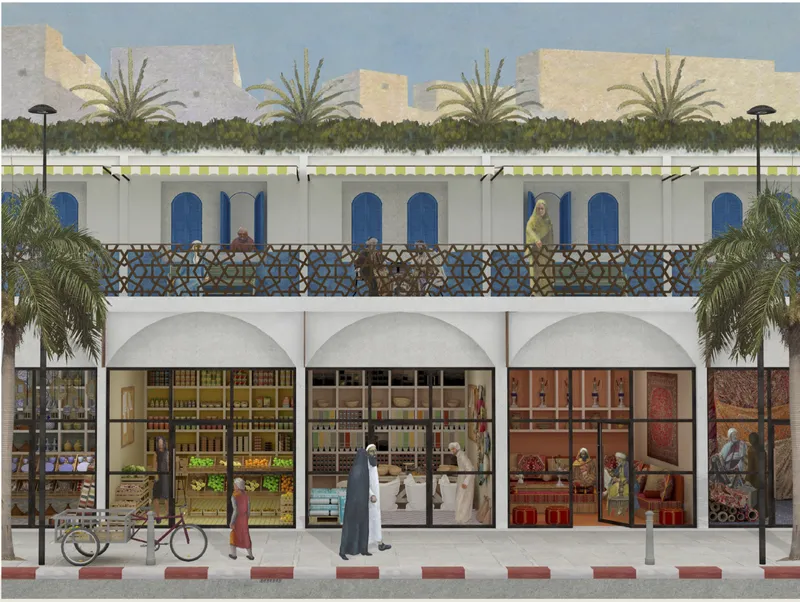
The street elevation states the project's position clearly. At ground level, an arcade shelters glazed market stalls; above, a latticed balcony overlooks the pavement. This is housing that does not hide its residents from the city. The shaded arcade offers the kind of protected, walkable edge that matters to someone moving more slowly, while the shopfronts guarantee a steady flow of people past every door.
The balcony screen carries the brief's principle of security and wellbeing. Patterned lattices give privacy to those inside while preserving passive surveillance of the street below. An older resident can watch, be seen and stay part of the scene without being exposed. It is a traditional Moroccan device doing contemporary social work, and that dual role recurs throughout the scheme.
Promenades and Courtyards as Shared Living Rooms
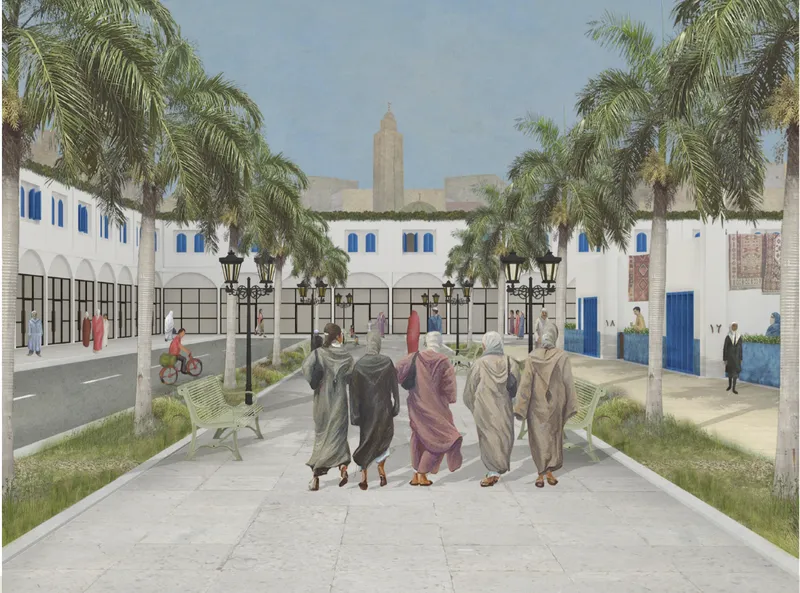
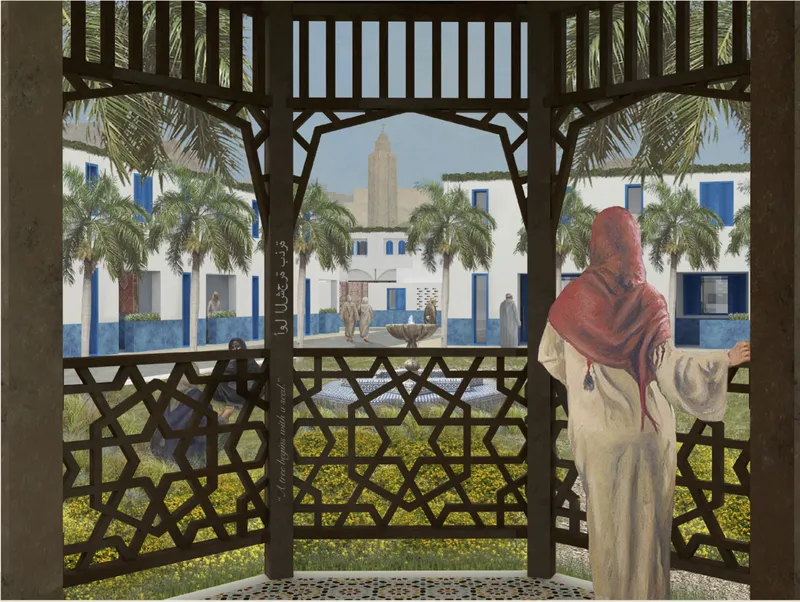
The designers argue that home extends beyond the individual dwelling, and these two views put that claim into practice. A palm-lined promenade with green benches gives residents a reason to linger outdoors, with frequent places to rest and an axis that points toward a distant minaret, anchoring the walk in Rabat's skyline. Shared spaces are distributed so that encounters happen along the way rather than only at a designated destination.
Inside the block, the register shifts. A timber lattice pavilion frames a courtyard fountain edged with yellow flowers, a calmer and more intimate counterpart to the public promenade. This gradient, from street to promenade to internal courtyard, is the scheme's most useful idea. It lets residents choose their level of social exposure on any given day, which is exactly what supporting independence while offering community requires.
An Interior Built for Aging in Place
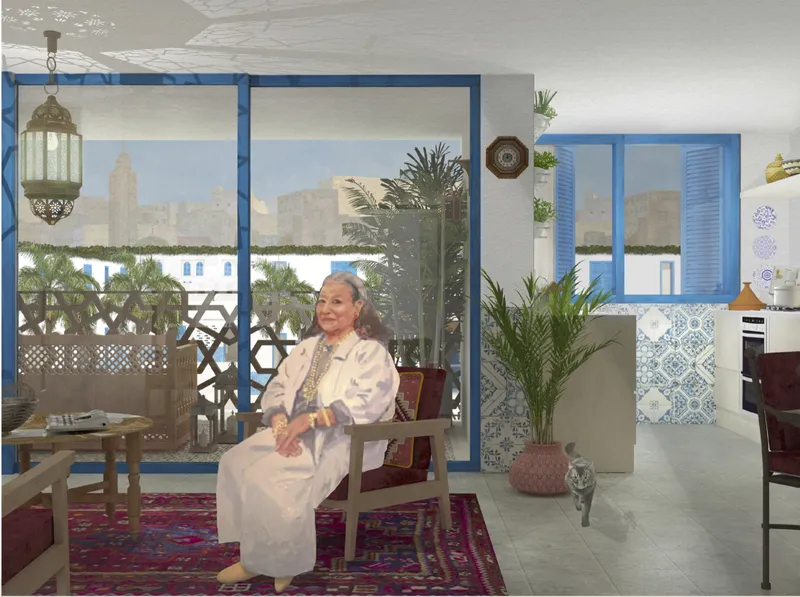
The apartment interior completes the sequence at the scale of the individual. An elderly woman sits on a red rug beside blue-framed glazing, patterned tiles and a potted palm, with a cat close by. The palette of white surfaces and blue accents that defines the façades carries indoors, so the private unit feels continuous with the neighbourhood instead of clinical or institutional.
That continuity is the point. Flexible housing options and familiar materials allow residents to age in place in rooms that look like a home rather than a care setting. The generous glazing keeps the courtyard and street in view, so even on days spent indoors, connection to community life is only a glance away.
Why This Project Matters
A Rabat Co-(mmunity) shifts the conversation about aging from care provision to urban design. Its argument is that dignity and belonging are not services to be delivered inside a facility; they emerge from arcades, benches, courtyards and shopfronts that keep people in the flow of everyday life. By siting the project on a busy Rabat junction and opening it outward, the designers make older residents part of the city rather than people the city has set aside.
Equally persuasive is its restraint. White façades, blue accents, shaded arcades, internal courtyards and patterned screens are drawn from local tradition, not imported as novelty, and each is given a specific social job. The result is a model that other cities could adapt using their own vernacular: begin with the street, layer degrees of privacy inward, and let the architecture do the work of keeping people connected.
View the Full Project
About the Designers
Designers: Lesley Mcintyre, Faye Sedgewick
Enter a Design Competition on uni.xyz
uni.xyz runs architecture and design competitions year-round that reward proposals with spatial conviction and real site intelligence.
Project credits: A Rabat Co-(mmunity by Lesley Mcintyre, Faye Sedgewick Co-Life (uni.xyz).


Popular Articles
Popular articles from the community


ETEH Reworks the Shared Spaces of São Domingos School in Brazil Around Timber, Color and Hanging Plants
At São Domingos School in Brazil, 436 m² of hall, refectory and library are recast with timber joinery, a yellow and blue code and trailing greenery.


Opera on the Sea: Driftwood Logic Shapes a Timber Opera House on Estonia's Coast
Trevor Orgill's opera house translates the entangled drift of floating timber into a civic building where wood, water, and music converge.

The Amber Palace Opera: A Geological Fiction Surfaces on Tallinn's Baltic Waterfront
Pierre Brillard reimagines a Baltic legend as a public landscape, opera house, and waterfront promenade rooted in Tallinn's coastal identity.

Cube Design Draws an Ecological Corridor Between Two Shenzhen Hills with the Nankai Building
Beside Shenzhen's container docks, the Nankai Building pairs stacked balconies with a climbing green screen to connect two hillsides across its height.

Similar Reads
You might also enjoy these articles
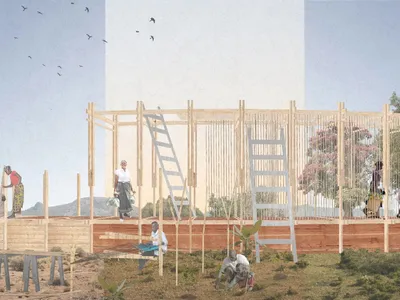
Healing Façade: A Modular Chapel System That Restores Ethiopia's Sacred Forests
Winner of the Eco-Chapel competition, this circular timber façade collects water from air to rebuild soil and reforest degraded Ethiopian landscapes.
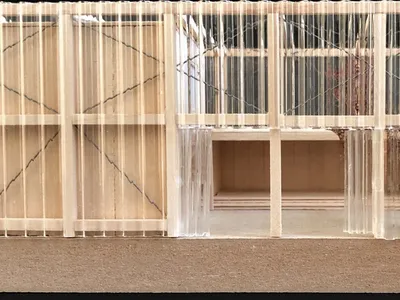
Kaffeebühnen: Where Coffee Shop Architecture Becomes a Civic Stage in Vienna
A linear sequence of timber boxes, transparent shells, and open yards turns the Viennese café tradition into a public performance space.
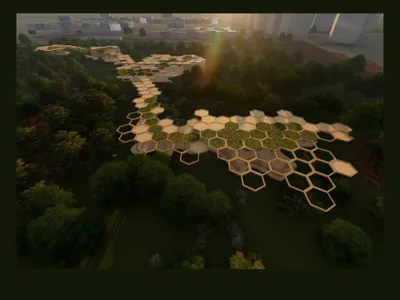
Eco Chapel: A Modular Forest Pavilion That Grows Like the Landscape It Protects
Hexagonal timber modules weave through existing trees, turning a chapel into a living system for prayer, education, and reforestation.


Urban Forest: A Vertical Ecosystem for 5,000 Workers in Singapore's Changi Business Park
Radially stacked pods and layered green decks turn a 7-acre plot into 47 acres of ecological workspace projected for 2040.

Comments (0)
Please login or sign up to add comments
No comments yet. Be the first to comment!