
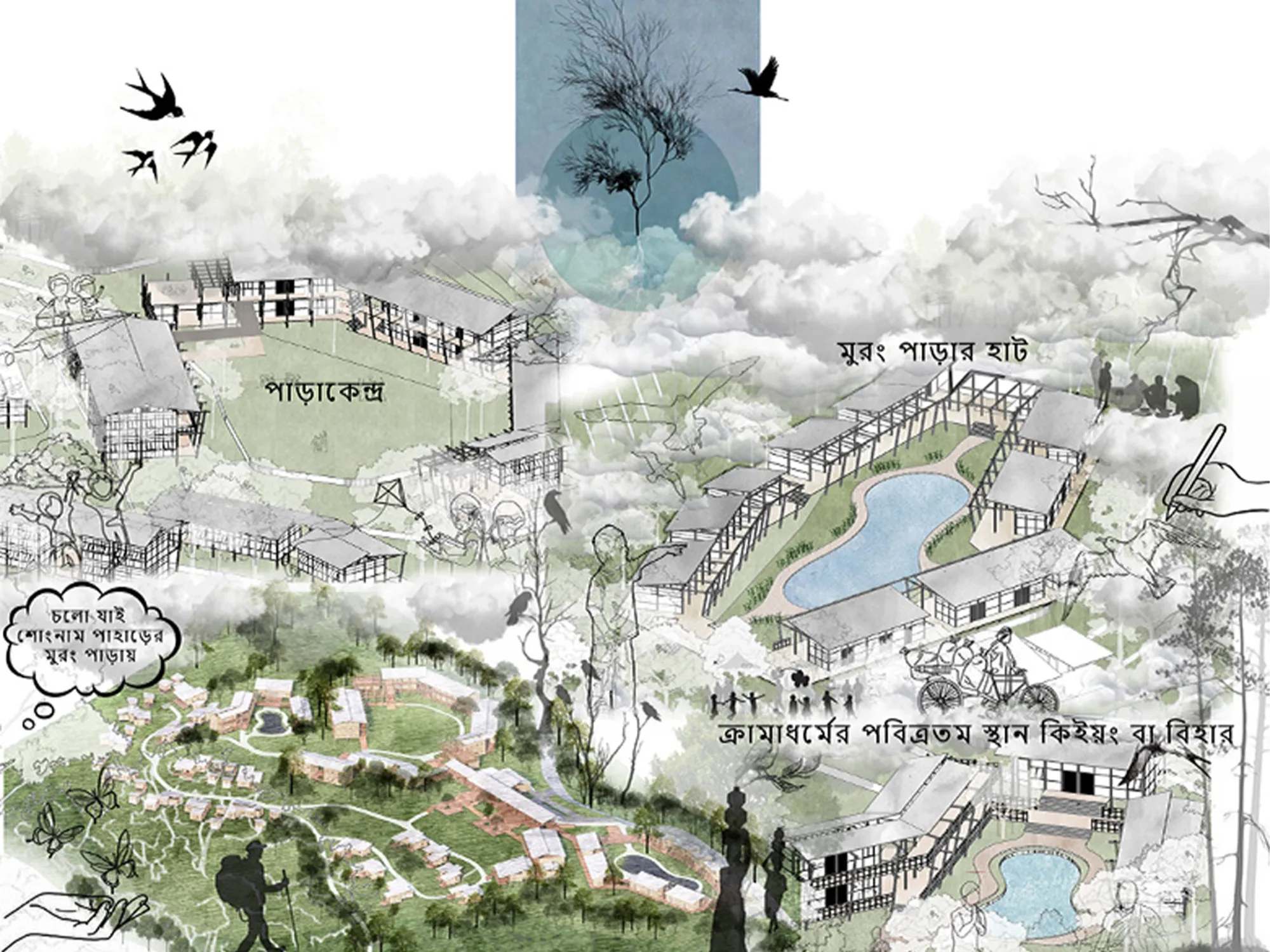
শোংনাম পাহাড়ে : A Resilient Mru Settlement And Sustainable Tourism Coexistence
Sustainable Tourism & Cultural Preservation in Chittagong Hill Tracts, Bangladesh

The oldest indigenous groups of Bangladesh's Chittagong Hill Tracts, the Murong people, represent a rich cultural legacy deeply connected with their natural surroundings. Their sustainable farming methods, especially jhum cultivation (shifting agriculture), which has long been a pillar of their social and economic structure as well as a farming technique, are what essentially define their cultural identity as traditional hill dwellers. The "para" system, which consists of a group of houses that constitute the fundamental unit of their community structure, is how the Murong typically arrange their settlements. These para villages show their profound awareness of environmental sustainability by being thoughtfully placed close to agricultural areas and water supplies. With raised platforms that adjust to the steep terrain and usually made of locally obtained materials like bamboo and timber, their traditional dwelling architecture shows their close relationship with the environment.
By emphasizing the preservation of the local people and promoting sustainable tourism, this architectural solution in Bandarban, Chittagong Hill Tracts, Bangladesh, offers an alternative to conventional mass tourism development. The initiative challenges an envisioned five-star hotel that would have uprooted the local Murong tribe and disrupted with their way of life. The design, which takes its inspiration from Mohammed Habib Reza's New Contextualism Theory, produces a progressive physical environment that respects the past while looking to the future. Fundamentally, the initiative uses agroforestry techniques to preserve agricultural traditions while converting a contentious jhum (shifting agriculture) land into a multipurpose communal area. In order to save essential water supplies and avoid community displacement, the design integrates creative solutions like a hydram pump system, guaranteeing both environmental sustainability and cultural continuity. The master design has a number of community-focused areas, such as a "Para Kendro" that serves as a center for healthcare and education, a spiritual center honoring Krama religious customs, and an open village market that unites nearby towns while allowing for expansion driven by tourists. Homestay choices and thoughtfully incorporated resort amenities are introduced by the project's unique approach to tourism infrastructure, which enhances rather than overshadows the indigenous town. This strategy shows how local communities may maintain their cultural identity while tourism coexists with them and benefits them economically. As the hub of the village, the Para Kendro offers seminars and cultural exchanges that promote cross-cultural learning and allow guests to interact deeply with Murong customs and crafts. In the face of challenges from tourism development, this architectural intervention provides a consistent paradigm for the preservation of indigenous communities by embodying the values of equality and social justice. The project sets a standard for how architectural design may preserve and improve indigenous cultural landscapes while meeting modern economic demands by constructing places specifically for displaced Murong households and necessary community amenities. The outcome is a tasteful fusion of contemporary conveniences and traditional values, demonstrating that the growth of tourism need not be accompanied by the uprooting of communities and the destruction of cultural heritage.



Popular Articles
Popular articles from the community


Co-Life: Senior Housing Design That Reconnects Older Adults With the City
Co-Life reimagines senior housing design through healing gardens, shared streets, workshops, and a sustainable community across generations.

The Earth Pod: 3D Printed Homes for Resilient Refugee Communities
The Earth Pod reimagines refugee housing through 3D printed homes made from clay, combining resilience, self-sufficiency, and rapid shelter.

The Musturak Paradise: Senior Living Architecture for a Connected Future in Temara, Morocco
The Musturak Paradise reimagines senior living architecture in Temara via private homes, social spaces, culture, community, and shared care.

Play: Fragments of Their World
Familiar architecture becomes modular playground design, creating safe spaces where displaced children can learn, connect, imagine and play.


Similar Reads
You might also enjoy these articles

The Rhythm of Seasons
A Farmers' Market Connecting Nature and the City

More Than a Building-Designing a Living System
More Than a Building-Designing a Living System
Base Beyond
DESERT COMPOUND ARID: TOURISM OF ABSENCE AND ABUNDANCE

Explore Sustainable Design Competitions
Discover active competitions in this discipline




Challenge to reimagine the Iron Throne


Photograph architecture without architects


Illustrate the lost glory of Angkor Wat - Render Challenge


Design challenge to reuse E-waste
Comments (0)
Please login or sign up to add comments
No comments yet. Be the first to comment!